Exercise for Lower Back Pain: 249 Trials, 15 Points Less Pain on a 100-Point Scale. If the Pain Is New, the Answer Changes.

There are two questions hiding inside this one, and they have different answers. Which one is yours?
If your back has hurt for more than three months, the evidence is about as good as evidence in this field gets, and it says yes. If it started last week, the evidence is thin, uncertain, and honestly does not say much either way. Most pages blend the two. This one will not.
A review of sixteen national guidelines found they group the warning signs under four things exercise cannot treat — a fracture, a cancer, an infection, and pressure on the nerves at the base of the spine. The features most of them agree on:
- pain that began with a significant fall or injury, or in someone who takes steroid medication long-term
- a history of cancer, or weight loss you did not try for
- pain that is worse at night or at rest rather than with movement
- new numbness around the groin or seat, or new trouble with bladder or bowel control — the signs guidelines list for nerve compression, and the one group that is a same-day matter
This page is journalism about what the research found. It is not medical advice, and nothing on it should replace a clinician who has examined you.
What 249 trials found
The largest review ever assembled on this question pooled 249 randomised trials and 24,486 people with low back pain that had lasted over twelve weeks [1]. Every trial compared some kind of exercise against either nothing, usual care, a placebo, or another treatment.
| Trials | 249, in 24,486 people, pain lasting over 12 weeks |
| Compared against | no treatment, usual care, or a placebo |
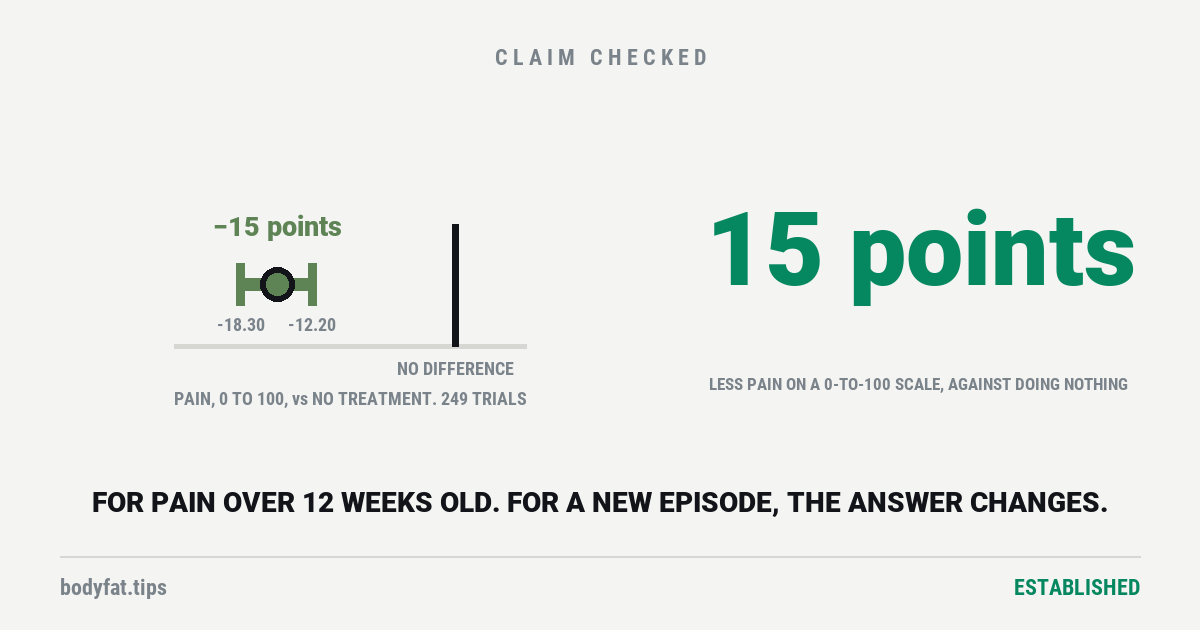
| Pain, 0 to 100 | 15 points lower — plausible range 12 to 18 |
| The review’s own bar | 15 points counts as clinically important. The average clears it; the near end of the range does not |
| Function, 0 to 100 | 7 points better — range 5 to 8. Under the review’s 10-point bar |
| Certainty | moderate, for both |
| Against other treatments | 9 points better on pain; no different from hands-on manual therapy |
Against doing nothing, people who exercised rated their pain 15 points lower on a 0-to-100 scale, with a plausible range of 12 to 18 [1]. Their day-to-day function was about 7 points better. The certainty was moderate for both — Cochrane’s second-highest grade, meaning the true effect is probably close to this and could still be somewhat different.
The 2025 Cochrane overview, which sits above 31 separate reviews and 97,183 people, restated those numbers without change [2]. This is not one study. It is the settled centre of a very large literature.
Fifteen points of what, exactly?
Imagine your pain on a scale where 0 is none and 100 is the worst you can picture. Fifteen points is the drop from, say, a 55 to a 40. Noticeable. Not gone.
Here is the part worth being precise about. The review set its own bar for “clinically important” at 15 points for pain and 10 for function [1]. The average pain result clears that bar. The near end of its plausible range — 12 — does not. And function, at 7 points, does not clear its bar at all. So the honest sentence is: exercise probably reduces chronic back pain by a meaningful amount, and probably improves what you can do by a smaller one.
Can lower back pain be fixed with exercise?
Helped, not fixed. The word matters.
Against other treatments rather than against nothing, the edge shrinks: 9 points on pain, 4 on function [1]. Exercise probably beats education alone and beats physical therapy that does not include exercise. It was no different from hands-on manual therapy [1]. Nothing in this literature makes the pain disappear for everyone; the American College of Physicians’ guideline nonetheless puts exercise in the first line of treatment for chronic low back pain, ahead of any drug [11].
If the pain is new, read this section instead
Everything above is about pain that has settled in. A separate Cochrane review asked whether exercise helps in the first six weeks, and the honest summary is that nobody knows [3].
Twenty-three studies, 2,674 people. Against a sham treatment, exercise made pain less than one point different on the 0-to-100 scale — from one study of 299 people, rated very-low certainty [3]. Against no treatment, two small studies with 157 people between them, also very uncertain. The reviewers’ own phrasing: exercise “may have no clinically relevant effect” in the short term, “but the evidence is very uncertain” [3].
Read that as unknown, not as useless. A single 299-person study is not a finding that something does nothing. What it means is that for a new episode, the evidence cannot yet tell you whether a structured exercise programme beats simply carrying on — and most new episodes improve over weeks whatever you do [11].
What the evidence does say about a new episode is older and simpler: do not take to your bed. Across the trials that compared advice to rest against advice to stay active, staying active came out ahead on both pain and function [7] — a small edge, on a scale where 0.2 is small, 0.5 moderate, 0.8 large, the trials landed around 0.2 to 0.3. Rest did not win anything.
Which exercise is best? And what are the “big 3”?
Two large network meta-analyses have tried to rank exercise types against each other, and it is worth reading them together because they disagree on one point.
The bigger one pooled 217 trials and 20,969 people [4]. Pilates, McKenzie therapy and functional-restoration programmes came out best for pain; flexibility work came out best for function. The effects were in the same territory as the main review — 15 to 19 points on pain against minimal treatment.
The other pooled 89 trials and 5,578 people [5]. Pilates again led for pain. Resistance training and stabilisation work — the “core” family — led for function. Aerobic and resistance training led for mood. But here it parts company with the first: in this analysis, stretching and McKenzie exercise were no different from doing nothing for pain or function [5].
So the two agree on Pilates, agree that nearly any structured exercise beats nothing, and disagree on McKenzie. Both rate their own evidence as low quality on this ranking question. The fair reading is that which exercise matters far less than whether, and that the specific-versus-specific differences are inside the noise.
The “big 3” people search for — a curl-up, a side plank and a bird-dog, a set taught widely by spine-biomechanics coaches — belongs to that stabilisation family. As a package, we could find no randomised trial of it in the indexed literature. What has been trialled is the family it belongs to, which does about as well as the others. That is not a criticism of the three exercises. It is a statement about what has and has not been measured.
Is walking good for lower back pain?
For preventing the next episode, there is now a first-rate trial, and it is the cheapest intervention on this page.
WalkBack randomised 701 adults who had just recovered from an episode of back pain to either nothing, or an individualised, progressive walking programme with six physiotherapist sessions spread over six months [6]. Then it waited to see whose back went again.
The walkers’ next activity-limiting episode came at a median of 208 days. The control group’s came at 112 [6]. The hazard ratio was 0.72 — roughly, at any given moment the walkers were 28% less likely to be having a recurrence — with a plausible range of 0.60 to 0.85, nowhere near the line for chance.
Two things to add, because the page would be dishonest without them. Nearly half of everyone had some adverse event over the year, in both groups. And the walkers reported more lower-limb complaints — 100 events to the controls’ 54 [6]. Knees and feet noticed the miles. Backs did better.
If walking is your exercise anyway, how many steps actually matter and what walking does and does not do for weight are already on this site.
Should you stretch your lower back if it hurts?
You can. The evidence that stretching by itself treats the pain is the weakest on this page: one network meta-analysis found flexibility work helped function [4]; the other found stretching no different from doing nothing for either pain or function [5]. Neither found it harmful. It is a reasonable part of a programme and a poor whole of one.
Where “rest it” came from, and why it lasted
Until the mid-1980s, bed rest was the prescription. In 1986 a trial in the New England Journal of Medicine randomised 203 walk-in patients to two days of bed rest or seven [8]. The two-day group missed 45% fewer days of work — 3.1 against 5.6 — and did no worse on any other measure. That was the year the prescription started to fall.
It kept a foothold because of the scan. A review of 33 imaging studies in 3,110 people with no back pain at all found disc degeneration in 37% of 20-year-olds and 96% of 80-year-olds; a bulging disc in 30% of the young and 84% of the old [9]. Scan almost anyone and you will find something to call damage. And damage says: do not move it.
The 2018 Lancet series on low back pain named the result: across the world, “inappropriately high use of imaging, rest, opioids, spinal injections, and surgery” while the first-line treatment in nearly every guideline — exercise — goes underused [10].
And the search results that bring people here? Ask Google this question and its AI Overview cites the Mayo Clinic, Kaiser Permanente, Cedars-Sinai and NHS Inform. For once, the right people. What they do not give you is the number, or the split between old pain and new. Underneath, the related searches are all listicles — the single best exercise, the best machine, 7 exercises, 13 stretches — a whole market for the specific, on a question where the specific turned out to barely matter.
None of this is aimed at anyone who rested a bad back. You were told to, by people with good intentions, for a century.
What this is rated, and what the rating covers
Established — for chronic, non-specific low back pain lasting more than twelve weeks.
It is rated Established because a Cochrane review of 249 trials found a clinically important reduction in pain with moderate certainty [1], restated in a 2025 overview of the whole field [2]; because two independent network meta-analyses agree that nearly every structured exercise type beats minimal treatment [4] [5]; and because national guidelines place exercise first-line [11].
What is not rated here, and each one is a different question: a new episode under six weeks old, where the evidence is very uncertain [3]; sciatica or any pain with a specific diagnosis; which exercise is best, where the rankings sit inside the noise and the two analyses disagree on McKenzie [4] [5]; and anything in the red-flag box, which is a clinician’s question and not a training one. Resistance training in older adults and why soreness is not a progress gauge are the nearest pages on this site. How we read a study, and what each tier means, is set out here.
- Time Under Tension: 14 Studies Put Slow Reps Against Fast. The Slow Group Grew the Same — If Anything, a Shade Less.
unsupported - Does Soreness Mean Muscle Growth? 110 Men Did 12, 24 or 60 All-Out Reps and Hurt About the Same.
unsupported - Weighted Vests: About 1.6 lb of Extra Fat Loss. And in the Best Trial, the Bones Went Anyway.
supported