Ice Baths Ease Soreness for Days. After Lifting, They Can Blunt Your Gains.

Ice baths work. That is not the interesting part.
One review pooled 52 studies of it, and the answer is reasonably clear: a day after a hard session of sprints, intervals or team sport, people who got into cold water had less muscle soreness, more muscular power, lower markers of muscle damage in their blood, and they felt more recovered. After eccentric work, the kind that loads a muscle while it lengthens, as in lowering a weight or landing from jumps, the soreness benefit showed up over the following days instead. [1]
The interesting part is what it costs, and what else would have done the same job.
First, the good news, precisely
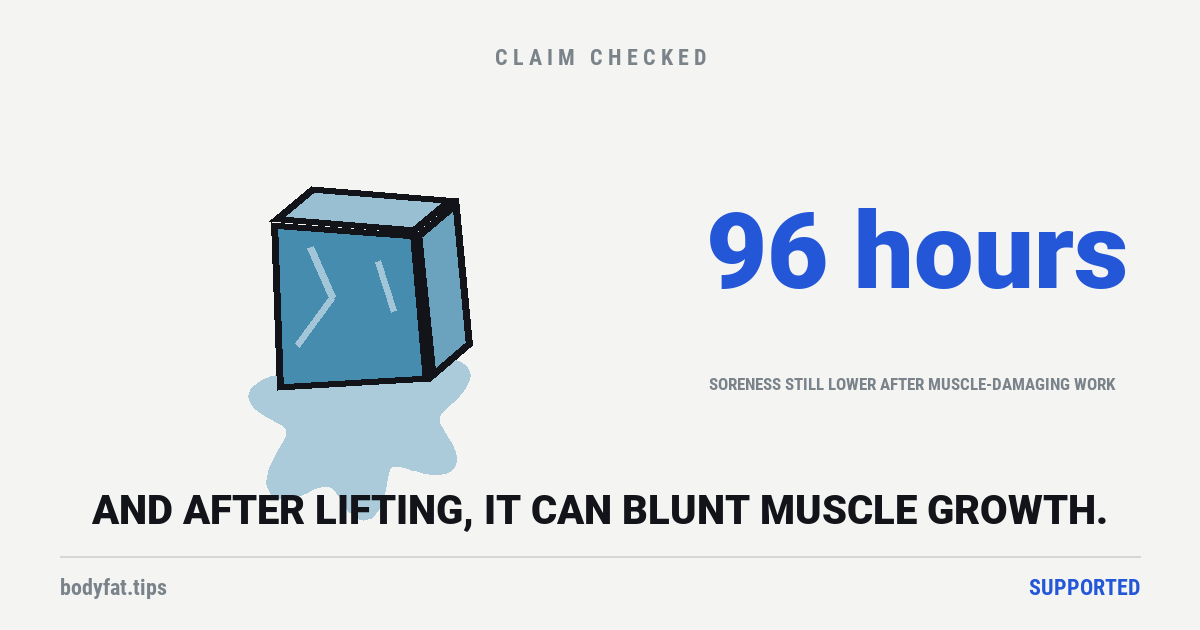
The best summary compared cold water immersion against simply resting, across 52 studies. [1] At 24 hours after high-intensity exercise, the cold group came out ahead on soreness, on power, on creatine kinase — an enzyme that leaks into your blood when muscle is damaged — and on how recovered they said they felt. After eccentric exercise, soreness was not significantly lower at 24 hours but was at 48, 72 and 96 hours: small effects, which the review graded high-certainty. [1] A 2026 umbrella review of 15 such meta-analyses also found soreness lower for up to 96 hours, but rated their methods low to critically low and, across the outcomes it graded, the certainty low to very low [14].
Most of those comparisons were small. The 24-hour soreness result after high-intensity exercise came from 20 studies with 297 people between them, and the one with the narrowest margin of error, 34 men doing a team-sport circuit, found no benefit (our reading of the review’s published data). Forty-four of the 52 studies were of men only, and the water ranged from 41 to 68°F (5 to 20°C). [1]
Two more things are worth knowing. There was no significant effect on recovery of strength after either type of exercise. And neither the water’s temperature nor the length of the soak changed the soreness result; shorter, colder immersions did better only on the blood marker of muscle damage, and shorter ones on endurance, after high-intensity exercise.
Second: did a hot pack do the same job?
On paper, it did better. Then you look at the trials.
A separate review pooled 32 randomised trials in 1,098 people looking at delayed onset muscle soreness — the ache that arrives a day or two after unfamiliar training. It tested cold and heat. [2]
Cold worked within the first 24 hours. Beyond that, this review’s pooled result for cold sat exactly on the line researchers use for “probably not chance” (p = 0.05), while the larger review above found the benefit at 48 to 96 hours. Heat worked too, and the hot pack produced the largest effect of anything measured, within 24 hours and beyond. [2]
But the review’s hot-pack figures each rest on five trials, and four of the five came from one research group testing one brand of heat wrap (our reconstruction from the review’s charts, which reproduces its figures exactly). Two of those four state that they were paid for under a contract with the company that then owned the brand. [5] [6] Leave that group’s trials out and the review’s other heat trials show no measurable effect against doing nothing, within 24 hours or after (our arithmetic, from the same charts). [2]
The reviewers’ verdict on cold versus heat: “there was no significant difference between cold and heat group”. [2] That comparison rests on three trials, and its pooled estimate leaned toward cold, because the same research group’s own head-to-head trial found cold the better pain reliever. [5]
The fairer test is water against water, and there cold has not clearly won on soreness. Cochrane found four small trials of cold against warmer water, 75 to 104°F (24 to 40°C): soreness did not differ at 24, 48 or 72 hours, one trial found cold ahead at 96 hours, and one found it slightly worse on one measure at 24. [7] A 2023 review by the team behind the 52-study analysis found cold ahead of warm water on most recovery measures; on soreness a day later its four warm-water trials split, two strongly for cold and two finding nothing, and the pooled result fell short of significance (our reading of its published data). [8] A 2024 network analysis of 57 small trials, which compares treatments through their results against rest, found cold water eased soreness against rest, by an effect size of 0.64 (0.5 is moderate), while warm or hot water showed no clear effect either way [13]. So the evidence leans toward cold, but the trials that set the two side by side have not yet shown the plunge tub clearly beating a warm bath for the ache itself, and the heat wrap’s bigger number came largely from one research group’s trials, two of them paid for by the brand’s owner.
Third, and this is the one that should change behaviour
In 2015, researchers took 21 young men who had been lifting for at least a year and had them train their legs twice a week for twelve weeks. Identical programme. The only difference: within five minutes of every session, half sat waist-deep for ten minutes in water at 50°F (10°C) and half did ten minutes of easy cycling. [3]
| What grew | Warm-down group | Ice bath group |
| Front-thigh muscle, one leg (MRI) | +0.68 lb (309 g) | +0.23 lb (103 g) |
| Leg-press max | +443 lb (201 kg) | +293 lb (133 kg) |
| Fast-twitch fibre size | +17% | no significant increase |
| Nuclei inside the fibres | +26% | no significant increase |
| Knee-extension work (first 25 reps) | +19% | no significant increase |
Both groups grew. The ice bath group grew far less. It put on about a third as much front-thigh muscle in the leg that was scanned, 0.23 lb against 0.68 lb (103 g against 309 g), and about two-thirds of the leg-press gain. Fast-twitch fibre size, the number of nuclei inside the muscle fibres and knee-extension work rose significantly in the warm-down group and not in the cold group. [3]
In a separate experiment in a smaller group of men, the researchers also looked at the two days after a single session, and found cold water blunted the rise in satellite cells, the stem cells muscle uses to repair and grow, and in the signalling proteins that drive muscle growth. Their conclusion is unusually direct for a physiology paper: “The use of CWI as a regular post-exercise recovery strategy should be reconsidered.” [3]
A second study, and where it disagrees
A 2019 trial ran seven weeks of whole-body resistance training in 16 previously untrained young men; after each session half sat chest-deep for 15 minutes in water at 50°F (10°C), and half sat in a chair at room temperature. [4] It agreed on the important bit: muscle fibre growth was attenuated, along with the anabolic signalling that produces it. On a whole-body scan, though, lean mass, everything in the body that isn’t fat, rose over the seven weeks with no difference between the groups.
But it disagreed on strength. In that study, leg press strength improved similarly in both groups. Its authors make the distinction explicitly — blunted fibre growth “does not necessarily translate to impaired strength development” — while still concluding that post-exercise cold “should therefore be avoided if muscle hypertrophy is desired”. [4]
Those are two trials, and two later reviews pooled the trials like them. Across eight small studies, all of young adults and seven of the eight in men only, growth was slightly smaller when cold water followed lifting; the range of likely answers still just includes no difference, and the authors rate the studies fair to poor. [9] Across ten studies of strength, nearly all in men, gains were slightly smaller when only the trained limbs were cooled, and not clearly different when the whole body went in. [10] So if the goal is getting bigger, cold water straight after lifting can cost you some of the growth, and the pooled evidence says “some” and “probably”, not more.
Which leaves a decision rather than a rule
This is one of the rare cases where the evidence gives you a genuinely useful if-then.
If the next performance matters more than the next adaptation — a tournament, a second match the same weekend, back-to-back sessions in pre-season — cold water is a real tool. That is exactly the situation the 52-study review was measuring.
If you are training to get bigger or stronger, the soreness is not the thing to fix. Soreness is not what builds the muscle (we checked that separately), but the cold that dulls it also dulled the growth signals in these trials. Do that habitually, straight after lifting, and you may be paying for recovery with some of the adaptation.
And if you simply want to hurt less tomorrow, cold water does help, but warm water has not clearly done worse in the trials that compared the two, and the hot pack’s bigger number rests on one research group’s trials.
The verdict
Supported — for recovery. In pooled trials, cold water after a hard session left people less sore for up to four days and helped their power come back, though it did nothing measurable for strength. The direction is not seriously in doubt. [1] [7]
It is Supported rather than Established because the trials are small, nearly all of young men, and at 24 hours disagree with one another more than chance would explain; because a 2025 trial in 30 women found that neither cold nor hot water sped recovery compared with doing nothing [11]; and because, tested directly against warm water, cold has not clearly won, which leaves open how much of the benefit is the cold itself. [7] [8]
Two neighbouring claims would rate lower on their own. That an ice bath after training makes you stronger, the other half of what gets sold: Unsupported, because strength came back no faster and, in training trials, strength gains were smaller or the same. [1] [10] That routine use straight after lifting blunts muscle growth, the caution on the other side: Preliminary, because real trials point that way but, pooled, the effect is small and not yet certain. [9]
And the catch for anyone who lifts: used routinely straight after resistance training, it can reduce the muscle growth you did the training for. The people who ran the 2015 study said the practice should be reconsidered; the trials pooled since suggest the cost is smaller than that study found, and not yet certain.
Related: whether cold plunges burn fat (a different question, and a different answer), massage, compression boots, saunas, and tart cherry juice — the rest of the recovery aisle, checked. If the goal is actually growth, start with creatine. Beta-alanine, often sold beside it, did not change fat-free mass, everything in the body that isn’t fat, in a 2022 pooling of body-composition trials. [12]
If you want to know what earns each rating, we wrote down how we read a study, and everything we have checked is in one place.
This page was corrected on 7 October 2026 after an independent editorial review. It said the soreness benefit of cold water “does not survive past 24 hours”. The 52-study review it leads with found soreness still lower at 48, 72 and 96 hours after eccentric exercise, graded high-certainty; the 24-hour limit came from a borderline result (p = 0.05) in the second review. The old title’s “52 Studies Say So” counted the whole review, when soreness a day later was measured in 20 studies after high-intensity exercise, where it fell, and 13 after eccentric exercise, where the difference was not significant. The page also said a hot pack matched cold water. Four of the five trials behind each of that review’s hot-pack figures came from one research group testing one brand of heat wrap, two of them paid for under a contract with the brand’s then owner; without that group’s trials heat showed no measurable effect (our arithmetic), and the review’s head-to-head comparison leaned toward cold.
Also corrected: in the 2015 trial the ice bath group did gain muscle and strength, about a third as much thigh muscle and two-thirds of the leg-press gain; two later meta-analyses pool trials like it, and the page now reports their answer, a small and uncertain cost to growth; the review found no effect of water temperature or soak length on soreness, so the line about shorter, colder dips is gone; the funding row now gives each source’s own statement, which the page had said was missing for three of them; and the line saying the growth caution travels with neither the marketing nor the videos was wrong, because one of the fifteen videos we counted says it, and so does an ice-bath seller’s guide. The page now says who was studied and how cold the water was, the unsourced tub price and sales claim are gone, and the claim beside the rating now reads “speeds up recovery” without “makes you stronger”, which the evidence does not support. A 2024 network analysis of 57 trials, which leans toward cold over warm water for soreness, is added beside the trials that compared the two directly, and a 2026 umbrella review of 15 meta-analyses, which agrees on the soreness result and grades its certainty lower, beside the 52-study review’s own grading. The rating is unchanged: Supported, for recovery. The verdict now says what the two neighbouring claims would earn on their own.