Beetroot Juice Benefits: 3.5 mmHg Off Resting Pressure, in Short Trials.

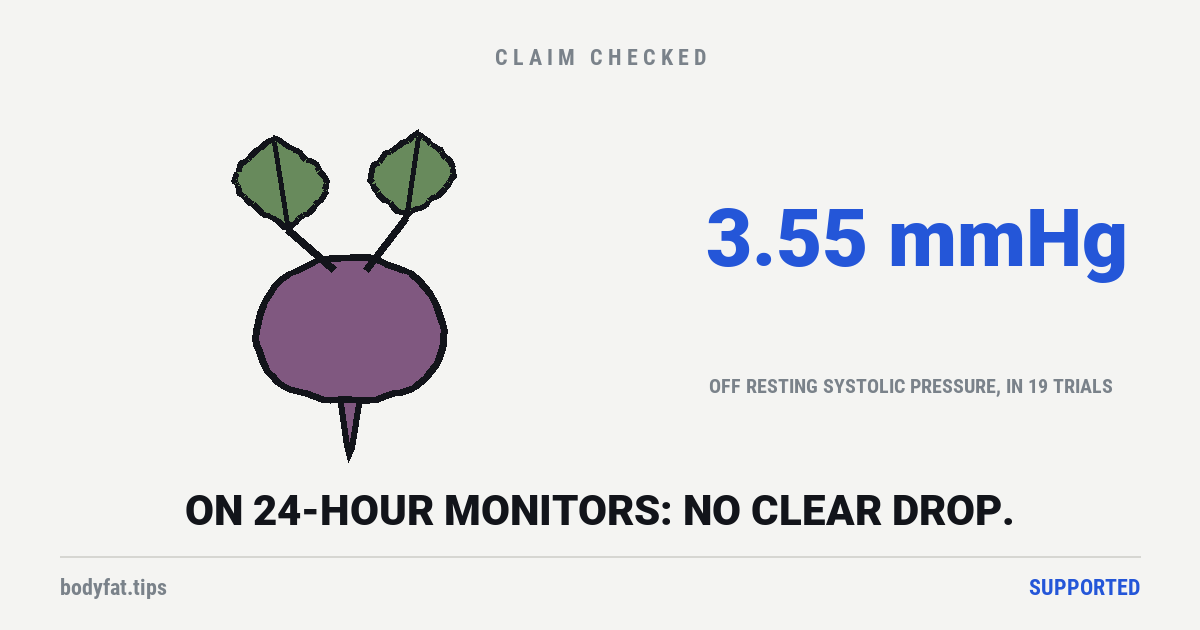
Beetroot juice lowers resting blood pressure, a little. Across 43 comparisons from 19 controlled trials lasting 2 to 56 days, systolic pressure (the top number) averaged 3.55 mmHg lower on the juice than on a placebo, and diastolic (the bottom number) 1.32. [1] A mmHg is a millimetre of mercury, the unit on every blood pressure cuff. That 3.55 is an average across groups of volunteers, read at rest. It is not a forecast for any one person.
Whose pressure? The volunteers’ average ages ran from 21 to 69, and they ranged from healthy adults to patients with high blood pressure, type 2 diabetes, lung disease, heart failure or high cholesterol. One trial of 68 people with high blood pressure supplies 16 of the 43 comparisons, about a third of the weight, because the review counted each follow-up reading and each subgroup as a separate result. [1][5] The longer trials and the bigger servings showed the larger falls in that review. A 2025 analysis of 75 trials found the fall stopped growing at about 3.4 to 5 fl oz (100 to 150 mL) of juice a day. [1][6]
Strap on a monitor that takes readings around the clock and the picture is less clear. Three reviews that pooled 24-hour readings found no significant change [7][8][9], though that trial of 68 people did find a fall on its monitors. [5] And for people who already have high blood pressure, the reviews disagree: one found clinic systolic pressure about 5 mmHg lower on beetroot juice and graded its own certainty low [8]; another found no significant change. [9]
So this is not a debunk, and we are not going to pretend it is.
It is a story about why it works — and about how much of the credit the ingredient on the label has earned.
| What was tested | Systolic blood pressure |
| Beetroot juice against a placebo · 43 comparisons, 19 trials | −3.55 mmHg |
| Against the same juice with its nitrate taken out · 27 of the 43 | −3.09 mmHg |
| Nitrate supplements, juice left out · 6 trials, 4 of them beetroot products | −3.81 mmHg, not significant |
| On 24-hour monitors · 3 reviews | no significant change |
| Exercise performance · 80 trials | d = 0.174 |
The concentrated shots did less than the big glasses
Beetroot is sold on nitrate. Nitrate becomes nitrite, nitrite becomes nitric oxide, nitric oxide opens up blood vessels. That is the pitch, and it is on every bottle and every gummy.
Inside the same meta-analysis, the reviewers sorted the juices by how much nitrate they held per 100 mL. That measures how concentrated a juice is, not how much nitrate anybody drank. The most concentrated juices showed the smallest fall in systolic pressure, 2.37 mmHg, and the weakest the largest, 4.63. [1] The reviewers read that as a sign that something other than nitrate was at work.
Look at what a concentrated juice is, though. It is a shot. A 2.4 fl oz (70 mL) bottle has to be concentrated to carry a useful dose, and a 17 fl oz (500 mL) glass does not. In the review’s own table, the row for the most concentrated juices and the row for the smallest servings print the same fall and the same range, to the decimal place, though one is labelled 14 comparisons and the other 17. [1]
The review’s own figures leave little room for anything else. Its smallest daily dose was 316 mg of nitrate. A juice in the weakest group, under 150 mg per 100 mL, could deliver that only in a glass of 8.5 fl oz (250 mL) or more; a 4.7 fl oz (140 mL) double shot of it would hold 210 mg at most. [1] That arithmetic is ours, from the review’s figures, and is not a calculation the reviewers made. So “the concentrated juices did less” and “the bigger glasses did more” are one finding described twice.
The review did not compare trials by how much nitrate people took in a day. A 2025 analysis of 75 trials did. Each extra millimole of nitrate (62 mg) went with a further 0.24 to 0.48 mmHg off systolic pressure, depending on how long the trials ran. [6] Its authors rated their certainty moderate for trials of up to a week and low for longer ones. In 70 of its 86 comparisons the nitrate arrived as beetroot, so on its own this cannot say which part of the juice did the work. The next comparison can.
Take the nitrate out, and most of the effect goes with it
Most of these comparisons, 27 of the 43, used a clever control: beetroot juice with the nitrate stripped out. Same drink, same colour, same everything, minus the thing supposedly doing the work.
That stripped juice is the placebo, not a second treatment. So the figure that goes with it, 3.09 mmHg, is how far the real juice beat the same juice without its nitrate. [1] If nitrate did nothing, that gap would be zero. Against other placebos, blackcurrant juice or a low-calorie drink, the gap was 4.51. Set the two side by side and about two thirds of the effect went when the nitrate did. The rest, about 1.4 mmHg, is the most this comparison can credit to everything else in the beetroot, and it comes from setting different trials, in different people, against each other. [1]
The reviewers’ own conclusion is that the results “highlight its potential NO3-independent effects”. [1] That is a fair name for the 1.4 mmHg. It is not a finding that the nitrate is a bystander.
The trial that supplies the most comparisons ran the test head on. Sixty-eight people with high blood pressure were randomised, and 64 finished, four weeks of a daily 8.5 fl oz (250 mL) glass of beetroot juice or the same juice with its nitrate removed. In the group on the real juice, clinic systolic pressure fell 7.7 mmHg from where it started, and so did the 24-hour average. The trial reports no significant change in anything it measured after the nitrate-free juice, and its authors concluded that the nitrate is what does the work. [5] Both juices were made by one juice company, James White Drinks, and one of the trial’s authors declared a directorship of a company called Heartbeet Ltd. The British Heart Foundation paid for the trial. [5]
We are not going to tell you what the rest is. Betalains are the usual suggestion and we have not read that literature. An honest gap beats a confident guess.
A 2026 review set out to test nitrate without the juice. Most of its trials still gave beetroot.
Which brings us to a 2026 meta-analysis that set out to test exactly that: nitrate supplements, with beetroot juice trials deliberately excluded. Its summary calls what it pooled sodium nitrate. [3]
Six trials, entered as 181 participants. Four of the six gave every volunteer both products in turn, so that is at most 134 people, and the largest trial enrolled adults aged 30 to 65. [3][10][11][12][13][14] The review’s own estimate for systolic pressure was a fall of 3.81 mmHg, a shade more than the juice figure at the top of this page. It did not count as a finding because the trials were small: the range of plausible answers ran from about 10 mmHg lower to about 2 higher, which still includes no effect at all. Diastolic pressure: 2.00 lower, with the same problem. Resting heart rate, pooled from two of the six trials: no change. [3]
Now look at what the six trials gave people. Two gave sodium nitrate, and both leaned toward a fall that was not statistically significant on its own. [3][14] The other four gave a beetroot and cereal bar [11], a beetroot powder [12][13], or a vegetable powder that was 60% beetroot. [10] One of the powder trials was paid for by the company that makes the powder, SuperBeets, and lists the company’s founder among its authors. [12] So the review left out beetroot juice. It did not leave out beetroot.
There is a second problem, and this part is our own arithmetic, not anything published. The review’s chart enters its largest trial as if the changes in its volunteers’ pressure differed from one another by about 2.4 mmHg. [3] That trial’s own table prints standard errors, and says so, and the review’s figures can be reproduced from them to the second decimal place. The trial gives the real spread between its volunteers’ readings at the start as 10.5 mmHg. [10] A standard error measures how precisely an average has been pinned down. It shrinks as a trial grows, so it is always much smaller than the spread. Entered that way, the one trial that leaned toward the placebo looked far more certain than it was and carried the most weight of the six, 30.7%. In the trial’s own analysis that lean was not statistically significant. [10]
Two letters to the same journal challenged the review’s methods, under titles that allege breaches of method, and its authors replied in print. We could read the letters’ titles and reference lists but not their text, so we cannot say whether they raise the same points. [3]
Six trials is not many, and the authors say so. What the review shows is narrower than its label. It does not show that nitrate does nothing, and it does not show what nitrate does without beetroot.
So what does nitrate do on its own? We read two direct tests, and they do not settle it. In 18 healthy adults, a single dose of beetroot juice lowered systolic pressure over the next few hours and the same amount of nitrate as plain sodium nitrate did not, though both lowered diastolic pressure. [15] In 231 people with raised blood pressure, a nitrate pill taken for five weeks left 24-hour pressure unchanged, and so did the same amount of nitrate eaten as leafy greens. Clinic readings fell 4.3 mmHg on the pill and 1.3 on the placebo, a gap the trial could not tell from chance. [16] Whether a capsule does what the juice does is a question those trials leave open.
On performance, the number is smaller than you think
Now the athletic claim. Eighty crossover trials in healthy young adults, 1,179 men and 156 women, sifted from 2,033 candidates in a search that ended in August 2019. Nitrate did improve exercise performance, and the result was highly statistically significant. [2]
The effect size was 0.174.
Effect size is a way of asking how big a difference is, stripped of what was being measured. Roughly: 0.8 is what researchers call large, 0.5 is moderate, and 0.2 is barely there. This one is 0.174 — below barely there. The reviewers say it plainly: “the effect size of NO3 supplementation was objectively small.” [2]
The reviewers also turn the number into a percentage: about 3%. Their example is a single trial in which nine cyclists were 48 seconds faster over a 10-mile (16.1 km) time trial, a margin they say could mean a great deal in competition. For time trials as a group their figure was smaller still, 0.086. [2] A 2025 umbrella review of 20 meta-analyses found the same split: nitrate helped people keep going longer before exhaustion, and on time trials seven of eight reviews could not rule out no effect at all. It also rated the methods of most reviews in this field low or critically low, this one among them. [17]
It was missing in the fittest athletes. In women, there were too few trials to tell.
The subgroup results are where this gets uncomfortable for the category.
In studies of women only, the effect was not observed. Six studies, and the range of plausible answers ran from −0.126 to +0.358 — comfortably including nothing. [2] The estimate itself was positive, 0.116, and women were 156 of the 1,335 volunteers. The reviewers call the blank “likely spurious”, a product of too few studies, and a 2022 panel of twelve researchers agreed there was too little evidence to say whether nitrate works differently in women. [2][18]
In well-trained endurance athletes, the effect was not observed. Twenty-six studies, effect size 0.021, which is indistinguishable from zero. [2] The reviewers note it has “more limited utility… in participants with excellent aerobic fitness that have optimized other training parameters.”
Read that again, because it inverts the marketing. The people buying beetroot shots to shave seconds off a race are the group it did not show up in. It showed up in recreationally active young men — and even there, barely.
While we are here: the mouthwash thing
You may have been told never to use antibacterial mouthwash near your beetroot, because bacteria in your mouth do the first step of converting nitrate.
A 2025 randomised pilot looks like a test of that advice. It is not one. Nobody in it was given beetroot or nitrate, and the volunteers were told to avoid high-nitrate foods for a day before each visit. Thirty young adults used an over-the-counter antibacterial mouthwash or a sea-salt one for seven days. The antibacterial rinse did reduce the proportion of nitrite in saliva. Breath nitric oxide, measured in 16 of the 30, did not change, and peak torque, maximum velocity and power in the knee extensors were all unaffected. [4]
Thirty people, one type of mouthwash, and the authors call it a pilot. It does not settle the question. The trials that did put mouthwash next to a nitrate dose are small, 7 to 12 people each. [19][20][21] They found what the advice predicts for the chemistry: antibacterial mouthwash blunted the rise in blood nitrite after sodium nitrate or beetroot juice, and the stronger the rinse the bigger the dent. One of them used the same over-the-counter rinse as the pilot. [20]
On blood pressure itself, we found three human trials that gave mouthwash with a nitrate dose and reported it, and they do not agree. In a four-hour test in 12 men, systolic pressure after beet juice ran lower with water or the mildest rinse than with the two strongest. [20] In a six-day trial of 12 people, resting pressure was no different whichever rinse they used, though pressure during a treadmill walk rose more with the strongest. [21] And in 10 adults who rinsed with chlorhexidine or with water before a beetroot shot, pressure over the next five hours did not differ. [25] So the chemistry behind the advice has been shown in a handful of people. Whether it costs you the blood pressure benefit rests, as far as we could find, on those three trials of ten and twelve.
The wider question, whether antibacterial mouthwash raises blood pressure at all, has had more study and no clearer answer. A 2024 meta-analysis of five crossover trials put systolic pressure 1.59 mmHg higher on mouthwash, a gap it could not tell from zero. [26] A scoping review published in September 2026 counted nine studies, five that found a rise and four that did not, and drew no firm conclusion. [27]
The verdict
Supported, for the blood pressure claim. Forty-three comparisons from 19 controlled trials, a consistent direction, a bigger fall with more nitrate, and about 3.5 mmHg off resting systolic pressure on average. [1][6] That is modest and it is real. It comes with the limits above: trials of 2 to 56 days, no clear drop on 24-hour monitors, reviews that disagree about people who already have high blood pressure, and one 2021 review of beetroot trials that reported no significant change in blood pressure at all. [22]
Mostly the nitrate, as far as the juice trials can tell. Juice with its nitrate beat the same juice without it by about 3 mmHg, and the one trial that ran that test directly in people with high blood pressure found the nitrate-free juice changed nothing. [1][5] Less clear is whether nitrate does the same outside the juice: the review billed as testing it alone mostly tested beetroot, and in the two direct tests we read, a nitrate salt and a nitrate pill did less than the juice trials would lead you to expect. [3][15][16]
And the performance claim is real but small. It did not show up in the fittest endurance athletes. In women the review had too few trials to tell: 156 of its 1,335 volunteers, and its own authors put the blank down to that. [2]
If you like beetroot juice, the evidence is modestly on your side: a few mmHg off resting blood pressure, in trials of weeks, not years. If you are buying a powder, a capsule or a “nitric oxide” gummy instead, the 3.55 figure is not about your product. It comes from juice, 2.4 to 17 fl oz (70 to 500 mL) a day. [1] The two powder trials we read point in different directions: a four-week trial in 13 older adults, paid for by the powder’s maker, saw resting systolic pressure fall 5 mmHg on the active powder [12], and a sixteen-week trial in 66 adults with raised pressure found a beetroot-rich vegetable powder no better than a low-nitrate one. [10] A 2026 audit of 18 nitrate and beetroot supplements sold online in Europe found “improves blood flow” on 8 of them and a cited study on 3. [23]
None of this is a dose. The acceptable daily intake for nitrate that Europe’s food safety regulator kept in place in 2017, while saying the data did not let it derive a better figure, is 3.7 mg per kg of body weight: about 259 mg a day for a 154 lb (70 kg) adult. [24] Every daily dose in the juice review, 316 to 860 mg, is above that for an adult of that weight. [1] The regulator’s opinion is about nitrate salts added to food. It judged the risks it assessed to be low at the limit itself, and it said the safety of total intake from all foods was outside its scope, so it does not say that a daily glass for years is safe and it does not say that it is harmful. [24] It is a safety judgement, not evidence that anything works. A 2022 panel of nitrate researchers judged that limit not appropriate on current evidence, and the same panel could not agree on whether long-term supplementation raises the risk of cancer or kidney injury; nine of that paper’s authors had received free or discounted beetroot juice for their research. [18] The authors of the 68-person trial add that people prone to oxalate kidney stones may need to avoid beetroot. [5] If you take medicines or have a health condition, how much nitrate is sensible for you is a question for your clinician, not for this page.
Blood pressure is a clinical matter. A 3.5 mmHg average across trials is not a treatment plan, and anyone managing hypertension should be having that conversation with a doctor rather than a juice.
Related: how to lower blood pressure naturally · creatine for women · do you need electrolytes · fish oil vs krill oil · how much protein to build muscle · every claim we’ve checked
This page’s account of why beetroot juice works was wrong, and it was corrected on 30 September 2026 after an independent editorial review. The page said nitrate was not the reason and gave three grounds. All three were misreadings. It said “more nitrate made it work less”, which was also the title: the 2017 review sorted juices by nitrate per 100 mL, which is concentration and in practice serving size, and did not analyse how much nitrate people took; a 2025 analysis of 75 trials that did found more nitrate went with a bigger fall. It said the juice “still worked” with its nitrate taken out: the nitrate-free juice was the placebo, and 3.09 mmHg is how far the real juice beat it. And it said isolated nitrate “did nothing”: the 2026 review’s own estimate was a fall of 3.81 mmHg that was not statistically significant, and four of its six trials gave beetroot products, one of them paid for by the product’s maker. The 2017 reviewers and the 2026 review’s authors both argued for an effect beyond nitrate; this page repeated them from their abstracts without reading their tables.
The desk’s own reasoning built on those readings (“that is not how an active ingredient behaves”, “the whole drink does something, the isolated compound does not”, and the line that the mouthwash advice outruns its evidence) has been deleted rather than reworded, and those sections rebuilt from what the sources show. Also corrected: the headline figure is now given as 43 comparisons from 19 controlled trials of 2 to 56 days on resting readings, not “22 trials”, with the 24-hour monitoring results and the disagreement over people with high blood pressure added; the 2026 review’s “181 people, all over fifty” is at most 134 people and its largest trial took adults aged 30 to 65; “absent in women” was six data sets and 156 women, a blank the review’s own authors call likely spurious; the 2025 mouthwash pilot gave nobody beetroot or nitrate, and the trials that did are now cited; the funding row said nothing was stated, when three of the four papers state their funding and companies that sell beetroot products made the juice, the placebo or the powder in trials inside the reviews; the note calling three sources paywalled was wrong for two of them; and a monthly search figure that could not be traced to a saved keyword pull was removed. A regulator’s intake limit was added, with what it does and does not settle. The rating is unchanged: Supported, for a small fall in resting blood pressure.
One count in the provenance box was corrected on 30 September 2026. It said that 11 of the 25 video descriptions we sampled “carried a commerce link or discount code”. That figure came from an automatic text match that was later found to match ordinary words. Read one by one, 10 descriptions link a shop, a storefront, a product page, affiliate links or a sponsor; an eleventh links a testing company’s own report on beetroot supplements; and one prints a discount code. Nothing else on the page changes, and the rating is unchanged.