Colostrum Benefits: Body Fat Fell 0.4 Points on 60 g a Day. On Whey Too.

A 2026 systematic review found nine trials that measured what bovine colostrum does to human body fat. Its summary credits exactly one of them with a reduction. [1]
That trial gave people 60 grams a day, for eight weeks. Their body-fat reading fell by 0.4 points, from 34.1% to 33.7%. [3]
So did the comparison group’s: 33.7% to 33.3%. They were on 60 grams a day of whey protein. [3]
Sixty grams. A day. And the whey did exactly the same.
The people in that trial averaged about 59 and were lifting weights three days a week for the eight weeks. Both groups added a little lean tissue. The weight of fat they carried barely moved — 60.6 lb to 60.4 lb (27.5 to 27.4 kg) on colostrum, 55.1 lb to 54.7 lb (25.0 to 24.8 kg) on whey — and the trial found no difference between the two powders on body fat. Part of its funding came from the company that made the colostrum it tested, and it still reported no advantage there. [3]
The review says as much in its own results section: “percentage body fat decreased by 0.4% in both groups.” [1] Its summary left the second group out. So did this page, until an independent review caught it.
| Dose | What happened to body fat |
| 60 g/day | down 0.4 points in 8 weeks, and down 0.4 on whey too |
| 20 g/day | no significant difference vs whey |
| 10 g/day, in a multi-nutrient mix | smaller rise in leg fat; total body fat no different |
| all 9 body-fat studies | certainty: very low |
The reviewers rate the whole thing very low
This is a 2026 systematic review, PRISMA, Cochrane risk-of-bias tools, GRADE — the standard machinery for working out how much confidence a body of evidence has earned. It covers trials published from 2001 to 2025. [1]
Its verdict on the certainty of its own findings: “predominantly very low”. [1] That is the bottom grade.
And the sentence that should end most conversations about this supplement, from the reviewers themselves: “the currently available evidence is insufficient to support firm conclusions regarding the independent effect of bovine colostrum supplementation on reducing body fat content or improving blood lipid profiles in adults.” [1]
On risk of bias, they are blunter still. Among the randomised trials, most had “some concerns or a high risk of bias”. Among the non-randomised ones: “all non-randomized studies were judged to be at critical risk of bias.” [1] Every single one.
In every controlled trial, colostrum was up against another protein
Here is the detail that reframes the numbers above. We met a cousin of it in the red light trials, where eight of the ten trials added the device to a diet or an exercise programme that both groups followed: a trial can be sound and still answer a narrower question than the one a buyer is asking.
Twenty-two physically active adults, eight weeks, 20 g a day of colostrum. The comparison group got 20 g of whey protein powder. [1]
Body fat went 18.8% to 17.6% on colostrum, and 18.7% to 20.2% on whey. Which looks like a win until you read the next clause: the difference between the groups was not statistically significant. [1]
More importantly, notice what question that trial answers. Not “does colostrum beat nothing”. It answers “does colostrum beat a scoop of whey” — and a reader deciding whether to buy a tub is asking the first question.
And it is not one trial. Eight of the nine had a comparison group, and every one of the eight gave that group another protein: whey or a whey-and-casein blend in five, milk protein in two, a protein-matched powder in one. [1] The 60-gram trial at the top of this page is one of the five. The ninth had no comparison group at all; body-fat percentage in it went from 24.0% to 25.5%. [1]
So how many of the eight found colostrum ahead on body fat? None. In not one of them did the colostrum group finish with less total body fat than its comparison group by more than chance could explain. [1] [3] One found leg fat rising a little less on a multi-nutrient powder that held 10 grams of colostrum a day. It was the only one of nineteen body-composition measures in that paper to reach statistical significance (the line researchers use for “probably not chance”), total body fat did not differ, and the comparison powder was also missing the product’s calcium, vitamins and choline. [1] [4]
Go and read the dose on your own tub
The body-fat trials that tested colostrum powder on its own used 20 to 60 grams a day; one more put 10 grams inside a multi-nutrient mix. When the reviewers set out what a proper future trial should look like, they recommend standardising on 20–25 g/day, with controlled calories, for at least six months. [1]
We are not going to tell you what is in the tub you are looking at, because we do not sell tubs and we have not measured yours. But that is the number to check. It is on the label, in grams, and the comparison takes about four seconds.
Just do not read those grams as a target. No dose in these trials, 60 grams included, put colostrum ahead of the protein it was compared with, and the reviewers found “no clear evidence of a dose-dependent increase in benefits” all the way up to 60. [1] What the label tells you is how far a serving sits from anything that has been tested.
How far can that be? Two sellers have registered studies of their own powders on ClinicalTrials.gov, the US trial registry. Armra’s gave people two 1-gram sachets a day for twelve weeks. Cowboy Colostrum’s gave a daily serving holding 3 grams. In neither study did any group go without the product. The first finished in March 2023 and the second in November 2025, and neither record showed any results when we read them on 30 September 2026. [9]
The gut claim is the strongest one, and it comes with a warning
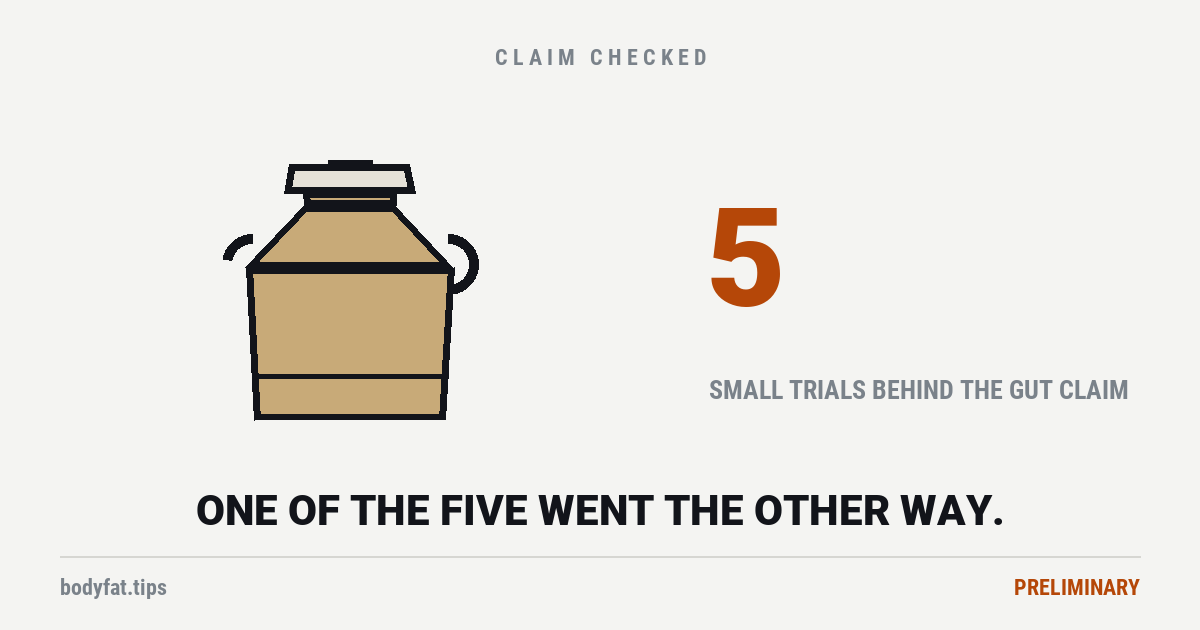
The other half of the pitch is the gut. There is a meta-analysis of randomised trials, and its headline result is positive: across five of its ten trials, colostrum significantly reduced a measured marker of intestinal permeability — how much leaks across the gut wall, tested by drinking two sugars and measuring what turns up in urine. [2]
Now the warning, and it is a big one. The heterogeneity on that result was 99%. [2]
Heterogeneity is the share of the spread between the trials’ results that is more than chance would produce. Zero would mean they differed no more than luck allows. Ninety-nine per cent means nearly all of the gap between them is real, and a pooled average sitting on top of results like that has very little to describe.
Here the disagreement has a name. Four of the five trials found the marker lower on colostrum. The fifth put 30 men through eight weeks of running training, nine of them on 60 grams of colostrum a day and eight on whey, and the marker rose far more on colostrum: up 251%, against 21%. [2] [5] Its title is “Bovine colostrum supplementation during running training increases intestinal permeability.” [5]
Then look at who was tested. All ten trials were in healthy volunteers or athletes, and where the papers give their sex nearly all were men. The gut was being put under strain on purpose: hard training, exercise in the heat, or a five-day course of an anti-inflammatory drug. [2] The review found two trials in patients, one in intensive care and one around abdominal surgery. They are in its risk-of-bias chart and in none of its pooled results. [2] So no pooled number on this page comes from anyone with a gut condition.
There is a second pooled result, and it is steadier. On a different two-sugar test, colostrum again came out lower, and this time the trials agreed with each other: heterogeneity of 29.8%. [2] But it is two trials from one research group, 47 athletes in all, on about a gram a day, and the pooled difference is one hundredth on the ratio. [2]
And the marker of actual gut damage did not move
The same meta-analysis measured something else: I-FABP, a protein that shows up in blood when intestinal cells are actually being damaged.
No difference. And the range of plausible answers ran from −293.9 to +298.5. [2] That is not a null result so much as a measurement that could not see anything at all.
So the honest reading: in healthy, mostly male volunteers whose guts were being put under strain, colostrum may tighten a permeability measure in a urine test. Whether that corresponds to anything you would notice, and whether it happens at all in someone with a gut complaint, are questions these ten trials did not ask.
The trials that did enrol people with gut disease are a separate pile, and the same research group went through them in 2024: 22 trials, 1,427 people, 14 of the trials in infants and children and four in healthy subjects. The patients in the rest had diarrhoea, AIDS, H. pylori infection or colitis, or were in intensive care, or were low-birth-weight babies. Diarrhoea became less frequent in 15 of the 20 treatment arms that tracked it; abdominal pain eased in four arms and did not in five. Nothing was pooled, and the authors’ summary is “limited evidence” with “mixed findings”. [6] That is a long way from an adult buying a tub for bloating.
What regulators have said, and what it settles
The European Union keeps a register of the health claims that may and may not be made for foods and supplements. Eight claims for bovine colostrum are on it, among them “Promotes gastrointestinal/bowel/gut health”, “Optimises the natural defense system in healthy persons” and “Combined with exercise and diet, colostrum supports muscle growth”. All eight are listed as non-authorised. [7] The stated reason is not that colostrum was tested and failed. For seven of the eight it is that the food “is not sufficiently characterised for a scientific assessment”: in an opinion published in April 2011, the European Food Safety Authority’s panel found the products behind the claims too loosely described to assess. [7] That opinion is older than most of the gut trials above, and none of the eight claims was about body fat.
The US Food and Drug Administration has written to colostrum sellers about what they say. On 5 June 2026 it sent a warning letter to one of them, Imu-Tek Animal Health, quoting the company’s claim that its colostrum capsules and powder “can also help correct bowel dysfunction by stimulating tissue repair” and telling it that claims like that one make the products unapproved new drugs. Two earlier letters went to another seller, Sovereign Laboratories: on 5 February 2019 over claims about Alzheimer’s disease, HIV and flu, and on 15 June 2020, with the Federal Trade Commission, over COVID-19 claims. [10] A warning letter is a judgement about what a seller may say. It is not a test of what colostrum does, in either direction.
The verdict
Preliminary, for the gut claim. There is real randomised evidence here and we are not going to pretend otherwise — a significant pooled effect on gut permeability is a genuine finding. It is also a finding from five small trials in healthy volunteers, one of which went the other way, and the rating rests on that half of the claim alone.
On body fat the claim does not get that far, and rated on its own it would be Unsupported. There are nine studies rated very low, every controlled one compared colostrum with another protein, and in none of them did colostrum come out ahead: the single reduction the review’s summary credits to it, 0.4 points on 60 grams a day, was matched by the whey group in the same trial. None of the review’s trials set colostrum against a powder with no protein in it, so whether it does more than nothing was never the question being tested.
That is a supplement whose evidence has not caught up with its marketing, which is a different accusation from saying it does nothing.
What this page does not rate: colostrum’s oldest claim is immune support and fewer upper-respiratory infections. A 2016 meta-analysis pooled five randomised trials, 152 people in all, every one of them in regular exercise training and taking 10 to 20 grams a day for eight to twelve weeks. The colostrum groups reported 44% fewer days with symptoms (a rate ratio of 0.56, where 1.0 would mean no difference; the range the true figure probably sits in runs from 0.43 to 0.72). [8] The symptoms were self-reported, not tested infections, and the authors judged four of the five trials to be at moderate or high risk of bias. [8] We have read that review, and not yet the trials under it or the ones published since. Nothing above should be taken as a verdict on it — when we have read them, we will say what we found.
Related: collagen benefits · fish oil vs krill oil · how much protein to build muscle · magnesium benefits · every claim we’ve checked
This page’s headline was wrong, and it has been corrected after an independent editorial review. The title said one study moved body fat by 0.4% on 60 grams of colostrum a day. That trial’s own table shows body-fat percentage falling 0.4 points on colostrum (34.1% to 33.7%) and 0.4 points on the whey it was compared with (33.7% to 33.3%), with no difference between the groups, in people averaging about 59 who were lifting weights. The review we cited says “in both groups” in its results section; we had worked from its summary, which does not. We also wrote that thirteen trials measured body fat, when nine did and the other four measured blood fats or blood sugar; that the gut result came from ten trials, when the result with 99% heterogeneity pooled five, all in healthy volunteers; and that funding was “not stated in the sources read”. It is stated. Both reviews declare no funding, and the 60 g/day trial was part-funded by the company that made the colostrum it tested.
The page now says who was in the gut trials, names the one in which permeability rose on colostrum, and gives the second, steadier pooled result the first version left out, with its limits. The heading “In one trial, the placebo was whey protein” undersold the point: every controlled body-fat trial compared colostrum with another protein. We have added the EU’s register of health claims, three FDA warning letters, two sellers’ own registered studies, a 2024 review of trials in gut disease and a 2016 meta-analysis of respiratory symptoms, each for what it does and does not settle, and corrected the dose range, the comparison with our red light page and the YouTube sample. The rating is unchanged, Preliminary, and it now rests on the gut finding alone: the page says so, and the claim our structured data names is now the gut claim. The body-fat half is described as what it is. Rated on its own it would be Unsupported.
One explanation was corrected on 30 September 2026, separately from the correction above. We wrote that a heterogeneity figure of 99% means the trials “found almost entirely different things”. The figure is the share of the spread between their results that is more than chance would produce; how far apart the results actually sit is a separate matter, and the paragraph after it describes that. We had made the same mistake on our zinc page and corrected it there the same day. No number on this page changes.