Red Light Therapy: The 3-Inch Waist Finding Isn’t About the Panel You’d Buy

Three inches smaller at the waist. At the end of seven randomised trials, the people given a light device measured 3.1 in (7.82 cm) less round the waist than the comparison groups, and it is the best-rated finding in the paper. [1]
In six of those seven trials the device was added to a diet or an exercise programme that both groups followed. Six used lasers, and one used LED straps worn round the abdomen. No trial in the review tested a home LED panel. [1]
Both of those are true. The first is the number that gets quoted. The second decides whether it has anything to do with the device you would buy.
| Measure | Result |
| Waist | 3.1 in smaller · 7.82 cm · 7 trials |
| Weight | 7.8 lb lighter · 3.54 kg · 8 trials |
| BMI | 1.18 lower · 9 trials |
| Body fat percentage | no clear difference · 1 trial |
| Waist-to-hip ratio | 0.05 lower, borderline · 3 trials |
| Insulin | no clear difference · 1 trial |
The waist figure is seven trials. The body-fat figure is one, counted twice.
The waist result is the strongest thing in the review. It comes from seven studies and 347 patients, and their results differed from one another no more than chance would produce: heterogeneity, the share of the spread between trials’ results that is more than chance would produce, came out at zero. The paper’s text calls their risk of bias low. Its own chart does not. The chart comes from the Cochrane risk-of-bias tool, a checklist of the ways a trial’s design or conduct can tilt its result, which grades each trial low risk, some concerns or high risk. Of the seven waist trials it grades three high risk, one some concerns and three low. [1]
A note on the number. The paper’s summary prints 7.28 cm. Its chart of the seven trials prints 7.82 cm against the same range, 5.67 to 9.97, and so does one line of its results. The seven rows of the chart work out to 7.82, which is also the middle of that range, so 7.82 cm (3.1 in) is the figure we use. We found no correction to the paper on PubMed, Crossref or Europe PMC when we checked on 30 September 2026. [1]
The body-fat-percentage result comes from the same review and lands at −0.28, with a range running from −1.25 to +0.69. [1] That range includes zero, and comfortably — meaning the device does nothing to body fat percentage is still entirely on the table.
But look at what that figure is. The review lists it as two studies and 126 people. They are two reports of one trial: the same ten authors, the same four Brazilian research grants, and one matching registration, for 64 women aged 20 to 40 in an exercise programme, half given the laser after each session and half a laser that was switched off. [3][4][5] The review’s chart prints the same averages on both rows, 38.83% body fat with the laser and 39.11% without, so one group of women has been counted twice. [1] The laser was infrared (808 nm; wavelength, measured in nanometres, is what sets a light’s colour), not red. And body fat was estimated by bioimpedance: a small electrical current measures the water in the body and an equation works out the fat from that, as our body-fat scale verdict explains. [4]
So did body fat really not move? It moved in both groups. Every woman in that trial was in the exercise programme, and its own reports say body fat percentage fell with the laser and without it, and fell further with it. [4][5] The review’s figure compares where the two groups finished, not how far each had come. Its authors say the body-fat evidence is “insufficient to draw conclusions”, and they grade it “very low”, the bottom of their scale. The waist result they grade “moderate”. [1]
Waist-to-hip ratio came out 0.05 lower with the device, sitting exactly on the line researchers use for “probably not chance” (P = 0.05). It rests on three small trials, two in adolescents and one in people over 60, and the reviewers call it a trend. [1]
So is there a puzzle here, a waist that shrank while the body’s fat stayed put? Not one the numbers force. The body-fat figure comes from one of the seven waist trials, and in that trial body fat came down in both groups. The paper does offer an explanation for a smaller waist without less fat. It relays the leading proposal, that the light opens temporary pores in fat cells and the fat leaks out to be burned or moved elsewhere, and says this is how a waist could shrink with “no significant change in overall body fat content”. Then it adds that there is “currently no official consensus on the mechanism”. [1] The same pore idea is written into the FDA’s own description of this class of device. [6] It is a proposed mechanism, not a demonstrated one.
Eight of the ten trials had people dieting or exercising at the same time
Here is the detail that changes how you read every number above.
The comparison is described as being against “exercise, dietary changes, and sham PBM” [1] — three different things, pooled. Count the Brazilian trial once and the review has ten trials. Two tested a device by itself against a sham, a look-alike machine that is switched off or gives out no treating light. The other eight, by the review’s own table, ran the device plus a diet, an exercise programme or both against the diet or the exercise alone. [1]
That is a perfectly reasonable question to ask. It is just not the question a person buying a panel thinks they are getting an answer to. Losing 7.8 lb (3.54 kg) more than a group who also dieted is a different claim from losing 7.8 lb more than a group sat in front of a switched-off device.
The paper answers that second question, in a supplement. In the two trials that tested a device alone against a sham, 105 people by its count, the device group finished 0.9 lb (0.41 kg) lighter. The range the true gap probably sits in runs from 10.9 lb lighter to 9.1 lb heavier (4.96 kg to 4.14 kg), and P = 0.86. P is how likely a gap at least that big would be if the device did nothing; the usual line for “probably not chance” is 0.05, and 0.86 is nowhere near it. For the waist there was one such trial, of 53 people: 1.9 in (4.70 cm) smaller, P = 0.14, which is also the wrong side of the line. The reviewers say as much: with “only one study with a sham control”, the result “did not reach statistical significance”. [1]
Three things about those two trials. Both used a green laser (532 nm), not a red one. Both are registered with the laser’s maker, Erchonia Corporation, as sponsor. [7][8] And their own posted results, which compare how far each group changed rather than where it finished, do show small gaps in the laser’s favour. One was a two-week trial of cellulite in women whose average BMI was 25: 1.41 lb lost with the laser, 0.31 lb with the sham. [8] The other measured waist, hips and upper abdomen added together: 4.14 in (10.52 cm) lost with the laser after four weeks, 0.71 in (1.80 cm) with the sham. [7] So the sponsor’s own trials point the laser’s way, by about a pound and by a measurement summed across three parts of the body. What they do not show is three inches off a waist or 7.8 lb off a scale.
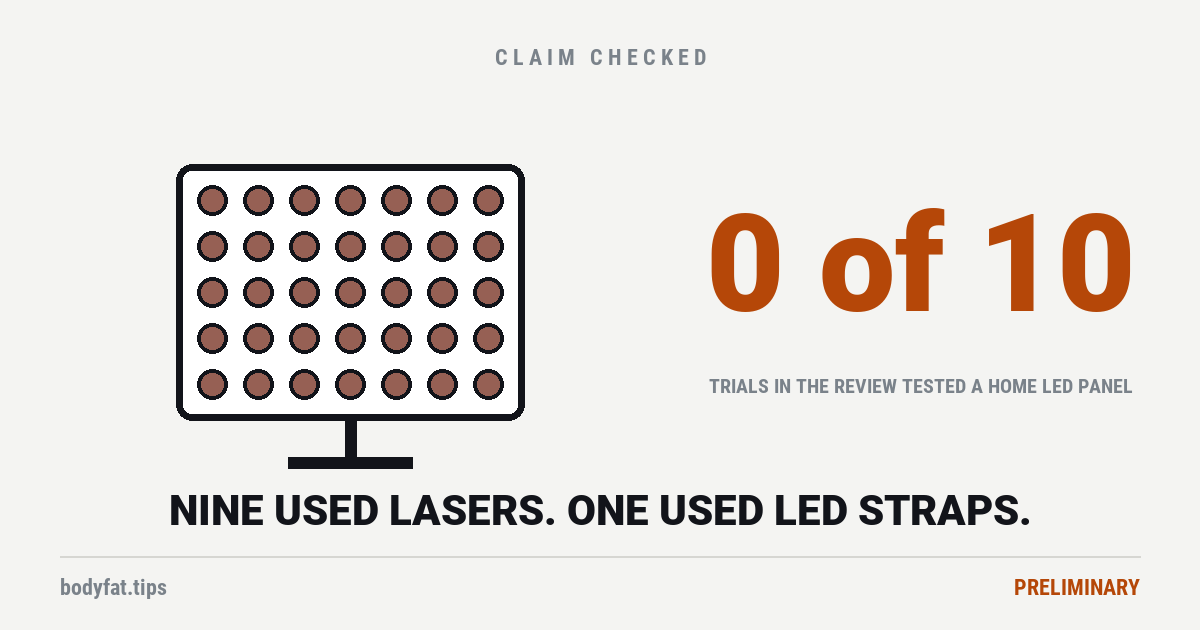
Nine of the ten trials used lasers. None used a panel.
The devices were not the ones in the adverts. Nine of the ten trials used lasers, which give a narrow beam of a single colour. One used LEDs (light-emitting diodes, the lamps in home panels and masks), held in straps round the abdomen. [1]
And not all of it was red. Only four of the ten are listed at a red wavelength, 635 to 680 nm. Two used green lasers (532 nm), one an infrared laser (808 nm), one is listed at 924 nm, and for two the review gives no wavelength at all. Two of the laser trials used a laser wristwatch that shines on the wrist and up the nose, nowhere near the waist, and one of those two counts for more in the waist figure than any other trial. In that trial, by the review’s table, the comparison group dieted and got no sham device. [1]
The reviewers rate their own results very low to moderate
This is the part we would want quoted back at anyone citing this study at you.
The authors ran GRADE, the standard system for rating how much confidence a body of evidence deserves. Their verdict on their own findings: “The quality of our results ranged from ‘very low’ to ‘moderate’.” [1]
The reasons they list are “the flawed methodology of the selected studies, inconsistent results due to significant heterogeneity, imprecise results due to wide confidence intervals and small sample size, and other bias due to publication bias.” [1]
And in the footnotes of their own quality table, one line explains a downgrade as: “Publication bias due to funding support.” [1] It is attached to six of their nine results, the body-fat figure among them, and to none of the three headline ones (waist, weight and BMI). They do not say whose funding they mean. That is their judgement, not ours, but it is their judgement, printed in their own table.
So who did pay? The review’s table names a funder for two of its eleven entries, public research bodies in Brazil and Egypt, and prints “No” for the other nine. [1] That column misses the two trials that matter most to a buyer. Both of the trials that tested a laser alone against a sham were sponsored by the laser’s maker, and one of the two papers discloses that an author owns the company and holds patents on the laser. [7][8][9] The review itself reports no funding and no competing interests. [1] The funding row of the evidence panel at the top of this page says what we could read, and for which trials we could not.
And nearly all of it comes from two countries
One more line from the limitations, which will sound familiar if you read our sauna verdict: “Most studies were conducted in Brazil and Egypt.” [1]
That is not a criticism of Brazilian or Egyptian research. It is the same structural problem the Finnish sauna data has — when a literature clusters in a couple of places, what looks like many independent confirmations is closer to one research community checking its own work.
The skin claim, which is the better one
Set the fat aside. Red light for skin has a genuinely interesting trial behind it, and a genuinely interesting flaw.
137 women, aged 40 to 65, ten sessions over four weeks. Wrinkle volume around the eyes fell 31.6% with red light. [2] That is a real number from a real randomised trial with objective measurement, not a satisfaction survey.
Now the design. It was split-face: red light on one side, amber light on the other. Every participant got light on both sides. There was no untreated side. [2]
So the trial can tell you that red and amber perform about the same — 31.6% versus 29.9%, which is close enough to be nothing. It cannot tell you whether either of them beats doing nothing at all, because nobody in the study did nothing.
And in the same trial, on the same faces: “None of the treatments improved skin hydration and viscoelasticity.” [2] Wrinkle volume moved. The other two skin measures did not.
Has anyone run the comparison this trial left out? Yes, and the place to start is the same university. In 2025 it reported a trial in 95 women aged 45 to 60: a red LED mask (660 nm) against a sham mask left switched off while a recording played the sound the device makes, two or three times a week for four weeks. On the outcome the trial had registered as its main one, a wrinkle scale scored from photographs by three specialists who did not know who had received what, there was no significant difference between the groups. A second measurement, of wrinkle length on the same photographs, found reductions in two of the four areas measured, and the women who got the light were more satisfied with how they looked. [10]
A 2025 trial of a home-use mask went the other way. Sixty adults, 56 of them women, were given a mask with red (630 nm) and infrared (850 nm) LEDs, or a sham, to use for nine minutes, five times a week, for 12 weeks; 59 were analysed. On its main outcome, 86% of the mask group and 17% of the sham group were judged at least one grade better on a crow’s-feet scale. Two things to weigh against that: the sham still gave out red light, at a tenth of the strength, and the mask’s maker paid for the trial. [11]
A second review, an LED trial, and what “FDA-cleared” means
A second team pooled the evidence in 2025, in Obesity Reviews: 18 human studies of light applied to the abdomen, not all of them randomised, and several of them the same trials as the first review. It also found smaller waists with the device (9 studies, P = 0.031), and larger hips (5 studies, P = 0.035). It found no difference in weight (8 studies) or in fat mass, whether counted in kilograms or as a percentage, and none in BMI across its 11 studies, though the three that used red wavelengths (635 and 660 nm) did show one: all three pointed the same way, with sizes that differed by far more than chance would produce. Its authors read the pattern as light that may shift where fat sits more than it changes how much there is. [12] So the smaller waist turns up twice, in two overlapping sets of trials. The 7.8 lb does not.
What about LEDs rather than lasers? We found one trial that tested LEDs on the abdomen against a switched-off device: 90 women recruited at ages 30 to 45 and a BMI under 30, given ten sessions of red (630 nm) then infrared (850 nm) LED light in a physiotherapy clinic. The two LED groups, one of which also used a cosmetic product on the skin, lost more round the abdomen than the sham group (P = 0.02; the paper’s text gives no size for the gap) and showed a thinner fat layer on ultrasound. There was no difference in BMI or in skinfold thickness. And 88% of the women who got the switched-off device said they were satisfied with the treatment. Two things to weigh. The paper’s methods say the left side of the abdomen was treated and the right side served as a control, and its results show the fat layer thinner on both sides; the paper does not comment on that. And seven of its nine authors, the first and the corresponding author among them, give the company that makes the device as their workplace. The paper reports no specific funding and declares no conflicts of interest. [13]
A larger trial of the same question was registered in 2019, at the university that ran two of the skin trials on this page: 174 men and women, LED straps giving red or infrared light against a sham, with waist circumference as the main outcome. Its plan was published in 2020. We found no results from it, in the registry, on PubMed or in Europe PMC, when we checked on 30 September 2026. [16] If they exist, we would like to read them.
And “FDA-cleared”, the phrase on the box? The FDA first let this kind of device onto the market on 24 August 2010: one red laser, for one stated purpose, “the reduction of circumference of hips, waist, and thighs”. [6][14] That is a tape-measure claim. It is not a fat-loss claim and it is not a weight-loss claim. Devices since then have come through a different door, in which the maker shows the FDA that its device is “substantially equivalent” to one already on sale. That is a finding about resemblance. It is not an approval, and it need not rest on a new trial. An over-the-counter LED panel was cleared that way on 15 April 2026, for the same circumference wording and for facial wrinkles, and the summary published with its clearance says: “Clinical testing was not needed for this 510(k).” [15] None of that tells you the panels fail. It tells you what the stamp on the box was awarded for.
Does red light lower blood sugar?
A newer claim for red light is not about fat at all. In September 2026 a large health-video channel posted the same video three times, “The Light Bulbs You Need to Get Rid of Immediately (New Research)”, and by 7 October the three had 2,365,449 views between them [17]. Its description says LED bulbs leave us short of red and near-infrared light, calls that “21st century SCURVY”, and cites a trial in which 15 minutes of 670 nm red light cut the rise in blood sugar after a sugar drink by 27.7%. It also says “no $1,000 red light panel required” [17]. So does red light lower blood sugar?
The 27.7% is real, and it comes from a small study. In London in 2024, 30 healthy adults with no known metabolic condition were assigned at random to 15 minutes of 670 nm light on the back, or to the same position with the light off, 45 minutes before a 75-gram glucose drink [18]. Over the next two hours the rise in blood sugar was 27.7% smaller in the light group than in the placebo group, and the peak was 7.5% lower [18]. The authors write that it was done in healthy people, “not those that are diabetic”, and that “a bridge between our data and diabetic subjects has yet to be made” [18]. It was funded by an eye-research charity, and the authors declare no conflicts [18].
In type 2 diabetes the trials are smaller still. A 2023 trial gave 10 people with type 2 diabetes, on different days, two doses of 830 nm light on the muscles of the arms and legs and a sham, with and without their usual tablets; blood sugar fell over the following hours, most after the middle dose, where the fall lasted 12 hours [19]. One of its authors declares advisory roles with several light-therapy companies, a maker of home red-light panels among them, and shares in two others [19]. A 2025 review of the randomised trials in type 2 diabetes found the effects on blood sugar “inconsistent and largely short-term”, could not pool them, and rated the evidence low [20]; a 2026 review reported falls in fasting and after-meal blood sugar and HbA1c, the three-month average, and rated its certainty very low to low [21]. That review declares no conflict of interest; the author with the advisory roles is one of its four authors [19] [21].
Daylight is a different thing. A 2026 trial kept 13 people with type 2 diabetes in an office for four and a half days with daylight through the windows and four and a half days under constant artificial light, in random order; with daylight they spent more time with blood sugar in the normal range [22]. That is daylight against office lighting, not a red-light device, in 13 people.
So, rated alone: that red light lowers blood sugar is Preliminary: one 30-person trial in healthy adults after a sugar drink, a 10-person trial in type 2 diabetes, and reviews that rate the evidence low or very low [18] [19] [20] [21]. That LED bulbs “starve” your cells is not rated here. The rating at the top of this page is unchanged.
This section was added on 10 October 2026.
Is red light therapy bad for your eyes?
That depends on which red light you mean, because two different things are sold under the name. One is the home mask or panel, which shines at your skin while your eyes sit a few inches away. The other is red light aimed into the eye on purpose, as a treatment: for children who are becoming short-sighted, and for older adults with dry age-related macular degeneration, a wearing-out of the centre of the retina, the light-sensing layer at the back of the eye, which blurs the middle of what you see. The evidence on each is different, so here they are one at a time.
Red light therapy: eyes open or closed?
Start with the masks and panels, and with what their sellers say. Among the pages a search engine’s AI answer cited on 20 October 2026, a device seller says its FDA-cleared masks are “cleared as safe for your eyes” and that you can keep your eyes open. A device maker calls the light in its masks “completely safe for the eyes” but says panels may need goggles. A skincare brand says the FDA “confirms that red LED is a universally safe treatment”, and recommends blackout goggles for any panel that sits away from the face [23]. Those are sellers’ claims, and we report them as claims.
So what does “FDA-cleared” tell you about your eyes? Take the over-the-counter panel cleared in April 2026, described above. It comes with goggles in the box. Its clearance rests on bench tests, among them IEC 62471, the international standard for how much light a lamp may give off before it becomes a hazard to eyes and skin, and the summary published with it says clinical testing was not needed [15]. That is a test of the lamp. It is not a study of anyone’s eyes.
Is closing your eyes enough? It helps, though less for red than for other colours. In a 1991 study that measured light passing through the closed eyelids of five adults, about 15% of deep red light (700 nm) got through, against 3% or less of green and blue light (below 580 nm) [24]. An eyelid works like a red filter, which is the colour these devices are built around. We read that study as its abstract.
Has anyone been hurt? Two researchers at a New York medical school counted the reports sent to the FDA’s database of device problems about home acne and anti-ageing devices from 2013 to 2023. There were 87, most of them about light-based devices, and 28 were eye injuries, four of which led to a hospital stay. Of those 28, 22 involved a single device that was recalled in July 2019, and 6 involved devices still on sale [25]. The number of people using these devices is unknown, the authors note, so the reports cannot tell you how often an injury happens, only that some have.
Red light shone into the eye: short-sightedness in children
Here the light goes into the eye on purpose. A child looks into a desktop device for three minutes, usually twice a day, five or seven days a week, at a deep red light of around 650 nm [26]. Does it slow short-sight? Over a year, the trials say yes. A 2026 review pooled 28 randomised trials and 3,573 children; all but one of the trials were run in China. Not all of them lasted a year. In the 14 trials, with 2,149 children, that measured short-sight at 12 months, the children on red light had become 0.68 dioptres less short-sighted than the comparison groups (a dioptre is the unit a glasses prescription is written in), and in 15 trials their eyeballs had grown about a hundredth of an inch (0.30 mm) less in length, the other thing these trials measure. The reviewers rate their confidence in the first result moderate and in the second low, partly because the trials’ results varied far more than chance would produce [26].
Against what? Mostly against ordinary glasses. In most of the 28 trials the comparison group simply wore single-vision spectacles, and only one of the 28 gave its comparison group a device, turned down to a tenth of its power [26]. That one trial, of 111 children over six months, found less progression on the full-power light, and it was paid for in part by the device’s maker; one of its authors sits on the maker’s board and owns a stake in it [58]. The biggest of the 28 enrolled 336 children aged 6 to 12 at a single hospital in Beijing, which, the paper says, holds a patent on the device it used. At a year the gap was 0.89 dioptres, and about 0.015 in (0.37 mm) of eye length, and a masked review of retinal photographs found no changes in either group. It was paid for by a public health research fund in Beijing, its authors report no conflicts, and they write that the result needs repeating at centres independent of the one that holds the patent [27].
And when a child stops? Eye growth picks up again. In a two-year follow-up of one of the first trials, children who stopped after a year had eyes that grew about 0.017 in (0.42 mm) over the next year, against about 0.011 in (0.28 mm) in children who had never used the light, though over the two years together theirs had still grown less, about 0.020 in (0.50 mm) against 0.025 in (0.64 mm). Its authors call that a modest rebound; two of them are inventors on related patents, and one is a director and shareholder of the device’s maker [52]. The Cochrane review of treatments for short-sight, described below, found two trials that reported what happened after red light stopped, and says the children who had used it then progressed faster than the comparison group [51].
Is it safe? That is where the doubts are, and they come from several directions.
In 2023, eye doctors in Shanghai described a 12-year-old girl whose sight fell from 20/20 to 20/30 in both eyes after five months of the treatment, with damage at the centre of the retina on scans. Three months after she stopped it had partly recovered, to 20/25. In comments published with the report, the device maker’s chief executive wrote that it may leave out relevant details, and two other eye doctors suggested the girl might have an inherited retinal disease, Stargardt disease, which the light exposed [28]. We read the report’s opening text and those comments, not its figures.
In 2025, a team in Beijing compared 52 children who had used the light for at least a year with 47 who had not, using a camera sharp enough to count cones, the retina’s cells for colour and fine detail. Near the centre of vision, the children who had used it had fewer. Eleven eyes showed unusual bright spots near the centre, ten of them in children who had used the light; none of those children had noticed anything. One child had small fluid-filled spaces in the retina that cleared three months after stopping. The study looked back at children already treated, and its authors say it cannot show cause [29]. A 2026 study from Chongqing, which examined 20 treated eyes once, found their cone counts not significantly different from those of children without short-sight, and its authors read that as a sign of safety [30].
Then there is the light itself. Two optometry researchers in Houston have measured the devices. In 2024 they tested two against a US laser-safety standard and found that, for both, three minutes of viewing “approached or surpassed” the maximum permissible exposure, the standard’s ceiling, depending on how wide the pupil was [31]. The maker of a third device, which they had not tested, replied in the same journal that a laser standard written for workplaces was the wrong yardstick, that the right one was the US standard for eye instruments, and that its own device met it; the reply was written by a healthcare communications specialist the maker engaged [54]. In measurements made between November 2023 and April 2024, and published in 2026, the Houston pair tested four devices, that maker’s among them, against the eye-instrument standard as well. Three were lasers. With a wide (7 mm) pupil, two of the lasers reached the exposure limit for the standard’s lowest-risk group of eye instruments in 2.8 and 1.4 seconds, the 1.4 seconds being that maker’s device, and the third in about four minutes (253 seconds) or more; the one LED device would take more than six hours (22,761 seconds). A session is three minutes. Their lead author declares consulting fees from two eye-care companies, one of which sells spectacle lenses for slowing short-sight in children [32]. A team at Indiana University measured one of the laser devices against the eye-instrument standard in 2025 and found exposures that “can exceed” its limits, reaching the threshold for light damage to the retina in under 100 seconds when the pupil is wider than 5 mm. That work was paid for by a company that makes a contact lens for slowing short-sight, and one of its authors works for that company [53]. So both teams that found a hazard have ties to companies selling other treatments for short-sight, and the reply that disputed the first measurement came from a maker of the light devices. The measurements themselves are physics, and anyone with the equipment can repeat them.
Researchers behind several of the trials have reviewed safety too. A 2024 review of 20 studies and 2,380 children and teenagers found no case of permanent vision loss; the one case of damage among them had been written up twice, and it had reversed. Afterimages, a lingering spot after the light goes off, were the commonest complaint. One of its authors is an inventor on related patents and a director and shareholder of the companies behind one of the devices [33]. Another case has been published since: in 2026, eye doctors in Hangzhou described an 11-year-old boy who developed fluid under the retina of one eye, and a mild loss of sight, after prolonged treatment, and improved partly once he stopped. We read its one-sentence summary [56].
And the regulators? The 2026 measurement paper notes China’s “recent regulatory reclassification of red laser devices as Class III”, its highest-risk category [32]. The Chinese regulator’s own draft rules, put out for comment in January 2025, draw the line by light source: a device that shines laser light into the eye to control short-sight goes in Class III, one that uses red LED light in Class II, and either kind should be used with caution, with possible cumulative damage to the retina in mind [55]. The final rules were issued in July 2025; we have read the draft, not the final text. In the US, the FDA’s classification database names two kinds of device for slowing short-sightedness, a soft contact lens and spectacle lenses, neither of them a light [34].
How sure can anyone be that it works? Two reviews grade the same question differently. The 2026 review rates its confidence in the main result moderate [26]. The Cochrane review of every treatment tried for short-sight in children searched to February 2024 and found three red-light trials, 367 children, all of Chinese ethnicity. It found that red light may slow short-sight at a year, by 0.80 dioptres, but rated that evidence very low, its lowest grade, and marked it down for three things: doubts about how the trials were randomised and which results they reported; too few children, by its rule of thumb that fewer than 400 is too few to be sure (these trials had 367); and results that varied more than chance would produce. In plain words, the reviewers wrote, “we are very uncertain about these findings”. None of its authors declares a tie to a maker of the light devices; four declare ties, for other work, to companies working on lenses for slowing short-sight [51]. The 2026 review’s result at a year rests on 14 trials and 2,149 children, and it marked that result down once, because the trials’ results varied so much, not for how the trials were run or for how many children they had [26]. Both reviews put the effect on the same side; they differ on how far to trust its size.
Rated in words: that red light shone into the eye slows short-sightedness in children while they use it, over a year, is Supported, and here is why it stays there with a very low grade beside it. Everything we read points the same way: the 2026 review’s pooled result, all three trials in the Cochrane review, the trial against a device at a tenth of the power, and two small trials outside China, in Australia and Spain [26] [51] [58] [59] [60]. A three-month trial of an LED device against a sham, in 40 children, leaned the same way, though not by enough to be statistically significant when each child’s two eyes were averaged [64]. That is consistent. The limits are known, and they are large: nearly all the trials were run in China; most compared the light with ordinary glasses rather than a sham; the trial against the low-power device and both trials outside China were paid for in part, or partly written, by one maker of these devices, the LED trial against a sham was supplied and partly paid for by its device’s maker, and the biggest was run at a hospital that holds a patent on its device; the pooled results stop at a year; and eye growth speeds up again when children stop [27] [52] [58] [59] [60] [64]. What is not settled is how big the effect is and how much of it lasts. Whether it is safe for a child’s retina over years is a separate question, and it is not settled either [28] [29] [32] [33] [53] [56].
Red light for macular degeneration
For older eyes, the FDA has authorised a light device. In November 2024 it granted a prescription device for dry macular degeneration through its De Novo route, the door for a new kind of device with nothing like it already on sale. It shines yellow (590 nm), red (660 nm) and near-infrared (850 nm) LED light into the eye in nine short sessions over three to five weeks, repeated every four months [35].
The FDA’s own summary of the trial behind it is worth reading slowly. A hundred people were assigned at random, 65 to the light and 35 to a sham. At 13 months the treated eyes read 2.6 letters more on an eye chart than the sham eyes (a chart line holds five letters), a gap that was not statistically significant. At 21 months it was 3.8 letters, and that was. Low-light vision, contrast and drusen, the fatty deposits under the retina that mark the disease, did not differ significantly between the groups. Fewer treated eyes developed geographic atrophy, the advanced dry form (6 of 87 against 12 of 50 by 24 months), which the FDA notes the trial was not designed to test. Seven of 93 treated eyes and 2 of 55 sham eyes developed the wet form of the disease. The trial’s investigator judged none of those related to the treatment; the FDA says it remains uncertain whether the higher rate in treated eyes came from a difference between the groups at the start, from chance, from the treatment, or from a mix of these. Among eyes whose other eye already had the wet form, 5 of 12 treated eyes and 1 of 4 sham eyes went on to develop it, and the FDA tells eye doctors to watch such patients closely. By 24 months, 28% of treated eyes and 38% of sham eyes had no vision measurement (our arithmetic from the FDA’s figures). No non-white participant was treated with the device, so how it performs for anyone else is unknown, the FDA says. And before the trial began, the FDA had said that its chosen main safety measure was inappropriate [35].
The maker’s own report of the same trial at 13 months says it met its main goal then, with a gap of 2.4 letters; the maker paid for the trial in part, alongside a US government grant, and five of the report’s authors are the maker’s employees or contractors [36]. In July 2025, Germany’s ophthalmology societies said the treatment’s effectiveness is not proven on the clinical data available, that there are signs of risk, and that it should for now be given only within clinical trials [37]. A 2024 pooling of three sham-controlled trials found a gain of 1.76 letters, statistically significant but, its authors judged, too small to matter to a patient, with every trial at high risk of bias [57]. A 2025 pooling of six trials, the biggest of them the one above and one of them a test of a green-light sleep mask, found no statistically significant improvement in sharpness of vision [38]. A 2026 trial at centres in Italy, Turkey, France and the UK, of 78 people, had drusen as its main measure: they shrank slightly in treated eyes and grew in sham eyes, a difference it reports as significant. Treated eyes also read 3.75 letters better than sham eyes at a year, and four sham eyes against no treated ones developed the wet form. Three of its authors declare speaking fees from a device company, and the paper declares no specific funding [39]. Its abstract does not name the device, and its open pages print no registration number. A trial registered in 2023 by a hospital in Catanzaro, where some of the paper’s authors work, lists sites in many of the same places as the paper’s other authors, the same optometry practice in Taunton among them. It tests yellow and red LED light against a sham mask, and its record names that same company as the maker of both masks. The match between the paper and the record is ours [61].
And the 670 nm torches sold to look into at home? In a 2020 pilot at a London eye hospital, people with intermediate dry macular degeneration shone a 670 nm torch into the eye for two minutes each morning for a year; 23 of them finished. There was no significant improvement in any measure of their sight or of their retinas at any point. There was no comparison group, and two developed the wet form and were taken out of the treatment and the analysis [40].
Rated in words: that red light improves sight in dry macular degeneration is Preliminary. The trials conflict: the maker’s trial passed its test at its second time point and not its first, a second trial found a gain, a pooling of three found a gain too small to matter, and a pooling of six found none it could call significant [35] [39] [57] [38].
So, is red light therapy bad for your eyes? For a home mask or panel, one count of the FDA’s device-problem reports on home acne and anti-ageing devices, from 2013 to 2023, found 28 eye injuries, 22 of them with one device recalled in 2019. With no count of users behind them, the reports cannot say how often injury happens, though eye injury was the commonest harm in that count [25]. The sellers themselves supply goggles with the stronger devices, and a closed eyelid lets red through [15] [23] [24]. Light aimed into the eye is a medical treatment, with the questions above still open. If your eyes hurt, your sight blurs or an afterimage lingers after any light treatment, stop and see an eye doctor. This is journalism, not medical advice.
Does red light therapy help rosacea?
Ask a search engine and its AI answer opens with “Yes, red light therapy can help manage rosacea symptoms”. Its sources are a drug-price website, a wellness clinic, a health-app company and a red-light seller, along with two medical bodies [23].
Start with the medical bodies, since they are the ones you would trust. The American Academy of Dermatology’s page on lasers and lights for rosacea is about treatments given in a clinic, for visible blood vessels, thickened skin and redness; it says that in a few small studies most patients had about a 20% reduction in redness, and that more research is needed [41]. The National Rosacea Society’s page lists intense pulsed light, a clinic flash lamp, and two kinds of laser among the light devices doctors use [42]. Neither page mentions red light or LEDs at all. The AI answer cites them for what red light cannot do, remove broken blood vessels, and for the treatments dermatologists use instead [23].
Another dermatology body does mention LEDs. The Brazilian Society of Dermatology’s 2020 consensus says LED light “has an additional indication in erythema and inflammatory lesions”, meaning redness and spots [43]. Seven of the twelve references it gives for that line are about acne, and the only study among them of LEDs and rosacea is a laboratory one, in skin cells and mice [43] [44].
What about trials in people? The newest systematic review of visible light and lasers for rosacea, published in 2026 with searches to June 2025, tabulated the studies it found, 2,266 patients in all, more than half of them treated with intense pulsed light. LED light of any colour accounted for 25 patients. Red LED light accounted for two, a 22-year-old woman and a 68-year-old man in a 2020 Italian case report, each given blue and red light in turn twice a week for ten sessions, the man alongside azelaic acid applied to the skin, itself a rosacea treatment; both improved [45] [46]. Red light also turns up in those tables as photodynamic therapy, in which a cream put on the skin is switched on by the light. That is a different treatment, and the light alone is not what it tests.
The nearest things to trials are three. In 2023 a hospital in western China randomised people with rosacea redness to an antibiotic, minocycline, for eight weeks, with or without weekly light. Its plan, posted with its open data, shows the light was amber (590 nm) and near-infrared (830 nm), not red; the data hold 33 people in each group, by our count. The results are in a three-page letter we could not open [47]. In a 2026 trial in Wuhan, red light (633 nm) was the comparison, not the thing being tested: 60 people on another antibiotic, doxycycline, got either red light or a radio-frequency device twice a week for 12 weeks, and the device group did better on some measures [48]. That tells you nothing about red light against no red light. And a 2025 study looked back at 90 patients at one hospital, 30 on drugs alone, 30 on drugs with intense pulsed light and 30 on drugs with LED light, which its methods give as yellow (590 nm) followed by infrared (830 nm), not red. Doctors judged the LED group’s treatment effective in 66.7% against 40% on drugs alone, but the patients were not assigned at random [49].
The laboratory work is where the idea comes from. In 2016 a Korean team shone LED light on human skin cells and on mice with rosacea-like skin; red (630 nm) and infrared (940 nm) light lowered the inflammatory signals linked to rosacea, and the authors wrote that clinical trials were needed [44].
What color LED light therapy is best for rosacea?
The studies are too few and too small to rank colours. Yellow or amber light is the colour in the 2023 randomised trial above and in two look-back studies (590 nm in the two that give a wavelength), each time with something else: infrared and an antibiotic in the trial, infrared and drugs in the 2025 study, and an antibiotic and ozonated water in a 2024 study in which 20 people had it [47] [49] [62]. Blue turns up in case reports, and red in the two case reports above, together with blue [45] [46]. A 2026 look-back study gave red and blue light to all 120 of its patients and tested an antidepressant on top, so it says nothing about the light [63]. And red was the comparison, not the treatment, in the Wuhan trial [48].
So why don’t doctors recommend it? Rated in words, that red light helps rosacea is Preliminary, and only just: what points in its favour is a laboratory study in cells and mice and two case reports in which red came with blue, one of them alongside azelaic acid [44] [46]. The three studies we found that added LED light to drugs and compared the result with drugs alone, the 2023 trial and the two look-back studies above, used yellow light, with infrared or ozonated water, not red [47] [49] [62]. In the indexes and registry we searched, we found no randomised trial that tested red light against no light, or against a sham, in people with rosacea [50]. That is the trial a recommendation would need. The rating at the top of this page, which is about fat and skin, is unchanged.
These two sections, on eyes and on rosacea, were added on 20 October 2026.
The verdict
Preliminary. There are real randomised trials here and some of the numbers are large. But eight of the ten trials behind the waist and weight figures tested the device on top of a diet or an exercise programme, nine used lasers and none a home LED panel, in the two that tested a laser alone against a sham the review found no clear difference on the scale, the body-fat figure is one trial counted twice, the reviewers grade their own evidence between very low and moderate, most of it comes from two countries, and on skin, the trial with the striking number had no untreated side and the sham-controlled trial from the same university found no difference on its main measure.
None of which means the panels do nothing. It means the trials behind the three inches did not test them, and the evidence is not yet good enough to tell you what they do — and that is a meaningfully different sentence from the one printed next to the discount code.
If you already own one and like it, nothing here says stop. If you are about to buy one to lose fat, know what the three inches were: a gap between two groups at the end of trials that mostly added a laser to a diet or an exercise programme, measured over one to four months. No trial in the review tested a panel. And where a laser was tested by itself against a sham, the gap on the scale was about a pound, which the review could not tell apart from chance.
Related: collagen benefits · sauna benefits · do cold plunges burn fat · does sweating burn fat · all the habits we have checked
This page was corrected on 30 September 2026 after an independent editorial review, and its headline was wrong. The title said body fat percentage “did not move”. That figure is one Brazilian trial of 64 women, entered in the review twice, measured by bioimpedance, using an infrared laser. The trial’s own reports say body fat fell in both groups, and the reviewers call the evidence “insufficient to draw conclusions”. We wrote that the paper offers no way to square a smaller waist with unchanged body fat; it offers one, and says it is unproven. We gave the waist figure as 2.9 in (7.28 cm) from eleven trials. The paper’s own chart gives 3.1 in (7.82 cm) from seven, and it is a gap between groups at the end of the trials, not a loss. And we repeated the paper’s line that risk of bias was low, when its own chart grades three of those seven trials high risk.
The page now says what was tested: nine lasers and one set of LED straps, eight of the ten trials adding the device to a diet or an exercise programme, no home panel. It gives the review’s comparison against a sham device, which found no clear difference in weight. The funding row said funding was “not stated for the pooled trials”. It is stated, in the review’s own table, and that table misses that both trials of a laser alone against a sham were sponsored by the laser’s maker. The skin verdict called a split-face trial the best available; sham-controlled trials existed, including one from the same university whose main outcome showed no difference. We have added a second review, a sham-controlled LED trial, a larger registered LED trial whose results we could not find, and what FDA clearance of these devices does and does not establish, and rebuilt “How this claim travelled” from dated events. Three figures in that panel (18,100 and 368,000 searches a month, and $3.68 a click) could not be traced to a saved keyword pull and have been removed. The rating is unchanged: Preliminary.
One explanatory clause was corrected on 1 October 2026. We called heterogeneity “the statistic for how far trials disagree”. It is the share of the spread between trials’ results that is more than chance would produce, which is not the same thing: trials far apart can score zero if each is small, and trials close together can score high. The waist figure, its seven trials and the rating are unchanged.
Corrected on 23 October 2026. Our evidence panel still said the seven waist trials “agreed closely”. That was a reading of their heterogeneity score of zero, the same reading we corrected in the text on 1 October and missed in the panel. A score of zero says their results differed no more than chance would produce, not that they sat close together: on the review’s chart all seven put the waist smaller, by anything from 1.9 to 5.2 in (4.70 to 13.25 cm). The panel now says that.
The text made the same slip about the second review: it said the three red-light studies that showed a lower BMI gave “results that disagreed widely with each other”. All three pointed the same way; what the review’s heterogeneity figure of 85% says is that their sizes differed by far more than chance would produce. The rating is unchanged: Preliminary.