Is Diet Soda Bad For You? Better Than Regular — With One Catch

Better than the regular kind. Not as settled as either side tells you.
And there is one finding about diet cola specifically, about your bones. Three of the ten first-page web results we read for “is diet soda bad for you” on 7 October 2026 mention a risk to bone, two of them pinning it on cola.
First, the swap — which is the thing you actually do
Nobody adds sweetener to a diet of plain water. The real-world question is what happens when a sugary drink becomes a diet one.
A 2022 analysis pooled 17 randomised trials covering 1,733 adults and looked at exactly that [1].
Swapping sugary drinks for diet ones: down 2.3 lb (1.06 kg), with body fat down 0.60 percentage points and less fat in the liver. The certainty grade on the weight finding was moderate [1].
Be exact about what that 2.3 lb is a number for, because this page was loose about it until today. The analysis ran three comparisons, not one, and the swap to diet drinks is the biggest of them: 12 trials, 601 adults [1]. The 1,733 in the panel above is everybody across all three. This kind of analysis links up trials that share a drink in common so the whole pool informs each pairing, which is legitimate and is why the panel’s count is right — but the trials that put a diet drink directly against a sugary one number twelve.
And the one that always surprises people: swapping sugary drinks for water was “not associated with any outcome” in those trials [1].
Now read the rest of the paper, which this page did not do carefully enough. “Not associated with any outcome” is not the same sentence as “water did nothing”, and four things in that analysis say so.
It rests on three trials. The water swap was measured in 3 trials on 429 people; the diet swap in 12 trials on 601 [1]. On body weight the water swap came out at 0.02 lb (0.01 kg), and the range of plausible answers ran from 2.1 lb lost to 2.2 lb gained (−0.95 to 0.98 kg) [1]. A range that wide is not a finding that water does nothing. It is a shrug with error bars.
The direction still went water’s way. The paper says so about its own null: there were no significant differences, “although the direction of association favored water for most of the outcomes” [1].
The certainty grades are not equal, and we printed one of them. Moderate for the diet swap; low for the water swap [1]. Low means further research is likely to move the estimate. Three trials is not enough to find a small effect even when there is one there to find.
And the authors, who have standing to say it, call them similar. The diet swap delivered benefits “similar to those of water, the standard-of-care substitution”, which makes diet drinks “a viable alternative to water as a replacement strategy” [1]. Similar. A viable alternative. Not better.
So this is not permission to give up on water. And a trial finding nothing is not the same as there being nothing.
Who were “those adults”, though? This page used to answer that from the paper’s abstract, which describes the pool as people with overweight or obesity, most of them women — 77% — who were at risk for or had diabetes [1]. The paper’s own results are looser than its abstract: 9 of the 17 trials enrolled only people with overweight or obesity, exactly one enrolled people with type 2 diabetes, and at least one enrolled healthy-weight volunteers [1]. So read the diabetes part as a description of the review at its widest, not of the particular people behind the water result. It still should make you suspicious of anyone who tells you the diet version is the problem.
As for whether the sweeteners themselves are harmful, that is a bigger question and it has its own verdict. Short version: the WHO advises against them as a conditional recommendation on evidence it grades low certainty, in a document that names reverse causation itself [3].
But is the sweetener itself safe? Different question, different referee
Notice what that WHO document is not. WHO says it on its own publication page: the guidance “is not based on toxicological assessments of the safety of individual non-sugar sweeteners and is therefore not intended to update or replace guidance on safe or maximal levels of intake” [3]. It is a document about weight and long-term disease risk. If your question is whether the stuff can hurt you, that file is kept somewhere else entirely — and nobody had brought it to this page.
In Europe it is kept by the European Food Safety Authority, which has been working through the sweeteners one at a time — Europe’s regulator rather than America’s, but it is the one that has just re-read the file. The opinion that matters for a diet cola landed in September 2026: EFSA’s food-additives panel re-evaluated the aspartame–acesulfame salt and, in the course of it, re-ran the exposure and toxicology on aspartame itself for the first time since 2013 [4].
What it found, in its own words. For aspartame and its main breakdown product, “no concerns for genotoxicity were identified” — genotoxicity meaning damage to DNA. No new study was strong enough to reset the safety threshold, so the panel confirmed the existing acceptable daily intake of 40 mg per kilogram of bodyweight a day [4]. An acceptable daily intake is the amount a regulator reckons you could take every day for a lifetime without expected harm. At 40 mg per kg that works out at about 3,000 mg a day for a 165 lb adult (75 kg) — which is our arithmetic on their figure, not a measurement of theirs.
One exception matters more than any can count. None of that applies to people with phenylketonuria, or PKU — a rare inherited condition in which the body cannot break down phenylalanine, one of the substances aspartame splits into. The same EFSA panel agrees that the limit does not apply to them [4], and in the US every product containing aspartame must carry the words “PHENYLKETONURICS: CONTAINS PHENYLALANINE” (21 CFR 172.804). If that is you, the answer comes from your clinician, not from this page; our aspartame verdict has the regulators’ own wording.
For acesulfame K, the other sweetener in that salt, the panel’s April 2025 opinion had already gone the other way and raised the acceptable daily intake to 15 mg per kg, up from the 9 mg per kg set decades earlier by the committee that preceded EFSA [4]. Estimated intake of acesulfame K came in generally below its number in every population group, aspartame exposure did not exceed its own, and so: “there is no safety concern at the reported uses and use levels” [4].
Sucralose went through the same mill in February 2026, with the same result — acceptable daily intake unchanged at 15 mg per kg, estimated intake below it, no safety concern at authorised uses [5]. One genuine loose end there, and it is the sort of thing that usually gets dropped from the summary: the panel could not clear a proposed new use of sucralose in fine bakery wares, because it could not rule out chlorinated compounds forming across the range of baking temperatures involved [5]. That is a baking question rather than a cold-drink one. It is still an open file.
Now the fence, because a regulator’s clearance is not an answer to this page’s question. What EFSA settled is narrow and real: at the amounts people are actually estimated to consume, the sweeteners in a diet soda did not trip a safety threshold, and that is worth knowing if you have been told they are poison. What it says nothing about is weight, appetite, long-term disease risk, or the bone finding below — none of which is a toxicology question. A compound can clear every toxicology hurdle there is and the drink can still be a bad idea, or a fine one. Which is why this page’s rating does not move on the strength of it.
Now the bit about cola that survives the switch
Here is where a can of diet cola stops being a sweetener question. A sachet of sweetener is one ingredient. A cola is a recipe — and the researchers who found what follows name three things in it that set cola apart from other fizzy drinks: caffeine, phosphoric acid and cola extract [2]. Not one of the three is the sweetener, and not one of them goes away when you pick the silver can.
One correction to this page while we are here. It used to say a cola contains “usually, caffeine”. In the cohort below, about half the colas the women drank were caffeinated and about three-quarters of the men’s were [2] — and among the women’s diet colas the decaffeinated ones slightly outnumbered the caffeinated. “Usually” was the wrong word for exactly the people the effect showed up in.
The Framingham Osteoporosis Study measured bone density by DXA scan in 1,413 women and 1,125 men, and compared it against how much soft drink they reported drinking [2].
Who they were decides whether any of this is about you, and this page never said. They came out of the Framingham Offspring Cohort. The women averaged 58 and the men 59, four in five of the women were past menopause, and their bones were scanned between 1996 and 2001 [2]. So this is a finding about people in late middle age and older — and, as you are about to see, about the women among them.
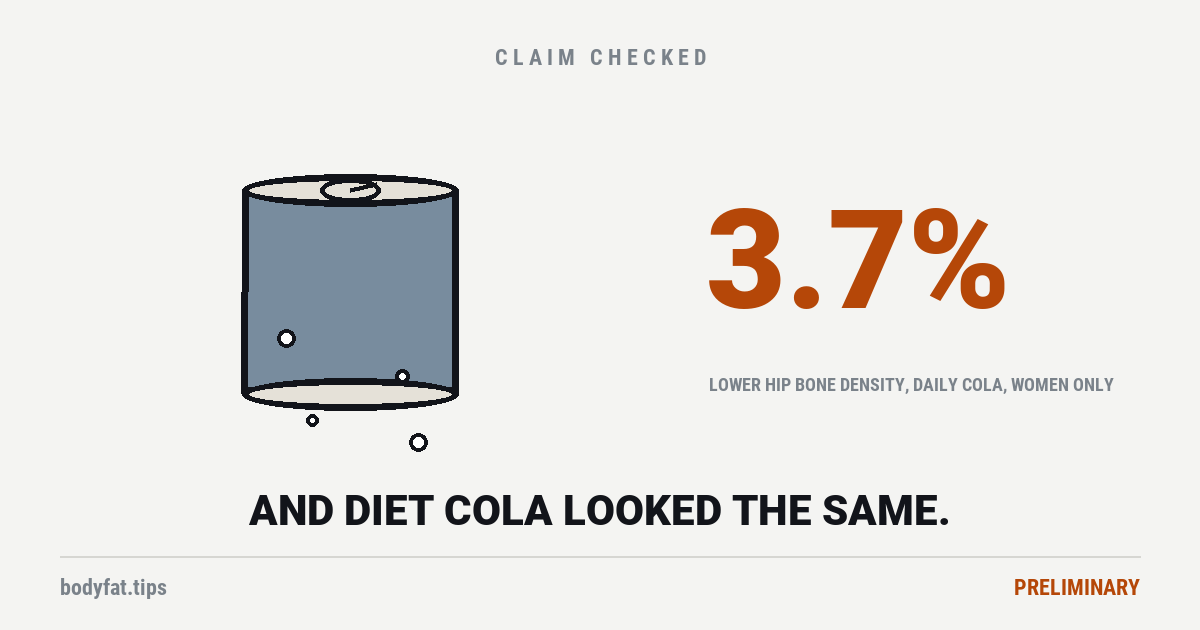
Women drinking cola daily had bone density about 3.7% lower at the femoral neck — the narrow part of the hip that breaks — and 5.4% lower at another hip site, compared with women drinking less than one cola a month [2].
Three details make this more interesting than the usual scare:
It was cola specifically. Other fizzy drinks showed no significant relationship at all [2]. So this is not about carbonation, which is the folk explanation everyone reaches for.
It was the hip, not the spine. And it was women, not men [2].
And diet cola looked the same. The researchers’ sentence is worth having whole, because its second half is the only clue in the paper about mechanism: “Similar results were seen for diet cola and, although weaker, for decaffeinated cola” [2]. Whatever is going on, sugar is not the explanation — which means switching to diet does not buy you out of this one. Hold on to the decaffeinated half. It comes back twice.
How much should that worry you? Genuinely: not much, yet
This is an observational study. It watched what people already did rather than assigning them to drink cola, and that limits what it can tell you about cause.
The obvious rival explanation is displacement: if your daily drink is a cola, it is probably not milk. The researchers tried to handle that by adjusting for total calcium and vitamin D intake, along with body mass index, age, activity, smoking, alcohol, caffeine from non-cola sources and — for the women — menopausal status and oestrogen use [2]. That is a serious attempt, not a hand-wave.
They also tested it head-on, which this page failed to mention and which is worth more than any amount of adjustment: “we saw no significant difference in milk intake by cola consumption group” [2]. The cola drinkers were not milk avoiders. The authors’ own reading is that the pattern “supports the likelihood that this is not due to displacement of milk or other healthy beverages in the diet” [2]. We were being more sceptical than our source, which is the safer direction to get it wrong — but it left a worry standing that the paper had already closed.
But adjustment is never the same as randomisation, and the abstract closes with the line that ought to be in every headline written about them: “Additional research is needed to confirm these findings” [2]. This page said “the authors close with”, which is wrong, and getting it wrong cost you the two sentences the paper actually ends on:
“No evidence exists that occasional use of carbonated beverages, including cola, is detrimental to bone. However, unless additional evidence rules out an effect, women who are concerned about osteoporosis may want to avoid the regular use of cola beverages” [2].
Both halves earn their place and they point opposite ways. Have a cola now and again and the people who did the work say there is no evidence it is doing anything to your bones. Be a woman who worries about osteoporosis and drinks one every day, and the same people, in the same paragraph, suggest you might want to stop. That is a recommendation, and this page had been quoting the shrug instead of it.
So what about the three suspects? Two of them the authors tested. On caffeine they land in a careful double position: caffeine “likely contributes” to lower bone density in general, and yet it is not what happened here, because decaffeinated cola showed the association too, total caffeine intake did not differ between the cola groups, and adjusting for caffeine barely moved the result — all of which, in their words, “suggest that caffeine does not explain these results” [2]. On phosphoric acid, adjusting for the ratio of calcium to phosphorus in the diet also barely moved the result, and the ratio itself was not significant. But they do not drop it, and the reason is worth following: a daily dose of acid arriving with no calcium beside it could do things that a ratio of daily totals would never show. Their sentence is “The role of phosphoric acid on bone loss requires additional investigation” [2]. Cola extract, the third, is the one nobody has studied properly.
Which means this page was pointing at the right can and the wrong pair of culprits. The can really is more than a sweetener. It is just that the two ingredients everybody names are the two the researchers could not pin it on.
Which brings us to the question this page had not asked.
Has anybody tested it since 2006?
This page implied nobody had. Its evidence panel called the bone association “a single cohort”; the line below said the signal was one nobody has yet explained. The second is still true. The first stopped being true years ago, and we should have known.
The big one is the Women’s Health Initiative, published in 2019: 72,342 postmenopausal women, a median 11.9 years of follow-up, 2,578 hip fractures across 700,388 person-years [6]. That is roughly thirty times the number of people in the Framingham analysis.
Its bone-density result is the one that bears hardest on this page, and it is a flat null: “There were no associations between soft drink consumption and hip or lumbar spine t scores” [6]. A t score is bone density written as how far you sit from a healthy young adult’s average — it is the number a doctor reads off a DXA scan. In the largest group of postmenopausal women ever asked this question, soft drinks did not move it.
That is the strongest reason on this page not to worry, and you are owed it plainly. Now do not let it settle more than it can. The WHI asked about soda and split it by caffeinated versus caffeine-free — not cola versus everything else [6]. The Framingham finding is a cola-versus-non-cola contrast, and nobody has repeated that contrast in a cohort anywhere near this size. So the specific claim on this page has not been refuted. It is unrepeated, which is a different and more irritating state of affairs.
The fracture side went the other way, and only at the top of the range. Against women who drank none, the highest-intake group’s risk of a hip fracture ran at a hazard ratio of 1.26, with a range of plausible answers from 1.01 to 1.56 [6]. A hazard ratio of 1.00 means no difference at all, so that range only just clears it. There was no steady climb across the intake categories either, which the authors read as a threshold rather than a dose–response, and their own summing-up puts the line at more than two servings a day [6].
And then the odd bit. Split by type, the signal sat in caffeine-free soda — 1.32, with a range running from 1.00, right on the no-difference line, up to 1.75 — and not in caffeinated soda, 1.16, with a range from 0.86 to 1.57 that comfortably includes no difference [6]. Here is our own observation on that, and it is ours rather than a result either paper reports: neither of these two studies could put it on the caffeine. Twenty years apart, different exposures, different outcomes, and both of them ended up looking somewhere other than the obvious stimulant. That is not proof of anything. It is the one place these papers agree.
The other post-2006 study worth naming cuts against the null, and it needs two fences before you read it. A 2021 meta-analysis pooled the adult studies of sugary drinks and bone and found intake inversely related to bone density, with an effect size of −0.66 (−1.01 to −0.31) across 4,312 adults, and −0.73 (−1.12 to −0.35) for carbonated drinks specifically [7]. An effect size of 0.8 is what researchers call large and 0.2 is barely there, so those are middling. Fence one: that review covered 26 publications and 124,691 people in total, but the pooled bone-density figure rests on the 4,312, not the 124,691 — most of that larger number sat in a review the authors described rather than pooled [7]. Fence two, and it is the one that matters here: its exposure is sugar-sweetened drinks [7]. It has nothing whatever to say about the diet can, which is the can this page is about.
So: a real signal, in a specific place, that nobody has yet explained — and, twenty years on, nobody has repeated either. The largest cohort to come near it found nothing on bone density and a fracture signal only above two drinks a day. The one meta-analysis pointing the other way was measuring sugar. That is what an unresolved finding looks like, and it is why this verdict reads Preliminary rather than a clean yes or no.
One thing we have not checked
Dental erosion. Diet drinks are acidic, and acid erosion of enamel is a different process from tooth decay — decay needs sugar, erosion does not. It is entirely plausible that the diet can is no better on that front.
We have not read that literature, so we are not going to tell you either way. It deserves its own verdict rather than a confident sentence here.
What to actually do
If you are drinking sugary cola, switching to diet is a small real improvement on the thing most people are switching for [1]. Do that.
If you drink cola of either kind every single day, the bone finding is the one worth knowing about — not because it is proven, but because it is the one thing on this page that the diet version does not fix [2].
Two claims, two very different strengths, and it is better to say which is which than to let one label cover both. The swap is the firm end: randomised trials, a moderate certainty grade, a small honest number [1]. That is why this page tells you to do something instead of hedging at you. The bone finding is the loose end: one cross-sectional analysis whose particular contrast nobody has repeated, a cohort thirty times the size that found nothing on bone density, and no mechanism anybody can name [2] [6]. Preliminary is the rating on the whole question — is diet soda bad for you — and the loose end is what keeps the whole question open. If you read that label as a verdict on the swap, it is understating what the trials found.
And if you were hoping this page would tell you diet soda is poison, or that it is completely fine: it is neither, and anyone offering you the clean version of that answer has not read the studies. For the in-vitro scare headlines about sweeteners, see the sucralose verdict.
An independent editorial review on 18 September 2026 found that this page’s central catch had been re-tested and this page had not looked. The evidence panel called the cola-and-bone association “a single cohort”. In 2019 the Women’s Health Initiative reported on 72,342 postmenopausal women followed a median 11.9 years and found “no associations between soft drink consumption and hip or lumbar spine t scores”, with a hip-fracture signal only in the highest intake group, above two servings a day, and in caffeine-free rather than caffeinated soda; a 2021 meta-analysis found sugary-drink intake inversely related to adult bone density. Neither repeats the original cola-versus-non-cola contrast, so the finding on this page is unrepeated rather than refuted — and that is what the page and the panel now say. A second error ran alongside it: we wrote that the bone researchers “close with” a call for more research. That line ends their abstract. Their paper ends by saying there is no evidence occasional cola harms bone, and that women worried about osteoporosis “may want to avoid the regular use of cola beverages”. Both sentences were missing, one of them cuts against how we had framed the section, and both are now on the page. So is the fact, which we had also left out, that the same researchers tested the milk-displacement explanation directly and found no difference in milk intake between cola groups.
And the evidence panel was wrong about the one row a sceptical reader checks. It called the substitution meta-analysis “Academic”. That analysis was commissioned by a European diabetes study group whose guidelines committee had input on all aspects of it, 9 of its 17 included trials carried industry money, and its authors declare grants and fees from the low-calorie sweetener trade — and, cutting the other way, from the sugar trade. It planned to test whether funding source changed the answer and could not, for want of trials. The row now says all of that; the bone study really was USDA- and NIH-funded with no declared conflicts, and that half stands. Four smaller corrections. We printed the moderate certainty grade on the finding that suited our opening and left out the low grade on the water comparison we then argued from — three trials on 429 people, against twelve on 601, with the direction still favouring water and the paper’s own authors calling the two swaps similar. We named phosphoric acid and caffeine as the things a diet can does not fix, when the researchers had tested both and could pin it on neither; the page now reports what they actually concluded, including the third ingredient they suspect and nobody has studied. We described a can as “usually” caffeinated when about half the colas the women in that cohort drank were. And we had answered a safety question out of a WHO document that says in terms it is not a safety assessment, so the page now reports what the EU food-safety regulator found when it re-opened these sweeteners in 2025 and 2026 — and what that does and does not settle. Later the same day, when our aspartame verdict was corrected for the same omission, we added the exception this page also owed its readers: that safety limit does not apply to people with phenylketonuria. The rating is unchanged at Preliminary.
Corrected on 7 October 2026. This page said almost nobody mentions its one finding about diet cola and bone, probably because everyone is too busy arguing about aspartame. We had not checked. In an ordinary web search for this page’s question, three of the ten first-page results we read mention a risk to bone, and one states the cola finding much as this page does. The sentence now says so. The rating is unchanged: Preliminary.