Is Sucralose Bad For You? The DNA Headlines Skipped One Sentence

Europe’s food regulator has now answered this, and the answer is no.
Until today this page opened with “nobody knows yet”. That was a fair paraphrase of the study everyone was quoting when they told you sucralose damages your DNA. It was also the right answer to the wrong date. The regulatory review those authors called for had already happened: the European Food Safety Authority adopted a full re-evaluation of sucralose on 10 December 2025 and published it on 17 February 2026, five months before this page went up, and it looked at the exact impurity the scare was about [2].
Its conclusion, in its own words: “there is no concern for the genotoxicity of sucralose when used as food additive (E 955)”, and the same applies to the impurities built like it [2]. Genotoxic means capable of damaging DNA.
There is one thing EFSA would not sign off, and it is not the one you were worried about. We will come to it.
The headlines in 2023 read like a verdict: chemical found in common sweetener breaks up DNA, may cause DNA damage, cancer, scientists warn. The study is real, it was competently done, and nobody paid the authors to find what they found. It also contains a sentence none of that coverage carried.
What the researchers actually did
A team at North Carolina State University looked at a compound called sucralose-6-acetate — not sucralose itself, but a close relative [1].
It exists because of the way sucralose is made. Sugar is chlorinated into sucralose-6-acetate, and then the acetate group is stripped off to leave sucralose [1] [2]. The impurity is the second-to-last step in the manufacture of its own parent, and some of it can survive into the finished product.
How much survives is the weakest number in this whole story, and this page printed it flat. Up to 0.67% is not something the study measured. It is cited, inside the paper, to an unpublished 2021 analysis of 18 food-grade commercial samples, written for the researchers’ own university department by the director of a commercial mass-spectrometry laboratory [1]. Eighteen samples, no journal, no peer review.
There is now a bigger and more public dataset, and it points the other way. At EFSA’s request, a manufacturer submitted analyses of 59 batches of sucralose made between April 2020 and January 2024. Sucralose-6-acetate was “not detected at an LOD of 1 mg/kg in all analysed samples” [2]. LOD is the limit of detection — the smallest amount the method can see at all. For scale: 0.67% is 6,700 mg per kilogram. One unpublished look at 18 samples found up to 6,700. A regulator’s survey of 59 found less than 1.
Neither of those is a survey of an American supermarket packet, and that is the number a reader here actually wants. EFSA’s samples came from the industry itself, at the regulator’s request, and they are European product. The 18-sample report was commissioned by the people making the case. Nobody has published a survey of US retail sucralose. For what it is worth, Europe’s own rules allow sucralose-6-acetate, counted among a group of related impurities, “at up to 0.5% as an impurity” [2] — so 0.67% would sit outside what Europe permits, and “not detected” sits comfortably inside it.
Then the rats. Dosed with sucralose, they passed sucralose-6-acetate in their faeces at up to 10% relative to the sucralose — another figure this study did not measure and cites to earlier work [1]. Until today this page told you that “suggests your intestine may be making some of it for you”. That is what the paper’s abstract says. It is not what the paper’s own experiment found.
The researchers grew human colon tissue with no bacteria in it, exposed it to sucralose and went looking for the conversion. There wasn’t one: “no apparent conversion of sucralose to sucralose-6-acetate in the RepliGut® System” [1]. Their own reading, in the discussion, is that what happened in the rats “was mediated by bacteria and not host metabolism”, and that acetylating sucralose “may serve as a detoxification mechanism for bacteria” — a way for a microbe to shove a compound back out of its own cell [1]. Not your intestine manufacturing a toxin. Gut bacteria getting rid of something.
EFSA does not grant even that much. Its panel read the rat result as leftover impurity in the dose rather than anything anybody’s body made: the compounds turning up in faeces and urine were “not necessarily an indication of metabolism, but … likely impurities in the administered sucralose” [2].
They then ran that compound past human cells. Two standard genotoxicity screens — a MultiFlow assay and a micronucleus test — both flagged it, and the mechanism was classified as clastogenic, meaning it produces breaks in DNA strands [1].
Both of those ran in the same human cell line, called TK6, and both were carried out by the same contract laboratory [1]. Two assays in one cell line at one lab is not two independent lines of evidence, and this page’s evidence panel called them independent until today. That was wrong. There was a third genotoxicity test at the same lab, and we will get to what it found, because it is the better half of the story.
They also grew human intestinal lining in a system called RepliGut, exposed it, and sequenced which genes switched on. Genes tied to inflammation, oxidative stress and cancer went up. And both sucralose-6-acetate and plain sucralose measurably weakened the gut barrier [1].
One thing about that last sentence, because it changes what you can read into it. The “plain sucralose” was not plain. It was off-the-shelf sucralose from a chemical supplier, and the paper says it “contained 0.5% sucralose-6-acetate … which is consistent with commercial food-grade sucralose” [1]. So that result cannot separate the two compounds. Whatever weakened the barrier, the impurity was in both dishes. The paper is upfront about it. The coverage was not, and neither were we.
All of that is a real result. Now the part that matters.
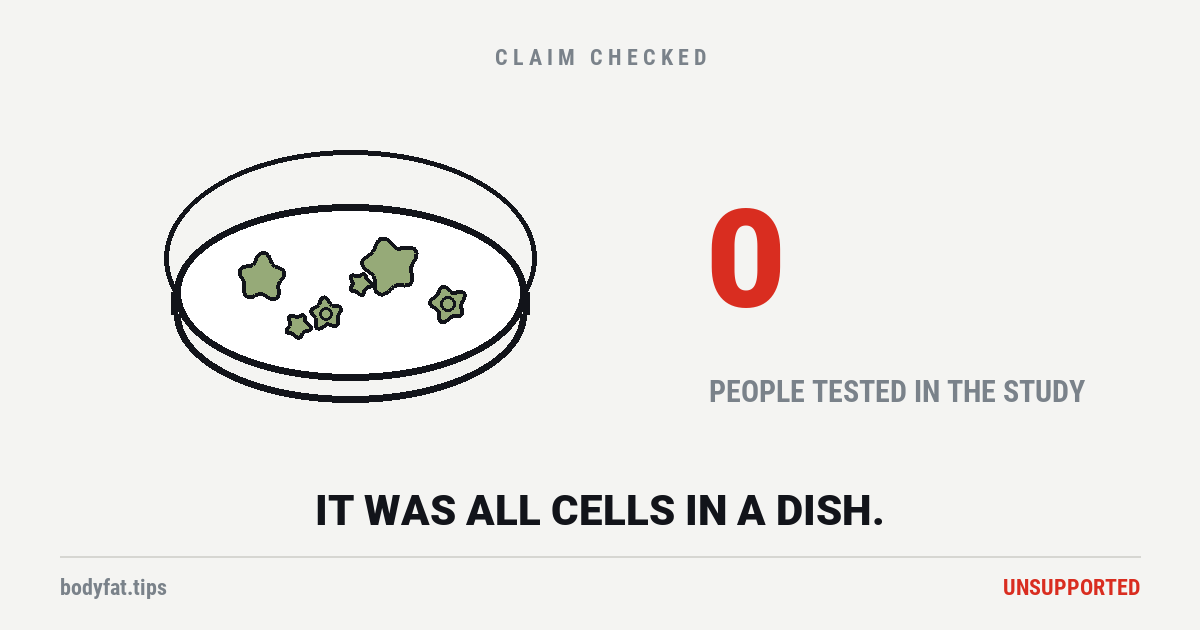
Every one of those experiments happened in a dish
There were no people in this study. No one drank anything. No one was followed for a decade. The human material was cells and cultured tissue in a laboratory [1].
Cells in a dish have no liver. No kidneys. No bloodstream diluting a compound across ten gallons of body. No immune system, no DNA repair operating at the scale it does in a person. A compound that breaks DNA in a well plate may do nothing whatsoever in a human being — and that is not special pleading, it is why in-vitro screens exist. They are a filter for what deserves a proper study, not a substitute for one.
We have watched this exact thing happen on this site before, in the other direction: mouse cells in a dish grew neurites, and the number became a claim about your workout. Same machinery, opposite conclusion, identical mistake.
The sentence that got left out
Here is the paper, word for word:
“The potential adverse health effects of exposure to sucralose-6-acetate are not yet known because this chemical has not been tested individually with a toxicology battery of tests to assess human risks.” [1]
The authors say the health effects are unknown. The coverage said may cause cancer.
And there is a second sentence the coverage skipped. This page skipped it too, right up until today, in the section where it was telling you everybody else skips sentences.
The same paper ran a third genotoxicity test: the Ames test, the classic check for whether DNA damage turns into a permanent mutation that gets copied into every cell after it. Sucralose-6-acetate came back negative. So did sucralose [1]. And here is what the authors wrote about their own positive results in light of that: the DNA damage “may not lead to permanent alterations in further generations of cells because it is not mutagenic” [1].
That is the load-bearing sentence for the thing people were actually frightened of. Cancer is what happens when damage becomes permanent and gets copied forward. A break that gets repaired and leaves no mutation behind is a different event.
EFSA read all three tests and weighed them the way a regulator does, which is worth reporting in full rather than in the half that suits us. Of the positive MultiFlow screen it said “both the assay system and the results were of limited relevance”. Of the negative Ames it said “a test with high relevance” — and, in the same sentence, “with results of limited relevance” [2]. So the regulator did not think much of either experiment. The one whose design it does rate is the one that came back negative.
That is not the researchers overselling. It is the gap between a paper and a press cycle, and it is the single most reliable place to look whenever a study frightens you.
About that “exceeds the safety threshold” line
You may have read that a single daily sucralose drink blows past a safety limit. The paper does say a serving might far exceed something called the threshold of toxicological concern for genotoxicity — 0.15 micrograms per person per day [1].
It is worth understanding what that threshold is, because it is not what it sounds like.
The TTC is a screening level, not a harm level. It is the exposure below which regulators agree a compound can be presumed fine without gathering more data. Cross it and the correct response is “this one needs proper testing”. It is emphatically not a dose at which damage begins — nobody has established such a dose here, which is the entire point of the sentence quoted above.
Reading it as a poisoning threshold would be the same error as the headlines, just wearing a lab coat.
Two things worth knowing before you get angry
The impurity was never hidden. Per this same paper, the manufacturer disclosed sucralose-6-acetate in its Food Additive Petition to the US FDA before approval — stated as 0.8%, under 1.3% [1]. Whatever this study means, it is not the story of a concealed contaminant.
And nobody bought this result. The work was funded by an engineering foundation at a public university, and the authors declare no conflict of interest [1]. On a topic this heavily lobbied from both directions, that is worth saying out loud. It is also why we are not waving the study away.
The review the authors asked for has happened
The paper ends by saying its findings “indicate that a regulatory status review needs to be undertaken” [1]. Fair enough. One was.
The European Food Safety Authority — EFSA, the European Union’s food-safety regulator — adopted a full re-evaluation of sucralose on 10 December 2025 and published it on 17 February 2026 [2]. It is not a summary of this one paper. Its panel pulled 41 studies on the genotoxicity of sucralose and its impurities, graded each one for how reliable it was and how much weight the test deserved, and had this paper in front of it — one of its authors sent the manuscript in to EFSA’s own call for data, and it is listed in the documentation [2].
No genotoxicity concern. In the panel’s words: “there is no concern for the genotoxicity of sucralose when used as food additive (E 955)”, and “based on read-across the same conclusions apply to impurities and degradation products structurally related to sucralose” [2]. Read-across means judging one chemical from what is known about its close structural relatives. That is a judgement rather than a measurement, and it is worth knowing that is what carries the impurity here. On the impurities as a group the panel was direct: “there is no concern for their genotoxicity” [2].
The safe intake did not move. The panel saw no reason to revise the acceptable daily intake — the amount regulators reckon you could eat every day for life — of 15 mg per kilogram of bodyweight per day, found that estimated real-world intakes do not reach it, and concluded there is “no safety concern at the reported uses and use levels of sucralose (E 955)” [2].
And a modern test battery says the same about the sweetener itself. In August 2026 a set of genotoxicity studies run to international test guidelines under Good Laboratory Practice — an Ames test, micronucleus tests in cells and in animals, a comet assay, a transgenic mouse mutation assay and one more — concluded that “commercial-grade sucralose is non-genotoxic” [5]. Two things about it, in the same breath as the finding. It was written by employees of Tate & Lyle, which makes sucralose, with consultants to the same company [5]. And one of its assays did show DNA damage: the comet assay found it in several tissues, which the authors report was “complicated” by problems in their own control samples [5]. They said so, which is to their credit, and it is the reason a battery is read whole rather than by its title.
What EFSA would not sign off
Here is the part that is still open. It is narrower than the scare, and it is more interesting.
A company had applied to extend sucralose’s permitted use into energy-reduced and no-added-sugar fine bakery wares — cakes, pastries, biscuits — at up to 700 mg per kilogram [2]. EFSA would not sign it off. On “the identified uncertainties regarding the potential formation of chlorinated compounds under the wide range of baking processes”, the panel “could not conclude on the safety of the proposed extension of use” [2].
Think about what sucralose is. It is a sugar molecule with chlorine atoms bolted onto it, which is why it goes through you instead of being used as fuel. What high heat does to those chlorine atoms is a separate question from what the intact molecule does, and across the whole range of industrial baking it is not a settled one.
Then EFSA said something that lands closer to a kitchen than a factory. It recommended the European Commission look at “the issue of potential formation of unwanted degradation products during the preparation of home-made products using sucralose during domestic uses that require high temperature such as frying and baking” [2]. It also asked for the EU specifications for sucralose to be revised, including separate limits for two named chlorinated impurities [2].
Now the calibration, because it would be very easy to turn that into a fresh scare and it does not support one. There is a specific compound in this corner of the argument — a chlorinated furan-3-one, which forms when dry sucralose is heated in sealed tubes. EFSA looked at it and reported that it “has not been detected under cooking (baking) conditions”, that “the experimental conditions under which it forms do not reflect food processing”, and that “therefore, this finding is not considered to raise a safety concern” [2]. In the same breath it records that no genotoxicity data on that compound were found at all [2], which is a data gap rather than a result.
So here is the honest shape of the only live question. It is a regulator declining to tick a box on industrial baking it has not seen enough data about — not a hazard anybody has measured in a cake, and nothing whatever to do with your diet soda. If the Commission acts on it, or a study closes it, this page will say so.
What to actually do
If you drink the occasional diet soda, nothing here tells you to stop.
This page used to justify that with “there is no human evidence of harm”, which is a far bigger claim than we had any business making. The accurate version comes in three parts.
On the DNA question there is no human study at all. Nobody has given sucralose to people and gone looking for DNA damage. That is still true, and it is why the argument about dishes matters.
On cancer, humans have been studied a great deal. A 2025 systematic review went through 90 epidemiological studies covering 17 types of cancer and found “no consistent associations” and no dose–response — no sign that the people consuming more sweetener got more cancer [3]. Who paid for that review matters, and we are not going to bury it at the bottom: the American Beverage Association funded it, and its authors are employed by the ABA or by consultancies working for it [3]. It is the largest count of human studies anybody has assembled on this question, and it was assembled by the industry with the most to gain from the answer. Both halves of that are true.
And sucralose is not inert in people. A randomised trial split 120 healthy adults into six groups of 20 for two weeks: four groups took sweetener sachets at doses below the accepted daily limit, one of them sucralose, one took sachets of the sweeteners’ glucose filler alone, and one took nothing. Sucralose and saccharin “significantly impaired glycemic responses” [4] — in those two groups, blood sugar handled a sugar load worse than in both control groups, and which volunteers it happened to tracked their gut bacteria. That is a different question from DNA and a different question from cancer. It is also a real human result, and it belongs in any honest sentence about what humans show.
If you were already minded to cut back, that is your call and nothing here argues against it. But the reason this page used to give for it — that the question is unresolved and the regulatory review the authors asked for is still outstanding — is not a reason any more. The review happened. It is the section above, and it went the other way.
What we would not do is switch back to sugar over this. The evidence that sugary drinks cause problems is vastly stronger than anything in this paper, and there are randomised trials of that swap — sugary drink for sweetened one — which come out in the sweetened drink’s favour by a small margin. We rate that question Preliminary on its own page, and this page previously called it “the closest thing to a settled answer in the whole sweetener argument”, which oversold our own work.
And the transferable habit: when a study makes you afraid, find out whether anybody in it was a person.
An independent editorial review on 18 September 2026 found that this page had told readers a question was open five months after the regulator closed it — and that it had dropped a sentence from its own source while accusing the press of exactly that. The page opened with “nobody knows yet” and said the regulatory review the study’s authors called for was still outstanding. The European Food Safety Authority adopted a full re-evaluation of sucralose on 10 December 2025 and published it on 17 February 2026, five months before this page went up. It concluded there is “no concern for the genotoxicity of sucralose when used as food additive (E 955)”, applied the same conclusion to its structurally related impurities, left the acceptable daily intake alone — and reported that sucralose-6-acetate was not detected at all, down to 1 mg/kg, across 59 batches of sucralose made between 2020 and 2024. This page’s one concrete number for what is in your packet, up to 0.67%, turns out to be cited inside the paper to an unpublished analysis of 18 samples written for the researchers’ own department. Both numbers are now on the page with their sources named, and so is the limit on both: nobody has surveyed a US retail packet.
Four more, and one of them is the sentence this page exists to complain about. The paper ran a third genotoxicity test, the Ames test, which checks whether DNA damage becomes a permanent mutation. Sucralose-6-acetate came back negative, and the authors wrote that the damage they saw “may not lead to permanent alterations in further generations of cells because it is not mutagenic”. That was missing from a page headlined on a missing sentence, and it is now beside the quote it belongs with, along with EFSA’s grading of all three assays — which is unflattering to both of them. The evidence panel called two assays “independent”; they were two assays in one cell line at one contract laboratory. We told you the rat result “suggests your intestine may be making some of it for you”, which is the paper’s abstract rather than the paper: its own experiment on human colon tissue found “no apparent conversion”, its discussion attributes the change to gut bacteria rather than to you, and EFSA reads the rat result as leftover impurity in the dose. And “there is no human evidence of harm” was an absolute we had no business printing: there is no human study of the DNA question, there are 90 observational studies of sweeteners and cancer that found no consistent link, and there is a randomised trial in which sucralose measurably worsened blood-sugar responses. Two of the reassuring sources are industry-funded, which the page now says where it uses them. The rating has changed with the finding, from Preliminary to Unsupported: on the claim that sucralose damages your DNA and may cause cancer, we looked, and it is not supported. What is still open — what baking with sucralose forms, which EFSA would not sign off — now has a section of its own.
One trial’s design was misdescribed here, and was corrected on 23 October 2026 after an independent editorial review of a related page. This page said a randomised trial gave 120 healthy adults sweetener sachets, and that the volunteers’ blood sugar handled a sugar load worse than the control group’s. The trial had six groups of 20: 80 people took sweetener sachets, 20 of them sucralose; 20 took sachets of the glucose filler alone; and 20 took nothing. The worse response was in the sucralose and saccharin groups, measured against both control groups. The page, its source entry and its evidence panel now say so. The rating is unchanged.