Are Artificial Sweeteners Bad For You? The WHO Hedged — Here’s Why

Probably not. But this is the rare case where we are going to hand you a shrug rather than an answer, and then show you exactly why the shrug is the honest position.
You have likely seen the headline: the WHO says don’t use artificial sweeteners. That is real. It is also one of the most misreported documents in nutrition, and the misreporting is in the footnotes rather than the headline.
What the WHO guideline actually says
Here is the recommendation, word for word: “WHO suggests that non-sugar sweeteners not be used as a means of achieving weight control or reducing the risk of noncommunicable diseases (conditional recommendation)” [1].
Two things in that sentence do a lot of work.
“Suggests”, not “recommends”. And “conditional” — which in guideline language is a specific technical grade, not modesty. It means the committee was not confident the benefits outweigh the harms, and that different people could reasonably decide differently on the same evidence.
Why so cautious? The document says it outright: “The recommendation is based on evidence of low certainty overall” [1].
Low certainty is also a formal grade. It means further research is likely to change the estimate. This is not a settled finding being announced; it is a cautious call made on thin evidence, and the WHO is transparent about that in the same paragraph the headlines were written from.
The part that got cut entirely
Buried in the same rationale is a sentence that flatly contradicts the popular reading.
“NSS use in any manner resulted in reduced sugars and energy intake, lower body weight and lower BMI in short-term randomised trials” [1].
So the WHO’s own review found that in controlled trials, sweeteners worked. The catch is duration: most of those trials ran three months or less, and the handful lasting six to eighteen months did not show a lasting effect on body weight [1].
Which is a genuinely useful thing to know. It is not the same thing as “bad for you”.
So where does the harm signal come from?
Observational studies — the kind where researchers watch large groups of people over years and record who develops what. Those studies found higher rates of type 2 diabetes, cardiovascular disease and death among heavier users of sweeteners [1].
That sounds damning until you ask the obvious question: who reaches for diet drinks in the first place?
People who are already worried about their weight. People who have just been told their blood sugar is creeping up. People whose doctor has had a word. The sweetener did not arrive first — the problem did.
This is called reverse causation: the thing you think is the cause is actually the consequence. It is the single most common way a population study gets misread, and it produces exactly this picture — a group of people who look sicker precisely because they were already sicker when they switched.
And here is the part that should have made the headlines. The WHO names it itself, as its reason for hedging: “the possibility that reverse causation may have contributed to one or more of the associations observed… a conservative approach was taken, leading to a conditional recommendation” [1].
The organisation everyone quoted as saying sweeteners are dangerous wrote down, in the same document, that the arrow might be pointing the other way.
Meanwhile, the swap people actually make
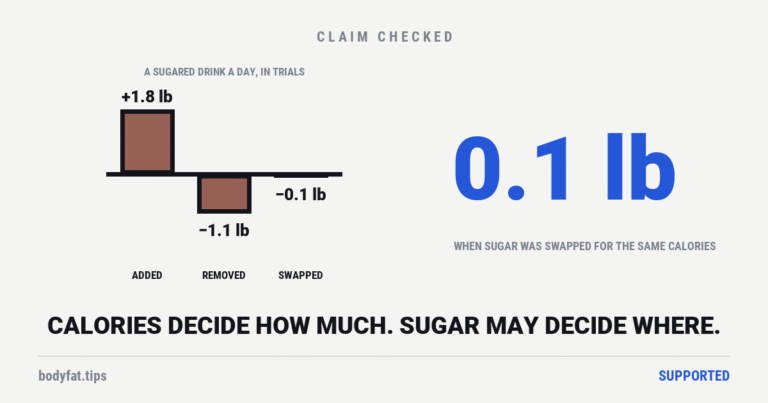
Almost nobody adds sweeteners to an otherwise sugar-free diet. They swap: regular cola becomes diet cola. So what happens when you study that specific exchange?
A 2022 analysis pooled 17 randomised trials covering 1,733 adults and looked at substitutions rather than sweeteners in the abstract [2].
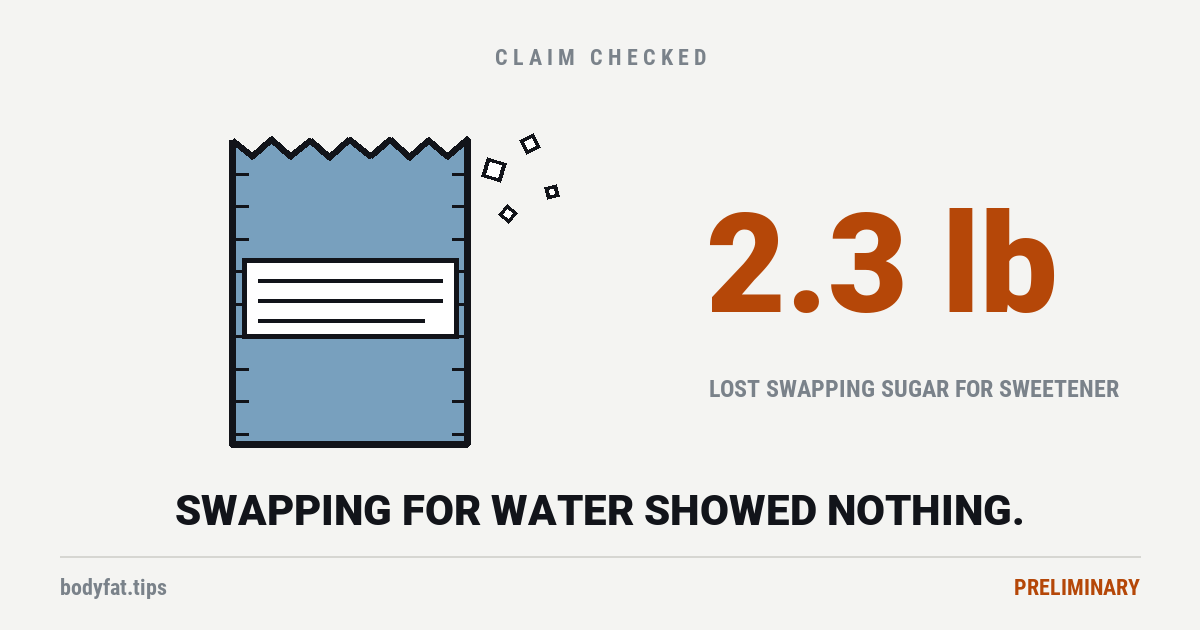
Swapping sugary drinks for sweetened ones: down 2.3 lb (1.06 kg), with body fat down 0.60 percentage points and less fat in the liver [2]. And the certainty grade on that weight finding was moderate — a step above the “low” the WHO applied to its overall judgement.
Now the result nobody expects.
Swapping sugary drinks for water was “not associated with any outcome” [2].
Read that twice. In these trials, replacing your Coke with a Diet Coke did something measurable. Replacing it with water did not. That is the opposite of the advice everyone gives, including the advice we would instinctively give, and it is why we are not going to pretend this is simple.
Be careful how far you carry it, though: these were adults with overweight or obesity who were at risk for or already had diabetes, three-quarters of them women [2]. It is not a finding about everyone, and “water does nothing” is not a sentence any sane person should build a diet on.
Two things worth knowing about definitions
The WHO recommendation does not apply to people with diabetes. That exemption is written into the guideline [1], and it is routinely dropped from coverage aimed at exactly those readers.
And sugar alcohols are not included. The guideline covers acesulfame K, aspartame, advantame, cyclamates, neotame, saccharin, sucralose and stevia. Erythritol, xylitol and the other polyols are outside it entirely, because they are sugar derivatives that contain calories [1]. If a product is sweetened with erythritol, this guideline has nothing to say about it.
What to actually do
If you drink sugary drinks and want to stop, the trial evidence says switching to sweetened versions is a real, small win, and the WHO’s own review agrees on the short term [1][2].
If you are already drinking four diet colas a day and wondering whether you have been poisoning yourself: on this evidence, no. The harm signal is observational, graded low certainty, and comes with a reverse-causation warning attached by the people who published it.
If you want the safest available position, it is the boring one that nobody clicks on: fewer sweet drinks of any kind. Not because sweeteners are dangerous, but because that is the one recommendation no reading of this evidence argues against.
And when a guideline makes the news, read whether it says conditional. That word is doing more work than the headline above it.