Is Running Bad for Your Knees? For Recreational Runners, No. That It Protects Them Is Less Certain.

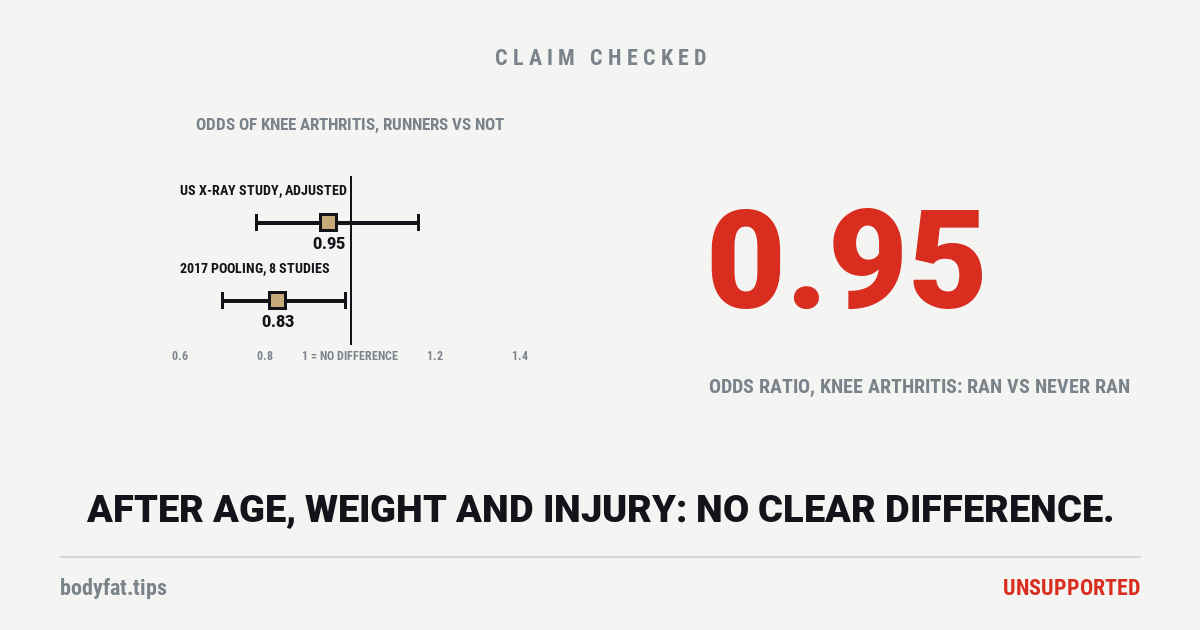
Short answer: no, not for recreational runners, by the studies that have measured it. In studies that compared thousands of people who run with people who do not, the runners did not have more knee arthritis. In a US study that X-rayed the knees of 2,637 adults, a small difference in the runners’ favour shrank to one chance could explain once age, weight and past knee injuries were allowed for [1]. In a 2017 pooling, the pattern held across eight studies of recreational runners’ knees [2].
Two things that answer leaves out. A career of elite or competitive running is a less clear story. And the newer line, that running is actually good for your knees, goes further than the evidence does. Both are below, and so is who the studies were done on: if you already have knee pain, arthritis or an old knee injury, that section is the one to read.
This is journalism, not medical advice. If your knee hurts, swells or gives way, that belongs with a doctor or a physiotherapist, not with a web page.
The claim, and who is making it
“Many people believe running wears out cartilage and leads to arthritis,” says the description of a video posted on 28 September 2025 by a physicians’ explainer channel run by two orthopaedic surgeons, which asks whether the idea is “one of the biggest myths in health”. The video, “Is Running Bad for Your Knees… or Actually Good?”, had 328,442 views when we checked [3]. It argues against the claim, and it links four papers. We read all four, and the studies they draw on.
The question is asked about 3,600 times a month in the United States as “is running bad for your knees”, and about 140 times a month as “does running cause arthritis” (from a paid keyword database, pulled 10 October 2026) [4]. A word first. Osteoarthritis, the kind of arthritis this is about, is the slow breakdown of a joint: the smooth cartilage that caps the bones thins, the bone underneath changes, and bony spurs grow at the edges. On an X-ray it shows as the gap between the bones narrowing and those spurs appearing.
Will jogging damage my knees?
The experiment that would settle it outright is one we could not find: take a few thousand people, tell half of them to run for twenty years and the other half not to, and X-ray everyone at the end. The 2017 review the video links says so in plain words: “No study of this kind exists, and it would be extremely difficult to perform” [2]. We searched for one too and found none [5]. So everything here comes from studies that watched people who chose for themselves whether to run. Keep that in mind; it matters later.
Here is what those studies found.
| Study | Who | What was found |
|---|---|---|
| United States, 2017 [1] | 2,637 adults averaging 64, with knee arthritis or at risk of it; 778 had run at some point in their lives | Arthritis on X-ray in 53.5% of runners and 58.8% of people who never ran; after allowing for age, sex, weight, other activity and past knee injury, an odds ratio of 0.95, with a range of 0.78 to 1.16 [1] |
| Stanford, 1984 to 2002 [6] | 45 runners and 53 non-runners aged 50 to 72 at the start, X-rays for 18 years | Knee arthritis at the end in 20% of runners and 32% of non-runners, a gap that could be chance; severe arthritis in 2.2% and 9.4%, likewise [6] |
| Framingham, about 9 years [7] | 1,279 adults averaging 53, many of them overweight; knees with arthritis at the start were left out | Jogging was not linked to more or less knee arthritis, including in the heavier half; the authors conclude that recreational exercise “neither protects against nor increases risk of knee OA” [7] |
| A 2017 pooling of 8 studies [2] | 1,456 recreational runners and 3,520 non-runners | An odds ratio of 0.83 for knee arthritis, with a range of 0.70 to 0.99; the biggest study in it is the first row of this table [2] |
The 2017 review gathered 25 studies and pooled 17 [2]. For the knee on its own, in recreational runners, it found an odds ratio of 0.83. An odds ratio compares the odds of having arthritis in one group with the odds in another: 1 means no difference, and 0.83 means the runners’ odds were about 17% lower. The range the true answer probably sits in ran from 0.70 to 0.99, so “lower” only just clears the line [2]. The review’s own authors add the warning that matters most: “it was not possible to determine whether these associations were causative or confounded by other risk factors, such as previous injury” [2].
The biggest study inside that pooling is the US one in the first row of the table; the video links it too, and it is worth reading on its own [1]. It asked 2,637 adults, averaging 64, which activities they had done through their lives. Before anything was allowed for, the runners had a little less arthritis on X-ray than people who had never run. After age, sex, weight, other activities and past knee injuries were allowed for, the odds ratio was 0.95, with a range of 0.78 to 1.16: no difference either way that the study could detect [1]. The runners did report frequent knee pain less often, 35.1% against 41.1%, a difference that held after the same adjustments [1].
The other review the video links, also from 2017, came out more cautiously. Looking at 15 studies, its authors concluded “it is not possible to determine the role of running in knee OA”, because the two best studies disagreed: one found no difference, one, in former elite orienteers (runners who race across country with a map), found more [8]. Its one pooled result, fewer knee operations among runners, rests mostly on a single study of unadjusted counts, and its authors advise caution with it [8].
Where the famous 3.5% comes from
If you have read about this before, you may have seen the headline numbers from the 2017 pooling: knee or hip arthritis in 3.5% of recreational runners, against 10.2% of non-runners [2]. They are in the review’s summary, and the same idea sits in Google’s AI answer, which says runners have “a significantly lower rate” of knee and hip arthritis [4]. So we opened the list of studies behind the 3.5% and found the biggest one.
It is a study of 74,752 runners, and its comparison group is not people who did not exercise: it is 14,625 walkers [2] [9]. The runners averaged 46 (men) and 40 (women); the walkers averaged 61 and 52. The review lists the comparison as “not adjusted” and notes that the walkers were older [2]. The arthritis was any kind people reported a doctor had diagnosed, anywhere in the body, not knees on an X-ray [9]. By our count, that one study supplies 74,752 of the 83,939 recreational runners in the 3.5% figure, about 89%. Arthritis rises with age, so a comparison of runners with walkers 12 to 15 years older tilts towards the runners whatever running does to knees. That is why this page leads with the knee-only figure and the adjusted US study instead.
The 2023 review the video links has a problem of its own. Its headline, that knee pain was significantly more common in non-runners, adds up counts across studies, and its largest row gives the US study’s non-runners a knee-pain rate of 58.8% [10]. The US study’s own tables give 41.1% for knee pain; 58.8% is its figure for arthritis on X-ray [1]. That is our reading of the two papers side by side. With the right number the gap is smaller, though the US study’s own adjusted result still found less knee pain among runners [1].
None of this turns the answer round. It sizes it. The honest version is “no sign of more arthritis in recreational runners”, not “runners get a third as much”.
What a study of people who chose to run can and cannot show
Ask what kind of person is still running at 60, and the problem appears. Someone whose knees ache on every run tends to stop. Heavier people run less: in the US study, 35.1% of the lightest third had ever run, against 25.0% of the heaviest third [1]. So a group of long-term runners is partly a group of people whose knees, and weight, let them keep running. The US study’s authors say it themselves: “people chose whether or not they wanted to run; therefore there is always the possibility that people stopped running because they had knee pain” [1].
That cuts one way more than the other. It can make running look better for knees than it is. It is much harder to see how it could hide a large harm: if running wore knees out, the people who ran for decades and stopped would still carry the damage, and in the US study, people who had run when younger and stopped had arthritis on X-ray in 54.3%, against 58.8% of people who had never run (after adjustment, an odds ratio of 0.98, with a range of 0.78 to 1.25) [1]. The long-follow-up studies point the same way. At Stanford, runners over 50 were X-rayed for 18 years [6]; in the Framingham study, 1,279 adults were followed for about nine [7]. Neither found more knee arthritis in the people who ran.
Is running 3 miles a day bad for the knees?
Three miles a day is 21 miles a week (34 km). Most of the studies that looked at distance found no sign that more miles meant more arthritis in runners who were not elite athletes. One found a rise, in one group of people, and it comes first.
At a preventive-medicine clinic in Dallas, 16,961 patients aged 20 to 87 were followed for an average of about 10 to 11 years [11]. Among men under 50, those running 20 or more miles a week were diagnosed with arthritis of the hip or knee about 2.4 times as often as the study’s comparison group, which the parts of the paper we could read do not describe, after allowing for weight, smoking, alcohol and caffeine. That figure is a hazard ratio, which compares how often something happens to two groups over the same stretch of time; the range the true answer probably sits in ran from 1.5 to 3.9 [11]. Three miles a day, 21 miles a week, falls in that top group. In women, and in men over 50, the study found no clear link [11] [2].
Three things limit it. The arthritis was what people said a doctor had diagnosed, with hips and knees counted together. Past joint injuries were not allowed for. And the 2017 review that pooled it describes its top group as walking or jogging more than 20 miles a week [11] [2]. A later analysis of 5,284 of the same clinic’s patients, followed for an average of 12.8 years, took past joint injury and surgery into account and found no link between weekly mileage and hip or knee arthritis among walkers and runners [12].
A 2023 pooling of nine studies split runners by weekly distance [13]. By its published summary, runners covering 20 to 30 miles a week (32.2 to 48 km), which is where three miles a day sits, had an odds ratio of 1.04 against people running less than 5 miles a week, with a range of 0.48 to 2.31: no detectable difference. Those running more than 30 miles had 0.62, range 0.35 to 1.10, and those running 5 to 20 miles had 1.17, range 0.77 to 1.80. Every range includes 1 [13]. Three cautions. Its charts include three studies of people who had raced at elite or serious competitive level: former elite women in its 5-to-20-mile group, men who had raced in the 1950s in its over-30-mile group, and former elite men in its overall figure [13]. The authors rated most of the studies at high or very high risk of bias, and the review’s overall figure differs between its summary (0.97) and its own chart (0.86); we could read the summary and the charts, not the text, so we cannot say which analysis each is [13].
The 74,752-runner study, for all its faults as a comparison with walkers, is useful inside its own runners [9]. Against those running the least, people covering roughly 15 to 23 miles a week (our conversion of its units) reported 16% less arthritis of any kind; once body weight was allowed for, the drop across all the higher-distance groups together shrank to 8.6% and could no longer be told from chance [9]. The number of marathons people ran was unrelated to arthritis [9]. The study counted 863 people running 60 miles a week or more, and its author reports finding no evidence that running raised the risk [9].
Two surveys of marathon runners found the same. Among 3,804 people entered in the Chicago Marathon, weekly mileage, number of marathons and years of running were not linked to arthritis; what was linked was a past knee or hip injury, surgery, family history, age and body weight [14]. A survey of 675 runners who had each finished at least five marathons found the same risk factors and no link to how much they ran [15]. Both surveyed people who were still running, which is the selection problem above in its purest form: they can show that heavy mileage does not rule people out, not that it does no harm to anyone.
What about elite and competitive runners?
Here the answer is less tidy, and it is where the worry came from. In 1996 a London study X-rayed 81 women who had competed at elite level, 67 of them middle- and long-distance runners and 14 tennis players, and compared them with 977 women from the same area [16]. After allowing for height and weight, the former athletes had about three and a half times the odds of bony spurs at the knee, called osteophytes, both in the main knee joint and behind the kneecap. Narrowing of the gap in the main knee joint was not clearly different (odds ratio 1.17, range 0.71 to 1.94); the odds of narrowing behind the kneecap were about three times higher (2.97, range 1.15 to 7.67) [16]. In the same study, 22 women from the comparison group who reported years of vigorous weight-bearing exercise had risks similar to the former athletes’, which led its authors to suggest that how long people train matters more than how often; 22 women is a small group [16].
In Finland, X-rays of 117 former top-level male athletes found knee arthritis in 14% of the runners, against 3% of shooters, 29% of soccer players and 31% of weightlifters [17]. The 2017 pooling put competitive runners’ knee odds at 1.16, with a range of 0.86 to 1.57, which includes no difference [2]. It also found that every study of people who had run for more than 15 years was a study of competitive runners, so it could say nothing about recreational running for that long [2].
So: small studies, mostly of men, mostly decades old, and they conflict. That is the definition of a preliminary finding, and it is rated that way at the bottom of the page.
What’s the worst sport for your knees?
A 2017 review of sports and knee arthritis found it about as common overall in people who played sport as in people who did not, 7.7% against 7.3% [18]. The sports that stood out were soccer (odds ratio 3.5), competitive weightlifting (6.9), wrestling (3.8) and elite long-distance running (3.3), mostly from small studies of former elite men [18]. Its authors also noted that the link between sport and knee arthritis showed up in studies published before 2000 and was not seen in those published after [18].
What the high-risk sports have in common, on our reading, is twisting, landing, collisions and the knee injuries that come with them. In the Finnish study, a past knee injury multiplied the odds of arthritis by 4.7, and playing soccer by 5.2 [17]. The reviews we read do not rank sports as a league table, and we would not trust one that did. Our one-line answer, and it is ours: the sports that hurt knees most are the ones that injure them.
Is running actually good for your knees?
This is where the story has overshot. Ask Google whether running is bad for your knees and its AI answer says that “medical research shows it can actually protect joint health”, and that regular running makes knee cartilage “grow thicker” [4]. A 2026 review calls recreational running “a safe, chondroprotective intervention”, meaning one that protects cartilage [19]. What does the evidence actually show?
On arthritis: fewer cases among runners in pooled counts, which shrink when age and weight are allowed for, as above [2] [1] [9]. In the study of 74,752 runners, about 45% of the runners’ lower arthritis rate was explained by their lower body weight, by the author’s own estimate [9]. Less knee pain among runners held up after adjustment in the US study [1]. All of it comes from people who chose to run.
On cartilage: right after a run, knee cartilage gets a little thinner. A 2023 review of 24 scanning studies found thickness and volume down by 3.3% to 4.9% immediately after running, with the water-sensitive MRI reading back to normal within about an hour and a half; the review rated its own certainty very low [20]. That is cartilage doing what a sponge does: squeezed under load, refilling after. A 2022 review of 43 studies found these changes did not last, and moderate evidence that running does not create new damage [21].
Over weeks, the one randomised trial we found that scanned the cartilage points the other way from the “grows thicker” claim. In China, 120 healthy students were assigned to 12 weeks of running, cycling, swimming, brisk walking or nothing; total knee cartilage volume fell 2.2% in the runners and 1.5% in the cyclists, and did not change significantly in the other groups [22]. We read it only as a summary. A second randomised trial of 12 weeks, in 44 healthy men split into four groups (running, cycling, swimming or none), measured something else: a cartilage protein that rises in the blood when the joint is loaded. After the running training, a 30-minute walk no longer raised it, which its authors read as the cartilage adapting [23]. We read that one as a summary too. A scan study of 82 first-time marathoners found some signs of damage improving after the race, in the bone under the cartilage, and a cartilage score behind the kneecap getting worse, with no significant change in symptoms [24]. Studies that scan people once are split: in one Czech group of 1,164 adults, people running 3.7 to 12.4 miles a week (6 to 20 km) had healthier-looking cartilage readings than both non-runners and the highest-distance runners [25]; in another, runners had less healthy-looking readings in parts of the knee than non-runners, with no significant difference in cartilage shape or knee function [26].
So “running is good for your knees” has early, mixed evidence in its favour: the pain findings, and a hint that moderate runners’ cartilage looks better on a scan. It has not been shown to protect against arthritis, and the claim that it thickens cartilage has a small trial against it. It is rated Preliminary below.
Then why don’t runners’ knees wear out?
This section is the desk’s own reasoning, and it is labelled as such. The question is fair. Running loads the knee far harder than walking, and the “wear and tear” picture says more load means more wear. Yet the studies keep failing to find it. Here are three answers, each rated.
Answer one: runners take fewer, longer steps. In a laboratory study of 14 adults, the peak force through the knee was about three times higher running than walking, 8.02 against 2.72 times body weight, but the load per metre travelled was about the same, 0.80 against 0.75, because a runner covers ground in far fewer steps [27]. That is measured in 14 people over minutes. That it explains anything over years is a surmise.
Answer two: cartilage is not tyre tread. It squeezes and refills, as the scanning studies show [20] [21]. This is measured for a single run. What repeated running does over months is not settled: one small trial found volume going down, not up [22], and another found a blood marker change its authors read as the cartilage adapting [23].
Answer three: knees choose runners. The people still running at 60 are the ones whose knees let them, and runners weigh less, which on its own lowers the risk [1] [9]. This is a surmise with two measurements on its side: runners’ lower weight explained a large share of their lower arthritis in the biggest study [9], and the US study’s authors name the stopping effect as a possibility [1]. It would make running look kinder to knees than it is; it would not hide a large harm.
Put the three together and here is what we think, stated plainly so you can disagree with it: a knee is not a tyre with a fixed number of miles on it, and the things that wear one out are injury, weight and age, not jogging.
What we could not find, and would like to: a trial that assigns adults to run or not for years and scans their knees. Two efforts come closest. A University of British Columbia study gave 74 runners, most of them with knee arthritis, 12 weeks of increased running and measured their cartilage; it finished in October 2024, and we found no results on its registry entry or in print [28] [5]. Its starting scans have been published [29]. The same university has registered a follow-on, not yet recruiting when we checked: 80 new runners aged 35 or over, with and without knee arthritis, six months of running and cartilage scans before and after, comparing people with and without arthritis rather than runners with non-runners [30]. And an Australian study is following 214 runners, half of them after knee surgery, for ten years, with knee scans at four and ten [31]. If you know of a result we missed, the corrections line on this site is open.
Is running bad for your knees as you get older?
The studies here are mostly of middle-aged and older people already. The Stanford runners were 50 to 72 when they started and were followed for 18 years [6]. The US study’s participants averaged 64 [1]. A 2022 review of five studies of runners and non-runners averaging 59 found no significant difference in arthritis between them [32]. Age itself raises the risk; in the Chicago survey, each year of age raised the odds by about 8% [14]. In these studies, the older runners did not have more arthritis than the older non-runners. They tell you little about someone who starts running for the first time at 70.
Is running bad for your knees when overweight?
Body weight is a strong risk for knee arthritis whether or not you run. In the Chicago survey each extra point of body mass index (BMI, weight relative to height) raised the odds by about 10% [14]. In the 74,752-runner study each point raised the risk by about 5% [9]. In a Czech scan study, adults with obesity had more abnormal cartilage than either runners or non-runners [26].
Whether running adds to that risk in heavier people has been looked at less. In Framingham, people in the heavier half, whose average BMI was over 30, had no increase in risk from jogging or other activity [7]. In the US study, the link between running and arthritis did not differ by body weight [1]. Neither was a trial, and the authors of the 2017 review wrote that it “still remains unclear whether prescribing running in the overweight/obese patient with an additional high-impact occupational workload and previous injury is safe for joints” [2]. We do not rate this one. If you are heavier and starting out, build up gradually, and if your knees hurt, see a physiotherapist; our weighted vest verdict gives the same advice for strapping on extra load: start lighter, because muscle and joint complaints showed up in its trials.
Is running bad for your knees after ACL surgery, or after a knee injury?
This is the group the reassuring studies cover least, and the one with the most reason for care. A serious knee injury is itself one of the biggest risks for arthritis: a 2019 review of 53 studies found the odds of knee arthritis about four times higher after an anterior cruciate ligament (ACL) injury, the ligament inside the knee most often torn in sport, with odds ratio 4.2 and a range of 2.2 to 8.0, and about six times higher after a meniscus injury [33]. Among Chicago marathon runners, a past injury that had stopped them running multiplied the odds of arthritis by 5.0, and past knee or hip surgery by 5.9 [14].
We found no study that has reported whether running after an ACL reconstruction adds to that risk over the years [5]. The Australian study above is following 108 runners who have had knee surgery, most of them ACL reconstruction, alongside 106 who have not, with scans at four and ten years [31]. Until its scans report, the decision belongs with your surgeon or physiotherapist, who can see your knee.
If you already have knee arthritis, can you run?
The evidence is thin but not alarming. In the US Osteoarthritis Initiative, 1,203 people over 50 with knee arthritis were followed for four years; the 11.5% who ran by choice were no more likely to see their X-rays worsen (odds ratio 0.9, range 0.6 to 1.3) or to develop new frequent pain (0.9, range 0.6 to 1.6), and were more likely to report that frequent pain had gone, though only just clear of chance (1.7, range 1.0 to 2.8) [34]. The authors point out that people who run with arthritis probably run as their knees allow [34].
We found one small randomised trial. In China, 131 people with early knee arthritis were assigned to rest, slow walking, brisk walking or jogging (30 minutes, five times a week, at 3.7 to 4.7 mph, or 6.0 to 7.5 km/h) for six months [35]. Side effects such as soreness and joint popping were not significantly more common in any group, and brisk walking did best on the function scores. The trial measured blood markers of inflammation and function scores, not the joint itself [35].
On the other side: among 7,038 runners who used one brand of GPS watch, those who reported osteoarthritis, in a joint the summary does not name, were injured more often while running; after 621 miles (1,000 km), the share with a running injury was 14.7 percentage points higher than in healthy runners [36]. We read that study as a summary only. A Canadian scan study of 74 runners in their fifties found that those with knee arthritis did not show “widespread cartilage degeneration” compared with those without [29].
Exercise in general eases knee-arthritis pain by a small amount; our verdict on squats and knees reports the 2024 Cochrane review of 139 exercise trials, and our verdict on resistance training for older adults reports a small effect on osteoarthritis pain too, from six trials. Our turmeric verdict covers the capsules sold for the same knees. If you have knee arthritis and want to run, that is a conversation to have with a physiotherapist, who can look at how your knee responds.
Is running bad for your knees on concrete?
Most people think so. In an international survey of 4,521 people in 2020, 60% of the public said running on hard surfaces raises the risk of knee arthritis, against 36% of health professionals [37]. We found no study that compared knee arthritis in people who run on concrete or asphalt with people who run on softer ground [5]. Studies of how hard a surface feels to the leg are not studies of arthritis. So the honest answer is that we do not know, and the belief has nothing tested behind it.
Who these studies were done on
Mostly adults in the United States and northern Europe; two of the small trials were in China. Of the studies of former elite athletes on this page, the Finnish one is of men and the London one of 81 women, and the 2017 sports review says its literature is mostly about elite men [17] [16] [18]. The US study was 56% women, averaged 64, and was recruited for having knee arthritis or being at risk of it [1]. Most of the distance studies are of people still running; the one that found a rise was of patients at one preventive-medicine clinic, in its authors’ words mostly white, well-educated and in the middle to upper socioeconomic strata [11]; and the Chicago survey heard back from one entrant in ten [14]. Very little of it is about young people, about women who ran at elite level, or about anyone who started running late in life. If you are one of those, the findings may still apply; they have just not been checked on you.
Where “running wears out your knees” came from
The worry was in place before the long studies began. When a Stanford team designed its study of runners over 50 in 1984, there was, in its words, “concern that running was likely to accelerate OA due to repetitive trauma to the joints”, and its starting hypothesis was that the runners would develop more arthritis; eighteen years of X-rays did not bear it out [6]. The best-known evidence for the worry came from former elite athletes, such as the 1996 London study of women who had competed at the top level, whose summary concluded that weight-bearing sport was linked to a “2-3-fold increased risk” of arthritis on X-ray [16].
It reached clinics. Of 3,804 Chicago marathon entrants surveyed in 2021, 24.2% had been told by a doctor to stop or cut back their running [14]. In the 2020 survey, 68% of the public saw regular running as healthy for the knees, against 86% of health professionals [37].
Now the correction has its own overshoot. The video that set this page off frames the claim as a myth, fairly [3]. The AI answer above it in Google says research shows running “can actually protect joint health” [4]. The first is what the evidence supports; the second is a step further than it goes.
The worry does sell something. Add “joint supplement” to the claim in an ordinary web search and the first page is a market: capsules of glucosamine and chondroitin, two compounds found in cartilage, and of MSM, a sulphur compound, ranked and sold as joint support for runners, one coach’s supplement page opening with “Are you worried running is bad for your knees?” [38]. The companies that rank for the question itself, a fitness equipment maker’s blog and a digital physiotherapy service, both answer it no [4].
None of this is aimed at anyone who was told to stop running, or who stopped because a knee hurt. Pain is a reason to get a knee looked at. It was never a reason to believe running had worn it out.
What this is rated, and what the rating covers
Unsupported — for the claim that running wears out your knees, in recreational runners, of the tested kind. Unsupported means we looked, and the evidence does not back the claim; here it was tested, repeatedly, and did not hold up.
It is rated Unsupported because the studies that compared runners with non-runners, over as long as 18 years, did not find more knee arthritis in the runners [6] [7]; because the biggest study in the 2017 knee pooling, which allowed for past injury as well as age, sex and weight, found no difference either way that it could detect [1]; and because the pooled evidence for recreational runners’ knees points, if anything, towards less [2]. Three results point the other way. One clinic cohort found more hip or knee arthritis in men under 50 running 20 or more miles a week, a result rated on its own below [11]. In a small randomised trial, 12 weeks of running cut healthy students’ knee cartilage volume by 2.2% [22], and in first-time marathoners a cartilage score behind the kneecap got worse, without symptoms [24]. Those two measured cartilage on a scan, over weeks or months, in small groups, not arthritis over years, so they do not outweigh the studies above. Its limits are the limits of the evidence: no trial, people who chose whether to run, and a selection effect that could flatter running. Those limits are why this page does not rate the opposite claim, that running protects the knee, any higher than Preliminary.
Rated alone, the claims around it. That a long career of elite or competitive running raises the risk of knee arthritis: Preliminary, on small, conflicting studies of former athletes, mostly men [16] [17] [2] [18]. That high weekly mileage raises it in runners who are not elite: Unsupported, of the tested kind, and the closest call on this page. One clinic cohort found a rise, in men under 50 running 20 or more miles a week [11]. On our reading it is outweighed, though not by much. The rise was clear only in men under 50; in women and in older men the study’s estimates also sat a little above no difference, too imprecise to tell either way, and past injuries were not allowed for [11] [2]. A later analysis of the same clinic’s patients, most of them over 40, took past injury into account and found no link with mileage [12]. And the 74,752-runner study found arthritis of any kind reported less often, not more, at every running distance above its lowest, up to a top group of roughly 23 miles a week or more (our conversion), though that gap shrank to one chance could explain once body weight was allowed for; it names 863 people running 60 miles a week or more but does not analyse them as a group [9]. The other distance studies, mostly of people still running, one of them a pooling that includes former elite athletes, found none [13] [14]. That running is actually good for your knees, protecting them from arthritis or building cartilage: Preliminary; less pain and less arthritis among runners in studies of people who chose to run, with one small trial in which running reduced cartilage volume and another in which a blood marker changed in a way its authors read as adaptation [1] [9] [22] [23]. That running speeds up existing knee arthritis: Unsupported, of the tested kind, on thin evidence: one study of people who ran by choice and one six-month trial that did not scan the joint [34] [35]. That runners with osteoarthritis get injured more often while running: Preliminary, on one large study read as a summary [36]. That running on concrete is worse for your knees than running on softer ground: Unsupported, of the untested kind; we found no study of it, and nothing tested supports it [5].
What is not rated here: running after ACL surgery or a serious knee injury, which no study we found has yet followed long enough to measure arthritis; running for people with overweight, where two studies found no added risk and neither was a trial; and the frame in the section above, which is this desk’s reasoning from the evidence rather than a result the evidence delivered. For whether running burns fat, see our jogging verdict. This is journalism, not medical advice: if a knee is painful, swollen or unstable, see a doctor or a physiotherapist. How we read a study, and what each tier means, is set out here.
- How to Raise HDL: Exercise Lifts It About 2 mg/dL. Two Pills Approved Partly to Raise It Lost Approval After Heart Trials Found No Clear Benefit.
supported - White Coat Hypertension: In Four Studies, High Blood Pressure or Pills for It Followed Roughly Twice as Often. The Death Risk Is Unsettled.
supported - How to Measure Blood Pressure at Home: A Cuff Two Sizes Too Small Added 19.5 Points. Skipping the Five-Minute Rest Added Less.
supported