Hibiscus Tea Benefits: A Few Points Off Blood Pressure in Small, Short Trials. Against Prescription Pills, the Trials Split.

“Some studies suggest it may be almost as effective or just as effective as certain blood pressure medications.” That line is from the description of “DRINK 1 CUP DAILY to Normalize High Blood Pressure”, posted on 15 March 2022 by a chiropractor’s health-video channel whose creator directs a supplement company; nearly every description on the channel advertises its products, this one included. The video had 2,889,474 views when we read it on 10 October 2026 [1]. The same description says a pigment in the flower “acts as a natural ACE inhibitor”, the kind of drug many blood-pressure pills are, and tells viewers to drink the tea “for about six weeks to see the full effect” [1].
Plenty of people are asking. In the United States, “hibiscus tea benefits” is searched about 60,500 times a month, “hibiscus tea blood pressure” about 14,800 times and “does hibiscus tea lower blood pressure” about 3,600 times a month (from a paid keyword database, pulled 10 October 2026) [2].
Two words first, because everything below is measured in them. Systolic is the top number, the pressure while the heart is pushing; diastolic is the bottom number, the pressure between beats. mmHg, millimetres of mercury, is the scale blood pressure has always been measured on; there is no American version of it.
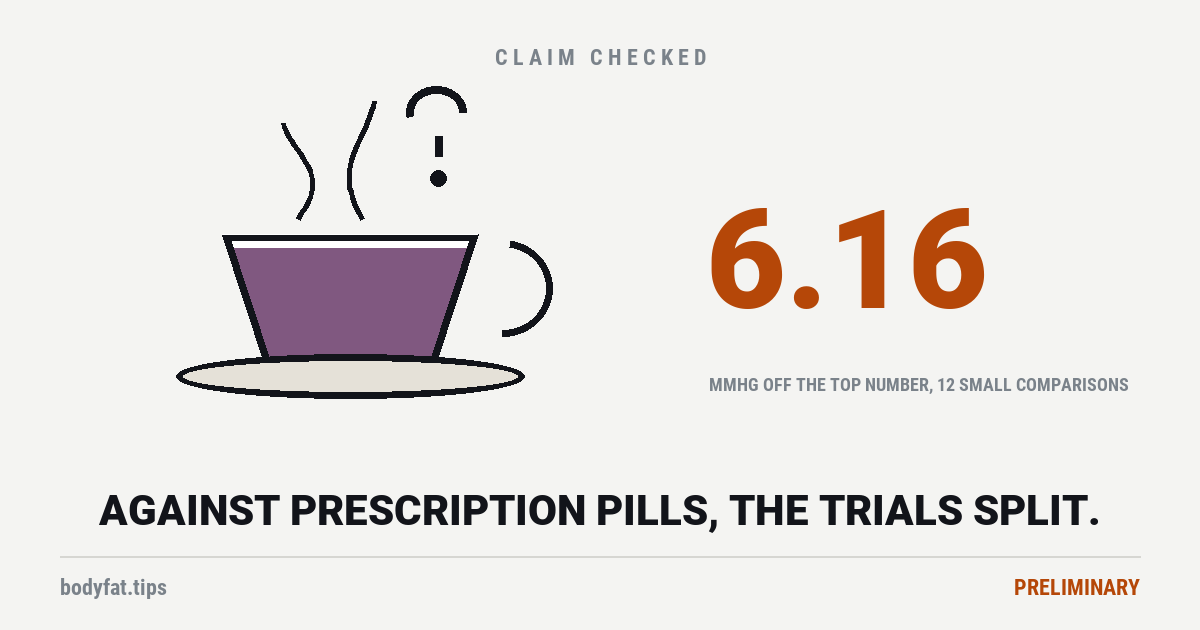
Hibiscus may lower blood pressure a little. Pooled across 12 comparisons from 10 small trials, hibiscus as tea or capsules took about 6 mmHg off the top number compared with a dummy or with no treatment, over four to eight weeks, and more in people whose pressure started higher [3].
It has not been shown to do what a pill does. Nine trials we found set hibiscus head to head against a prescription drug, one of them a capsule of hibiscus and olive leaf, and they split. The drug did more in three, two against lisinopril and one against ramipril [4] [5] [6]. Hibiscus did more in one, against lisinopril, and in another, against a water pill, only once treatment had stopped; both results come from one Nigerian hospital, and the first rests on its paper’s own test [7] [8]. The other four, all against captopril, found no clear difference; the “just as effective” results come mostly from them, and the table below lists all nine. Pooled, a 2025 review found no clear difference and graded that very low certainty [3].
The strictest review could not say yes. The Cochrane review, which counts only trials in people with diagnosed high blood pressure set against a dummy or nothing, found one such trial, and it showed no clear effect [9].
Is Hibiscus sabdariffa the same as hibiscus tea?
Yes. Hibiscus tea is brewed from the dried calyces of Hibiscus sabdariffa, the fleshy red cups around the plant’s seed pods [10]. The same plant and drink go by roselle, sour tea, karkadé, bissap, red sorrel and agua de Jamaica [10]. The ornamental Chinese hibiscus, Hibiscus rosa-sinensis, is a different species [11]. One of the six papers the video lists as its evidence is a test-tube study of the leaves of that garden species [11]. Another measured the antioxidant chemistry of teas and juices on sale in Portugal [12]. Neither measured anyone’s blood pressure.
What is it used for? Mostly as a drink: an ingredient in many herbal-tea blends sold in the United States, and a drink in its own right in many countries [10]. The health claims most tested in people are blood pressure, cholesterol and blood sugar, the three a 2022 review pooled [13]. This page weighs blood pressure.
Does hibiscus tea lower blood pressure?
Start with a trial that put brewed tea, at an ordinary dose, against a dummy drink. In Boston, researchers took 65 adults aged 30 to 70 whose top number was 120 to 150, none of them on blood-pressure pills, and gave them three 8 oz (240 mL) cups a day for six weeks [10]. Half brewed a tea bag holding 1.25 g of dried hibiscus for six minutes; the other half got a placebo, a dummy drink made with artificial hibiscus flavor and red food coloring, so nobody could tell which they had. Neither the volunteers nor the staff measuring them knew who was drinking what [10].
On hibiscus, the top number fell by 7.2 mmHg. On the dummy, by 1.3. That gap, 5.9 by the authors’ arithmetic, cleared the line researchers use for “probably not chance” [10]. The bottom number fell by 3.1 against 0.5, a gap that could easily have been chance. And the higher a person’s top number at the start, the more it fell [10]. The trial was paid for by the US Department of Agriculture’s research agency and by a US herbal-tea brand, which also supplied the hibiscus [10].
One trial is one trial. So what happens when everything is pooled? A 2025 review gathered 26 randomised trials, 1,797 people in all [3]. In the 12 comparisons, from 10 trials of four to eight weeks, that set hibiscus against a dummy or against no treatment, 339 people on hibiscus and 290 not, hibiscus took 6.16 mmHg off the top number and 3.79 off the bottom [3]. The range the true answer probably sits in ran from 2.05 to 10.25 for the top number. The reviewers graded that comparison “moderate” certainty, the second of four grades: probably close to the truth, possibly quite a way off [3]. Read the review’s own trial table, though, and five of the 12 had no dummy at all: the comparison group got diet or lifestyle advice, or nothing. They hold 282 of the 629 people [3]. The largest of the 12 is an open study in Iraq, led and paid for by a Swiss foundation that, by its own statement, sells hibiscus capsules to fund its research, in which one clinic, picked at random, served as the comparison group [14]. Pooled again by our own arithmetic from the review’s chart, the seven comparisons with a real dummy came to about 9.7 mmHg off the top number, and the five without one to about 2.2, a figure that could be nothing [3].
Three things temper it. First, the trials disagree a great deal about the size. In the comparisons with a dummy or no treatment in people with high blood pressure, 97% of the spread between their results was more than chance would produce, a measure researchers call I-squared [3]. Second, the trials are small and short: two weeks to six months, and none we found counted strokes or heart attacks, only readings [3] [15]. Third, the pool has soft spots. By our arithmetic, two of its entries carry ranges far narrower than their own papers allow: a trial in fatty liver disease reports its blood-pressure difference at p = 0.03, just inside the line for “probably not chance”, yet is entered with a range that would make chance all but impossible, and a trial with lifestyle advice as its comparison looks the same [3] [16] [17]. And two of the dummy comparisons come from one Nigerian hospital, under one ethics approval, and report the identical fall on hibiscus, 17.08 mmHg; the papers describe different numbers of volunteers, and we could not tell whether they share a hibiscus group, which would count it twice [8] [7]. None of this turns the result around. It is part of why we read “moderate” as softer than it sounds.
For scale, 6 mmHg is more than this site found for beetroot juice (3.55) or magnesium (2.0 to 2.8) [18], and it rests on fewer trials. The site’s blood-pressure verdict weighs the DASH diet, salt, exercise and those supplements against each other, with the warning that figures from different reviews are not one league table; the same warning applies here.
Who gets the biggest effect? The people who need it most. Across trials, the higher the starting pressure, the bigger the fall [13]. In the 2025 review, the comparisons with a dummy or no treatment in people over 50 found 11.6 mmHg off the top number; in people 50 or under, 2.97, a figure that could be no effect at all [3]. And in a 2025 Thai trial of 108 adults chosen for a large waistline rather than high blood pressure, 12 weeks of a 1,000 mg hibiscus capsule did no better than a dummy on blood pressure [19]. That trial came out after the 2025 review’s search ended, so it is not in its numbers.
Which leaves the review that says it cannot tell. The Cochrane review, searched to August 2021, accepted only trials of adults with a top number of at least 140 or a bottom number of at least 90, on two readings, set against a dummy or nothing [9]. It found one: 60 people with type 2 diabetes in Indonesia, hibiscus capsules or lactose capsules for eight weeks [9] [20]. The top number came out 1.65 mmHg higher on hibiscus, with a range running from 7.89 lower to 11.19 higher, which is to say the trial could not tell. The reviewers graded it very low certainty and concluded that the evidence “is currently insufficient to determine the effectiveness of Roselle compared to placebo” [9].
It turned most of the rest away for reasons it lists one by one, and set three aside as awaiting classification, two of which are in the 2025 pool [9]. The Boston tea trial was out because its volunteers’ pressure was below the review’s line. Four Nigerian trial reports were out because their dummy drink was blackcurrant [9], a branded blackcurrant drink diluted to match hibiscus’s colour [8]. Trials against drugs or other herbs were out because neither is a dummy [9].
Is hibiscus tea as effective as blood pressure medication?
This is the video’s boldest line, and the trials behind it are worth reading one at a time. We counted every trial we found that assigned people by chance to hibiscus or to a prescription blood-pressure drug and compared how far their pressure fell [15]. Nine set hibiscus head to head against a drug, one of them a capsule of hibiscus and olive leaf, and two more set it against a water pill with both groups also taking another drug, valsartan. Each is classed below by its own paper’s test on its main measure, the result it was set up to compare.
| Trial | Hibiscus, against what | Fall in the top number, mmHg |
|---|---|---|
| Mexico, 2007; 193 adults, 171 analysed, four weeks; neither patients nor doctors knew which they got [4] | An extract with 250 mg of the red pigments a day, against lisinopril 10 mg | 17.1 on hibiscus, 23.3 on lisinopril; the drug did more [4] [21] |
| Mexico, 2016; 115 adults, 16 weeks; neither patients nor doctors knew which they got [5] | Capsules of an extract with 100 mg of the red pigments, twice a day, one dose at night, against lisinopril 5 mg twice a day | On the trial’s main measure, a fall of 10 or more in the bottom number, the drug did more; among those who finished, 33 of 57 on hibiscus and, by our count from the paper’s table of dropouts, 47 of 58 on lisinopril, readings at 16 weeks were not clearly different [5] |
| Nigeria, 2017; 78 adults, 75 finished, four weeks; neither patients nor the staff measuring them knew which they got [7] | A brew at 150 mg per kg of body weight a day, against lisinopril 10 mg once a day | 17.08 on hibiscus, 12.60 on lisinopril; hibiscus did more, by the paper’s own test [7] |
| Senegal, 2017; 125 adults, four weeks [6] | Capsules of the dried flower, 320 mg twice a day, against ramipril 5 mg | 11.2 on hibiscus, 16.7 on ramipril; the drug did more [6] |
| Mexico, 2004; 90 adults, 75 analysed, four weeks; everyone knew what they were taking [22] [3] | A brew of 10 g of dried flower a day, against captopril 25 mg twice a day | 14.2 on hibiscus, 16.4 on captopril, by a 2013 review’s table; no clear difference [21] |
| Iran, 2015; 20 adults, each took both in turn for six weeks, pressure tracked over 24 hours [23] | A sour-tea pill of hibiscus extract, 500 mg twice a day, against captopril 12.5 mg twice a day | 13.3 on hibiscus, 7.75 on captopril; no clear difference [23] |
| Senegal, 2021; 219 adults, six months [24] | A brew of 10 g a day or tablets, against captopril 50 mg twice a day | 19.5 across four herbal groups, two of them hibiscus and two kinkeliba, another plant, and 19.7 on captopril; each hibiscus group came within about 2 of captopril, no clear difference [24] [3] |
| Egypt, 2020; 134 adults, eight weeks; two of the authors worked for the product’s maker [25] | A hibiscus-and-olive-leaf capsule at two doses, against captopril 25 mg twice a day | 15.4 and 14.9 on the capsule, 16.4 on captopril; no clear difference [25] |
| Nigeria, 2015; 80 adults recruited, four weeks [8] | A brew at 150 mg per kg of body weight a day, against hydrochlorothiazide 25 mg, a water pill | 17.08 on hibiscus, 12.9 on the water pill; clearly apart only a week after treatment stopped [8] |
| Iran, 2024; 72 adults with mild kidney disease, 90 days [26] | Pills holding 350 mg of hibiscus extract, twice a day, against hydrochlorothiazide 12.5 mg twice a day, both on top of the drug valsartan | A fall of 10 on hibiscus and 17.5 on the water pill, the middle value in each group; the water pill did more [26] |
| Iran, 2026; 70 adults with diabetes and kidney disease, three months [27] | Hibiscus tablets, 500 mg twice a day, against hydrochlorothiazide 12.5 mg twice a day, both on top of valsartan | A fall of 5 on hibiscus and 10 on the water pill, the middle value in each group; the water pill did more [27] |
Start with captopril. In 2004, researchers at the Mexican Social Security Institute gave 90 adults, 75 of whom were analysed, either a brew of about a third of an ounce (10 g) of dried hibiscus in about 2 cups (0.5 L) of water each morning before breakfast, or captopril 25 mg twice a day, for four weeks [22]. The top number fell from 139 to 124 on hibiscus, by the trial’s abstract, and the two groups ended up with no significant difference [22]. Everyone knew which they were taking; a 2025 review lists the trial as open-label [3]. Three later trials against captopril found the same. In Iran, 20 adults took a sour-tea pill and captopril for six weeks each, their pressure tracked by a monitor worn for 24 hours: the top number fell 13.3 on the pill and 7.75 on captopril, a gap the authors could not tell from chance [23]. In Senegal, over six months, the four herbal groups’ top number fell by 19.5 and the captopril group’s by 19.7; two of those groups took hibiscus and two kinkeliba, another West African plant, and a 2025 review puts each hibiscus group within about 2 mmHg of captopril, neither clearly different [24] [3]. And in Egypt, a hibiscus-and-olive-leaf capsule, two of whose authors worked for the capsule’s maker, did no differently from captopril [25].
Who ran the Senegal trials matters too. Both were co-written by researchers from a Swiss foundation [6] [24], which states in a 2021 trial paper that it “has commercialized HS capsules in Switzerland to fund future research projects in the humanitarian sector” [14]. That is not a reason to dismiss the trials. It is a reason the funding row of this page is long.
Then lisinopril and ramipril. The same Mexican group ran a double-blind comparison in 2007: an extract delivering 250 mg a day of the flower’s red pigments against lisinopril 10 mg, for four weeks, with neither patients nor doctors knowing which was which [4]. The top number fell 17.1 on hibiscus and 23.3 on lisinopril [21], and the authors report that hibiscus did less, by a margin unlikely to be chance [4]. This trial is one of the video’s own six references. The same group’s 16-week trial gave 115 adults hibiscus capsules or lisinopril 5 mg twice a day, neither side knowing which; on its main measure, a fall of at least 10 points in the bottom number, lisinopril did better, though among those who finished, readings at 16 weeks were not clearly different [5]. In Senegal, ramipril 5 mg took 16.7 off the top number in four weeks and hibiscus capsules 11.2; 39% of the ramipril group reached a normal reading, against 21% on hibiscus [6].
Two reports from one Nigerian hospital have hibiscus ahead. In one, 78 adults took a hibiscus brew, lisinopril 10 mg or a dummy drink for four weeks, with neither they nor the staff measuring them knowing which: the top number fell 17.08 on hibiscus and 12.60 on lisinopril, and the paper reports the gap as unlikely to be chance [7]. A 2025 review that entered the same figures put the gap at 4.48, with a range just wide enough to include no difference at all [3]. In the other, against a water pill, hydrochlorothiazide, the top number fell 17.08 on hibiscus and 12.9 on the pill; the paper found the two clearly apart only a week after treatment stopped, when pressure on the pill had gone back to where it started and pressure on hibiscus had not [8]. The hibiscus dose in both was 150 mg per kg of body weight a day, about 10.5 g for a 154 lb (70 kg) person by our arithmetic [8] [7], and the water-pill paper disagrees with itself about potassium, of which more below [8]. The two reports share a hospital, an ethics approval and that fall on hibiscus to the hundredth of a point; they describe different numbers of volunteers, so we cannot tell whether they are two trials or one hibiscus group reported twice.
Pool eight comparisons from seven of these trials and the 2025 review finds no clear difference between hibiscus and the drugs: 1.19 mmHg in the drugs’ favour, with a range from 2.59 in hibiscus’s favour to 4.98 in the drugs’ [3]. It graded that “very low” certainty, the bottom grade, and strongly suspected publication bias: the worry that small trials with good news for hibiscus got published and the others did not [3]. An earlier pooling reached the same no-clear-difference result [13]. The 2025 pool does not include the 16-week trial, the Egyptian capsule or the two trials on top of valsartan [3].
So is it as effective? “No clear difference” in a small trial is not the same thing as “just as good”; it often means the trial was too small to tell. Against captopril, hibiscus kept up in four trials. Against lisinopril and ramipril, the drug did more in three trials of four, and the fourth, from that Nigerian hospital, went the other way. On top of valsartan, a water pill did more in both trials that tried it. The site’s blood-pressure verdict found the same shape in the claim that exercise works as well as pills. None of this is a reason to stop, skip or swap a prescribed blood-pressure drug; that is a conversation with whoever prescribed it.
What the video’s six sources say
The video lists six papers under “DATA” [1]. Read in order, they make a narrower case than the video does. A 2013 review found hibiscus “as effective at lowering blood pressure” as captopril and “less effective than” lisinopril, and called many of the trials “of low quality” [21]. A 2015 pooling of five trials found 7.58 mmHg off the top number and called for “Further well designed trials” [28]. The 2007 trial found lisinopril did more [4]. A 2020 pooling of seven trials found 4.71 [29]. The last two are the Portuguese antioxidant survey and the test-tube study of the garden species [12] [11].
Of the six, then, one compares hibiscus with drugs in its own words, and finds it as effective as captopril and less effective than lisinopril; one is the lisinopril trial itself; two pool trials against other controls, not drugs; and two say nothing about blood pressure at all. A 2022 pooling of 13 trials that also found no clear difference from drugs had an author who had been paid for consulting work, on behalf of the Egyptian capsule’s maker, “relevant to the study concept” [30].
Is hibiscus a natural ACE inhibitor?
ACE, angiotensin-converting enzyme, makes a hormone that tightens blood vessels. ACE inhibitors, such as lisinopril, ramipril and captopril, block it. In a test tube, two of hibiscus’s red pigments, the anthocyanins, block it too [31]. So the claim starts from a real laboratory finding.
In people, the picture is thinner. In the 2007 lisinopril trial, ACE activity in the blood fell on hibiscus, from 44.0 to 30.1 units [4]. In a Nigerian trial, it fell 6.6% on hibiscus and 5.7% on lisinopril, and neither fall was clearly different from the dummy [32]. In a small pilot for the Boston trial, the two main pigments could not be found in the blood or urine of three of the researchers within an hour of drinking the tea, or the next morning [10].
And the Swiss foundation’s researchers, who ran several of the trials, now point elsewhere. Comparing three of their own trials, they found the pigment content of their hibiscus varied up to fourfold from batch to batch while the blood-pressure results stayed similar; they conclude that hibiscus acid, a different compound, is “a main active principle” [33]. In two trials, people on hibiscus passed more sodium in their urine, which is how a water pill works, though in a third they did not [22] [6] [8]. It may act several ways at once; “a natural ACE inhibitor” is one guess at one of them.
How quickly does hibiscus tea lower blood pressure?
Not immediately. In a UK trial, 25 men drank about 8.5 oz (250 mL) of a hibiscus drink or water with breakfast, and their blood pressure, measured every hour for four hours, did not fall significantly [34]. In a 2025 trial of 20 adults, a hibiscus drink with breakfast made no difference to blood pressure over two hours [35].
Within days, perhaps. In a 1999 Iranian trial of 54 people with high blood pressure, sour tea brought the top number down 11.2% from where it started in 12 days, more than black tea did; three days after stopping, systolic pressure was up 7.9%, the abstract says [36]. In the Boston trial, which measured every week, most of the fall on hibiscus had happened by the second or third week, by our reading of the paper’s chart, and only the sixth week was marked as clearly different from the dummy [10].
And the six weeks? That is the length of the Boston trial. Across trials, the 2025 review found bigger effects in comparisons lasting more than four weeks (10.0 mmHg off the top number) than in shorter ones (3.69, which could be no effect) [3]; that compares different trials, with different people and doses, not the same people over time. There is a twist: the Egyptian drug regulator’s monograph on hibiscus, which treats it as a traditional remedy “As adjuvant therapy for managing the hypertension”, gives “Duration of use: Up to 6 weeks” [37]. The six weeks the video calls the time to the full effect is, in that monograph, the longest it advises using it.
When is the best time to drink it, and does hot or cold matter?
We found no trial that tested one time of day against another, or hot against cold, in people [15]. The trials used what was practical: the Boston volunteers drank their three cups hot or cold as they liked [10], the 2004 Mexican trial gave its brew before breakfast [22], and a 2019 Iranian trial gave two cups each morning [17]. One study compared hot and cold extracts in rats and found the hot one did more [38]. The nearest thing to evidence on timing points away from bedtime. In the 16-week Mexican trial, hibiscus capsules were taken every 12 hours, one dose at night, and 14 of the 57 people on hibiscus (24.5%) dropped out because the night dose had them getting up to pass urine, against 1 of 58 on lisinopril; the authors write that night dosing “is contraindicated” [5]. That trial did not compare one time of day with another, but it is a reason to be wary of the bedtime cup some wellness sites recommend [15].
How the trials made it varies as much as how much they gave. The Boston tea was 1.25 g per cup, three cups a day [10]; the Egyptian regulator’s monograph gives 1.25 to 1.5 g in 8 oz (240 mL) of boiling water, steeped 5 to 10 minutes, up to three times a day [37]; the Mexican and Senegalese brews used about 10 g a day, and the Iraqi one started there and moved 43% of its drinkers up to 15 or 20 g [22] [24] [14]. A brew of 10 g is roughly eight Boston tea bags a day, by our arithmetic.
Can you drink hibiscus tea with blood pressure medication?
Ask whoever prescribed it first, and here is why. The Egyptian regulator warns that taking hibiscus with blood-pressure drugs “may cause blood pressure to go too low” and that pressure should be monitored closely [37]. It also warns that hibiscus may weaken diabetes medicines, and, because it may affect blood sugar, advises stopping it at least two weeks before planned surgery [37]. In an Iraqi trial, 121 adults whose pressure was not controlled, some of them on blood-pressure drugs, kept taking whatever they were taking, and those given hibiscus brew had their top number fall by 23.1 against 4.4 in those who were not; the researchers noted no interaction, in an open trial of six weeks [14].
Other drugs have been tested more directly. In six healthy volunteers, a hibiscus drink cut the amount of simvastatin, a cholesterol drug, reaching the blood by about a third, by our arithmetic from the paper’s ratio of 0.646 [39]. In healthy men, it cut the malaria drug chloroquine to less than a third of what reached the blood with water [40]. A 2026 case report describes a woman on warfarin, a blood thinner, whose INR, the measure of how slowly blood clots, rose sharply after she started drinking hibiscus tea; the authors call it a possible interaction [41]. In rats and rabbits, hibiscus raised and prolonged the level of the water pill hydrochlorothiazide in the blood [42]. The video’s own advice to check with a doctor if you take a water pill is sound [1].
What about the video’s claim that hibiscus “doesn’t reduce potassium” [1]? In the 2007 trial, potassium in the blood did not change [4]. The Nigerian paper says in its results that hibiscus lowered blood potassium compared with the dummy, and in its discussion that it did not [8]. That is a question for a blood test, not a video.
Is hibiscus tea bad for your kidneys or liver?
Not in the trials, which ran up to three months for these measures. In Nigeria, a measure of how well the kidneys filter, creatinine clearance, rose on hibiscus compared with a dummy [7]. In the 2025 Thai trial, 12 weeks of capsules changed no kidney or liver test compared with a dummy [19]. In an Iranian trial of 72 people with mild kidney disease, hibiscus capsules added to the drug valsartan for 90 days changed the kidney tests no differently from a water pill added instead; one of its authors runs a company that makes herbal medicines [26]. In the 2025 review, one liver enzyme, AST, came out 3.09 units higher on hibiscus than on a dummy, with a range from 0.8 lower to 6.97 higher, which could be no change; the review called it minor [3].
In rats, a strong infusion has done harm. Rats given a 6% hibiscus infusion, about 2 oz of dried flowers to a quart (60 g to a litre), as their only drink for a month showed signs of kidney damage [43]. The Boston tea was about a twelfth of that strength, by our arithmetic [10]. In people, hibiscus tea raises the amount of uric acid passed in urine: in 18 adults, nine of whom had had kidney stones, two cups a day for 15 days did so [44]. What that means for stone-formers is a question for their doctor.
Is hibiscus tea safe in pregnancy?
The Egyptian regulator says its safety in pregnancy and breastfeeding “has not been established” and that use “is not recommended” [37]. The blood-pressure trials we read that say whom they turned away excluded pregnant women [10] [8] [14]. A handful of small studies have given hibiscus tea or a hibiscus drink to pregnant women or new mothers anyway, none with groups assigned by chance. In Mexico, 10 women in the middle three months of pregnancy, all with normal blood pressure, drank a hibiscus drink daily for four weeks with no comparison group; their blood pressure did not change, one reported nausea that bothered her, and none needed medical care [45] [46]. Our PubMed and Europe PMC searches did not find it; an ordinary web search did [15]. In Indonesia, where hibiscus is called rosella, at least two studies have given the tea to pregnant women with high blood pressure: 30 women, their pressure compared before and after [47]; and 100 women in 2025, given the tea for 14 days alongside the blood-pressure drug nifedipine, or the drug alone, in which the top number fell 24.92 against 18.78 [48]. A 2019 conference paper says it studied 30 more, half of them given the tea, and reports large falls [49]. Its results tables, though, print the same group averages and spreads, to the third decimal place in all but one row, as a 2017 study of 30 mothers with high blood pressure just after birth, which shares an author with it, so we count the two as one study, the 2017 one [49] [50]. In that study, 15 mothers drank the tea alongside their usual blood-pressure drugs and 15 took the drugs alone. The top number fell 39.67 on the tea and 34.67 without it, a gap of 5 that the paper’s own table could not tell from chance (p = 0.178), though the summary at the top of the paper says the groups differed [50]. All three report falls from where pressure started. None was set up to show that the tea is safe for mother or baby. High blood pressure in pregnancy is a reason to see a clinician, not a tea. In rats, hibiscus drunk by nursing mothers delayed puberty in their daughters [51].
What are the benefits of hibiscus tea for men?
The same as for women, as far as the trials can say: the Boston trial was 57% men, and the effect did not differ by sex [10]. None of the trials on this page tested a benefit particular to men, and the searches on hibiscus and male fertility return animal studies [15].
If it works, why can’t the strictest review say so?
This section is the desk’s own reasoning, and it is labelled as such. The 2025 review grades hibiscus against a dummy moderate certainty [3]; the Cochrane review says the evidence is insufficient [9]. Both are careful. Three answers, each rated.
Answer one: they are answering different questions. Cochrane asked whether hibiscus treats diagnosed high blood pressure better than a dummy. The 2025 review asked whether hibiscus moves blood pressure at all, counting people with slightly raised pressure and comparisons with no treatment [9] [3]. Of the 26 trials in the second review, the first counted one, and its table lists why it turned many of the others away [9]. This is measured: it is in the review’s own table of excluded studies.
Answer two: the effect lives where pressure is high. The Boston trial’s biggest falls were in its highest readings [10]; across trials, the same [13]; in the 2025 review, people over 50 did far better than younger ones [3]; and a trial of people chosen for their waistline found nothing [19]. A small effect concentrated in some people blurs when trials mix in others. This is a surmise with three analyses on its side; none of them was a trial designed to test it.
Answer three: it is not that the better trials found less. The usual suspicion about herbs is that the sloppiest trials make them look best. In the 2025 review’s own grading, its seven comparisons with a dummy or no treatment judged at low risk of bias found 10.7 mmHg off the top number, and its five at high risk found 0.52, a figure that could be nothing [3]. That cuts against the suspicion here, though the split nearly matches the dummy split described above: six of the seven low-risk comparisons used a dummy, and four of the five high-risk ones did not. The review also counted the Iraqi study among the low-risk seven while rating how its groups were assigned at high risk; without it, the other six still come to about 9.1, by our arithmetic [3]. It is measured, by one review’s own judgment of the trials, and another review could grade them differently.
Put the three together and here is what we think is true, stated plainly so you can disagree with it: hibiscus tea is a plausible small nudge for raised blood pressure, not a treatment for high blood pressure.
What we could not find, and would like to. A trial of brewed hibiscus tea in people with diagnosed high blood pressure, against a dummy drink, lasting months and using a monitor worn for 24 hours. And any trial that counts strokes or heart attacks rather than readings; we found none [15]. A larger trial of the hibiscus-and-olive-leaf capsule against captopril is registered, sponsored by its maker, listed with an estimated completion of April 2025 and no results posted [52]. If you know of any of them, the corrections line on this site is open.
Who these studies were done on
Mostly middle-aged adults with mildly or moderately raised blood pressure: more trials from Iran than anywhere else, and others from Mexico, Nigeria, Senegal, Iraq, Indonesia, Taiwan, India and the United States [3]; the trials outside that review add Egypt and Thailand [25] [19]. The Boston trial took people aged 30 to 70 [10]; the Mexican trials 30 to 80 and 25 to 61 [22] [4]. The Cochrane reviewers note that the one trial they could include averaged 55 years of age, and call for trials in younger adults [9]. Several trials were in people with type 2 diabetes [3].
Three things change the answer for a reader. The starting point: the falls were bigger in people whose pressure was higher [13] [3]. The dose: the trials ranged from under a gram a day in capsules to brews of 10 g a day or more [3]. And what else you take: the trials we read in detail mostly took people on no blood-pressure drug [10] [22] [8]; the Iraqi trial and two Iranian trials that added hibiscus to the drug valsartan are the exceptions [14] [26] [27]. Pregnant women were turned away where trials said so, and the longest trial we read lasted six months [24].
Where “as effective as blood pressure medication” came from
The research came first, from Mexico: the 2004 trial in which a morning hibiscus brew and captopril ended four weeks with no significant difference [22]. Its authors went on to the lisinopril trial, in which the drug did more [4].
The framing came from a government press office. On 10 November 2008 the US Department of Agriculture’s research agency announced “Study Shows Consuming Hibiscus Tea Lowers Blood Pressure”, on the day the Boston trial was presented to a heart association’s annual conference; it said the trial was paid for by the agency and by a US herbal-tea brand, and added that “more research is required” [53]. That news item is still among the pages Google’s AI answer cites for “hibiscus tea blood pressure”, beside a hospital’s health blog, a cardiology practice and a YouTube video [2].
Then the spread: the video, in March 2022, turned its own first reference’s reading, that hibiscus did as well as captopril and less well than lisinopril [21], into “almost as effective or just as effective as certain blood pressure medications” [1]. The product came alongside: capsules and blends sold for blood pressure, among them a hibiscus-and-olive-leaf capsule tested against captopril by researchers including its maker’s staff [25], and the hibiscus capsules a Swiss foundation says it has put on sale in Switzerland to fund its research [14].
None of this is aimed at anyone with a cup of hibiscus tea in their hand. It is a pleasant drink with a small, plausible effect on blood pressure. It is the swap from a pill to a cup that the evidence does not carry.
What this is rated, and what the rating covers
Preliminary — for the claim that drinking hibiscus tea lowers blood pressure.
It is rated Preliminary because the trials point one way but are small and short. Pooled, hibiscus as tea or capsules took about 6 mmHg off the top number against a dummy or no treatment, graded moderate certainty by the review that pooled them [3]; the Boston placebo trial of brewed tea at an ordinary dose found 5.9 [10]; and the effect was bigger where pressure was higher [13] [3]. But those 12 comparisons hold about 630 people between them, five of them had no dummy at all, and the largest is an open study led by a foundation that sells hibiscus capsules [3] [14]; the results vary far more than chance allows [3]; the strictest review found one eligible trial and it showed nothing clear [9]; the newest double-blind trial found no difference, in people not chosen for high pressure [19]; and no trial we found counted strokes or heart attacks [15]. This is the same rating, for the same reasons, that the site’s blood-pressure verdict gives kiwifruit and pomegranate. It sits near the top of Preliminary, and a trial of brewed tea against a dummy drink in people with diagnosed high blood pressure, lasting months, could move it to Supported.
Rated alone, in words. That hibiscus is “almost as effective or just as effective as certain blood pressure medications”: Preliminary; small trials point both ways. Of nine that set hibiscus head to head against a drug, one of them a capsule of hibiscus and olive leaf, the drug did more in three, two against lisinopril and one against ramipril; hibiscus did more in one, against lisinopril, a result a 2025 review could not separate from no difference, and in another, against a water pill, only once treatment had stopped; and the four against captopril, one of them co-written by the capsule maker’s staff, found no clear difference. Added to the drug valsartan, a water pill did more than hibiscus in both trials that tried it, and the pooled comparison is graded very low certainty [4] [5] [6] [7] [8] [22] [23] [25] [24] [26] [27] [3]. That it is “a natural ACE inhibitor”: Preliminary; a test-tube finding, one trial showing lower ACE activity in the blood and one not, and its main pigments undetected in the blood of the three people in a small pilot [31] [4] [32] [10]. That it takes “about six weeks to see the full effect”: Preliminary; longer trials found bigger effects than shorter ones, comparing different people, and in the one tea trial with weekly readings most of the fall came by week two or three [3] [10]. That it has “virtually no side effects”: Preliminary; the trials conflict. Side effects in most trials were few and mild, mostly stomach complaints, more often at higher doses [14]; two three-month trials that added hibiscus pills to a blood-pressure drug reported none from the pills [26] [27]; and a 2025 review’s pooled counts, from five trials, could not tell hibiscus apart from a dummy or no treatment, or from drugs [3]. But the promise is a blanket one, and a 16-week trial in which neither patients nor doctors knew who took what put it to the test: on hibiscus capsules twice a day, one dose at night, 14 of 57 people dropped out with side effects, mostly getting up at night to pass urine, against 1 of 58 on lisinopril, and 24 of 57 left the trial in all, against 11 of 58 [5]. Hibiscus also changes how much of some drugs reaches the blood, and a drug regulator advises against it in pregnancy [39] [40] [37].
What is not rated here: the video’s other claims, about stomach cancer, antibiotics and liver fat, and hibiscus for cholesterol, blood sugar, weight or skin, which this page did not weigh; hibiscus as a substitute for any prescribed drug, which no trial on this page was set up to test over the years a blood-pressure drug is taken; and the frame above, which is this desk’s reasoning from the evidence rather than a result the evidence delivered. It is marked as ours so that you can weigh it as ours. The European Medicines Agency’s herbal committee, which writes the EU’s assessments of medicinal plants, lists no assessment of hibiscus, finished or under way [54].
This is journalism, not medical advice. High blood pressure usually has no symptoms; if you do not know your number, getting it measured comes before any tea, and if it is high, it belongs with a clinician. The site’s blood-pressure verdict ranks the changes with the best evidence, the beetroot verdict and the magnesium verdict weigh two other things sold for blood pressure, and how we read a study, and what each tier means, is set out here.
- Kiwi Benefits: For Constipation, Two a Day Kept Pace With Mostly Low-Dose Fiber Supplements Over Weeks, Not 24 Hours. Against a Dummy, No Clear Difference Yet.
preliminary - Resistant Starch: Chilled Rice Cut the Blood-Sugar Rise 18% in the Study a 3-Million-View Video Cites. A 40-Person Rice Trial Found No Difference.
preliminary - Does Alcohol Make You Gain Weight? Fat-Burning Drops By A Third. Thirty-One Studies Still Could Not Agree.
preliminary