Lion’s Mane: The Trial Everyone Cites Had Fifteen People Per Group. Four Weeks After They Stopped, It Was Gone.

Almost every article about lion’s mane rests on one trial. It is worth meeting it properly, because the shape of it explains the whole category.
| People | 30 — fifteen per group |
| Who | Japanese adults 50–80 with mild cognitive impairment |
| Dose | 3,000 mg a day, as twelve tablets |
| Length | 16 weeks on, then 4 weeks watched |
| Result | scores up at weeks 8, 12 and 16 |
| Four weeks after stopping | scores fell significantly |
| Run by | the Mushroom Laboratory of a mushroom company |
| Replicated since | No |
Thirty people, and the effect had a shelf life
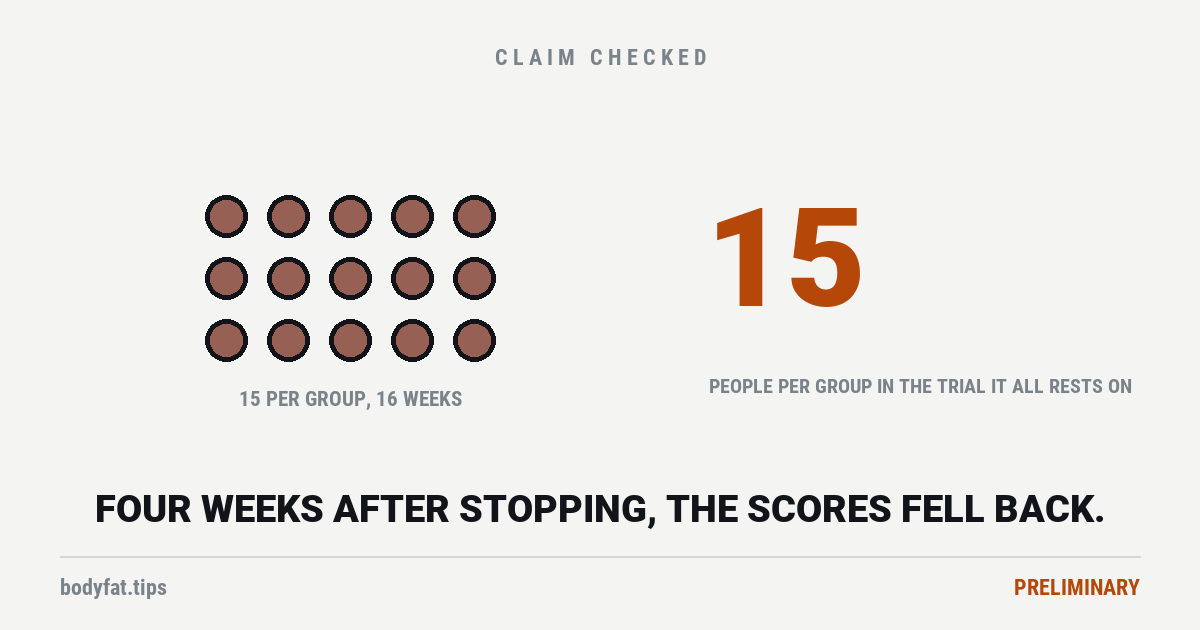
In 2009 researchers in Japan gave 30 adults aged 50 to 80, all diagnosed with mild cognitive impairment, either lion’s mane powder in tablet form or a placebo, for sixteen weeks. Fifteen people in each group [1].
It worked. Scores on the cognitive scale were significantly higher in the mushroom group at weeks 8, 12 and 16, and they climbed with the length of the intake — more weeks, better scores. Nothing showed up on the safety bloods [1].
Then they stopped the tablets and watched for another month.
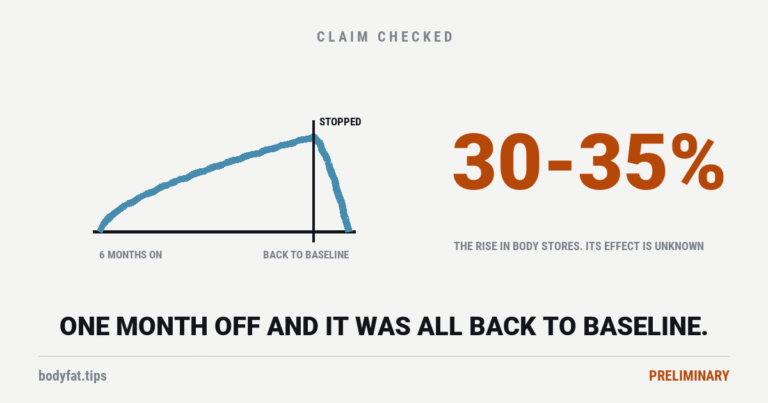
At four weeks after stopping, the scores had fallen significantly [1].
That is the most useful sentence in the paper and it is almost never quoted. Whatever was happening was not a repair. It was a thing that persisted while the tablets did and stopped when they stopped.
Who ran it
The first author’s listed affiliation on that paper is the Mushroom Laboratory of the Hokuto Corporation [1], a mushroom company.
That is not an accusation. It is a disclosure the paper prints, and this site reports the same thing about every source — including the creatine position stand written partly by people who consult for creatine companies, and we rate creatine Established.
What it means is narrower and more useful: the single trial the entire category rests on was run by someone who sells the thing. That raises the bar for replication rather than lowering the finding, and who paid for a study is a question worth asking here.
Has anyone repeated it?
No, and you do not have to take our word for it.
In 2024 a panel of nineteen neurologists and researchers — Duke, Emory, Miami, Utah, Sheffield, Wisconsin and others — reviewed lion’s mane as part of a standing series that assesses alternative treatments for ALS. They describe the 2009 trial as “very small”, note that it showed a temporary improvement, and state that the finding “has yet to be replicated” [3].
They also record that there have been no studies of lion’s mane in ALS models or in people with ALS at all, and conclude there is not enough information to support using it for that [3].
And a search for a systematic review of lion’s mane in humans returns nothing. Not a review that came out negative. There has not been enough to review.
What about healthy people?
One study, and its own authors call it a pilot.
In 2023 a team at Northumbria University gave 41 healthy adults aged 18 to 45 either 1.8 g of lion’s mane or a placebo, and tested them 60 minutes after a single dose and again after 28 days [2].
The acute result is the interesting one. An hour after a single dose, people were faster on the Stroop task — the test where the word “red” is printed in blue ink and you have to say the colour — at p = 0.005, which is comfortably inside what researchers treat as unlikely to be chance [2].
And here is the sentence to learn to read
After 28 days, the paper reports “a trend towards reduced subjective stress”, at p = 0.051 [2].
Researchers conventionally draw the line at 0.05. So 0.051 is on the wrong side of it by one thousandth — which sounds like nothing, and which is precisely why the convention exists as a line rather than a slope.
“A trend towards” is how a result that did not reach the line gets described. It is not dishonest — the authors reported the number, which is exactly right. But when that finding leaves the paper and lands on a label, the 0.051 does not come with it, and “reduces stress” is what you end up reading.
The same paper says out loud that “null and limited negative findings were also observed”, that the sample is small, and that the results should be interpreted with caution [2]. We are quoting the authors’ own hedge because it is more honest than most of what has been written about their study.
Is there a downside?
It is one of the most asked questions about this mushroom, so here is what the record actually holds.
The 2009 trial found no adverse effects on laboratory tests over sixteen weeks [1]. The 2024 panel describes lion’s mane as appearing safe and inexpensive taken as powder or capsules [3].
They also record one case of anaphylaxis — a whole-body allergic reaction — reported after a patient ate fresh lion’s mane mushroom [3].
One case is not a rate, and we are not going to turn it into one. It is a mushroom; some people react to mushrooms. Worth knowing, not worth being frightened by.
Why this is Preliminary
Not Unsupported. The trials that exist are positive, and nobody has run one that found nothing. Filing this alongside things we checked and found empty would misrepresent it.
Not Supported. Fifteen people per group, once, by an interested party, never repeated, with the effect gone a month after stopping — plus one self-described pilot in healthy adults with mixed results and no systematic review of any of it.
Preliminary is the honest description: real trials, too few of them, and the interesting question wide open. The site’s own definition adds not actionable alone, and that is where this sits.
What would move it: one adequately powered replication, run by somebody who does not sell mushrooms. That is a very ordinary thing to ask for after sixteen years.
What we would actually do
If you take it, judge it on the acute effect, not the promise. The best-evidenced finding here is that people were quicker on a focus test an hour after a dose [2]. That is a small, real, same-day thing. It is not the neurogenesis story on the packet.
Do not expect it to accumulate. The one long trial found the benefit disappeared a month after stopping [1]. Whatever you get, you get while you are taking it.
Be careful reading “supports nerve growth”. That claim comes from cell and animal work, which the 2024 panel lists as the reason for interest rather than as evidence of benefit [3]. A mechanism in a dish is a reason to run the trial, not a result from one.
And if you are choosing between this and ashwagandha — a comparison people search for — we have checked that one too, and it has the same shape of problem in a different place.
This is journalism about research, not medical advice. Cognitive decline is a doctor’s question, not a supplement’s. How we read a study · NAD+ supplements · Glutathione
- Glutathione Benefits: It Does Absorb. That Is the Part Everyone Got Wrong, and It Is Not the Part That Matters.
preliminary - Fadogia Agrestis: The Testosterone Study Was Rats. The Same Lab Then Found Liver and Kidney Damage.
preliminary - Do Multivitamins Work? 84 Trials and 739,803 People Later, the Official Verdict Is “Cannot Be Determined”
preliminary