How to Lower Blood Pressure Naturally: What Each Thing Is Actually Worth, in mmHg

The best-graded evidence for lowering blood pressure without a prescription is for a diet, and it does not come in a bottle. In a 2020 analysis of 22 non-drug approaches it took about 7 mmHg off systolic pressure, and the reviewers ranked it first. [1] A review of the diet on its own, 30 trials, found about 3. [5]
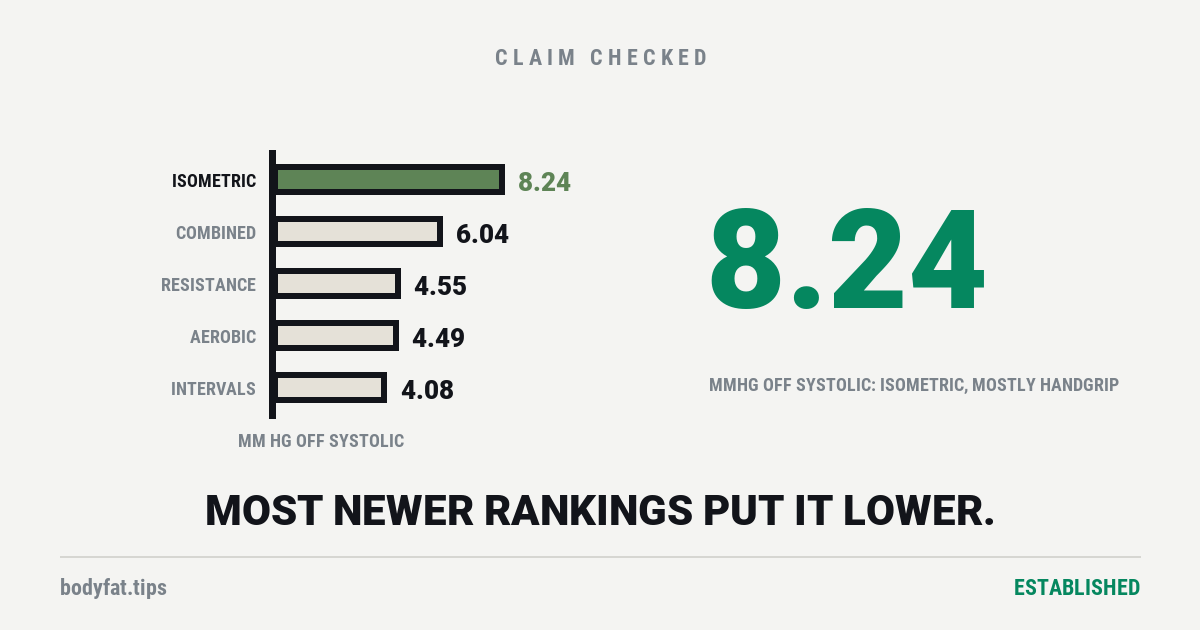
The exercise that topped a 2023 ranking of 270 trials was isometric training, holding a muscle under load without moving, and in those trials it mostly meant squeezing a handgrip. [2] Newer rankings mostly put it lower; two published in 2026 placed it last. [6] [7] One from 2025 put it first, but only for the bottom number, and only in people whose pressure was raised but not yet high. [12]
And the two supplements sold hardest for blood pressure did less, on their average figures, than any kind of exercise in the table.
Two words first, because everything below is measured in them. Systolic is the top number — the pressure while your heart is actually pushing. mmHg is millimetres of mercury, which is just the scale blood pressure has always been measured on; there is no American version of it. A reading of 130 over 80 means systolic 130, diastolic 80.
The whole thing on one page
| Intervention | mmHg | Evidence base |
| Isometric exercise (mostly handgrip) | −8.24 | 19 of the 270 trials in a 2023 review; 17 of its 24 groups squeezed a handgrip |
| DASH diet | −3.2 to −6.97 | two reviews: 30 trials, 5,545 people (−3.2); 4 trials, about 405 people (−6.97) |
| Combined aerobic + resistance | −6.04 | 46 trial groups, same 2023 review |
| Dynamic resistance training | −4.55 | 57 trial groups, same review |
| Aerobic exercise | −4.49 | 182 trial groups, same review |
| Cutting sodium | −4.26 | 133 RCTs, 12,197 people |
| Interval training | −4.08 | 49 trial groups, same review |
| Beetroot juice | −3.55 | our verdict · resting readings, trials of 2 to 56 days |
| Magnesium | −2.0 to −2.8 | our verdict |
Read down the middle column and the shape of the advice industry becomes obvious: the things sold in a bottle are at the bottom.
The best-graded evidence is for a diet from 1997
In 2020 a Bayesian network meta-analysis went through 60,166 articles, kept 120, and compared 22 different non-drug interventions across 14,923 people. [1]
The reviewers put the DASH diet first: 6.97 mmHg off systolic (the plausible range ran 4.50 to 9.47) and 3.54 off diastolic, on evidence they graded high quality, the top rung and rarer than it sounds; only meditation shared it. [1] First is their reading of rank and quality together, not of size. On the ranking statistic alone, tai chi came first, on two trials graded very low quality. Three approaches had bigger estimates than DASH, and aerobic exercise (6.60) and a lower-calorie diet (6.50) sat within half a point. [1]
Most of DASH’s evidence in that analysis is one trial. Five of its nine DASH entries are reports from the original 1997 feeding study, in which the food was supplied, some of it donated by food companies, and sodium was the same on every diet, about 3,000 mg a day. [11] Two more entries are reports of one 55-person trial. That is four trials and about 405 people, where the analysis counted 1,022 (our count, from the review’s own tables). [1] A 2020 review of DASH on its own, 30 trials and 5,545 people, found 3.2 mmHg, and the effect did not differ between people with and without high blood pressure. [5]
DASH stands for Dietary Approaches to Stop Hypertension. It is vegetables, fruit, wholegrains, low-fat dairy, less salt, less red meat and less sugar. It is thirty years old, it is free, and there is nothing in it to put in a bottle. It is still sold, as books: one 2011 DASH book is subtitled “Proven to Lower Blood Pressure and Cholesterol Without Medication”, which is the claim this page checks.
Also effective in the same analysis, at moderate-to-high quality: aerobic exercise, isometric training, low-sodium and high-potassium salt, breathing control, meditation, and in people carrying extra weight, a lower-calorie diet. [1] One caution on that salt: the 2025 US guideline calls potassium-based salt substitutes useful except for people with kidney disease or on drugs that make the body hold on to potassium, some water pills among them, where it advises extra monitoring. Ask before switching. [9]
The exercise result: isometric training topped one ranking, and most newer ones disagree
A 2023 network meta-analysis pooled 270 randomised trials and 15,827 people to rank exercise modes against each other. [2]
Everything worked. Aerobic training took off 4.49 systolic, dynamic resistance 4.55, intervals 4.08, and combining aerobic and resistance work 6.04. [2]
Isometric training took off 8.24. [2] Isometric means holding a position under load rather than moving through a rep, and in this review it mostly meant squeezing a handgrip: 17 of its 24 isometric groups did that, from 19 of the 270 trials. When the reviewers looked at which specific version did most, the wall sit came out top for systolic pressure, at 10.47 on four small trials, each co-written by at least one of the review’s own authors. It beat walking and aerobic intervals by more than chance would explain; against running, lifting and sprint intervals the gap could have been chance. Running came out top for the diastolic number. [2]
A note on how confident to be about that. The ranking uses a statistic called SUCRA, which is simply the probability that a treatment is among the better ones — 100% would mean it beat everything in every simulation, 50% is middling. Isometric scored 98.3%, combined training 75.7%, and the rest sat between 39% and 47%. [2] Isometric training’s lead over aerobic, interval and resistance training was bigger than chance would explain; its lead over combined training was not. It is still an ordering built from far fewer isometric trials than aerobic ones, and no trial in the analysis put isometric training against another exercise head to head. The reviewers advise caution for both reasons, and note that trials outside the analysis that did make that comparison have given conflicting results. Nor was isometric training a newcomer: a 2013 analysis had also ranked it first, on four trials. [2]
Newer rankings mostly put it lower. In one published in 2026, of 105 trials in people with raised or high blood pressure, combined aerobic-and-resistance training and interval training came top and isometric training came last of seven, level with resistance training. [6] In another, of 159 trials in adults aged 45 and over, isometric training came last of six, and every isometric trial in it was a handgrip one. [7] A third, of 31 trials that measured pressure with a monitor worn for 24 hours, put it joint last of eight for the systolic number, level with resistance training, and its effect there could not be told apart from no exercise at all; its isometric trials were mostly short handgrip programmes. [13]
One newer ranking points the other way. A 2025 analysis of 18 trials and 2,592 people whose pressure was raised but not yet high put isometric training first for the diastolic number, at 4.61 mmHg, and its authors named it and tai chi as the most effective exercises they compared. For the systolic number, tai chi, steady aerobic exercise and interval training all ranked above it. [12] Rankings like these move with the trials that go into them, which is the point: no single exercise has a settled claim to “best”.
Where the analyses disagree, we are not going to pick. The 2020 paper puts DASH first at 6.97 with high-quality evidence; the 2023 paper puts isometric exercise at 8.24. Those two numbers come from different reviews with different comparison groups, run three years apart. But the 2020 analysis did rank both, and in it DASH (6.97) and aerobic exercise (6.60) both ranked ahead of isometric training (5.77). [1]
Salt: the effect is real, and short studies hide it
133 randomised trials, 12,197 people, with sodium intake measured properly through 24-hour urine collection rather than asked about on a questionnaire. [3]
Cutting sodium took 4.26 mmHg off systolic and 2.07 off diastolic, for an average cut of 130 mmol a day: about 3,000 mg of sodium, or 1.3 teaspoons of salt (our arithmetic). [3] That is a big cut: the FDA puts the average American’s whole intake at about 3,400 mg and counts 2,300 mg as about a teaspoon of salt. [10] The effect scaled with the size of the cut. [3]
The interesting finding is about study length. In trials shorter than fifteen days, each 50 mmol cut (about 1,150 mg of sodium, half a teaspoon of salt) bought about 1.05 mmHg. In longer trials the same cut bought 2.13 — roughly double. [3] Short studies underestimate salt. Anyone quoting a two-week trial to tell you salt does not matter is quoting the half of the literature built to miss it.
The effect was also larger in older people, in people whose pressure was already higher, and in non-white populations. [3] Worth knowing that the electrolyte industry sells you the opposite instruction, a claim our electrolytes verdict did not test.
And the supplements
We have already checked the two sold hardest for blood pressure, and both of them work — just not by much.
Magnesium takes about 2 to 3 mmHg off systolic on average: 2.0 across 34 double-blind trials in 2016, and 2.81 across 38 trials in 2025, which found nothing significant in people whose blood pressure was already normal. That is a real effect and it is the most defensible thing on the magnesium shelf. It is also between about half and two-thirds of what the big salt cut above did, about what half a teaspoon of salt a day did in trials longer than two weeks, and a quarter to a third of what isometric training did in the 2023 analysis. In people already taking blood-pressure medication, the 2025 analysis found more: about 7.7 mmHg.
Beetroot juice manages about 3.55 mmHg on resting readings, in trials that ran 2 to 56 days. Reviews that pooled 24-hour readings found no clear drop. On paper that is more than magnesium. Still below the big salt cut, and it is the one on this page you have to keep buying.
“Exercise works as well as the pills” — where that came from, and what it leaves out
You have probably seen this claim. It comes from a 2019 network meta-analysis of 391 randomised trials — 197 of exercise, 194 of blood pressure medication. [4] It is a serious paper. The headline version of it is not.
Three things the paper says that the headline does not.
First: none of the 391 trials compared them directly. [4] Every exercise-versus-drug number in the paper is an indirect comparison, worked out by chaining each against its own control group. That is a legitimate method and it is not the same as a head-to-head. A few small trials outside the paper have run one. In the ones we found that set weeks or months of ordinary training (walking, running, cycling, swimming) against a pill, the exercise never came out ahead. In one, 28 older adults with high blood pressure were randomly given six months of endurance training or a thiazide water pill, and the pill took about twice as much off systolic pressure: 26.6 mmHg against 11.5. [8] Two other kinds of trial point the other way. Tai chi and qigong, the slow Chinese movement-and-breathing practices, have been set against blood-pressure drugs in small trials that the reviewers who pooled them judged mostly poor in quality; pooled, the tai chi trials came out ahead of the drugs on both the top and bottom numbers, and the qigong trials on the bottom one. [15] [16] And in trials of one exercise session against one dose, the session lowered systolic pressure more in the hours that followed, which is a different question from months of treatment. A 2021 review that gathered all of these concluded that exercise alone lowers blood pressure more than medication alone, grading that evidence limited for ordinary exercise and moderate for the Chinese practices; in its own training trials, the drug did as well or better. [14]
Second: in the overall analysis, the medications won — by 3.96 mmHg, with a plausible range of 2.91 to 5.02. [4]
Third: the similarity shows up only in one slice. Among people who actually had high blood pressure, the reviewers found no detectable difference between endurance or resistance exercise and four of the five drug classes they looked at: ACE inhibitors, angiotensin-receptor blockers, beta-blockers and diuretics (water pills). In that slice the comparisons ran both ways: the fifth class, calcium-channel blockers, did better than resistance exercise, and combined endurance-and-resistance training did better than three of the drug classes. [4] But only 56 of the 197 exercise trials enrolled hypertensive people, covering 3,508 participants — while every single medication trial did. [4] The comparison that produces the headline rests on the thinnest part of the exercise evidence. The reviewers also note the exercise trials carried a higher risk of bias, mostly from not being blinded.
So: none of this is a reason to stop taking, skip, or delay blood pressure medication. That is a conversation with a doctor and nothing on this page substitutes for it. The honest reading of that paper is that exercise is worth doing and is under-studied in the people who need it most — not that it replaces a prescription.
What this adds up to
If you want the short version:
— The diet has the best-graded evidence: about 3 to 7 mmHg depending on the review, and nothing in it comes in a bottle. [1] [5]
— Any exercise works; the newest rankings put combined aerobic-and-resistance training near the top, and the training itself is worth having for other reasons. [2] [6] [7]
— A big salt cut, about 1.3 teaspoons a day, did one and a half to two times what a magnesium capsule does; half a teaspoon, held for more than two weeks, did about as much as the capsule, and short trials undersell salt. [3]
— The two supplements did less than any exercise on their average figures, though magnesium did more in people already on blood-pressure medication.
Three levers this page has not checked are on the US guideline’s list, with its rough figures for people with high blood pressure: losing weight (about 1 mmHg off systolic for every 2.2 lb, or 1 kg, lost; 6 to 8 for a sustained loss of 5% of body weight or more), more potassium (about 6) and less alcohol (4 to 6). The guideline warns, as this page does, that its figures should not be compared with one another directly. [9]
And the part that is genuinely important: high blood pressure usually has no symptoms at all. If you do not know your number, none of this ranking is your first step — getting it measured is, and if it is high, that belongs with a clinician rather than a shopping list. How we grade evidence like this, and the simplest version of moving more.
Our magnesium verdict was corrected on 18 September 2026 after an independent editorial review, and this page took its magnesium figure from that verdict. We gave magnesium’s effect as 2.0 mmHg, from a 2016 analysis of 34 trials. A 2025 analysis of 38 trials, now on the magnesium page, found 2.81 on average and no significant effect in people whose blood pressure was already normal. The table row, the magnesium paragraph and the salt comparison now give the range: cutting salt is worth one and a half to two times a magnesium capsule, not twice. The rating is unchanged: Established.
One table row and one sentence were corrected on 30 September 2026. This page gave beetroot juice’s 3.55 mmHg with no limits on it. Our beetroot verdict was corrected the same day: the figure is an average on resting readings from trials lasting 2 to 56 days, and three reviews that pooled 24-hour readings found no significant change. The figure itself stands. This page has not yet had its own independent review, and nothing else on it changes today.
This page was corrected on 9 October 2026 after its own independent editorial review, and both of its headline claims were wrong. It said the DASH diet beat twenty-one other approaches. In the 2020 analysis DASH came first only on the reviewers’ reading of rank and evidence quality together; three approaches had bigger estimates, four trials stand behind its 6.97 mmHg (five of the nine DASH entries report one 1997 trial), and a 2020 review of 30 DASH trials found 3.2. It said a wall sit beat running, lifting and intervals across 270 trials. The 8.24 belongs to isometric training as a whole, mostly handgrip squeezes, from 19 of those trials; the wall sit’s own lead rested on four small trials and could have been chance against running or lifting; and most newer rankings put isometric training lower, though one from 2025 put it first for the diastolic number.
Also corrected: the evidence panel said its sources did not state who paid for them, when all four do and no company paid for any of them (one declares its authors’ outside interests, among them salt substitute supplied for other trials by two salt companies); the search snippet said “the pills came last” on a page where medication did better than exercise overall; “no trial compared them directly” is true of the 391 trials in that paper, not of the literature, and a few small trials elsewhere have; the line that nobody had ranked DASH and isometric training together was wrong, because the 2020 analysis does; DASH is sold, as books, though nothing in it comes in a bottle; and the supplement rows are averages, not “their own best numbers”. The salt figures now carry their doses, the drug comparison now says which way each part of it ran, the provenance chain names the press releases and headlines, a monthly search figure we could not trace to a saved keyword pull is gone, and the page adds the US guideline’s figures for weight loss, potassium and alcohol and its caution on potassium salt substitutes. Our provenance chain also said the finding’s qualifiers were dropped as it spread. We had not checked: in an ordinary web search, all four of the first-page results we read that relay it keep at least one, and the chain now says so. We also wrote that none of the trials we found that set exercise directly against a blood-pressure drug had the exercise doing more; trials of tai chi and qigong against drugs, and of single exercise sessions against single doses, did, and the page now says so. The rating is unchanged: Established, because diet changes and exercise still lowered blood pressure by measurable amounts in every analysis.