Oil Pulling: In Two Eight-Week Trials, Water Did as Much for Gums

Something unusual happens when you look up oil pulling.
Thirteen videos on the subject carry over eleven and a half million views between them — and four of the top five are dentists. One of the biggest is a dentist video titled, more or less, the truth about oil pulling.
On most trends we check, the professionals are nowhere near the top of the results. Here they turned up in force, which usually means one of two things: either there is something worth correcting, or there is something worth explaining.
In this case, both.
It is not nonsense. Start there.
A 2024 meta-analysis took in 25 trials covering 1,184 people, assessed with the standard risk-of-bias tool and graded formally. [1] That is a reasonable body of research by the standards of anything else on this site. The headline number inside it is much thinner.
Here is that number. Against rinses other than chlorhexidine, oil pulling improved a gum-inflammation score by a standardised mean difference of 1.14 — a way of putting different scoring scales on one ruler, where 0.2 is small, 0.5 moderate and 0.8 large — and the review calls it large. [1] That figure comes from two of the 25 trials: 70 children and teenagers in India, swishing for three to five minutes a day, set against a probiotic rinse in one trial and against brushing alone in the other. [4] [5]
Open the two trials and it shrinks. In the first, 45 schoolchildren, the children on sesame oil started with worse gum scores than the children on the probiotic rinse and still had worse scores at 15 and 30 days; the trial itself found no difference between its groups. [4] The second, 80 teenage boys with inflamed gums, did find both of its coconut oils ahead of brushing alone. But it never says its groups were chosen at random, it describes no blinding and carries no funding statement, and it appeared in a journal published by an intergovernmental body of coconut-producing countries. [5]
The review’s other gum score, from four trials and 188 people, showed no difference, and neither did its plaque comparison against rinses other than chlorhexidine. The reviewers’ own conclusion is that oil pulling “cannot be recommended for clinical use” until better evidence arrives. [1] And by our own arithmetic, the range the review prints around its 1.14 (0.97 to 1.31, the band the true answer probably sits in) is narrower than two trials this small can produce, so we do not lean on the number at all.
Since the review, the fairest tests have set oil beside plain water swished the same way. Two trials in Austria, 40 adults each, fifteen minutes every morning for eight weeks, found gum bleeding fell about as much on distilled water as on oil. [6] [7] One found plaque fell further on oil, from unequal starting levels [6]; in the other, plaque fell the same on both, and its authors put what happened down to “the mechanical action of swishing” rather than the oil. [7] Two other trials point the other way. In 30 people with gum disease in Spain, coconut oil cut bleeding more than a flavoured-water rinse used for a tenth of the time. [8] And a 15-day trial of a ready-made oil rinse, paid for by its maker, reported a gum improvement over placebo that its own authors call “modest”. [11]
| Measure | Result |
| Gum inflammation vs a probiotic rinse or brushing alone: 2 trials, 70 children and teens |
large by the review’s figure; one of the two trials found no difference |
| Gum bleeding vs distilled water, eight weeks: 2 trials, 80 adults |
no difference |
| Plaque vs chlorhexidine mouthwash: 8 trials, 305 people |
chlorhexidine better |
| Whiter teeth | no more than plain water; less than a peroxide rinse; one maker-paid trial: a small gain |
| Drawing out toxins | no studies found |
Now the three problems
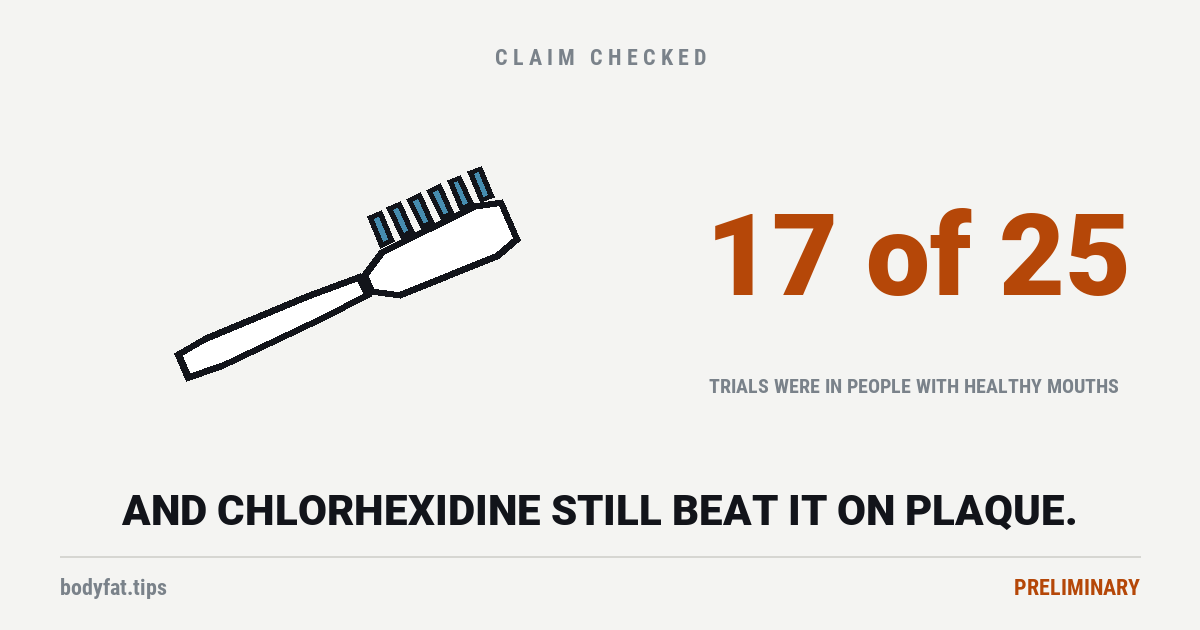
One: mouthwash still wins on plaque. When oil pulling was compared with chlorhexidine — the antiseptic mouthwash dentists actually prescribe — chlorhexidine came out ahead on plaque reduction. [1] The reviewers say so plainly: chlorhexidine remained superior.
Two: the reviewers do not trust their own result very much. Their assessment of the whole body of evidence, in their words: “The overall quality of the body of evidence was very low.” [1] That is the bottom grade. It means the direction might be right, and it might not survive better trials.
Nor does an earlier review, from 2016, settle it either way. It covered the five randomised trials in 160 people published by then, all five of them among the 25, and against chlorhexidine it found no significant difference on plaque scores in three and on gum scores in two, which its authors read as a point in oil pulling’s favour. [2] Every one of the five was rated at high risk of bias for whether the people enrolling volunteers could foresee who went into which group, and for missing data. [2]
Three, and it is easy to miss: most of the people studied had nothing wrong with their mouths. Seventeen of the twenty-five trials enrolled participants with no reported oral health issues. [1]
Which makes the results harder to use than they look. If you already have healthy gums, a study showing improvement in healthy gums is not telling you much about what happens to yours.
What about whiter teeth, and the toxins?
Here is where the gap between the research and the videos gets wide.
The 2024 review pooled plaque, two gum-inflammation scores and bacteria counts. Its 25 trials measured more than that between them, including bad breath, dry mouth, saliva chemistry, tooth-decay activity and complications after wisdom-tooth surgery, [1] and other trials have measured tooth colour.
We searched again on 30 September 2026. Tooth colour has been measured in people who pulled oil, in several trials since 2019. Drawing out toxins has not. We found no study, in PubMed, OpenAlex, ClinicalTrials.gov or the World Health Organization’s trial registry portal, that measured any toxin before and after oil pulling.
Take whitening first. Where oil was set beside plain water, in 100 dental students who stopped brushing for four days, teeth changed colour about as much on three oils as on water, and in almost everyone, whichever group, they ended slightly darker and yellower. [9] Set beside a peroxide whitening mouthwash in 60 women for two weeks, coconut oil changed tooth colour less. [10] In 30 people with gum disease, coconut oil leaned toward whiter teeth after a month against a flavoured-water rinse, just the wrong side of the line researchers use for “probably not chance” (p = 0.071). [8]
The one trial we found in a journal that cleared that line against a placebo tested a ready-made oil-pulling rinse with seven essential oils in it, for 15 days, in 63 adults: 0.9 of a step lighter on a shade guide judged by eye, against 0.3 of a step darker on placebo, a result its own authors call exploratory. [11] The paper declares no financial support. The trial’s registration names the rinse’s maker as its sponsor and its source of money. [11] The maker’s own website also describes a four-week placebo-controlled whitening study of 100 people with a bigger gain; the page names no journal, investigators, registration or date, and its placebo group’s two-week scores are identical to its starting scores. [18] We found it in no journal.
The toxin story in particular has the shape we keep meeting: a system described as clogged, and a product that unclogs it, with nobody naming the substance being removed. It is the same sentence sold by detox teas and castor oil packs.
The safety point, which is small but real
For most healthy adults the risk looks small. It is not zero. Doctors in South Korea, Japan and Hong Kong have published at least four reports, from 2014 to 2022, of oil reaching the lungs of people who practised oil pulling or gargled with oil, and inflaming them, a condition called lipoid pneumonia: at least six patients in all. [12] [13] [14] [15]
In the two reports we read in full, a man rinsed sesame oil through his nose every evening for eight months and often breathed some in; a 38-year-old woman with no medical history swished sesame oil every morning for six months, sometimes breathed some in, and recovered after she stopped; and two women treated for tongue cancer, one with severe trouble swallowing, had pulled oil for more than a year. [13] [14] The 2024 review says the very young, the elderly and anyone at risk of inhaling liquids should be told. [1] The American Dental Association does not recommend oil pulling as a dental hygiene practice. [16]
The other risk is substitution — ten minutes of swilling replacing two minutes of brushing, or replacing a dental appointment for gums that have started bleeding. A few trials have tested it instead of brushing, over days rather than months. In the largest, 100 students over four days, plaque built up as much on oil as on plain water and only chlorhexidine held it back [9]; a smaller trial of the same four-day design, 29 volunteers, found coconut oil slowed plaque about as well as chlorhexidine. [17] Days say nothing about months. And bleeding gums are a reason to see a dentist rather than to buy a bigger jar of coconut oil.
The verdict
Preliminary. The large effect on gum inflammation in the 2024 review’s abstract comes from two small trials in 70 children and teenagers, one of which found no difference of its own, and the people who pooled them graded all their evidence very low. In two eight-week trials in adults, plain water swished the same way did as much for bleeding gums; two other trials, one of them paid for by a rinse maker, found oil ahead of their placebos. Prescription mouthwash still beats oil on plaque, and most participants had healthy mouths to begin with.
That is still unresolved, but the fairest tests so far lean one way: whatever swishing does for gums, the oil adds little or nothing that water does not. That is our reading of a handful of small trials, not a settled result. The other two claims fare worse. Whiter teeth has been tested, and where oil was compared fairly it did no better than water. Drawing out toxins has never been measured by anyone we found.
The practical version: if you enjoy it and it is on top of brushing and flossing rather than instead of them, the case is weak and, for most healthy adults, the risk is small. If you have trouble swallowing, or you are thinking of it for a young child or an elderly relative, the lung reports are a reason to ask a doctor first. If you are doing it for whiter teeth, the fair comparisons found it no better than swishing water. If you are doing it to draw out toxins, nobody we found has measured one leaving.
Related: honey for cough, the other kitchen remedy that turned out to have real trials behind it, and beef tallow for skin — the same natural-is-better pitch, with a much thinner file.
If you want to know what earns each rating, we wrote down how we read a study, and everything we have checked is in one place.
This page was corrected on 30 September 2026 after an independent editorial review, and the corrections are large. It said 25 trials had found a real and large effect on gum inflammation. That figure came from two of them, 70 children and teenagers in India: one trial found no difference between its own groups, and the other does not say its groups were chosen at random. The page now says so, adds the review’s null results for its other gum score and for plaque against the same rinses, and reports two eight-week trials in adults that found gum bleeding fell as much on distilled water as on oil, beside two other trials that found the reverse. It said oil pulling “is not dangerous” with “no downside”; at least four published case reports describe oil reaching the lungs, and the page now says who is at risk and that the American Dental Association does not recommend the practice.
It also said whitening had never been studied. It has: tooth colour has been measured in several trials, and where oil was compared fairly it did no better than water. The toxin claim still has no measurement behind it that we could find, searched again on 30 September 2026. Also corrected: the 2016 review was called stricter and said to find nulls, when it held the same five early trials and found no difference from chlorhexidine; the funding row said no source stated its funding, when two of the three do; “none of the trials tested oil pulling instead of normal oral hygiene” was wrong; the follow-up row missed the eight-week trials; the list of what the trials measured was incomplete; a figure of monthly searches that no saved keyword pull of ours holds was removed; the view count now names the platform and the search behind it; the provenance chain now names the gum claim the rating is about; and the headline changed to match. The rating is unchanged.
Corrected again on 7 October 2026. Our provenance chain said that the review’s grading of its evidence as very low certainty does not travel with the headline. We had not checked. In an ordinary web search for oil pulling’s benefits, six of the nine first-page results we read say the evidence is thin or the studies small, and the chain now says so. The other half of that sentence held: none of the nine, and none of the thirteen videos we sampled in August, says that prescription mouthwash still beat oil pulling on plaque, and five of the nine say oil pulling matched a mouthwash on some measure. The rating is unchanged: Preliminary.