Walking After Eating: The Rise After Dinner Fell 22%. The Average Did Not.

Almost everything we check on this site is something being sold to you. A powder, a panel, a compress, a subscription.
This one is free. It asks for the same half hour of walking the standard advice already asks for, and tells you when to take it. And the narrow version of it is one of the better-evidenced things we have looked at.
Fifteen YouTube videos on this topic, in a search we ran in August 2026, have picked up over six million views between them, which usually makes us suspicious. This time the core of it holds up. The headline version does not.
The study worth knowing about
Researchers in New Zealand took 42 adults with type 2 diabetes, average age 60, most of them men, who had had it for about ten years, and gave them two different sets of walking instructions, two weeks each, in random order. The 41 who finished did both, so each person was their own comparison. [1]
Set one: walk 30 minutes a day.
Set two: walk 10 minutes after each main meal.
On paper, that is the same half hour of walking, and the only difference is when it happens. Both sets of advice meet the official physical activity guidelines.
Then they measured blood sugar continuously — a reading every five minutes for a week — and looked at the size of the rise after each meal.
| When you walk | Blood sugar rise after meals |
| 30 minutes, once a day | the baseline |
| 10 minutes after each meal | 12% lower |
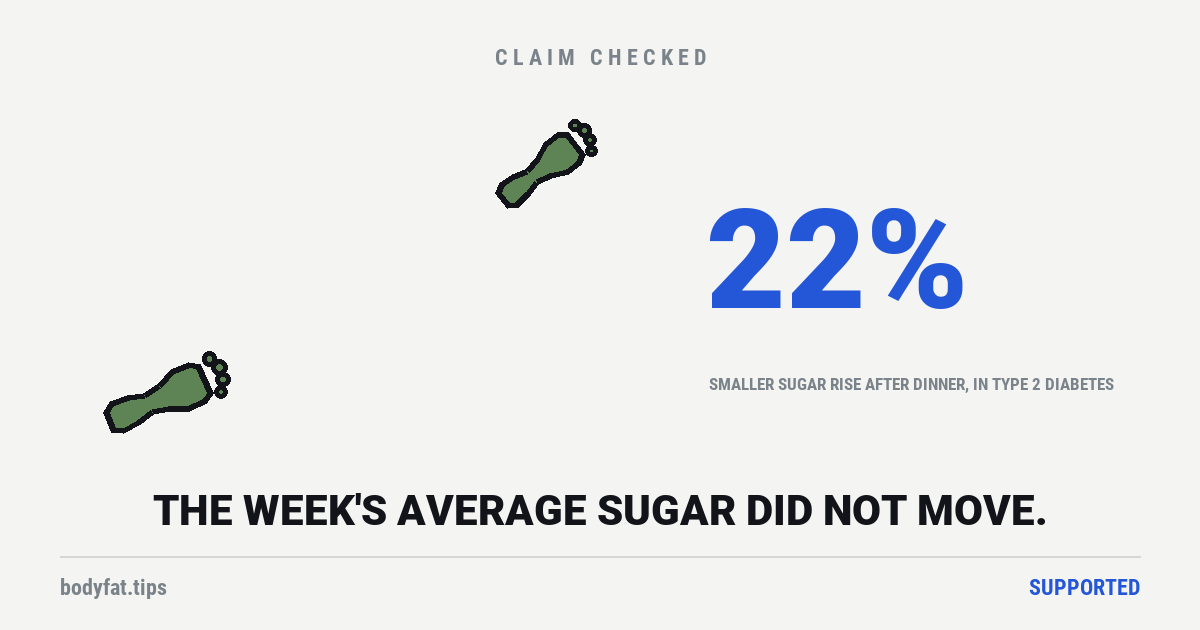
| … after the evening meal | 22% lower |
Twelve per cent lower, somewhere between 1% and 22% (the range the true answer probably sits in). And after the evening meal, where people ate the most carbohydrate and moved the least afterwards, it was 22% lower. After breakfast and lunch, the differences were too small to tell apart from chance: the evening meal carried the result [1].
Now the two things that number does not say. It is the size of the rise after meals, not blood sugar itself. Averaged over the monitored week, blood sugar was the same on both plans, about 168 mg/dL (9.3 mmol/L). And the plans were only the same on paper. The activity monitors recorded more movement overall on the after-meal plan, including about three more minutes of walking in the hour after lunch and four and a half more after dinner [1]. By their own account these people walked 14 minutes a day on average before the trial, and only seven of the 41 managed half an hour, so for most of them neither plan was walking they were already doing. So the trial cannot fully separate the timing from the extra movement.
So here is the sentence we can write: that is a real effect on the rise after dinner, for no money and the same prescribed half hour. It is not, on this evidence, a change in your average blood sugar.
Why the timing does the work
A 2023 review pooled eight randomised trials that tested this properly — the same people exercising before a meal, after a meal, and not at all. [2]
Exercise after eating (mostly walking; a few trials used cycling, weights or standing) beat both the do-nothing condition and exercise before eating. The effect sizes were around 0.5, which researchers call a moderate effect — on that scale 0.2 is small, 0.5 is moderate and 0.8 is large.
But the striking bit is the other arm. On average, exercise before the meal did not lower the rise after it. The comparison against sitting still came out at −0.13, with a range that comfortably included zero — which is the statistical way of saying “we cannot rule out no effect whatsoever”. The trials behind that average did not all agree, though: the reviewers note that the one that waited longest after eating, an hour, even showed a trend in favour of walking before the meal [2].
The reviewers also found that the gap between eating and moving mattered: in their trials, the sooner people went, the smaller the rise after that meal [2].
Which makes sense. You are trying to be using the sugar while it is arriving in your blood, not an hour before it gets there or two hours after it has gone.
That logic is about the rise after one meal. Beyond it, the details are argued over. A 2023 review of 31 studies found the 24-hour average fell more when exercise started an hour or more after eating [6], and a 2026 review of 17 trials in type 2 diabetes found the effect on the rise strongest after breakfast, with no clear effect after dinner [7].
Standing is not the same thing
Worth saying, because a standing desk is the substitution people reach for.
A separate review of seven trials compared sitting, standing and light walking as ways of breaking up a long day. Standing did produce a small improvement in post-meal blood sugar. Walking produced a much bigger one — and unlike standing, walking also moved insulin. Head to head, walking beat standing on both. [3]
Standing up is better than not standing up. It is not a replacement for the walk.
Now the caveats, and they are real
These are small, short studies. The timing review pooled 116 people in total, and its authors rate the underlying trials as being at high risk of bias — their words, not ours. The standing-versus-walking review is seven one-day experiments. The New Zealand study is 41 people over two weeks. And a 2024 review points out that the timing review counted some people twice, when the same volunteers tried more than one kind of exercise [4].
The biggest caveat is the rest of the day. A smaller rise after a meal does not automatically mean lower blood sugar overall, and on that question most of the trials we found came up empty. In the New Zealand trial, the week’s average did not move [1]. A 2024 review of 28 studies and 382 people found no difference between activity before and after meals over 24 hours, or after four to six weeks of training, though its longer trials were all built around cycling, in people without diabetes [4]. A 16-week trial in 20 people with type 2 diabetes found walking after breakfast no better for HbA1c, a blood test that reflects your average over the past two to three months, than walking before it [10]. And in a seven-week trial that randomised 40 pregnant women with gestational diabetes (26 finished), three 10-minute walks after meals did no better on the rise after meals than one 30-minute walk [8]. The exception: in India, 64 people with type 2 diabetes had lower HbA1c after 60 days of walking after each meal than after 60 days of one 45-minute walk before breakfast, in a trial whose authors note it had no break between the two periods [9].
Every outcome here is a marker, measured over days to months. We found no study that has followed people for years to see whether walking after meals changes how long they live or whether they develop the complications of diabetes. What we have is a consistent, plausible, short-term effect on a marker that matters.
Who gains most is not settled. The New Zealand trial took only people with type 2 diabetes, so it cannot say. In the timing review, the effect of exercising after a meal was, if anything, larger in people without diabetes (0.60 against 0.47 on the scale above), and its edge over exercising before the meal reached significance only in them [2]. The 31-study review found the opposite on one measure: the 24-hour average fell more in people with type 2 diabetes [6].
If your blood sugar is normal, the effect on the rise after a meal has been measured in people without diabetes too: 69 of the 116 in the timing review’s trials [2]. A smaller bump after lunch is not a transformation, though, and it should not be sold to a healthy person as one.
What it will not do
This is not a weight-loss intervention. The trials that weighed people say so. Two weeks on either plan left the New Zealand volunteers’ body mass index and waist size where they were [1]. In a Norwegian trial, people with raised blood sugar, or at high risk of it, who added at least 30 minutes of light activity starting within half an hour of a meal, every day for 12 weeks, ended about 1.5 lb (0.7 kg) lighter on average, while the comparison group ended about 1.3 lb (0.6 kg) heavier; no blood sugar measure changed [5]. That is extra movement at work, not timing: the comparison group kept to its usual routine. Ten minutes of gentle walking burns roughly what ten minutes of gentle walking burns, which is not much.
Walking absolutely can contribute to weight loss, and we have checked that separately. But that is a story about total volume over months. This page is about a different thing: what happens to your blood sugar in the three hours after you eat.
Two different claims, two different piles of evidence. Do not let anyone merge them for you.
The verdict
Supported. Walking soon after a meal lowers the rise in blood sugar that follows that meal: more than sitting, more than standing, and, pooled across trials, more than the same exercise taken before the meal. The New Zealand trial and the reviews on this page point the same way on that, though not after every meal, and the mechanism is not controversial. What the rating does not cover is your blood sugar across the whole day: on that, most of the trials we found show no difference, with one exception, so it is not settled [1] [4] [9].
It is Supported rather than Established because the trials are small and short, one review flags high risk of bias in its own included studies, and the longest trials ran for months and measured markers such as HbA1c and weight, not the long-term complications of diabetes.
But the practical version is simple, so here it is: if you are already walking, moving some of it to just after your meals costs nothing and blunts the rise after those meals — in the New Zealand trial it showed up after the evening meal [1], though the 2026 review found it strongest after breakfast [7].
If you are treating diabetes, changes to activity can interact with medication and with hypoglycaemia risk. That is a conversation with your clinician, not with a website.
Related: how many steps a day you actually need and whether walking helps you lose weight — the same activity, asked two different ways.
If you want to know what earns each rating, we wrote down how we read a study, and everything we have checked is in one place.
This page was corrected on 1 October 2026 after an independent editorial review. Its headline said blood sugar fell 12%. The trial measured the size of the rise after meals, which was 12% smaller on the after-meal plan (somewhere between 1% and 22%) and 22% smaller after dinner; averaged over the week, blood sugar was the same on both plans. Our headline made the same move this page’s provenance chain now describes. The page also said both plans were the same walking: only the instructions were, and the people on the after-meal plan moved more. It said the benefit was clearest in people whose blood sugar was already high and that healthy readers should expect less; its own source found the effect, if anything, larger in people without diabetes. And it said we had found no trials of post-meal walking and body weight; its own source measured body mass index and waist size, and a 12-week trial weighed people. Each passage now says what the trials found, and the headline and the evidence panel are rewritten.
Also changed: the page now reports a larger 2024 review of 28 studies that found no difference between activity before and after meals over a whole day or several weeks, along with newer reviews and longer trials that point both ways; “three independent reviews” miscounted what the page cited, which was two reviews and a trial; the funding row gives both reviews’ own funding statements, which it had called missing, and the new sources’ funding; the trial randomised 42 people, 41 of whom finished; the video count names its platform, search and date; and the framing step no longer credits walking with a pattern we found for psyllium. The rating is unchanged: the verdict now says plainly that it covers the rise after a meal, not blood sugar across the day.