Castor Oil Packs: The Drug Is Real. It Just Has to Go Through Your Gut, Not Your Skin.

Castor oil is not a scam. Let us get that out of the way first, because almost everything written about it lands on one of two silly extremes.
It is one of the oldest drugs we have. It has a known molecular mechanism, worked out properly and published in one of the best journals in the world. It reliably does something to the human body, and there are trials and hospital records covering more than two thousand women showing exactly what.
There is just one problem with the tub of it currently sitting on a folded cloth on somebody’s stomach.
Almost everything castor oil is known to do inside the body, it does after being swallowed.
What castor oil actually does, and how
In 2012 a team published the answer to a question that had been open for centuries: why does castor oil work? [1]
Castor oil is mostly a fat called ricinolein. When you swallow it, enzymes in your intestine — lipases, which exist to break fats apart — snip it into ricinoleic acid. That freed acid then latches onto a receptor called EP3, sitting on the smooth muscle of your gut and uterus, and tells that muscle to contract.
How certain is that? The researchers bred mice without the EP3 receptor. In those mice the laxative effect vanished. So did the uterine contractions. Then they got more specific: deleting the receptor only from the gut lining changed nothing, while deleting it only from smooth muscle abolished the response. That is not a hand-wave about mechanism. That is a mechanism nailed down.
Read the first step again, though, because the whole question turns on it. Intestinal lipases. The active molecule does not exist until something in your gut cuts it loose.
And it demonstrably works in people — at one particular job
Castor oil has been used to start labour for a very long time, so that is where the human trials are.
A 2022 meta-analysis pooled 12 studies and 1,653 pregnant women. Labour induction was over three times more likely in the castor oil groups (relative risk 3.27, meaning roughly triple the rate; the plausible range ran from about 2 to 5.5, so chance alone is an unlikely explanation). Bias is another matter. The review found signs that small studies with positive results were likelier to be published; its own chart adds up to 1,606 women, not 1,653, and two of its twelve reports appear to be the same trials published twice; and the trial its table describes as double-blind, meaning neither the women nor the staff knew who got castor oil and who got a sunflower-oil dummy, found no clear difference overall (an effect showed up only in women who had given birth before). Vaginal delivery happened in 81% of the castor oil group against 69% of controls. [4]
A 2026 hospital cohort added 1,015 more women, 824 of whom got castor oil. Their castor oil came in a cocktail: about four teaspoons (20 mL) blended with almond butter, apricot juice, cinnamon and non-alcoholic sparkling wine or water. About half of them went into labour on it alone; the rest needed further induction. Delivery took longer than with standard drugs and balloons (26.9 hours against 19.0), with no significant difference in how they delivered or in complications, and the authors say their design cannot show cause and effect. [5]
And the Cochrane review, which is more sceptical about the older trials, records one detail worth keeping. Most of the women who swallowed castor oil felt sick. In the two trials that recorded it, 63 of the 76 given castor oil were nauseous (all 52 in one trial, 11 of 24 in the other), against none of the 71 who were not. The review’s summary says every one of them; its own analysis says 63 of 76. [3]
Which is, in its way, the most useful sentence in this article. That is what a substance reaching your gut and acting on it feels like. A cloth on your belly has to get the oil there first.
Now the pack
We went looking for the human evidence on castor oil applied to skin: the pack, the topical application, absorption through skin, the liver, the navel. Most of the pack studies sit in journals and reports that PubMed, the main medical database, does not index, which is why our first searches turned up just one.
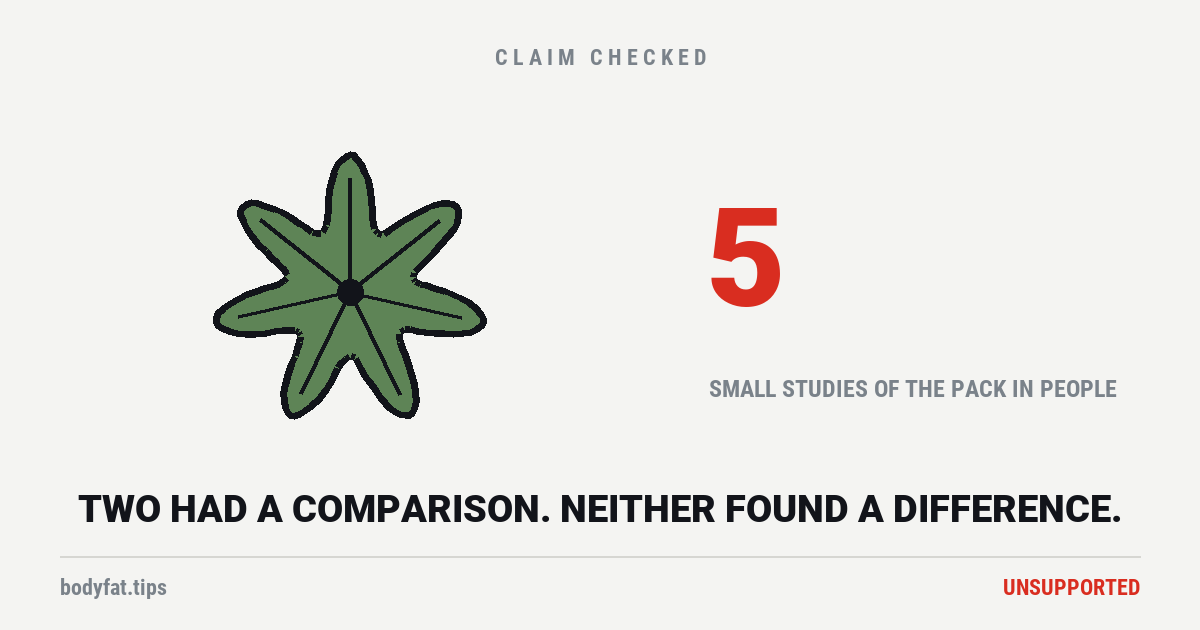
We have now found five small studies of the pack in people. The two that compared it with a stand-in found no difference between the groups.
| Swallowed | On the skin | |
| Human studies | 11 studies, about 2,500 women | 5 small pack studies, 3 to 36 people |
| Known mechanism | EP3 receptor, confirmed in knockout mice | none proposed that survives the gut step |
| Absorption through skin | not applicable | tested once, in 3 people: markers stayed near background |
| Effect on the liver | not what it does | tested once, in 10 people: no change |
Start with the constipation study. It was run at two rest homes in Manisa, Turkey, among 35 residents aged 65 to 86, about three in four of them women, all with long-standing constipation — 80% of them had been constipated for a decade or more. Researchers tracked them for seven days before the packs, three days during, and four days after. [2]
Here is the result, and it is worth reading slowly. Castor oil packs did not change the number of bowel movements. They did not change the amount of stool. Those are the two things you can count, and neither of them moved.
What did change were the things the residents reported: stool consistency, how much they had to strain, and the sense of having finished. The authors concluded that the packs may be useful for controlling constipation symptoms.
So did it work? On the honest reading: elderly people who had an oiled compress placed on their abdomen for three days reported straining less. That is not nothing. It is also not a bowel movement, and there was no dummy compress to compare against — everybody knew what they were getting.
The dummy compress has been tried, in a different study. In 1987 a research institute at a holistic clinic, founded by two physicians who championed the pack, randomly gave 36 healthy volunteers either a castor oil pack or an identical pack of paraffin oil, worn over the liver for two hours; neither the volunteers nor the staff knew which. When the two groups’ white blood cell counts were compared directly, the difference was not significant. The author, writing it up in a naturopathic journal in 1997, reported that lymphocytes (the white cells that coordinate immune defence) rose significantly within the castor oil group but not within the paraffin group, and concluded that the packs stimulate the immune system. A change that reaches significance in one group and not the other is not the same as the two groups differing, and on the paper’s own chart one of those counts rose further in the paraffin group. [8]
Two more studies tried castor oil on sore knees in India: a pack, in 30 women with no comparison group, and warm oil massaged in under a heating pad, in 100 women compared with no treatment. Both reported less pain. Neither had a dummy that could separate the oil from the warmth and the attention. [11] [12]
One more trial points the other way. In 2024 an Ayurvedic hospital in India spread a paste of castor oil, long pepper and sweet flag root over the lower belly, groin and pelvis of first-time mothers already in labour, and compared it with a paste of a different root. In the castor oil group the cervix changed faster and the contractions came more often. Labour moves on by itself, the castor oil came mixed with two plants its authors say also bring on contractions, the comparison was another remedy rather than a dummy, and the paper gives its size both as 40 women in all and as 40 in each group. [14]
The step that never gets explained
Put the two halves together and the gap is obvious.
The mechanism requires intestinal lipases to release ricinoleic acid from the oil. Those enzymes are in your small intestine. They are not in your abdominal skin, and the oil on a compress never meets them.
So what is the proposed route? Does castor oil cross skin in meaningful amounts? The one study we found that measured it in people found no sign that it does. In 2005 an institute that researches the remedies of an early-twentieth-century American psychic, whose readings prescribed the pack, tested three of its own researchers, all of whom had used the packs before. It gave them hot abdominal packs, up to the heating pad’s highest setting for an hour and a half, and on other days castor oil by mouth. After as little as half a teaspoon (2.5 mL) was swallowed, the breakdown products castor oil leaves in urine rose many times over; after the packs, they stayed close to their normal background levels. [10] Its authors wrote that it would be “truly amazing” if no significant amount got through after an hour and a half of high heat, and that they were unable to show that any did. Three people is a small test, and it is still the only measurement in people that our searches turned up.
The liver claim
This is the one the packs are actually marketed on: place it over your liver overnight, and it detoxifies.
Studies we found examining castor oil packs and liver function: one, and we found it through an ordinary web search, not the medical databases. In 2002 the same institute randomly split ten adults, all used to the packs, into two groups of five. One group wore a heated castor oil pack over the liver for an hour a day for three days; the other wore the same heated flannel, dry. Before and after, a laboratory measured how their bodies cleared test doses of caffeine, aspirin and acetaminophen. No measure changed significantly in either group, and the groups did not differ; the institute’s own report saw “no suggestion that a larger sample might give statistically significant results.” The volunteers and staff knew who had which, and the version we read is a report on the institute’s website, not a journal paper. [9]
Searching for castor oil and the liver does return results, and they are a good lesson in reading carefully. They are about polyethoxylated castor oil — a chemically modified derivative used as a solvent to dissolve chemotherapy drugs for injection. Real medicine, real papers, completely different substance doing a completely different job. It has no bearing on a compress.
And “detox” remains what it always is in this aisle: a claim with no stated toxin, no measurement, and therefore no way to fail. We have been here with detox teas and with the cortisol detox. Your liver is not a filter that clogs. It is an organ that is either working or is a medical emergency.
The belly button version
“Castor oil belly button” is a search of its own: the oil poured into the navel instead of soaked into a cloth.
Studies of it: one small one, from India’s traditional medicine. Ten women with period pain put castor oil in their navels from a week before each period to its fifth day, and reported less pain, nausea and tiredness afterwards. There was no comparison group, so the oil cannot be separated from the ritual, the attention or a milder month, and nothing about the liver was measured. [13]
The reasoning offered is that the navel is a doorway to something internal — and there is a version of that which sounds compelling, so let us take the strong form of it. Before you were born, a vein really did run from your umbilical cord toward your liver. That is true.
What happened to it is the part that matters. A 2025 radiology review of the umbilicus describes the structure in its opening line as a scar of the umbilical cord, and lists the umbilical arteries and vein among the obliterated remnants it contains. [7]
Obliterated is the operative word. The vessel did not stay a tube with a lid on it. It closed and fibrosed into a solid cord of tissue. There is no channel there to pour anything into, which is why an oiled navel has exactly the same access to your liver as an oiled elbow.
A detour we could not resist
When you search PubMed for “castor oil pack”, you get three results. One is the Turkish rest home study. One is about phenytoin capsule formulation.
The third is a chemical analysis of Egyptian mummies. [6]
Researchers ran mass spectrometry on embalming balms from a mummy of the Ptolemaic era — around 100 BC — and found castor oil in half the samples, present in the balm inside the thorax but not in the skull. It surfaced in our search because the paper discusses the canopic pack of the heart.
We include this partly because it is wonderful, and partly because it is the clearest possible statement of where this field stands. A third of what PubMed returns for that phrase is about a two-thousand-year-old corpse, because PubMed quietly searched for castor oil and the word pack instead.
If you are pregnant, this section is the one that matters
Everything above should make this obvious, but it is too important to leave implied. Castor oil taken by mouth induces labour. By our count that rests on eleven distinct studies and about 2,500 women, most of them in hospital records rather than trials.
That makes it a drug with a real obstetric effect, and starting labour is a decision for a clinician who knows your pregnancy — not something to self-administer because a video suggested it. In the hospital cohort above, it was given under supervision, in a unit, to women being induced on purpose.
The verdict
Unsupported — and not because castor oil is inert. Because the evidence that it does anything is almost all attached to a route nobody is using.
Swallow it and you have a genuine drug: known receptor, confirmed in knockout mice, trials and hospital records covering more than two thousand women, and a side effect common enough that 63 of the 76 women given it in the Cochrane review’s nausea analysis reported it. Put it on a cloth on your stomach and the small tests that exist found no sign that it gets through the skin, no change in how the liver handled test doses of caffeine, aspirin and acetaminophen, and no difference from an identical pack of paraffin oil in the immune counts one trial measured. In the constipation study, the two countable outcomes did not budge.
What would change our mind is not the two tests this page used to ask for. Both have been run, both small, both run or paid for by the pack’s own advocates: the absorption test found no sign of the oil getting through, and the dummy-pack trial found no difference between the groups. What would move the rating is a blinded pack trial big enough to detect a modest effect, on something a buyer actually cares about: bowel habit, bloating, liver tests.
Until then the pack is a warm compress with an ingredient list. Warm compresses on a sore abdomen are genuinely soothing, and there is no need to invent a liver mechanism to justify one.
Related: whether waist trainers work and what detox teas actually do — the same shape of promise, that something applied to the outside reorganises the inside.
If you want to know what earns each rating, we wrote down how we read a study, and everything we have checked is in one place.
This page was corrected on 1 October 2026 after an independent editorial review. It said castor oil packs had been studied once, that nobody had measured whether the oil crosses skin, that no study had looked at the liver, and that no trial had used a dummy compress. All four were wrong. A 1997 double-blind trial compared castor oil packs with identical paraffin-oil packs in 36 volunteers; a 2002 report compared heated packs with heated dry flannel on liver-clearance tests in ten adults; a 2005 study measured castor oil’s breakdown products in the urine of three volunteers after packs and after swallowing it; and a 2023 study tried packs on knee pain. Most sit outside the medical databases we searched first. The three that tested what abdominal packs are sold on found no sign of absorption, no change in liver tests and no difference from a dummy pack, and the page now describes each, with who ran and paid for it.
Also corrected: “every woman felt nauseous” is the Cochrane review’s summary; its own analysis counts 63 of 76 in the two trials that recorded nausea. “Sixteen studies and nearly three thousand women” counted the Cochrane trials twice and took the 2022 meta-analysis’s total at face value; by our count the oral evidence is eleven distinct studies and about 2,500 women, most of them in hospital records. The constipation study’s 35 participants, which we said we could not confirm, are in the publisher’s free preview. A monthly search figure and a “fastest-growing” claim that we could not trace to any saved data were removed; the funding row now says what each source states; the belly-button section now reports a ten-woman pilot study it had missed; a 2024 trial of a castor oil paste in labour, which points the other way, is now reported with its limits; and the claim this page rates is narrowed to the liver claim it tests. The rating is unchanged: Unsupported, now because the tests have been run and found nothing, not because nobody ran them.