Forest Bathing: People Feel Better. You Cannot Blind Anyone to a Forest.

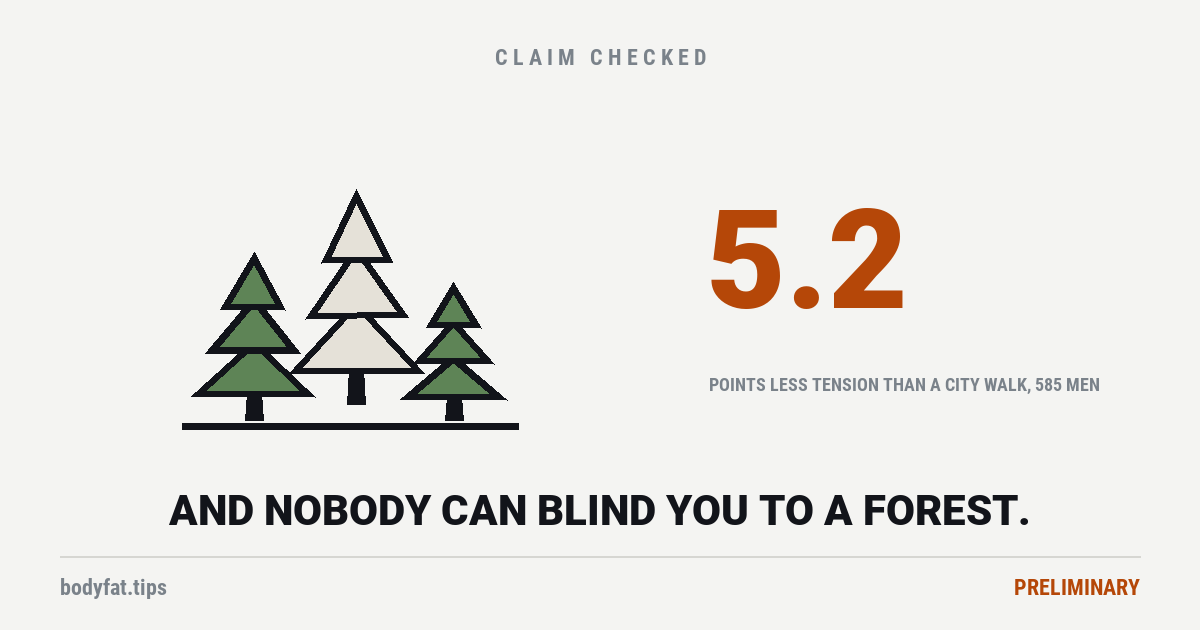
People say they feel better after a walk among trees than after a walk among buildings, and that has been found again and again. In one large study, 585 young men in Japan each walked for 15 minutes in a forest and for 15 minutes in a city. After the forest, their tension scores on a standard mood questionnaire were 5.2 points lower, on a scale where 10 points is the usual spread between people. [12] A 2026 review of 18 controlled studies, 16 of them run in South Korea, Japan or China, found depressive symptoms eased more after forest time than after the comparison (usually a city walk or ordinary routine) in most of them; a 2023 review of 36 studies found depression and anxiety fell, with fewer gains on physical measures. [3][4]
For scale: 0.2 is small, 0.5 is moderate, 0.8 is what researchers call large. The 2026 review pooled its 18 studies at about 1.0 on depressive symptoms, which would be large. [3] Hold that loosely; the reasons are further down.
Now the problem, and it does not go away. You cannot blind anyone to a forest.
| Outcome | Finding | How far to trust it |
| Tension after a 15-minute walk, forest against city (one study, 585 men) | 5.2 points lower | one large study; the men knew which walk was which |
| Depressive symptoms (18 studies) | effect size about −1.0 | results scattered far beyond chance; signs of missing studies that found nothing |
| Systolic blood pressure, forest against city (24 comparisons) | −3.4 mmHg | every randomised study judged at high risk of bias |
| Saliva cortisol, forest against city (8 studies) | −0.05 µg/dL | already lower before the session began |
| Heart rate, before against after (2 studies) | −4 bpm | very low; no comparison group |
Why the blinding problem is not a technicality
In a drug trial, nobody knows who got the pill. That is what stops expectation doing the work.
Here, everyone knows. You were driven to a wood, walked among trees for two hours, and then handed a questionnaire asking how stressed you feel. You are aware you have just done the nice thing, and you are aware somebody is measuring whether the nice thing worked.
A 2026 review that we have otherwise set aside (more on that below) names it precisely: the limitations are “the reliance on self-report measures and the impossibility of participant blinding”. [1] Not the impracticality — the impossibility. No amount of research funding fixes this one.
What researchers can do is hide one ingredient. In a 2025 trial in Washington State, adults sat in a forest for an hour on two visits, wearing a hood that filtered the air they breathed. Neither they nor the field staff knew which visit stripped out the forest’s scent chemicals, terpenes, one proposed explanation for the calm. Heart rate variability, the trial’s main measure, did not differ between the visits, and nor did self-reported stress, heart rate, blood pressure or cortisol; a marker of inflammation and skin conductance did. [7] Forty-three people enrolled and 31 completed both visits, so it is small. And the trees themselves cannot be hidden that way.
Swap the city for another pleasant place and, in one trial at least, the forest’s lead shrinks. In a 2022 German trial, 39 adults screened as highly sensitive people spent an hour in a forest and, a week apart, an hour in an open field. A well-being questionnaire leaned towards the forest, a mood questionnaire favoured the field (though the authors note the groups started unevenly on it), and cortisol did not differ. [13]
So the honest reading of all these numbers is: people taken to forests report feeling substantially better afterwards. Which is worth knowing. It is just not the same claim as the forest having done it.
What the monitors found
Heart rate, blood pressure and cortisol are measured rather than reported. They tell a smaller story.
Heart rate fell by about 4 beats a minute in a 2026 review, but that figure comes from two small studies measured before and after a session, with no comparison group: 12 young Japanese men sitting among trees for 15 minutes, which carries most of the weight, and 99 adults in South Korea on a two-hour walk. [2] The review’s own authors say their design supports only “short-term associations rather than definitive intervention effects”.
A blood-pressure cuff does not know you are having a lovely time, though the person wearing it does. Against a city walk, blood pressure after forest time was about 3.4 points lower (mmHg, the unit on a blood-pressure cuff) across 24 comparisons from 21 studies in a 2022 review, which judged every randomised study in it at high risk of bias; for any one new study, the likely result runs from 13 points lower to 6 points higher. [5] A 2022 review that kept only randomised trials could pool blood pressure from just two of them, and found no change. [11]
Cortisol, a stress hormone, does something stranger. In a 2019 review that pooled eight studies, saliva cortisol was lower in the forest groups than in the city groups after the session, by 0.05 micrograms per decilitre. In the studies that also measured it before the walk or the viewing began, it was already lower, by 0.08. [6] The reviewers write that “anticipated placebo effects can play an important role”. That looks like the blinding problem, turning up in a hormone.
So the body does respond, a little, and for cortisol the gap was there before the walk began.
How much to trust the reviews, including the one we dropped
Worth stating plainly. This page used to lead with a 2026 review in BMC Public Health: 25 studies, 1,876 people, a stress effect size of 0.71 and “moderate” certainty. [1] We have set it aside, because its numbers do not add up. Its stress chart lists 18 studies whose results sit so close together that they differ no more than chance would produce, yet the paper reports an I-squared of 74.8% (the share of the spread between the studies’ results that is more than chance would produce); worked out from its own chart, that share is zero (our arithmetic). The chart’s weights add up to 85%, not 100%. Its table of studies adds up to 2,181 people, not 1,876. And all 15 of the studies in that table that we checked against the papers they name are described at least partly wrongly: one listed as a trial of 38 adults is, by the review’s own reference list, a review of other studies.
The newest review is checkable, and its chart adds up. Read it closely, though. [3] Its biggest study, the 585 young men, came out at 0.19 for low mood in the review’s own chart, a small effect; weight each study by how precisely it measured and the 18 results average about 0.5, not 1.0 (our arithmetic, from that chart). At least two of the 18 it calls randomised trials describe themselves otherwise: one assigned people “on a non-random basis”, another calls itself quasi-experimental, a design without random assignment. And its authors found signs that small studies which found nothing had gone unpublished.
Its studies also disagreed far more than chance allows: an I-squared of 90%. The range a new study’s result would probably fall in runs from a very large benefit to a moderately large result in favour of the comparison. [3] The 2026 heart-rate review graded all its evidence very low, citing “risk of bias, inconsistency, and imprecision”. [2] The studies agree on the direction and disagree considerably on the size.
Does it matter who you are, or how often you go?
The review we set aside said longer programmes and people who were unwell to begin with showed bigger effects. [1] Its subgroup chart, though, uses a different set of studies from its main chart, with different numbers for the studies they share, so we cannot lean on it.
The newest review found depressive symptoms eased in healthy people, in people with long-term physical illness and in people with depression, with no clear difference between the three, and sessions with a guide did about as well as going alone. [3] Most of the people studied were in South Korea, Japan or China, a mix of students, patients and healthy adults, and nearly all were measured straight after the session.
Does going more often do more? Maybe. A 2025 German trial randomised 171 adults to two or to three two-hour forest sessions and found no difference between the groups; both improved. [8] A 2025 review of 78 studies of time in nature, forests and otherwise, among adults with mental illness or its symptoms, found repeated short visits did better than single ones. [9] In the blood-pressure review, walks and multi-session programmes lowered pressure, and seated viewing did not clearly do so. [5]
We are not going to give you a number of hours a week. The figure you have seen quoted, two hours, comes from a 2019 survey of nearly 20,000 adults in England about time in any kind of nature: those who spent two hours or more were more likely to report good health and wellbeing, and its authors add, “It did not matter how 120 mins of contact a week was achieved.” [10] A survey like that shows who feels better, not that the two hours did it.
The verdict
Preliminary. Study after study finds people feel less tense, low and anxious straight after time among trees, healthy people and patients alike. That much is consistent. How much it is worth is not: the pooled sizes run from moderate to large depending on how the studies are weighted, nearly every study is small, unblinded and measured on the day, and the measures a questionnaire cannot shade, blood pressure and cortisol, move a little, with cortisol already lower before the walk began.
What holds it at Preliminary is a problem no amount of money fixes: nobody can be blinded to a forest, and most outcomes are questionnaires filled in by people who know exactly where they have been. Measuring the body instead is possible and has been done; those measures move less, and a trial that hid part of the forest from people, its scent, found no difference in stress. What would move this rating: large trials against a comparison people expect as much from, with blood pressure or cortisol as well as questionnaires, and a look at whether anything lasts beyond the day.
The 2026 heart-rate review’s own summing up is the fairest sentence written about this practice: forest bathing should be treated as “a potential complementary practice for health promotion, and not as an individual preventive or therapeutic intervention”. [2]
Which, translated: go for the walk. It appears to help, and a walk on your own costs nothing; nobody needs to sell it to you. Just do not stop treating a diagnosed condition because a wood made you feel better on a questionnaire.
Related: box breathing · doomscrolling · ikigai · all the habits we have checked · every claim we’ve checked
Corrected on 18 September 2026. This page said forest bathing’s pattern, working best in people who were unwell to begin with, is the pattern this site keeps finding, the way box breathing and most of the stress literature behave. Our box breathing verdict, corrected today after an independent editorial review, does not show that for box breathing. In the breathwork meta-analysis it cites, the stress benefit was clear only in the trials of healthy volunteers; and in a 2020 trial of three short relaxation recordings, one of them box breathing, all three worked better in people who were less anxious to start with. We had no source for the claim about most of the stress literature either. The sentence now keeps the forest-bathing finding and drops the comparison. The rating is unchanged: Supported.
This page was corrected on 1 October 2026 after an independent editorial review, and its rating was reconsidered. It led with a 2026 review in BMC Public Health: 25 studies, 1,876 people, a stress effect size of 0.71 and moderate certainty. That review’s figures do not add up: its stress chart’s own rows show no more spread than chance, against a reported I-squared of 74.8%; its weights sum to 85%; its table sums to 2,181 people; and all 15 of the studies in its table that we checked are described at least partly wrongly. We have set it aside and rebuilt the page on reviews and trials we could check. The heart-rate figure, which we called resting heart rate from eleven studies, comes from two small before-and-after studies. The funding row said funding was not stated in our sources; both reviews state it, and the row now gives every source’s funding.
Also changed: the page no longer says sustained programmes beat single outings, or that people who are already coping should expect less; it reports what the newer trials found, in both directions, and says who the studies were in. The panel no longer says both reviews called nearly all outcomes self-reported; the heart-rate review measured the body. The provenance chain now names the real 2019 headline behind the two-hours figure, and states the claim this page rates; its cost per click now matches our saved keyword pull: $5.29, not $3.57. The line saying nobody is selling you anything now says a walk on your own costs nothing. The rating changed from Supported to Preliminary: people consistently report feeling better after time among trees, but the studies cannot yet separate the forest from the outing and the expectation, and the measures a questionnaire cannot shade move only a little.
Corrected on 9 October 2026. The provenance chain gave a search figure, about 14,800 US searches a month for “forest bathing” at $5.29 a click, with the date of our pull but not where it came from. It comes from a paid keyword database, pulled on 6 August 2026, and the chain now says so. The rating is unchanged.