Methylene Blue: No Energy Boost Shown. On an Antidepressant? Read This.

Methylene blue is not a supplement. It is a drug, and it is approved by the Food and Drug Administration to treat exactly one thing.
Methemoglobinemia — a poisoning in which the blood loses its ability to carry oxygen. [1] It is an emergency, it happens in hospitals, and methylene blue is the antidote.
It is now sold in dropper bottles to people who want more energy.
Know what that warning is built on. The published cases followed methylene blue injected or infused in hospital, most often during parathyroid surgery or to treat shock, in patients taking an antidepressant. [5] [6] Whether the same happens when it is swallowed, the FDA said in 2011, is “not known”. [5] Not known is not the same as safe: in September 2025 Australia’s regulator told consumers not to use it by mouth unless a health professional advises or prescribes it. [9]
The symptoms the label lists: agitation, hallucinations or sudden confusion; a racing heart, swings in blood pressure, sweating, flushing or fever; tremor, rigid or jerking muscles, poor coordination; seizures; nausea, vomiting or diarrhoea. It tells doctors to advise patients to “seek immediate medical attention” if these follow a dose. [4]
We are not telling you to stop any medicine your doctor prescribed. We are telling you that this is a conversation to have with them before anything else.
The hospital evidence is real, and it is worth stating properly
We are not going to pretend this is snake oil, because it isn’t.
Beyond the poisoning indication, methylene blue is used in vasoplegic shock, in a specific chemotherapy complication, and as a surgical stain. [1] And there is genuinely interesting recent work on preventing the confusion and memory problems that follow major surgery in older patients — a problem affecting somewhere between 15% and 40% of them. [3]
In one trial at a Shanghai hospital, 248 patients aged 60 to 80 were given either a single dose into a vein during their operation or the same volume of salt water. Delirium followed in 7% of those given methylene blue, against 24% of those given salt water: 9 patients of 124, against 30 of 124. [12] That is a large effect on a serious problem.
Now notice everything that sentence contains
Intravenous. Single dose. Weight-calculated. Given during surgery, by an anaesthetist, to elderly patients under monitoring, in a hospital.
None of those words describe a dropper bottle and a glass of water.
This is the move the whole category runs on, and it is worth naming because you will see it again: a real drug with real uses is not the same thing as a supplement, and the evidence for the first does not transfer to the second.
And the hospital evidence is itself young. Two later trials, each at a single hospital in China, found smaller gaps: 8.3% against 20.4% after hip and knee replacements in 217 patients, and 11.5% against 23.6% after pancreatic surgery in 314, where a second dose was given. [13] [14] A 2026 analysis pooled all three, 779 patients, and put the odds of delirium with methylene blue at about a third of the odds without it. The figure is an odds ratio of 0.35: an odds ratio of 1 would mean no difference, and the range the true average effect probably sits in runs from 0.23 to 0.53. [15] We re-did the sum from the three trials’ own counts (36 cases among 390 patients given the drug, 89 among 389 who were not) and got the same answer.
Now the limits. None of the three kept everyone in the dark about who got the drug, which turns urine blue: the first was open-label, and the other two were single-blind, meaning only some of the people involved did not know. [3] [13] [14] [15] Two of the three come from one research group. All three kept out patients taking SSRI or SNRI antidepressants and patients with G6PD deficiency, which tells you how the people running them regard the two risks this page sets out. [12] [13] [14] And when the joint-replacement trial phoned its patients a month later, a test of thinking and memory showed no difference between the groups. [13] The pooled analysis says further large trials are required. [15] The review this page first cited, a narrative one, asks for large trials at more than one hospital before methylene blue’s role is considered established. [3]
For the thing actually being sold — drops in water, taken daily, for energy, by healthy people — we did not find a trial, in searches of PubMed, OpenAlex and the US trial registry on 30 September and 1 October 2026. None that gave the drops, and none that set out to measure energy.
So has anyone tested it in healthy people?
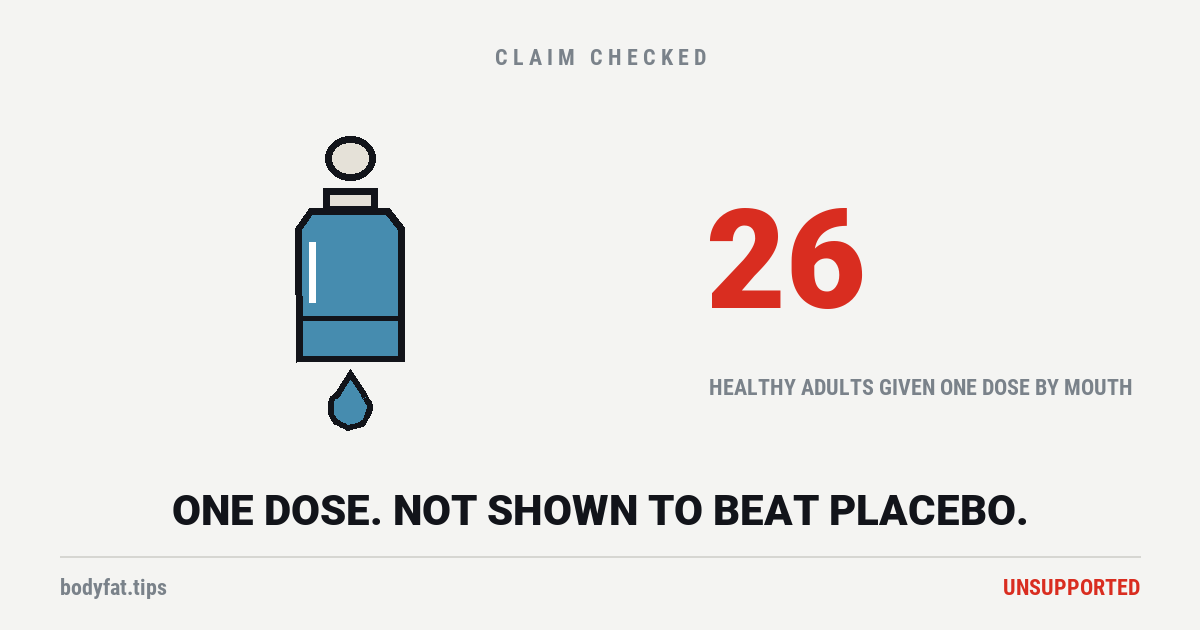
Yes, a little, and not the way it is sold. One trial is the one that sellers’ pages and the videos we sampled point to. In 2016 a University of Texas team gave 26 healthy adults either one 280 mg capsule of methylene blue or a capsule of blue food colouring, then scanned their brains and tested them an hour later. [16] That is one dose, given once, and it is many times the serving printed on the two drops labels we read. [29]
What did it find? The paper’s summary says methylene blue was “associated with a 7% increase in correct responses” on a memory test. Its results section is more careful. The people given methylene blue got about 7% more answers right than they had an hour earlier, and the people given the dye did not change. But when the two groups were tested against each other, the difference fell the wrong side of the line researchers use for “probably not chance” (the paper gives P = .09; the line is .05). [16] Reaction time on the attention test, the first thing the trial was registered to measure, did not differ significantly between the groups (the paper gives P = .43); on methylene blue the average stayed at 230 milliseconds, and on the placebo it went from 230 to 220. [16] [17] The change in mood scores a week later did not differ significantly between the two groups (the paper gives P = .505; the line is .05). [16] Only six of the 26 were over 30. The press release from the journal’s publisher was headed “Methylene Blue Shows Promise for Improving Short-Term Memory”; it gave the 7 percent and did not mention that, tested against placebo, the difference was not statistically significant. [31]
The same team then ran the trial that could have settled it: 282 mg a day for twelve weeks, against a dyed placebo, in healthy older adults and in people with mild memory problems. [18] Its main measurements were complete by April 2022. Its results went onto the US trial registry in September 2024 as tables of averages, with no statistical test, and we found no published paper. Of the 43 healthy older adults who started, 25 finished. The registry records no serious harm in any group. It does record this, among the healthy volunteers: an urgent or frequent need to urinate in 12 of 22 on methylene blue against 2 of 21 on placebo, and bladder irritation in 7 against none. It posts no statistical test of those counts either. [18]
And the mitochondria? Two small British studies, from one research group, measured the thing the slogan is about: how much oxygen the brain uses. Both gave methylene blue into a vein, not by mouth. In eight healthy women the brain’s oxygen use fell, by 8% at the lower dose and 12% at the higher, and its blood flow fell by 8%. The authors had predicted a rise, and said so. [19] In the second study, of 15 people with bipolar disorder and 15 healthy volunteers, oxygen use and blood flow fell again across the group as a whole. [20] Both studies also asked people to rate their energy before and after the infusion. Neither found that methylene blue raised it. In the eight women, energy ratings fell measurably after the placebo and after the higher dose, but not after the lower one, which the authors took as some support for their idea; in the second study the ratings did not differ between methylene blue and placebo. [19] [20]
One thing all five of those reports share: each kept out people taking serotonin-raising medicines, people with G6PD deficiency and anyone pregnant. The Texas trials went further and took nobody on any psychiatric medicine. [16] [17] [18] [19] [20] That includes the trials that gave it by mouth.
In patients the record is longer, and mixed at best: an exploratory trial of methylene blue itself in 321 people with Alzheimer’s disease reported a benefit at the middle of its three doses, and of the three large trials of a related compound that its developer ran next, the first (891 patients) found no benefit, the second (800) swapped its main comparison before unblinding for one that was not randomised, and the third (598) could not separate its groups on its main measures at one year; small trials in bipolar disorder, claustrophobia and post-traumatic stress gave mixed results. [32] [21] [22] [23] [24] [25] [26] None of those people is the healthy buyer this page is about.
So what are the benefits of methylene blue?
What is methylene blue used for in humans?
In hospital, for real things, and they are set out above: an antidote for a blood poisoning, a rescue drug in one kind of shock, a treatment for a chemotherapy complication, a surgical dye, and early work on confusion after surgery [1] [15]. The bottles promise other things. Here they are one claim at a time, in people, as far as the human evidence goes and no further.
Does methylene blue improve memory?
In healthy people it has been tested for memory twice by mouth, and both trials are described above. In the 2016 trial, the 13 adults given one 280 mg capsule got about 7% more memory answers right than an hour before, and the 13 given a dummy capsule did not change; tested against each other, the gap between the two groups fell short of the line researchers use for “probably not chance” (P = .09). The twelve-week trial in older adults has posted its results with no analysis [16] [18].
A third trial by mouth was in young adults with a strong fear of enclosed spaces: 42 university students, given at random 260 mg of methylene blue or a dummy, in three capsules over the next day, the first straight after a session spent facing that fear in a small chamber. Its main question was the fear. It also asked them, a day later and one month later, to recall numbers that had been fixed inside the chamber, and where they were. A day later the two groups did not differ significantly. A month later those given methylene blue recalled more, scoring 1.4 against 0.7, just the right side of that same line (p = .047) [25].
Behind these trials sit animal studies going back to 1978, in which small doses given to rats and mice just after a learning session improved what they remembered a day later. A 2012 review of that work comes from a Texas group that includes one of the 2016 trial’s authors, and it was funded in part by the US National Institutes of Health [35].
In Alzheimer’s disease the trials are summarised above: one of methylene blue itself, then three of a related compound that its developer ran next [32] [21] [22] [23]. The developer’s own later papers add three things. The trial of methylene blue itself, 321 patients given 69, 138 or 228 mg a day or a placebo, reported its benefits at 138 mg in some groups of patients and on some measures [32]; it had kept the colour of patients’ urine from the staff who rated them, and regulators still criticised the design, the developer wrote, “because of the possibility of participant-bias in reporting of clinical outcomes on subjective scales”. The developer also names “bias in retention of participants after 24-weeks” in that trial: the patients who stayed on were not a fair sample of those who began [36].
Of its first two large trials of the related compound, the developer wrote that neither “showed any difference on primary or secondary outcomes between the high doses and 4 mg twice a day in the as-randomized comparisons”, that is, between the groups chance had put patients in [22]. Its favourable results have come other ways. In the second trial it compared patients taking the compound on its own with patients taking it on top of other Alzheimer’s drugs: groups that chance had not set up [22]. In the third, the main measures could not separate the groups at one year; differences in its favour appeared in one subgroup, people with mild memory problems, in the second year, when both groups were on the drug and differed in when they had started it [23]. On measures of the disease process rather than of symptoms, the same trial did report differences in its favour at one year between the groups chance set up. A blood marker of nerve damage rose less on the higher of its two doses than on the comparison dose; the trial had named that marker in advance, before anyone knew which patients had which dose, as its main blood measure. And a mapping of brain scans, with the two doses counted together, found less shrinkage in some regions, among them the hippocampus, a part of the brain central to memory. The trial’s planned scan measure, shrinkage of the whole brain, did not differ significantly at one year; a second planned blood marker leaned its way without reaching significance; and a tau marker added to the analysis later did not differ significantly in the whole trial, though it did in the subgroup with mild memory problems by the end of the second year [23]. And in 2026 it matched 127 patients from that trial, all on its compound, with 127 people from the placebo groups of earlier trials, held in a database that the paper calls FDA-sponsored and describes as run by a non-profit in partnership with the FDA. It reported statistically significant differences in its drug’s favour on thinking scores and brain shrinkage, and named the weakness of such comparisons itself: the differences may be “explained by unmeasured confounders”, ways the two groups differed that nobody measured. It then argued that such differences would have to be large to explain its results away, and that differences that strong would already be known and measured. It gave its reason for not running an ordinary placebo-controlled trial: one was “precluded by loss of blinding due to urinary colouration and therapeutic activity at the minimum dose required to maintain blinding”. The second half is its argument that the low dose given to its comparison groups, so that their urine was coloured too, was itself active. And it says the study “was financed entirely” by the developer [36].
Rated in words. That methylene blue sharpens memory in healthy people: Preliminary, small and conflicting: animal studies point that way; in people, the one published trial in healthy adults could not tell its memory result from a dummy capsule, and the trial in students afraid of enclosed spaces found better recall than on a dummy one month later but not the next day [35] [16] [25]. That is why this page’s verdict calls focus the closest call.
That methylene blue itself slows Alzheimer’s disease: Preliminary: one exploratory trial of 321 patients reported benefits at its middle dose in some groups and on some measures, in a design regulators criticised, and the developer’s later trials were of the related compound [32] [36]. That the related compound slows Alzheimer’s disease: Unsupported, of the tested kind: its three large trials did not show it on their main measures as randomised, and an independent 2026 review of drugs aimed at tau, which included one study of it, says it “did not demonstrate consistent clinical benefit in phase 3 trials”. The favourable results on thinking and daily life come from groups chance did not set up, from one subgroup’s second year, and from comparisons with other trials’ placebo groups [21] [22] [23] [65] [36]. Between the groups chance set up, what favoured it at one year were a blood marker and a mapping of brain scans: signs of the disease process, which do not by themselves show that patients declined more slowly, and in that year the trial’s planned measures of thinking, daily life and whole-brain shrinkage did not separate [23].
Can methylene blue help with fat burning?
Not that we could find in people. We found no study that set out to see whether methylene blue changes people’s weight or body fat [37].
The nearest measurement in people comes from intensive care. In at least seven small reports published from 1995 to 2005, two of them from one team, doctors gave methylene blue into a vein to patients in septic shock, a collapse of the circulation during a severe infection, and measured the whole body’s use of oxygen, which tracks the calories it burns. In six it did not change significantly. In the seventh, of nine patients, it rose for a while along with the output of the heart, and was back where it started two hours later [54] [55] [56] [57] [58] [59] [60]. These were people whose circulation was failing, measured for up to three hours, and the results say little either way about a healthy person’s metabolism.
In animals the results point different ways. In a 2014 study, mice fed a high-fat diet for eight weeks built up less fat in their livers when given methylene blue, which the authors put down to the drug slowing the liver’s making of new fat; their proposal is a treatment for fatty liver disease [38]. In a 1999 study of anaesthetised rats, in groups of four, an injection of methylene blue markedly sped up the burning of a labelled fat, measured in the carbon dioxide they breathed out [61]. But mice given methylene blue for 60 days in a 2016 study showed no significant change in body weight, in oxygen use, or in the mix of fat and sugar they burned [62]; and in a 1985 study it did not significantly reduce the fat that builds up in rats’ livers on alcohol, nor change how much weight they gained [63].
In people, weight turned up once in our reading, as a side effect. In the first large Alzheimer’s trial of the related compound, “weight decreased” was logged in 6 of 354 patients on the low comparison dose (2%), 8 of 267 on the middle dose (3%) and 10 of 264 on the highest (4%). It is listed among the side effects, with no statistical test [21]. And when the brain’s own use of oxygen was measured after a dose into a vein, it went down, as the section above says [19] [20].
A warning about what you may read. Among the results of an ordinary web search for this question sits an article, dated 9 September 2026, on a nutrition website that carries affiliate links. It says that “A study in the International Journal of Obesity found increased fat oxidation and improved insulin sensitivity in obese men given methylene blue supplementation.” It names no paper, and further down it says itself that no randomised trial has tested methylene blue for weight loss in healthy adults [39]. PubMed holds one paper from that journal that mentions methylene blue in its title or summary: a 2006 trial of a weight-loss balloon placed in the stomach and filled with salt water and methylene blue [40]. The dye is there as an alarm. If the balloon leaks, the patient’s urine changes colour [41]. The article’s second study, in a food journal, we could not find either [37].
Rated in words: that methylene blue helps you burn fat is Preliminary, of the animal-only kind, and conflicting: in one study in mice it lowered liver fat and in one in rats it sped up fat burning, while in another mouse study and another rat study the measures did not move significantly; in people we found no test of it for weight or fat, and in septic shock the body’s oxygen use mostly did not change significantly [38] [61] [62] [63] [37] [54] [56].
Does methylene blue make you sleep better?
No trial we found has tested it for sleep [37]. The trials we found that scored sleep at all were about pain: four randomised trials, all in China, of methylene blue injected for pain. In two, people with nerve pain after shingles had methylene blue added to an injection or an infusion beside the spine. The pain eased more than with the same treatment without it, and their insomnia scores fell further as well. One, of 72 patients, describes itself as double-blind; the other, of 104, says double blinding was not used [42] [43]. In a third, 106 people having rib cartilage taken for plastic surgery were given methylene blue or ropivacaine, a standard local anaesthetic, for the pain afterwards; the methylene blue group reported less pain and better insomnia scores from the fifth day to the end of the first month. We read that one as its abstract [44]. In the fourth, 120 people with low back pain from the small joints of the spine were given methylene blue injected into the joint, or put in a control group; at three and six months the 53 followed up on methylene blue had less pain and better sleep-quality scores than the 51 in the control group. That trial too says double blinding was not used, and we read it as its abstract [64]. It comes from the same Shanghai hospital as the trial of 104, with several of the same authors [43] [64].
Why would sleep improve? This part is our reasoning, and it is labelled as such: in all four trials sleep got better alongside pain, after a procedure done by a specialist, so the likeliest reading is sleep improving as pain eases. It says nothing about a few drops at bedtime.
Rated in words: that methylene blue makes you sleep better is Preliminary, and only in people in pain: in four randomised trials of injections for pain, sleep scores improved more than in the comparison groups, and two of the four say they were not double-blind; we found no trial of it for sleep itself, and none of it by mouth [42] [43] [44] [64] [37].
Does methylene blue help with depression?
Here there are trials, small and mostly old, in people with serious mood disorders. In a two-year trial, 31 people with bipolar disorder, all also on lithium, spent a year on 300 mg a day and a year on 15 mg a day, in what the authors call a double-blind crossover: everyone had both, and neither they nor the staff were meant to know which year was which. Seventeen finished. They were significantly less depressed in the high-dose year; their manic symptoms did not differ significantly. The authors listed their own doubts: few patients, many dropouts, simple rating scales, “doubts about blindness”, and whether 15 mg a day “could be considered a placebo” [45].
A year later the same lead author reported that 15 mg a day beat a placebo over three weeks in severe depression, and called that dose “a potent antidepressant” [46]. Thirty years on, the 2017 trial cited above used 15 mg as its placebo again: 37 people with bipolar disorder, all on lamotrigine, in a six-month crossover, with depression and anxiety scores improving on 195 mg a day and thinking not significantly changed [24]. In healthy adults, the 2016 trial found mood a week after its single dose not significantly different [16]. And the pain trials above scored mood too: in three, scores for depression, or for anxiety and depression together, fell further with methylene blue than in the comparison group, at one week in one trial and for months in the other two [42] [43] [64].
Why would a dye lift mood? This part is our reasoning, and it is labelled as such. Methylene blue blocks MAO-A, the enzyme the oldest antidepressants, the MAOIs, are named for blocking [10]. If it lifts mood, that is the likeliest route, and it is the same property that makes it dangerous beside a modern antidepressant. The benefit and the boxed warning may be one fact seen from two sides.
Rated in words: that methylene blue eases depression is Preliminary: three small controlled trials point that way, in people with bipolar disorder or severe depression, two of them alongside lithium or lamotrigine, one with blinding its own authors doubted [45] [46] [24]. None of that is evidence about a healthy person’s mood. And if you take an antidepressant, the warning at the top of this page comes before any of it.
Is methylene blue good for your skin?
The research behind the skincare claim that we found was done in the lab. In 2017 a University of Maryland team treated skin cells, from healthy donors and from people with progeria, a rare disease of premature ageing, and lab-grown skin. Methylene blue cut the damaging molecules called reactive oxygen species, kept ageing cells dividing, and left the lab-grown skin thicker and holding more water; at high strengths it did not irritate it [47]. The university’s press release was headed “Common Antioxidant Could Slow Symptoms of Aging in Human Skin”; its first paragraph says the tests were in cultured cells and simulated skin. The study’s senior author was quoted in it: “We have already begun formulating cosmetics that contain methylene blue. Now we are looking to translate this into marketable products” [48].
The paper declared no competing interests [47]. A 2021 review from the same laboratory, which says methylene blue in daily skincare “may effectively delay photoaging”, the ageing of skin by sunlight, declares that its senior author founded a biotech company that focuses on skincare [49]. We found no test of a methylene blue skin product on people [37].
On real skin, medicine uses it the other way round. In photodynamic therapy a drug on the skin is switched on by light: in a 2017 trial in Egypt, flat warts cleared completely in 13 of 20 people treated with a methylene blue gel and daylight, and in none of 20 given a different dye as a placebo [50]. And the FDA’s label for the injection tells doctors to warn patients that methylene blue can make skin react to light, and can turn skin and body fluids blue [4].
Rated in words: that methylene blue skincare slows skin ageing is Preliminary, of the lab-only kind: cells and lab-grown skin, from a laboratory whose senior author has since declared founding a skincare company, and no test on people that we found [47] [49] [37].
Can methylene blue treat multiple sclerosis?
It has been tried in mice. In a 2016 study, mice given the standard laboratory model of MS, an immune attack on the brain and spinal cord set off on purpose, had milder disease when treated with methylene blue [51]. We found no trial of it as a treatment for MS in people, in PubMed, Europe PMC or two trial registries [37]. The studies we read that gave it to people with MS were not testing it as a treatment: in a 2017 study it was the light-activated agent in a treatment for bad breath, given to those with bad breath among 30 people with MS and 30 without [66]; in a 2020 bladder study it was mixed into injections of botulinum toxin into the bladder wall to measure how much of the dose leaked, and 6 of its 48 patients had MS [67]; and in a 2020 case report a woman with MS was tested with it for a leak between bladder and vagina [68]. Rated in words: Preliminary, of the animal-only kind, on one study in mice.
Is methylene blue safe to take orally?
The three big warnings are above: antidepressants, G6PD deficiency, pregnancy. Two sources add to them. On 8 October 2026 Operation Supplement Safety, the US military’s office for dietary supplements, wrote: “The purity of non-prescription methylene blue products sold online varies widely.” Their safety, it said, “is not guaranteed”, including for products labelled “pharmaceutical grade”. It puts G6PD deficiency at about 2% of the US population, and lists the commonly reported side effects of prescribed methylene blue as “headache, nausea, dizziness, and blue-green discoloration of urine”. Methylene blue is on the Department of Defense’s list of ingredients prohibited in supplements, and service members may not take it in any form without a prescription [52].
The FDA’s label for the injection adds three things to tell a patient: methylene blue can turn skin and body fluids blue; it can make skin react to light, so patients should protect themselves from it; and confusion, dizziness and possible eye disturbances can affect driving. It also records what large doses into a vein did: at 7 mg/kg or more in total they caused, among much else, a mild form of the very blood disorder methylene blue is approved to treat [4]. Neither of the two drops labels we read says that it can colour skin or urine, that it can make skin react to light, or that it can affect driving; the nearest is “The product is a strong dye. Avoid contact with clothing and surfaces.” [29]
Where did the current wave come from?
From things you can place. The memory claim leans on the 2016 trial and its press release, above [16] [31]; the skin claim on the 2017 Maryland release [48]. On 5 February 2025 an undated clip spread on X and Reddit, drawing millions of views in under a day: the man then nominated as US health secretary, on a plane, putting several droppers of a cobalt-blue liquid into a glass. He is not seen drinking it. Viewers guessed methylene blue; the newspaper that reported the clip said it could not verify their claims, and that it had asked him and the White House [53].
The products were there to meet it. The military’s supplement office lists dropper bottles, tablets, capsules, dissolvable strips and lozenges held against the cheek, some sold as dietary supplements and some labelled “not for human consumption” or “for research purposes only” [52]. Two sellers have filed labels for 1% drops with the FDA giving the purpose as “Memory consolidation” [29]. Then the warnings: Australia’s regulator in September 2025 [9], and the US military’s supplement office in October 2026, which says that “there is no reliable scientific evidence to support the safety or effectiveness of methylene blue for any dietary supplement use” [52].
None of these ratings changes this page’s, which is about energy and focus.
The interaction, in the reference’s own words
This is the part of the page that matters most, so here it is verbatim.
“Serotonin syndrome has been reported following administration of methylene blue, particularly when used concomitantly with medications that increase serotonergic activity, including selective serotonin reuptake inhibitors, serotonin-norepinephrine reuptake inhibitors, and monoamine oxidase inhibitors; certain opioids; and dextromethorphan. The risk is increased with concurrent use, and fatal cases have been described.” [1]
And the instruction that follows it: “Concomitant use of methylene blue with serotonergic agents and opioids should be avoided.” [1]
SSRIs and SNRIs are among the most widely prescribed medicines in the world. Dextromethorphan is in cough syrup. So this is not a warning about two rare drugs. The question for a reader on one of those medicines is narrower: where did the cases happen, and does the warning reach a dropper bottle?
Where the cases happened
In hospital. A 2018 review of the medical literature counted 50 published cases. In every one the methylene blue had been injected or infused, not swallowed; most were around surgery on the parathyroid glands or treatment for shock; and every patient was taking a serotonin-raising antidepressant. One of the 50 died. [6] A 2014 report, which calls itself the first of a fatal outcome, describes a patient on the antidepressant venlafaxine who had been under a general anaesthetic. [7] The cases in the FDA’s own files, it said in 2011, mostly followed doses of 1 to 8 mg/kg into a vein during parathyroid surgery. [5] Britain’s medicines regulator had counted 33 reports by April 2009: 32 followed methylene blue used as a dye in parathyroid or thyroid surgery and one followed its use for low blood pressure during heart surgery. Its advice is about the drug given into a vein and does not mention taking it by mouth. [33] We searched for case reports published since. The ones whose summaries we could read were hospital cases too: heart and lung surgery, shock, cancer care.
By mouth the record is almost empty, and empty is not the same as clean. The same 2018 review reported what it called the first case after a swallowed product: a prescription urinary tablet that contains methylene blue, started in a patient already on several serotonin-raising drugs. [6] The FDA’s public file of adverse-event reports adds one: a report received in May 2026 of a 65-year-old man on the antidepressant citalopram, hospitalised with serotonin syndrome and delirium, with methylene blue recorded both as taken by mouth and as put on the skin. Reports in that file are unverified, and this one gives no dose. Of the 16 reports of serotonin syndrome it flags as deaths, none records the drug being swallowed. [27] In the other direction, a 2021 review of 17 studies, in which 1,902 patients were given methylene blue by mouth, counted three serious adverse events blamed on it. The paper is behind a paywall and we could read only its summary, which does not say what the three were or whether anyone in those studies was on an antidepressant. [28]
And by mouth? Three regulators, three answers
The FDA, October 2011: “it is not known whether there is a risk of serotonin syndrome in patients taking serotonergic psychiatric medications who are given methylene blue by other routes (e.g., orally or by local tissue injection) or at intravenous doses lower than 1 mg/kg.” [5] It wrote that before it had approved any methylene blue product. The label it has approved since, in 2016, is for the injection. [4]
The European Union, in the label for methylene blue tablets that are swallowed over one evening, with the bowel preparation before a colonoscopy: “It is not known if there is a risk of serotonin syndrome when methylthioninium chloride is administered orally in preparation for colonoscopy.” (Methylthioninium chloride is methylene blue’s other name.) The same label adds that peak blood levels were lower after the tablets than after an injection, “suggesting a lower risk”. [8]
Australia, 25 September 2025, in an advisory about exactly this product: oral methylene blue, imported and promoted for “cognitive enhancement, mood improvement, and anti-ageing effects”. It does not say “not known”. It lists serotonin syndrome, harm in pregnancy and red-cell damage in G6PD deficiency as risks of these products, and tells consumers: “Do not use oral methylene blue products unless advised or prescribed by a healthcare professional.” [9]
Why take seriously a risk that has not been measured by mouth? Here is our reasoning, and it is reasoning, not a measurement. The mechanism belongs to the drug, not to the needle. In the laboratory, methylene blue is a potent blocker of MAO-A, the enzyme that clears serotonin, which is the action the MAOI antidepressants are named for; the team that showed it drew its conclusion about infusions, which is where the cases were. [10] And a swallowed dose does reach the blood: about 72% of it, in a study of 16 healthy volunteers given a single 500 mg dose. [11] What the FDA and the EU label both call not known is whether, and at what amount, that adds up to harm by mouth. That gap is the honest answer. It is a reason to ask before you take it, not a reason to relax.
And a second contraindication most buyers have never heard of
Methylene blue is contraindicated in people with G6PD deficiency — an inherited enzyme difference — because of the risk of haemolysis, the destruction of red blood cells. [1]
The awkward part is that plenty of people who have it do not know they have it. Would a wellness video tell you? Of the 25 video descriptions we read, one named it. Would the bottle? Neither of the two drops labels we read in the government’s drug-label database mentions it. [29]
Two more lines, for two specific readers
If you are pregnant, or trying to be: the FDA’s label says methylene blue “may cause fetal harm when administered to a pregnant woman”. Injected into the fluid around the baby in mid-pregnancy it has been linked to babies born with a blocked bowel and to deaths in the womb, and fed to pregnant rats and rabbits, at doses at least 16 times the hospital dose, it harmed their young. [4] The reference this page opened with says the same, in the very section that lists G6PD. [1] Europe’s colonoscopy tablet is barred in pregnancy outright, [8] and Australia’s advisory says methylene blue “should not be used during pregnancy”. [9]
If you are breastfeeding: the NIH’s lactation database has an entry. It notes that current labelling says “breastfeeding should be discontinued during and for up to 8 days after administration”. [2]
And then: “No information is available on the safety of oral methylene blue during breastfeeding.” [2] Oral being the exact route the dropper bottle uses.
The verdict
Unsupported, for the claim that methylene blue boosts your mitochondria for energy and focus. Take the claim a piece at a time. Energy: we found no trial that set out to measure it in healthy people, and the two small studies that asked volunteers to rate theirs, both after a dose into a vein, did not find a rise. Focus: the published trial that tested memory and attention in healthy adults, with one large dose, could not tell its reaction time or its memory score apart from placebo; the twelve-week trial that followed has posted no analysis. That half is the closest call: two real trials exist, both at many times the serving on the drops labels we read, and neither has shown a benefit over placebo. Mitochondria: in the two studies that measured the brain’s oxygen use in people, it went down. And we found no trial of any kind that tested the drops as they are sold. What exists is a real drug, with one approved indication, several legitimate hospital uses, and promising early surgical research that is delivered by injection under supervision.
What is documented is the harm, and it is worth being exact about how well. A serotonin interaction that the FDA’s label calls “serious or fatal”: documented in 50 published cases after injection or infusion, plausible by mouth for the reason given above, and not measured by mouth. A contraindication in G6PD deficiency, an inherited condition a person can carry without knowing. A warning that it may harm an unborn baby. And a drug that stays in you long enough that the labelling talks in days.
So are the people selling it lying? About the chemistry, no: in a dish, and in some animal experiments, methylene blue really can carry electrons inside a mitochondrion, and you can watch someone explain it very persuasively. The trial they cite says the same, and cites laboratory and animal work for it. [16] What the explanation skips is that when the brain’s oxygen use was measured in people, it fell. [19] [20]
About the warnings, sellers are not one thing, and it would be unfair to write as if they were. Some say it plainly. One brand’s safety page tells customers “Do NOT combine with any serotonergic medication”, and says of its own product category that “No published randomized trial has tested chronic daily oral methylene blue in healthy adults for cognitive or mitochondrial endpoints.” [30] Others do not. Two sellers’ labels for 1% drops, filed with the FDA as over-the-counter drug labels in 2025 and 2026, give the product’s purpose as “Memory consolidation” and “Mental fatigue resistance”. Each tells the buyer to “Consult a health care professional before using the product orally or on the skin”; neither mentions antidepressants, G6PD deficiency or pregnancy. [29] Australia’s regulator said much the same of the imported products it looked at: most “do not include clear instructions or warnings”. [9] In the United States the FDA has written to a seller at least once: in June 2020 it and the Federal Trade Commission warned a New York wellness centre that the methylene blue products on its website were “unapproved new drugs”, sold with claims about COVID-19. That letter is about one seller’s COVID-19 claims; it says nothing about energy. [34]
And the evidence a seller shows you deserves a second look even when the warnings are in place. The brand with the careful safety page also publishes a table of “12 methylene blue clinical trials” that it says are registered on ClinicalTrials.gov. We looked up all twelve registry numbers. Two match. Four belong to studies with no methylene blue in them at all, one of them about ear infections in children and one about breast milk for newborns. The number it gives for the 2016 memory trial belongs to a nine-patient Alzheimer’s study. [30]
This is journalism, not medical advice. If you are taking methylene blue or thinking about it, and especially if you take an antidepressant, an opioid or cough medicine, that is a conversation for a doctor or a pharmacist — who can check your actual medication list, which we cannot.
Related: NAD+ supplements · sea moss benefits · colostrum benefits · does zinc help with colds · every claim we’ve checked
This page was corrected on 1 October 2026 after an independent editorial review, and the corrections are large. We wrote that we had looked for trials of methylene blue in healthy people and found none. There were some: a 2016 trial of one 280 mg dose in 26 adults, which two of the video descriptions in our own sample cite, one by its main paper and one by its second; a twelve-week trial whose results sit unanalysed on the trial registry; and two studies of a dose into a vein in which the brain’s oxygen use fell. The page now reports each and says what it did and did not test. We also printed the serotonin warning, fatal cases included, without saying where those cases happened. The published ones followed methylene blue injected or infused in hospital; by mouth, the FDA said in 2011 that the risk is “not known”, and the page now gives that, the EU label and Australia’s 2025 advisory in their own words. And we left out pregnancy, which our own first source lists in the section we cited.
Smaller errors, all ours. The delirium figure we gave as the result of “randomised trials”, 24% to 7%, was one trial at one hospital; two later trials and a pooled analysis now stand beside it, with their limits. Our count of 13 videos with a “commerce link or discount code” took in three descriptions that had neither; ten had one, nothing for sale was labelled as methylene blue, and the description we quoted as the pitch also listed the antidepressant and G6PD warnings. The sentences saying that a wellness video would not tell you, and that sellers leave the warnings out, were not supported; they have been replaced with what sellers’ own labels and pages say. The funding row said “not stated in the sources read”; the sources do state it, and the row now reports each. The chain tracing the claim named a review published after every video in our sample; it now starts from the 2016 trial. A search figure in it, 301,000 a month, was a twelve-month average for the bare term “methylene blue”, which is also the name of the hospital drug; it says nothing about demand for the drops, and it has come out. The headline no longer reads as if deaths had followed the drops. The rating is unchanged.
This page was corrected on 23 October 2026 after an independent editorial review. We wrote that in the 2016 trial of one 280 mg dose, mood a week later “was no different”, that reaction time “did not change”, and, in our verdict, that the trial “found no change in reaction time”. The paper reports that neither the change in mood scores (P = .505) nor reaction time (P = .43) differed significantly between the two groups; on methylene blue, average reaction time was 230 milliseconds before and after. A result that falls short of significance does not show that the groups were the same, and the sentences now say what the paper reports. The rating is unchanged.