Is Vegetable Oil Bad For You? The Hydrogenated Kind Was — And It’s Banned

The hydrogenated kind was. Genuinely, measurably, and for decades.
And the part that was doing the damage has been taken out, which is why this page reaches a different answer from the one you might expect.
What is vegetable oil actually made from?
Start with the bottle. The front says “vegetable oil”. The back says what is in it.
“Vegetable oil” is a labelling term, not a plant. A manufacturer can fill the bottle with soybean, corn, sunflower, cottonseed or a blend. What it cannot do is keep that from you: federal labelling rules require the ingredient list to name each oil, and in a bottle of oil to list only the oils actually in it, largest first [10]. Two brands sold as plain “vegetable oil”, Crisco and Wesson, list a single ingredient on their own product pages: soybean oil (checked 18 September 2026).
Where the name really can hide the answer is packaged food. When a blend of oils is one ingredient among many, the label may list oils that “may not be present”, under words such as “contains one or more of the following” [10].
In practice, in America, it is mostly soy. An analysis tracing 373 food commodities through the US food supply from 1909 to 1999 found that the rise in linoleic acid, the main omega-6 fat in these oils, came “primarily from soybean oil” [1].
So when someone tells you to avoid vegetable oil, they are mostly telling you to avoid soybean oil, and the back of the bottle will tell you whether that is true of yours.
Is vegetable oil the same as canola oil?
No, and it is a fair question because the bottles sit next to each other and cost about the same.
Canola is a specific crop. It is rapeseed, bred in Canada to be very low in erucic acid, and a bottle labelled canola contains that and nothing else. “Vegetable oil” is a category that usually means soybean and legally need not.
Their fatty acid make-up differs too — canola is higher in monounsaturated fat and carries some omega-3, soybean is higher in linoleic acid. We took canola apart separately in is canola oil bad for you, where the short version is that the thing it is accused of was bred out of the crop fifty years ago.
The exposure really did change, enormously
Before getting to whether it matters, it is worth being straight about the scale of what happened, because it is the part the sceptics underplay.
Between 1909 and 1999, estimated per capita consumption of soybean oil in the United States rose more than a thousandfold [1]. Linoleic acid went from 2.79% of calories to 7.21%. On the paper’s model of the 1909 diet that uses today’s food compositions — the one behind the 2.79% — the ratio of all omega-6 to all omega-3 fats went from 6.7 to 9.6. A second model, built from foods produced the early-20th-century way, starts that ratio at 5.4 [1].
That is a change in the food supply with very few parallels. And it did not stay in the food supply: the linoleic acid stored in Americans’ body fat has risen 136% over half a century, closely tracking intake [3]. Body fat is a slow, honest record of a long-term diet, and it agrees.
One caveat on that thousandfold figure, since we would want it applied to anyone else’s numbers: it comes from disappearance data — how much oil entered the food supply per head — not from watching people eat [1]. It measures supply, and supply overstates intake.
Are hydrogenated oils bad for you?
Here is the part of the story that is unambiguously true, and it is the reason the fear exists at all.
Liquid oil is inconvenient for industry. It does not make a solid margarine, it does not give pastry the right texture, and it goes rancid. So the oil was partially hydrogenated — hydrogen forced into it to make it solid and stable.
That process created industrial trans fat. Not the plant, not the seed, not the linoleic acid. The processing.
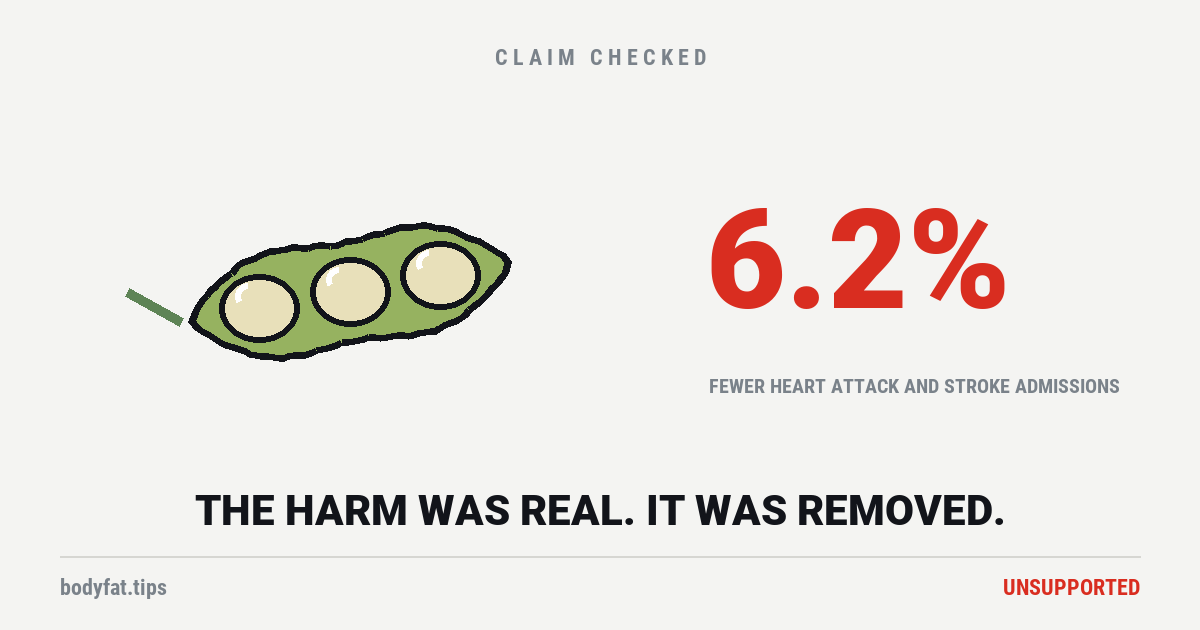
And trans fat did what the current fears only allege. We can see it because New York ran something close to an experiment: between 2007 and 2011, eleven of its counties restricted trans fat in restaurants and other eateries while others did not, and researchers compared them [2].
| Heart attacks and strokes | −6.2% | −9.2 to −3.2 |
| Heart attacks alone | −7.8% | −12.7 to −2.8 |
| Strokes alone | −3.6% | not significant |
Three or more years after the restrictions, hospital admissions for heart attacks and strokes in the counties that restricted trans fat fell an additional 6.2% beyond the trend in 25 similarly urban New York counties without restrictions — and admissions for heart attacks alone 7.8% [2]. Eight point four million adults in the restricted counties against 3.3 million in matched comparison counties, with the comparison counties chosen for similar urbanicity. The rules covered restaurants and other eateries, not packaged food, and the researchers could not measure how much trans fat anyone actually ate [2].
Being straight about it: the stroke number on its own was not statistically significant (−3.6%, P = 0.08) [2]. The combined result is carried by heart attacks.
Still — that is what a real dietary harm looks like when you remove it. A policy change, a comparison group, and fewer people in hospital.
And it is the comparison the current claim has never produced.
Is soybean oil bad for you?
So the hydrogenation is gone. In 2015 the FDA ruled that partially hydrogenated oils are no longer “generally recognized as safe”; manufacturers had to stop adding them to most foods in June 2018, and the last products made with them had to leave distribution by 1 January 2021 [9]. Trans fat is not quite zero — it occurs naturally in meat and dairy, and at very low levels in other edible oils — but the main artificial source is gone [9]. What is left in the bottle is the oil itself, and the accusation against it has moved to the linoleic acid.
We tested that claim on its own terms in are seed oils bad for you, and the short version is that the route usually named — linoleic acid turning into arachidonic acid, and arachidonic acid into inflammation — fails at the first step: cut dietary linoleic acid by up to 90% and the arachidonic acid it is supposed to become does not move [5]. Thirty randomised trials measuring inflammation found no overall effect, though the review flagged that C-reactive protein (CRP), a blood marker of inflammation, might rise with the biggest increases in linoleic acid [6].
That is one route, not every route. The researchers who recovered the old trials below proposed a different one: linoleic acid oxidised inside LDL, the cholesterol-carrying particles most tied to heart disease [7]. That is a proposal, it has not been tested here, and this page does not rate it.
The seed-oils page is also honest about the other half — two recovered BMJ trials, run in Sydney and Minnesota between 1966 and 1973, where swapping saturated fat for vegetable oil produced no mortality benefit, and one where the intervention group died more [7][8].
One detail belongs here, because trans fat is this page’s subject: neither trial was a clean test of liquid oil against the hydrogenated kind. Both took the era’s ordinary margarines and shortenings, which were sources of trans fat, off the oil group’s menu, and gave that group a polyunsaturated margarine of its own that may have carried some trans fat. Neither left a record of how much trans fat anyone ate [7][8]. The researchers who recovered the data judge trans fat an unlikely explanation for the results; whether those margarines muddied them is argued out on that page. Go and read it if you want the full argument; we are not going to relitigate it here.
What can be added specifically about soybean oil is where it sits against other fats. A network meta-analysis, which ranks many options at once by linking up trials that each compared two of them, put 54 randomised trials together and ranked thirteen oils and solid fats on blood lipids [4]. Here is what it can and cannot tell apart.
In those trials, swapping 10% of daily calories (about 200 calories on a 2,000-calorie day) from butter to soybean oil left LDL cholesterol about 11 mg/dL (0.29 mmol/L) lower; swapping from lard, about 8 mg/dL (0.20 mmol/L) lower [4]. But palm oil, coconut oil and beef fat beat butter on LDL too, so beating butter is not what sets an oil apart. Against those three, the trials could not tell soybean oil apart on LDL. Against beef fat — tallow, the fat now sold as the traditional replacement — the best estimate of the difference was zero, with the range the true answer probably sits in running from about 8.5 mg/dL lower to 8 mg/dL higher (−0.22 to 0.21 mmol/L) [4].
On HDL, the cholesterol usually called protective, soybean oil came out slightly behind sunflower and olive oil, by about 1 to 1.5 mg/dL (0.03–0.04 mmol/L), and about 2 mg/dL (0.05–0.06 mmol/L) behind beef fat, palm oil and coconut oil. The authors warn that a diet’s effect on HDL is hard to read, since whether HDL itself protects the heart is in doubt. Where some trials had compared two fats directly, they rated the certainty of the LDL results mostly low or moderate; where the comparison was pieced together only indirectly, through other fats, mostly low or very low — and most of the network’s evidence was indirect [4].
What is the healthiest cooking oil?
This is the fourth page we have written about cooking oil, so we can finally answer that properly, and the answer is duller than the question deserves.
On LDL and total cholesterol, safflower oil ranked first and rapeseed second across those 54 trials, though on LDL the gaps between the liquid oils were mostly too small for the trials to be sure of [4]. On our other pages: canola beat olive oil on LDL by 6.13 mg/dL in thirteen head-to-head trials, and olive oil showed no significant advantage on death rates over corn, safflower, soybean and canola oil taken together, in a 28-year study of about 92,000 US nurses and health professionals.
Put those together and the honest conclusion is the one none of the marketing wants: among unsaturated cooking oils, the differences between them are small enough that the choice barely matters. What moves the LDL number in the trials is replacing butter or lard [4].
After that, buy on taste, smoke point and price. Those are real differences. The health gap between one unsaturated bottle and the next is not.
And the heart itself? Those trials measured cholesterol, not heart attacks or deaths. For those, turn to cohort studies, which follow people for years and count who falls ill; they show what goes with what, not what causes what. A 2025 review of 150 publications on such studies found that people who ate the most omega-6 fat had death rates about 12% lower, from any cause and from cardiovascular disease, than people who ate the least, though no measurable difference in new cases of cardiovascular disease. People with the most omega-6 in their blood had less coronary heart disease and fewer strokes. Higher intake did go with more ovarian and endometrial cancer, and the review rated its confidence in these links from very low to moderate [11]. A second 2025 study, of blood samples from 172,891 people plus an updated pooling of earlier studies, linked more linoleic acid in the blood with fewer strokes and, in the pooled studies, with less coronary heart disease too — though some of the omega-6 fats the body makes from linoleic acid went with more heart disease [12]. Mostly the opposite of what the claim predicts, then, with a cancer signal worth knowing about.
The FDA has looked at the same question for soybean oil. In 2017 it allowed a qualified health claim — a label claim that has to say how strong its evidence is — for the statement that eating about 1½ tablespoons (20.5 grams) of soybean oil a day in place of saturated fat may reduce the risk of coronary heart disease. The strength it had to state was “supportive but not conclusive”, because the trials were few, small and inconsistent, and two of the four used diets that may not represent the healthy US population [13]. The claim was requested by Bunge, a company that processes oilseeds and sells plant oils.
Official advice split in January 2026. The Dietary Guidelines for Americans, 2025–2030, issued that month by the US Departments of Health and Human Services and of Agriculture, say: “When cooking with or adding fats to meals, prioritize oils with essential fatty acids, such as olive oil. Other options can include butter or beef tallow.” They add that “More high-quality research is needed to determine which types of dietary fats best support long-term health” [14]. The World Health Organization’s healthy-diet fact sheet, dated 26 January 2026, advises “replacing butter, lard and ghee with oils rich in polyunsaturated fat, such as soybean, canola (rapeseed), corn, safflower and sunflower oils” [15]. Both keep the ceiling on saturated fat at 10% of daily calories [14][15]. These are advice documents, not trials: neither is new evidence about the oil, and neither moves this page’s rating.
What we are rating
Unsupported: that vegetable oil as sold today is harming you. The route usually offered, from linoleic acid through arachidonic acid to inflammation, fails when tested [5][6]; a second route, through linoleic acid oxidised inside LDL, is a proposal untested here, and we do not rate it [7]. On LDL, soybean oil beats butter and lard in trials, and against beef tallow the trials cannot yet tell them apart [4]. And people with more omega-6 fat in their diets or blood had less cardiovascular disease or lower death rates, not more — an association, not an experiment [11][12].
Supported, historically, and now fixed: that partially hydrogenated vegetable oil harmed people. It did. The FDA’s 2015 ruling rests on evidence and expert panels “establishing the health risks” of trans fat [9], and when New York restricted it in eateries, hospital admissions for heart attacks fell faster than in comparable counties [2].
Genuinely true and worth sitting with: the exposure change is real and enormous — a thousandfold rise in supply, and a 136% rise in what is stored in people [1][3]. Anyone who tells you nothing changed is not being straight with you either.
Untested: what that exposure does when it arrives inside fried and ultra-processed food. Not assessed on this page at all: what refining and repeated frying do to the oil itself.
What to actually do
Check for “partially hydrogenated” on any label and put it back. That is the ingredient with a body count and a natural experiment behind it. It is largely gone from the food supply, but the phrase is the one worth recognising.
Do not pay extra to avoid the plain bottle. On LDL, soybean oil beats butter and lard in trials, and the trials cannot tell it apart from tallow [4].
Judge the food, not the oil. If fried and packaged food is where you meet most of your vegetable oil, cut those and your linoleic acid falls as a side effect — along with a dozen other things that have better evidence against them.
And notice what happened here. A real harm was identified, regulated, and removed, and the fear outlived the thing that caused it and reattached itself to what was left. That is worth watching for, because it is not the only claim it has happened to.
This is journalism, not medical advice. Cholesterol and heart-disease decisions belong with a clinician who knows your numbers.
An independent editorial review on 18 September 2026 found that the main reason this page gave for its rating overstated its own source. We said soybean oil “sits with the other unsaturated fats on every lipid comparison we have”, and that every oil tested beat butter. The 54-trial analysis says less. On LDL cholesterol, soybean oil beat butter and lard, but the trials could not tell it apart from palm oil, coconut oil or beef fat, all of which beat butter too; hempseed oil did not clearly beat butter; and on HDL, soybean oil came out slightly behind several fats. That section, the verdict and the advice now say what the trials can and cannot tell apart, including against tallow. We also said the bottle does not say what oil is in it. It does: federal rules require the ingredient list to name each oil, and the two brands we checked list soybean oil alone.
Also corrected. The omega ratio we gave, 6.4 to 10, is a narrower ratio, linoleic to alpha-linolenic acid, from the paper’s summary; its omega-6 to omega-3 ratio, on the model behind our other figures, went from 6.7 to 9.6. A quotation from that paper had a word wrong (“from” soybean oil, not “to”). New York restricted trans fat in restaurants and other eateries, not in packaged food; the comparison was 25 similar counties, not everywhere else; and what fell was hospital admissions. The national ban our headline refers to is the FDA’s 2015 ruling, now cited, and the headline now says which vegetable oil did the harm. We had dropped the inflammation review’s caveat about CRP, presented one tested route as the whole mechanism, left out that both recovered trials also took trans-fat-rich margarines and shortenings off the oil group’s menu, and said our sources’ funding was not stated when all four papers state it (none of it from industry). A sentence about where most vegetable oil is eaten had no source and is gone, as are an unsupported superlative, a “largest” that was not, and a menu badge we could not find, replaced in the provenance chain by a restaurant chain’s own tallow claim. We have added the 2025 cohort evidence on omega-6 fats, the FDA’s 2017 qualified health claim for soybean oil, and the January 2026 US and WHO advice, which disagree with each other. The rating is unchanged: Unsupported.