Does Lemon Water Help You Lose Weight? No. And It Doesn’t Alkalise You Either.

No.
But do not leave yet, because lemon juice has been put to a proper test for one thing — keeping kidney stones from coming back — and what that test found is worth knowing. It is just not about your waist, and not about most of the people drinking it.
The water question is a different page
Let us clear the ground first. Some of what people notice from lemon water is simply what happens when you drink a glass of water before you eat, and there is modest randomised evidence for that.
We took that apart separately in does drinking water help you lose weight — short version: the famous metabolism boost is about 24 calories and the best attempt to replicate it failed, but drinking water before meals has two small trials behind it and costs nothing.
None of that is about lemons. So this page is about the lemon.
The alkaline claim, and why we do not need to argue about blood
The central promise of the morning lemon water ritual is that it alkalises you. Lemon is acidic going in, the story goes, but it leaves an alkaline residue, and shifting your body toward alkaline is supposed to do everything from burning fat to preventing disease.
The usual rebuttal is a lecture about how your blood pH is held between 7.35 and 7.45 by your lungs and kidneys and does not care what you had for breakfast. That rebuttal is correct. It is also unnecessary, because there is a much shorter way home.
Somebody measured it.
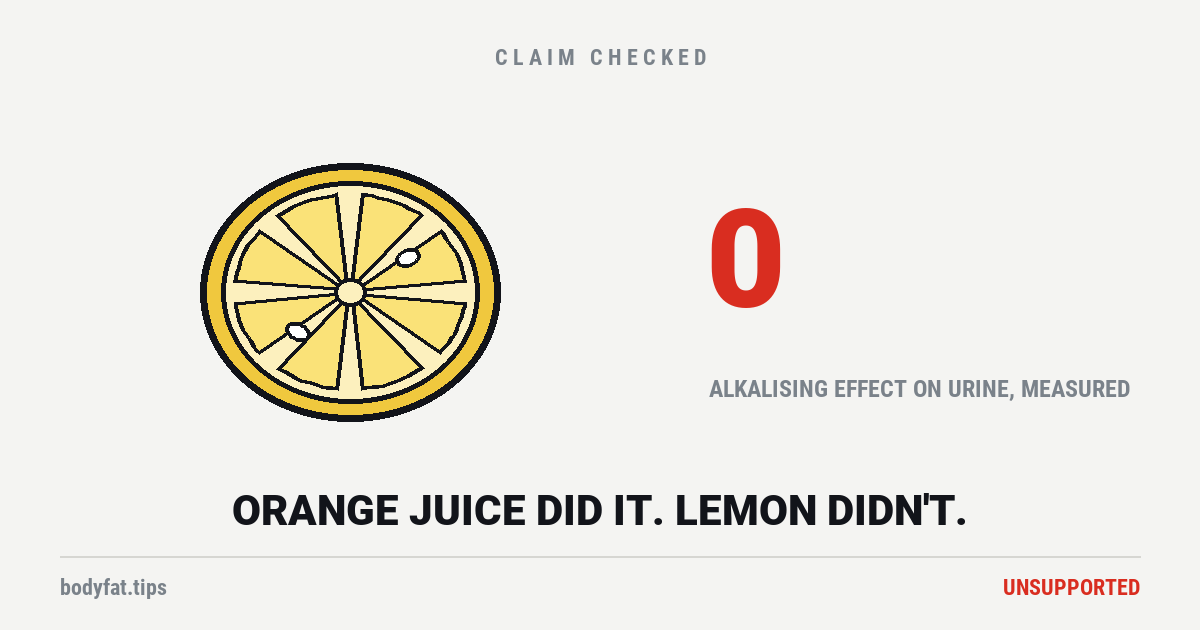
A 2021 review gathered thirteen studies of citrus juices and kidney stones: ten small studies that measured urine chemistry — urine being where an alkalising effect, if it existed, would actually show up — and three large population studies of who went on to form stones. The finding, verbatim: “Only orange and grapefruit juices had an alkalinizing effect and while lemon juice has a protective effect by raising urinary citrate levels, it lacked a significant alkalinizing effect on urine pH” [1].
That summary gets grapefruit wrong, by the review’s own numbers. Its data table shows no significant rise in urine pH in any of the three grapefruit studies it includes, and none for lime [1]. One of the grapefruit studies, which we read in full, says it plainly: on about a pint or a quart of grapefruit juice a day (0.5 or 1.0 litre), urine pH rose only slightly, and “the differences were not statistically significant” [5].
Now read it again, with the table. Orange juice alkalised. Grapefruit and lime did not. Lemon did not. And in a two-year randomised trial of fresh lemon juice in 203 people, urine pH never differed between those drinking it and those who were not [6].
So you do not have to win the argument about whether alkalising your body is a coherent goal. Take the theory entirely at face value, go and measure the one number it points at, and lemon fails its own test. The ritual picked the wrong fruit.
Now the part researchers actually tested
Here is what lemon juice might do. Urologists have been testing it against kidney stones since at least 1996 [7], while the wellness industry was busy with the other thing.
Lemon is loaded with citrate. And citrate in urine is one of the body’s own defences against calcium kidney stones — it binds calcium before it can crystallise. People who form stones are often low in it, a condition with the unlovely name hypocitraturia.
Researchers put a range of drinks through nuclear magnetic resonance to find out which actually carry citrate [2].
| Grapefruit juice | 64.7 |
| Lemon juice | 47.66 |
| Orange juice | 47.36 |
| Crystal Light lemonade, from powder | 38.39 |
| Homemade lemonade | 17.42 |
| Diet 7Up | 7.98 |
Note the two rows we have highlighted. Lemon juice is near the top. And homemade lemonade came in at 17.42, well under half the powdered Crystal Light at 38.39 [2] — presumably because a home recipe is mostly water and sugar around a small squeeze. The artificial-looking option is the stronger one, which is not how this is supposed to go.
How good is the evidence that it prevents stones?
Better than you would guess, and weaker than the headlines. Both.
The famous paper is a 2007 study of “lemonade therapy”. It is cited everywhere, and here is what it actually was: a retrospective look at patients, of whom exactly eleven met the criteria, compared with eleven matched patients on prescription potassium citrate [3].
Urinary citrate did rise on lemonade — by 383 mg a day, which was statistically significant. Prescription potassium citrate raised it more, by 482 [3].
The number that travels is that stone formation fell from 1.00 to 0.13 stones per patient per year. What almost nobody repeats is the note beside it: p > 0.05 [3]. Not statistically significant. Neither was the change in stone burden. In eleven people, that is exactly what you would expect — and the authors say plainly that a randomised trial is needed.
In 2022 came the kind of trial those authors asked for. In Bergamo, Italy, 203 adults who kept forming calcium oxalate stones, about two in three of them men, were all put on the same stone-prevention diet, and half were randomly assigned to add about 2 fl oz (60 mL) of fresh lemon juice twice a day, for two years. Nobody got a placebo; the other half simply went without, and every new stone had to be confirmed on an ultrasound scan read by a doctor who did not know who was drinking the juice. The one in six who were low in urinary citrate also took prescription potassium citrate, in both groups [6].
Stones came back in 21 of the 100 on lemon juice and 32 of the 103 without it. That looks like a cut of about a third, but it could still be chance. The hazard ratio — the risk of a new stone on lemon juice relative to the risk without it — was 0.62, and the range the true answer probably sits in ran from 0.35, a large benefit, to 1.07, none at all [6]. The authors think falling adherence weakened the result: 79% of the lemon group were drinking it as told at six months, 48% at two years. An analysis they chose after the fact, stopped at one year, did find a clear difference, 10 recurrences against 22, and they call it exploratory. Their own conclusion is that the findings are “not robust enough to recommend oral juice supplementation in everyday clinical practice” [6].
Two more results matter for anyone reading this page. Urinary citrate, the thing lemon juice is supposed to raise, did not rise, and urine pH never differed between the groups. And one person in five on lemon juice got heartburn, against one in a hundred without it [6].
In January 2026 an evidence review commissioned by the US Agency for Healthcare Research and Quality weighed that trial. It graded the evidence that lemon juice cuts recurrence as “low for at least a small benefit”, and the evidence that it causes side effects, mostly heartburn and stomach pain, as “low for at least a small harm”. Low, in the agency’s own definition, means “limited confidence that the estimate of effect lies close to the true effect”. Judging daily citrate as a whole — citrate salts such as prescription potassium citrate, and lemon juice — it lowered its grade from the moderate of its previous review to low [8]. Its search ran to May 2025, and it listed a two-year trial of a lime-powder supplement from Thailand as published only in abstract form [8].
A full report of such a trial appeared in December 2025. It tested a very different product from lemon juice, and reported a much bigger effect. A double-blind randomised placebo-controlled trial across six hospitals in Thailand followed 173 patients who had just had calcium oxalate stones removed, for two years [4].
Recurrence — a new stone, or a leftover fragment growing past 4 mm (about a sixth of an inch), seen on x-ray or CT scans — was 14% on the lime supplement against 45% on placebo: a hazard ratio of 0.24, with a range of plausible answers from 0.13 to 0.44 [4]. That is a large effect. It is also one trial, not yet repeated, and it counted stones seen on scans rather than stones that caused symptoms.
Four documented details bear on how much weight it can carry. The trial registration number printed in the paper leads to a different trial: a six-month study of a lime extract for kidney disease in people with diabetes, which began enrolling in July 2021 [9]. The closest registration we found, on ClinicalTrials.gov, is for a lime-powder stone trial that differs from the published one in size (137 people, not 173), blinding (participants only, not double-blind), dosing (twice a day for six months, not once a day for two years) and when its main result was due (at six months, not 24) [9]. The paper describes one-to-one randomisation, but the groups ended up 98 and 75; asked about it by the journal’s statistical reviewer, the authors said the imbalance may have been chance, or an unequal ratio applied without notice by the third party that ran the randomisation [4]. And the paper gives the citrate dose only approximately and the potassium not at all: the authors told the journal’s reviewers that their university’s intellectual-property office had advised against disclosing the exact dose before a patent was granted [4].
And now the limits, because they matter enormously for whether this page applies to you.
It tested a manufactured lime supplement — the paper calls it a lime-based phytochemical-rich regimen, made from lime juice and peel by a private manufacturer — not a glass of lemon water. Each once-a-day sachet carried citrate at the upper end of the range doctors prescribe as potassium citrate, with less potassium, and the paper says the supplement alkalises urine, as the citrate salts do [4]. So it is evidence about citrate therapy in a sachet, not about citrus in a glass. It was given to people who had just had kidney stones surgically removed, a group whose recurrence risk runs above 50% in five years. It says nothing whatsoever about whether citrus prevents a first stone in someone who has never had one.
And the 2021 review adds a deflating footnote for lemon specifically: “Lemon juice had a smaller protective role than orange juice” [1]. If you are drinking citrus for your kidneys, the evidence points at the orange — with two catches from the same review: orange juice raised urinary oxalate, one of the things calcium stones are made of, and it is high in carbohydrate, which in a juice means sugar [1].
One more thing from that review, which is the sort of detail that stops a tidy story: two large studies following American health professionals in the 1990s found that people who drank more grapefruit juice formed more stones, despite it having the most citrate of anything on the list [1]. Citrate is not the only thing in a fruit. But the review’s summary counts three such studies, and the third, a 2013 analysis of the same two groups plus a third, 194,095 people in all, did not confirm the grapefruit link [1][10].
What we are rating
Unsupported: that lemon water helps you lose weight. The trials that exist credit the lemon with nothing. In the trial closest to lemon water, 84 overweight Korean women were randomly assigned to a week of ‘lemon detox’ — lemon juice mixed with maple and palm syrups, and nothing else — or to a placebo juice diet matched for calories, or to their normal food. Both juice groups lost more weight, and a bigger share of their body fat, than the women eating normally; the authors put it down to “caloric restriction” [11]. Three small placebo-controlled trials of lemon compounds in capsules — powdered citrus peel, which its authors call lemon, for four weeks in 60 overweight children and teenagers, and an extract of eriocitrin, a flavonoid found in lemon, for twelve weeks in adults with prediabetes or high blood sugar — changed no measure of weight or body fat against placebo [12][13][14]. The only fat-burning mechanism we found comes from mice fed lemon-peel polyphenols as half a percent of a high-fat diet [15]. Any effect people notice belongs to the water and the habit, which we cover elsewhere.
Unsupported: that lemon alkalises you. Not on the grounds that alkalising is impossible — on the narrower and more damning grounds that when researchers measured urine pH, lemon juice did not raise it, in small studies or in a two-year randomised trial [1][6]. Of the citrus juices tested, only orange did [1][5].
Preliminary, for a specific group: lemon juice and calcium kidney stones, in people who already form them. The one randomised trial of fresh lemon juice to count new stones, about 2 fl oz (60 mL) twice a day for two years, found fewer recurrences, but not enough to rule out chance, and no rise in urinary citrate [6]; a 2026 federal evidence review rates the evidence of benefit as low [8]. The strong result belongs to a manufactured lime supplement with citrate at prescription strength, in one trial not yet repeated [4] — evidence about that kind of product, not about a glass of lemon water.
What to actually do
Drink it because you like it. That is a completely good reason and it is the one that survives this page. Water you enjoy is water you drink.
Do not buy a programme. Lemon-water detox plans, alkaline systems and pH strips are selling you a number that does not mean what they say it means — the same trick we took apart on detox teas, where nobody would name the toxin either.
If you form kidney stones, this is a real conversation to have — with a urologist. Citrate therapy is genuine clinical practice. In the three comparisons our sources describe, prescription potassium citrate raised urinary citrate more than lemonade did; one of them added the drug to lemonade rather than swapping it [1][3]. Which is right for you depends on urine chemistry that requires testing. If lemon juice comes up, know that the doses studied are far beyond a squeeze in a glass: 4 fl oz of reconstituted lemon juice a day in the 1996 lemonade study [7], and about 2 fl oz (60 mL) twice a day in the two-year trial. At that dose one person in five got heartburn, and two reported dental erosion or sensitive teeth against none without the juice, too few to tell from chance [6]. This is journalism, not medical advice.
And notice what the ritual is actually doing. A glass of water, first thing, every morning, because you have made it a small ceremony. That is a genuinely useful habit. It just does not need a theory about alkalinity to justify it, and it is a little sad that somebody decided it did.
An independent editorial review on 18 September 2026 found that this page overstated what lemon does for kidney stones. We rated citrus citrate for stones “genuinely supported” and said lemon had a real use there, while leaving out the one randomised trial of fresh lemon juice: 203 people over two years, in which fewer stones came back but not enough to rule out chance, urinary citrate did not rise, and one in five got heartburn. A January 2026 evidence review for the US Agency for Healthcare Research and Quality grades the evidence for lemon juice, and for citrate therapy as a whole, as low. We also called the 2025 lime trial “properly designed”. Its product is a manufactured supplement with citrate at prescription strength; the registration number printed in the paper leads to a different trial, the closest registration we found differs from it in size, blinding, dosing and timing, its groups ended up 98 and 75 under a one-to-one design, and the exact dose was withheld pending a patent. The page now reports all of this, and rates lemon juice for stones as preliminary.
Also corrected. We said grapefruit juice alkalises urine, quoting the review’s summary; the review’s own table shows no significant rise in any of its three grapefruit studies, or for lime, and only orange juice did it. We said three large studies found grapefruit juice raised stone risk; two did, and a larger 2013 analysis of the same groups did not confirm it. We said there was no trial of lemon and weight; there are four small ones, and none credits the lemon with any weight lost. We said the prescription drug beat lemonade in “the one comparison we have”; our own sources describe three. The evidence panel said our sources’ funding was not stated; the papers state it, and the panel now lists every tie by role, including a senior author’s relationship with a maker of prescription potassium citrate. The replication row now says the lemon results are mixed, as the review itself does. The first two steps of the provenance chain ran backwards in time and now begin with the 1996 lemonade study; the step we could not trace now says so, and the claim itself is now stated in our words rather than in quotation marks, because we found no one to quote. The rating is unchanged: Unsupported.