Does Lack of Sleep Cause Weight Gain? Yes — But Not How You Think

Yes. But almost everything you have been told about the mechanism is wrong, and the real finding is more useful than the myth.
Short sleep does not secretly switch your metabolism off. It makes you hungry, and it changes what your diet takes off you.
Start with the second one, because it is the strangest result in this whole area.
Same diet. Same weight lost. Different body.
Researchers at the University of Chicago took ten overweight adults and put them through the same fourteen-day calorie-restricted diet twice.
Once with 8.5 hours a night in bed. Once with 5.5 [1].
This is a crossover design, and it is worth understanding why that’s clever: every person did both versions, months apart. Nobody is being compared with a stranger who has different genes and a different life. Each participant is their own control group. It is one of the cleanest ways to run a comparison, and it is why ten people can produce a result worth reading.
Here is what came off, on the well-slept version versus the short-sleep version [1]:
Fat lost: 3.1 lb, versus 1.3 lb.
Fat-free mass lost: 3.3 lb, versus 5.3 lb.
Add the paper’s own two numbers together and the totals come out at 6.4 lb and 6.6 lb. Effectively identical.
Both versions of the diet “worked”. The scale would have congratulated you either way.
Learn More:



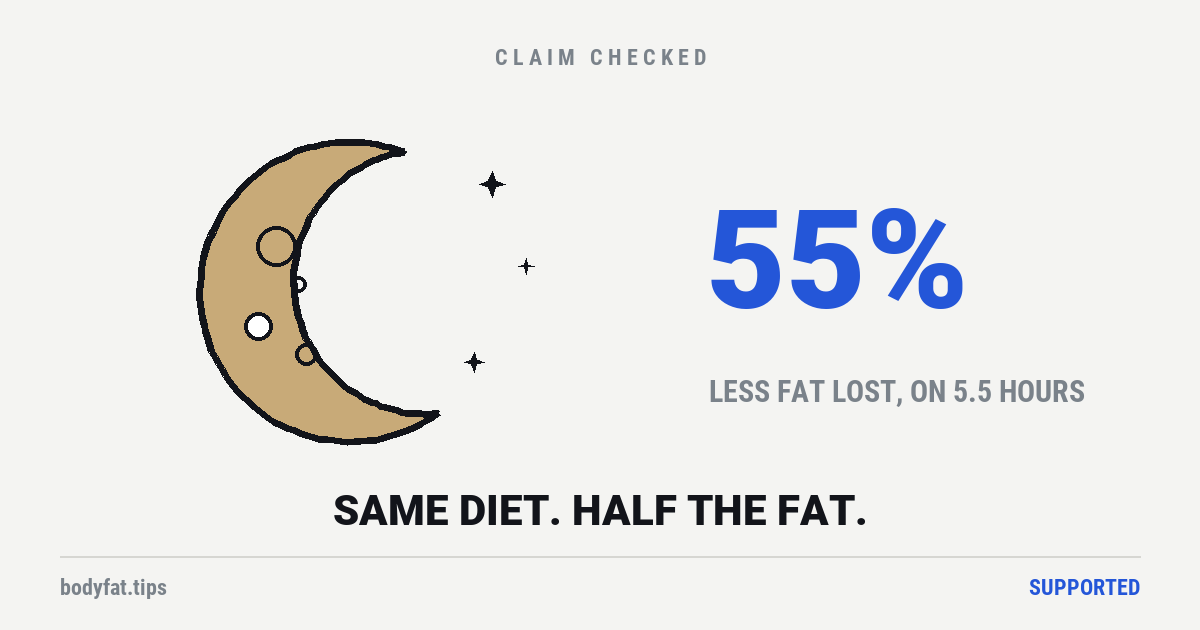
But sleeping five and a half hours cut the proportion of that loss that was fat by 55%, and increased the amount of fat-free mass — muscle, mostly — you gave up by 60% [1].
Same suffering. Half the fat. That is the trade you are making when you diet on short sleep, and no bathroom scale in the world will tell you it is happening.
How solid is that, really?
Ten people. Fourteen days.
We are not going to dress that up: it is a small study, and the paper lists exactly that under its own limitations [1]. A finding this striking from a sample this size is a strong hint, not a settled fact, and that is why this verdict sits at Supported rather than Established.
Two things do make it more credible than the headcount suggests. The crossover design, as above. And the funder — the National Institutes of Health [1], which is to say nobody with a mattress or a supplement to sell.
So does sleeping more actually make you eat less?
This is where the second study comes in, and it is the one that closes the argument on causation.
In 2022 a randomised trial took 80 adults who habitually slept under six and a half hours, and simply helped half of them sleep longer. No diet. No exercise programme. No lab. They went home and lived their lives [2].
The sleep group gained about 1.2 extra hours a night.
They ate 270 calories a day less [2]. Without being asked to.
Now, the detail that makes this trial worth more than a dozen like it: they did not ask anyone what they ate. Food diaries are famously, hopelessly wrong — people under-report, forget, and lie, mostly to themselves. Instead the researchers used doubly labelled water: you drink water with traceable isotopes in it, and how fast they leave your body reveals how much energy you burned. Combine that with a body-composition scan and you can calculate what somebody must have eaten, without ever taking their word for it [2].
Total energy expenditure did not significantly change [2]. So the burn stayed flat, intake fell, and weight came down.
Which kills the popular version of this story dead. Sleep is not doing anything to your metabolism. It is doing something to your appetite.
And 270 calories a day is not a small number
Sustained, that is roughly the gap people spend years trying to close with willpower.
The trial ran two weeks, so nobody should extrapolate it out to a year and quote you a pound count — the researchers didn’t, and neither will we. But it does reframe the question. If you are fighting your appetite every afternoon and sleeping six hours, you may not have a discipline problem. You may have a sleep problem wearing a discipline problem’s clothes.
What this does not license
There is an entire shelf built on the sentence “your body burns fat while you sleep” — the PM fat burners, the night-time metabolism formulas, the bedtime powders.
Nothing above supports any of that. The mechanism in both of these studies runs through how much you eat. There is no overnight furnace to stoke, and a capsule taken at 10pm does not extend your sleep by 1.2 hours — the thing that actually did that in the trial was a counselling session about bedtimes [2].
Which is free, and nobody can sell it to you at $49.99 a month, which is roughly why you have heard about the capsules and not the counselling.
What to actually do
If you are dieting, treat sleep as part of the diet rather than a separate virtue. On this evidence it is the difference between losing fat and losing muscle while the scale reports the same success either way.
If you habitually sleep under six and a half hours, the trial suggests the single highest-yield change available is not a food swap. It is going to bed earlier [2].
And if the scale is your only instrument, you are blind to the exact thing short sleep is doing to you. Waist tape. Photographs. How your lifts feel. Anything that separates fat from everything else.