Does Chewing Gum Burn Calories? Yes — About 3.6 an Hour

Yes. Chewing is muscular work and muscular work costs energy, so the answer was never going to be no.
The interesting part is how much.
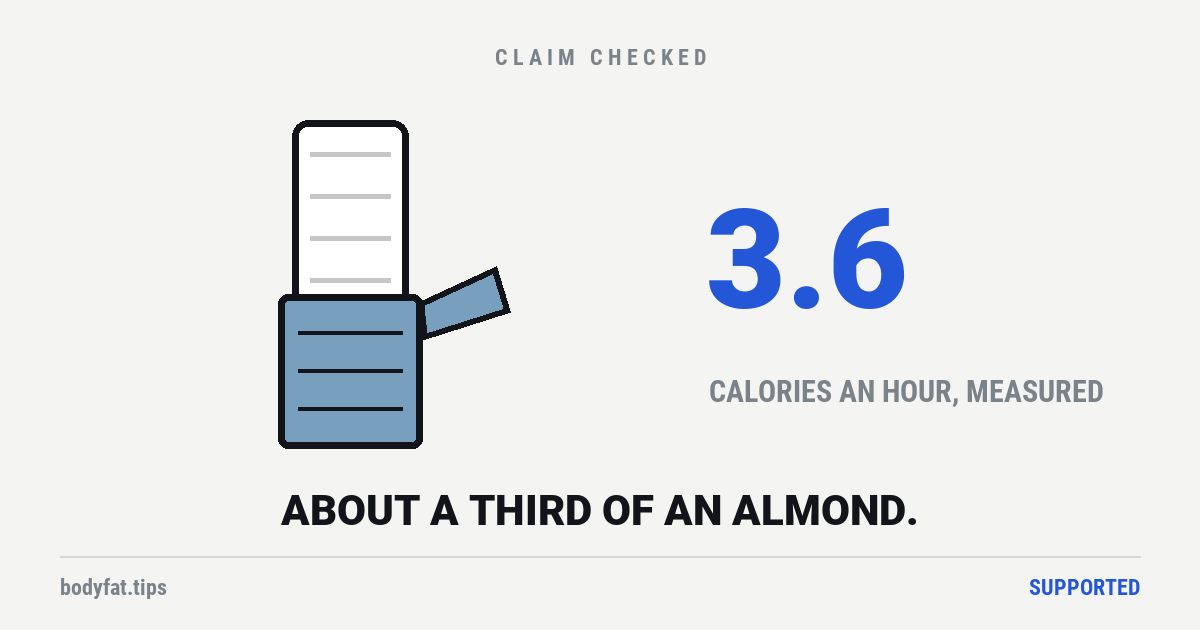
About 3.6 calories an hour
Thirty people, crossover design, measured with and without gum. Fasting energy expenditure came out at 1.23 kcal a minute while chewing against 1.17 without (p = 0.016). After breakfast: 1.46 against 1.42 (p = 0.037) [1].
Those are real, statistically significant differences. Now do the subtraction, which the headlines never do: 0.06 kcal a minute. Roughly 3.6 calories an hour. (That last step is our arithmetic, from their measured figures.)
An hour of continuous chewing buys you about a third of a single almond.
The number everyone quotes, which we could not read
You will see “11 calories an hour” everywhere. It comes from a 1999 research letter in the New England Journal of Medicine [4].
We tried to read it. There is no abstract indexed, and the full text was not accessible to us. So we are not going to print its figure and imply we checked it.
Worth sitting with that for a second: the single most-repeated number in this entire claim is one we could not verify at source. It may well be sound. We just cannot tell you that it is.
So does it help you lose weight?
No, and this is the best-run study in the whole file.
Two hundred and one overweight and obese adults, eight weeks, randomised. The gum group chewed a minimum of ninety minutes a day. Adherence was better than 95%, which almost never happens in a behavioural trial [2].
Learn More:

The result: “virtually no changes in weight or BMI in either group.” Waist circumference did fall 1.4 cm inside the gum group, but there was no significant difference between the groups, which is the comparison that counts [2].
The authors’ own sentence: chewing gum on a regular schedule for eight weeks “did not facilitate weight loss.”
Ninety minutes a day. Ninety-five percent adherence. Nothing.
The appetite angle is more interesting, and less settled
Here is where the idea keeps its dignity. Gum does seem to do something to hunger.
A 2025 review pooled nine randomised trials. Hunger was significantly suppressed in five of seven. Desire to eat fell in three of five, and desire for something sweet in three of four [3].
But watch what happens when you move from what people felt to what they ate. Energy intake reached significance in only two of seven trials [3].
Feeling less hungry and eating less are not the same measurement, and the gap between them is where a lot of diet advice quietly lives. The reviewers’ own verdict on body weight is blunt: it “has not been proven.”
What to actually do
Chew gum if you like gum. If it genuinely stops you walking to the biscuit tin, that is worth more than the 3.6 calories — not because of chewing, but because you did not eat the biscuit.
Do not count it as exercise. At an hour of chewing per third of an almond, the arithmetic is not close, and the one properly powered trial put ninety minutes a day into it for eight weeks and got nothing on the scale.
The claim is true and it is trivial. Those two things sit together more often than the internet lets on, and telling them apart is most of the job.