Are Squats Bad for Your Knees? The Warning’s Best-Known Source Is a 1961 Study of 128 Weightlifters. Squatters’ Knees Have Mostly Tested Fine Since. Hours of Squatting at Work Have Not.

“It only takes 2 minutes to do 20 bodyweight squats, but the effects reach FAR beyond your legs.” That is the first line under a video a physician’s health-video channel posted on 7 July 2026, “What 20 Squats a Day Actually Does to Your Body (9 Benefits Explained)”. It had 1,291,776 views when we read it on 10 October 2026 [1]. Its chapters promise muscle, the brain, the heart, blood sugar, bone and fewer falls, and one is called “The truth about squats and knee health” [1].
The description does not say which way that chapter comes down, and we read the description, not the video’s audio [1]. But it is the question people actually type. In the United States, “are squats bad for your knees” is searched about 1,000 times a month and “are squats good for your knees” about 320; “squats benefits” and “benefits of squats” about 3,600 each; “20 squats a day” about 170 (from a paid keyword database, pulled 10 October 2026) [2]. So the knees first.
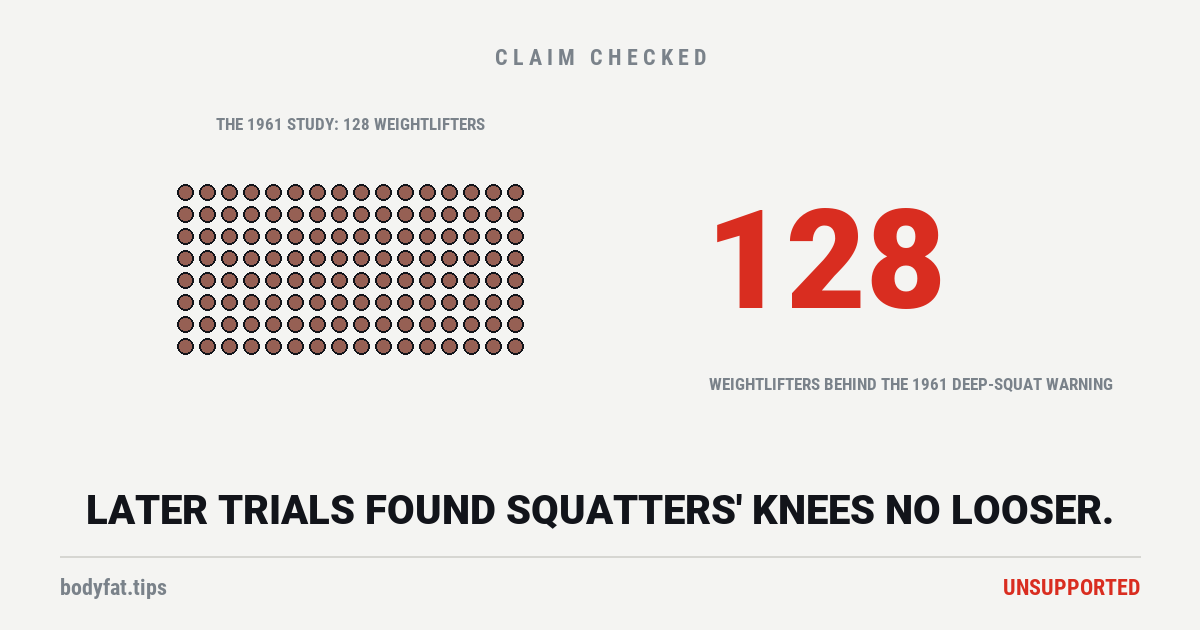
For healthy knees, the evidence does not back the warning. The deep-squat scare is usually traced to a 1961 study of 128 weightlifters. Trials since found squatters’ knees no looser than anyone else’s, and among 2,607 adults, those who had strength trained had less knee arthritis, not more [3] [4]. One trial points the other way, and we give it its full weight below [5].
For knees that already have arthritis, exercise helps a little, and heavy leg training did not make them worse on average. Across 139 trials, exercise eased pain by a modest amount, though side effects such as sore or swollen knees were more common; after 18 months of heavy leg-machine training, pain had fallen about as much as in people given health-education classes, and the trial could not rule out a clinically important worsening [6] [7].
The knee risk that does show up is measured in hours, not reps. Years of kneeling or squatting at work go with more knee arthritis [8]. Twenty squats take two minutes.
Most of the nine benefits rest on studies of something else: squat breaks repeated every 20 to 45 minutes through a long day of sitting, or barbell squats at 80% of the most a person can lift [9] [10] [11]. The table further down sets out what was tested for each.
Where did “squats are bad for your knees” come from?
The warning goes back at least to 1959, when a researcher named Karl Klein reported, from cadavers and then athletes, that deep knee bends could overstretch the knee’s ligaments, the tough bands that hold the joint together; that is how a 2024 review describes that first paper, which we have not read [12]. His best-known study came in 1961, when he compared 128 competitive weightlifters who squatted deep, until the back of the thigh met the calf, with 386 students who never had [3]. He reported the lifters’ knees looser, with “61% greater instability” in two or more ligaments [3]. He measured it with an instrument that a 2024 review calls unvalidated [12].
Klein recommended stopping at parallel, thighs level with the floor, instead of squatting deep, and strength coaches took the advice [3]. A 1984 history in a strength-coaching journal, as that 2024 review describes it, traces the whole belief to his studies [12].
Then people checked. In 1971 another researcher, using the same testing instrument, randomly assigned 69 men to deep or parallel squats three times a week for eight weeks and found no significant change in how loose their knees were, in any group [3]. In 1989 an Auburn University team trained 100 students on squats for eight weeks, and also tested 27 powerlifters and 28 weightlifters who had squatted heavy for years. The training made no consistent difference, the loosest knees belonged to the controls who did not squat, and the powerlifters were tighter than the controls on seven of nine measures [13] [3]. Thirty-two professional football players squatted to parallel with 1.3 to 2 times their body weight for 21 weeks, and their knees were no looser at the end [3].
A 2001 review in the American College of Sports Medicine’s journal gathered these studies and concluded that “the parallel squat was not injurious to the healthy knee” [3]. Even so, it still advised healthy athletes to stop at parallel, because the forces in the knee peak near the bottom, and the risk to the menisci, the two cartilage pads that cushion the joint, and to the ligaments “may increase with the deep squat” [3]. Hold on to that. It comes back.
Are squats bad for your knees if your knees are healthy?
Looseness is not what most people fear. They fear wear: arthritis, the slow loss of the cartilage that lines the ends of the bones. No trial we found has assigned healthy people to squat or not and followed them for decades, so the best evidence here compares people who did and did not train.
In the Osteoarthritis Initiative, a US study of adults with knee arthritis or at risk of it, 2,607 people averaging 64 were asked which activities they had done regularly at four stages of life [4]. After allowing for other differences between them, those who had strength trained at any stage had lower odds of arthritis on their knee X-rays: an odds ratio of 0.83, where 1 would mean no difference, and a range of plausible values from 0.70 to 0.99 [4]. They also had lower odds of frequent knee pain, and those who had trained the most had the lowest odds [4].
This is people remembering what they did decades earlier, and the authors name the catch themselves: people whose knees start to hurt may stop training, which would make training look protective when it is not [4]. Still, it is not the result you would expect if strength training wore knees out.
Look wider than squats and the answer is the same. Six cohort studies in the US, the UK and Australia, one of them recruited for its higher risk of arthritis, followed 5,065 people with healthy knees for five to twelve years; how much recreational exercise they did was not linked to whether they developed knee arthritis, with risk ratios of 1.00 to 1.02, where 1 means no difference [14].
Now the trial that points the other way. In Indianapolis, 221 adults averaging 69 were randomly assigned to strength training, on machines at a fitness centre plus wall squats and bands at home, or to gentle range-of-motion exercise, and their knees were X-rayed after 30 months [5]. In knees that were normal at the start, the average narrowing of the joint space, the gap the cartilage fills, was much the same: 0.34 mm against 0.29 mm, a difference well inside what chance produces [5]. But more of the strength-trained knees narrowed by more than half a millimetre (about two hundredths of an inch), the margin of measurement error: 34% against 19% [5]. It was not linked to how faithfully people trained or changes in their thigh strength, and the authors called it unexplained and said it needs confirming. In knees that already had arthritis, the strength group’s worsened less often, 18% against 28%, a gap that could be chance [5].
What about the cartilage itself, seen on a scan? A 2019 systematic review, a study that gathers every trial on a question, found nine randomised trials, 702 people averaging 58, at risk of knee arthritis or, in most of the trials, already with it, that imaged the cartilage by MRI before and after exercise that loads the knee [15]. Most comparisons found no change. One trial found one measure of the cartilage’s make-up worse; three trials, that one among them, found a measure better; and the reviewers concluded that the exercise “seems to not be harmful”, on evidence they rated low quality [15].
One review written to answer the question is weaker than its conclusion. A 2024 scoping review, a survey of what has been studied rather than a pooling of results, gathered 15 studies and concluded that the deep squat “appears to be a safe exercise for knee joint health” [12]. Of the 15, four were narrative reviews and one a computer model built from one person’s knee scans; the trials were short training studies in young adults that measured strength and jumping; and five asked whether a squat test, or squat strength, predicts injury. The largest, 2,476 soldiers, tested a movement screen, not squat training [12]. Its summary says one of the 15 linked deep squats to injury; its results section says two [12]. It is a map of the field, not a test of the knee.
Are deep squats bad for your knees?
Here the two best-known reviews agree on more than they are usually said to. The 2001 review found the forces between the thigh bone and the shin bone rising all the way down, and advised healthy athletes to stop at parallel to spare the menisci and ligaments [3]. On the kneecap it found the force peaking around a right angle and then holding steady, so the pressure on it may ease deeper down, because the contact area keeps growing [3]. A 2013 review took that point further: deeper down, the back of the thigh pressing on the calf spreads the load, so the deep squat is no worse, and a heavy half squat may be worse over time [16]. Where they part is the advice. We read the 2013 review only as its summary, and its long-term warning about heavy half squats is reasoning, not a measurement [16].
One trial measured pain. In Spain, 53 trained men did ten weeks of full, parallel or half squats, or stopped training; only the half-squat group reported more pain, stiffness and difficulty afterwards [17]. We read it as its summary.
A career of heavy competitive lifting is a different exposure, and the signal there is not clean. Among 117 retired Finnish top-level athletes, arthritis on knee X-rays showed up in 31% of 29 former weightlifters, against 3% of former shooters, 14% of runners and 29% of soccer players [18]. The authors put the weightlifters’ excess down partly to their high body weight when young, and found knee injuries and years of kneeling or squatting work raising the risk too [18]. Competitive weightlifting means the snatch and the clean and jerk, at loads far beyond most people’s training, as the authors of the 2,607-person study point out [4]. A 2017 review counted 1 to 4.4 injuries per 1,000 hours of training in weightlifting and powerlifting, with the knee among the commonest sites, and called the rate low next to contact sports [19]. We read both as summaries.
What about squatting all day at work?
This is where the warning has teeth. A 2017 review commissioned by a Danish workplace fund pooled studies of people whose jobs kept them kneeling or squatting. Those exposed had higher odds of knee arthritis than those who were not: an odds ratio of 1.70, from 12 studies, though the reviewers found signs that small studies finding no link had gone unpublished, which would make that figure too high [8]. In the five studies that counted hours, with no such sign, the odds rose with them: each 5,000 hours of kneeling or squatting over a working life went with odds about a quarter higher, an odds ratio of 1.26 with a range of 1.17 to 1.35 [8]. Five thousand hours is roughly an hour of every working day for twenty years; that conversion is our arithmetic. A 2020 review of 80 studies named farmers, builders, metal workers and floor layers among the jobs with more knee arthritis, and squatting at work for more than half an hour a day among the activities that went with it [20].
The same picture shows up on scans, though there the exposure was mostly stairs and lifting, and the study did not record for how long. In 115 people aged 45 to 55 with risk factors for knee arthritis but no knee pain or X-ray signs of it, drawn from the same US arthritis study, the 84 who said that on most days they squatted or knelt for 30 minutes or more, climbed ten flights of stairs or moved objects of 25 lb (11 kg) or more had more cartilage damage on MRI than the 31 who did none of these: odds 3.6 times higher, with a range from 1.4 to 9.5 [21]. Of the 84, 62 climbed the stairs and 41 did the lifting; 20 squatted for half an hour or more [21]. Over three years their damage was also more likely to worsen [21]. The comparison group was small, and the authors note that the many comparisons they ran raise the chance of a false alarm [21].
Squatting as a way of life points the same way. In Beijing, where squatting was an everyday posture, people over 60 who recalled squatting longest each day at age 25 had more arthritis in the joint between the thigh bone and the shin bone, the odds roughly doubling in the longest-squatting group [22]. The trend across the groups landed just the wrong side of the line researchers use for “probably not chance” (P = 0.074 in men, 0.077 in women) [22]. We read it as its summary.
The work studies and the Beijing study count time spent down in a squat or on the knees, held, for years. A bodyweight squat is a movement in and out. They are different exposures, and nothing on this page shows the second carrying the risk of the first.
Are squats good for your knees if you have arthritis?
Every current international guideline recommends exercise for knee arthritis, says a 2024 Cochrane review [6]. It gathered 139 trials, 12,468 people. Against an attention control or placebo, something that takes the same time and attention without the exercise, exercise eased pain by 8.7 points on a 100-point scale, on what the reviewers graded low-certainty evidence [6]. That is under the 12 points they count as a difference a patient would notice. The six trials they judged well run and big enough, including the two largest, of 439 and 377 people, found 4.2 points [6]. So: real, small, and smaller in the best trials. It is not free of side effects either: against no treatment, more of the people who exercised reported adverse events, on low-certainty evidence, and the events the review tabulates include muscle soreness, increased knee pain and swollen knees [6].
The 377-person trial is the one to know if you fear heavy lifting on a bad knee. In North Carolina, adults aged 50 and over with knee arthritis trained at 75 to 90% of the most they could lift once, three times a week for 18 months, on leg-press, leg-extension and other machines [7]. Their knee pain fell, from 7.0 to 4.9 on a 20-point scale, and about as much in a group given health-education classes, whose pain fell by a third; after allowing for differences at the start, the gap between the two groups was 0.2 points, which could be chance [7]. A third group, lifting light weights (30 to 40% of their maximum) for more repetitions, ended with slightly less pain than the heavy lifters, 4.4 against 5.1, a gap that could also be chance; and the authors add a caution of their own: the range of plausible results included the heavy lifters’ pain being 1 to 2 points worse, so “clinically important levels of increased pain with high-intensity training cannot be ruled out” [7]. Their joint space was, if anything, slightly wider, 2.9 mm against 2.8 mm, again a gap that could be chance [7]. The heavy lifting bought no extra relief, and the heavy lifters logged more minor adverse events, 53 against 4 in the education group and 30 in the light-weights group [7]. Those were machines, not squats.
Strength training’s effect on osteoarthritis pain comes out small in our verdict on resistance training for older adults too, and our turmeric verdict is about the same knees. Exercise for lower back pain has a similar shape: a real benefit, of modest size.
Knee pain when squatting: when should you see a doctor?
If a squat hurts, the useful question is why, and that is a clinician’s question, not this page’s. The US National Library of Medicine’s consumer guide says to contact a provider if you cannot put weight on the knee; the pain is severe even at rest; the knee buckles, locks or looks misshapen; you cannot bend or fully straighten it; there is fever, redness, warmth or a lot of swelling; the calf below it is painful, swollen, numb, tingling or bluish; or the pain is still there after three days of home treatment [23]. This page is journalism, not medical advice, and nothing here is a reason to push through pain.
What do twenty squats a day actually do?
| Chapter | What was tested | Rated alone |
|---|---|---|
| Muscle, “the mTOR connection” | One day of squat breaks every half hour raised a laboratory marker of muscle building in 12 young adults; the mTOR signal itself did not change [24] | Preliminary |
| The brain | One session of continuous squat-stands improved an attention test afterwards, about as much as cycling [25] | Preliminary |
| The heart | 26 extra sit-to-stands a day for three months lowered the bottom blood-pressure number by 2.24 mmHg (millimetres of mercury) [26]; a review of exercise snacks found fitness up and blood pressure not significantly changed [27] | Preliminary |
| Blood sugar | Squat breaks through a long day of sitting: a smaller sugar rise in two studies, no significant difference in two others; one-minute bursts of mostly other bodyweight moves lowered the rise after two of three meals in a two-day home trial in type 2 diabetes; no significant change in long-term blood sugar in two 12-week trials [28] [10] [9] [29] [30] [26] [31] | Preliminary on the day; Unsupported over months (Preliminary in type 2 diabetes) |
| Bone | A simple home programme of sit-to-stands and step-ups, three times a week for three years, showed no benefit to bone density over the comparison group’s exercises in adults over 70 [32]; heavy barbell squats, deadlifts and presses raised spine density, and light bodyweight leg exercise, the comparison group, lost it [11] | Unsupported |
| Falls | Programmes of balance and functional exercise cut falls; strength-only programmes left reviewers uncertain [33] | Preliminary |
| The knees | Ligament trials, a 2,607-person study of strength training, cartilage scans and arthritis trials: see the sections above | Unsupported, that squats damage healthy knees |
Blood sugar. The studies are real, and they are about squats repeated through a long day of sitting. In Melbourne, 24 adults with type 2 diabetes sat for eight hours, or sat with three minutes every half hour of half-squats, calf raises, buttock squeezes and knee raises; the rise in blood sugar after meals was 14.7 against 24.2 on the paper’s measure, about 40% smaller by our arithmetic [28]. In Hangzhou, 18 young men with overweight squatted for three minutes every 45 minutes, ten times in a day, and their sugar rise was 7.9 against 10.2 when they sat [10]. We read both as summaries.
In other studies the sugar rise did not shrink. In Toronto, 14 people did 15 chair stands every half hour for seven and a half hours: their insulin, the hormone that clears sugar from the blood, was lower after lunch, but their blood sugar was similar to when they sat [9]. In Glasgow, 14 adults, most of them men with overweight, did ten chair squats every 20 minutes: insulin lower after breakfast, blood sugar not significantly different [29]. Stair-climbing breaks lowered insulin but not sugar [34].
Other studies of short bursts did lower blood sugar. The first “exercise snacks” study, often cited for the idea, gave nine people with insulin resistance six one-minute bursts of hard uphill walking before meals, and their average blood sugar over the next 24 hours came out lower than on a day with one 30-minute walk before dinner, the trial’s only comparison; a version alternating walking with resistance exercise worked as well [35]. In 2026 the Canadian group behind the 12-week trial below ran a two-day trial at home in 31 adults with type 2 diabetes: four one-minute bursts a day of hard bodyweight exercise, mostly step-ups, running on the spot and a short shuttle run, with squats used only as a substitute for some people, most of the bursts within about an hour after a meal. The sugar rise after breakfast and after dinner was smaller, after lunch it was not, and the average over the two days, the trial’s main measure, was not significantly lower; the authors call the effects small [30]. A 2026 pooling of 20 crossover trials, in people with overweight, obesity or type 2 diabetes, found that short bursts lowered the sugar rise after meals compared with sitting, on what it graded moderate-certainty evidence; most of the bursts were walking or other aerobic exercise, and in the five trials of resistance-type bursts, chair squats among them, the result leaned the same way but its range of plausible values still included no effect [36]. An umbrella review, a review of the reviews, found 21 of them on exercise snacks; with trials counted twice taken out, only four independent sets of studies were left for the sugar rise, which it calls “limited and statistically unstable evidence rather than evidence of no metabolic benefit” [37]. For walking after meals, our verdict covers the stronger evidence.
The two trials that ran for months found no significant change in long-term blood sugar. In San Diego, 407 sedentary women past menopause with overweight or obesity, 9% of whom had diabetes, were coached for three months to add sit-to-stands to their day and managed 26 more a day than a comparison group; their fasting sugar, insulin and HbA1c, a blood test that averages sugar over about three months, did not change significantly [26]. In Canada, 69 adults with type 2 diabetes did four one-minute bursts of hard bodyweight exercise, squats, lunges and step-ups among them, five days a week for 12 weeks; against people who stretched, their HbA1c did not differ significantly [31]. That trial was built to test whether people would keep the habit up, not to detect a change in HbA1c, and its participants’ blood sugar was already well controlled, which its authors say may have left little room to improve [31].
The heart. In the San Diego trial, the women adding sit-to-stands lowered the bottom number of their blood pressure by 2.24 mmHg (millimetres of mercury, the unit on the cuff) more than the comparison group; the top number fell 3.33 more, which missed the threshold the trial set itself [26]. A 2026 review of 11 trials of exercise snacks, 414 people, found they raised aerobic fitness, with no significant change in blood pressure in the three trials that measured it [27]. Holding a wall squat still is a different exercise, covered in our blood-pressure verdict.
The brain. In one laboratory study, a single session of continuous squat-stands improved performance on an attention test afterwards, about as much as the same time cycling [25]. We read it as its summary. One session, measured minutes later.
Muscle, and “the mTOR connection”. mTOR is a switch inside muscle cells that helps start the building of new protein. In Toronto, 12 young adults who did 15 squats every half hour of a sitting day built muscle protein faster from their meals, 0.103% an hour against 0.080% when they sat; but mTOR itself, measured in the same muscle samples, did not change, though a protein further along the same signalling chain was more active after the squats [24]. That is one day and a laboratory marker, not bigger legs. Over 12 weeks, in the Canadian diabetes trial above, people doing one-minute bursts of squats, lunges and step-ups gained 1.9 more chair stands in 30 seconds than people who stretched [31]; a 2026 review of exercise-snack trials found leg strength not significantly changed, and muscular endurance up in older adults, on very low-certainty evidence [27]. Whether twenty squats build muscle depends on whether twenty is hard for you, which is the subject of our calisthenics verdict.
Bone. This is the strangest one, because the video cites the trial itself. In LIFTMOR, 101 women past menopause with low bone density were randomly assigned to eight months of deadlifts, overhead presses and back squats, five sets of five at over 80 to 85% of the most they could lift once, plus jumping chin-ups, or to a home programme of lunges, calf raises and light arm work with body weight or hand weights of up to 6.6 lb (3 kg) [1] [11]. The home programme was designed to give bone “minimal stimulus”. Spine density rose 2.9% with the heavy lifting and fell 1.2% with the light bodyweight work [11]. The bodyweight version was the comparison group, done twice a week; it was never a test of daily squats. The nearest real test is a European trial in adults aged 70 and over: a simple home programme of 30 sit-to-stands, 30 step-ups and three other exercises, three times a week for three years, showed no benefit to bone density at the spine or hip over the comparison group’s exercises; 1,493 people across the trial’s eight groups had scans [32]. Its authors note that the programme was light, never made harder, and given to people who were mostly active already [32]. One small study of a loaded version found a gain at one site: in Japan, seven women past menopause with sarcopenia, low muscle mass, who did fast squats, lunges and calf raises twice a week for six weeks, supervised and made harder as they went, in a vest carrying on average 7.7 lb (3.5 kg) by the end, gained 1.6% in pelvic bone density while eight who did not train lost 0.9%; their forearm bone density did not change significantly, and the paper does not say the groups were randomised [38]. Another of the video’s references followed 913 Geneva retirees and found low muscle mass, on one of several definitions, went with more fractures; it tested no exercise [39]. Our verdict on resistance training for older adults sets out what strength training did for bone in 14 trials.
Balance and falls. A 2019 Cochrane review of 108 trials, 23,407 people averaging 76, found exercise programmes cut falls, on high-certainty evidence, and that the programmes doing it were mainly what the reviewers call balance and functional exercises [33]. For programmes that were mainly strength training, the reviewers were uncertain [33]. Twenty squats on their own sit closer to the second kind; that is our reading. The description’s “simple test” that “can predict how long you’ll live” is not named there, but its third reference is a study of the floor sit-rise test, which our sit-to-stand verdict covers [1].
Who these studies were done on
Check whose knees these were before any of it applies to yours. The ligament studies were young men, students, competitive lifters and professional football players, followed for weeks [3]. The 2,607-person study was adults averaging 64, chosen because they had knee arthritis or were at risk of it [4]. The trial that pointed the other way was adults averaging 69 [5]; the cartilage-scan trials were mostly women averaging 58 [15]; the heavy-training arthritis trial was adults aged 50 and over, 40% of them women [7]. The work studies were workers, most of them from case-control comparisons of people who had arthritis against people who did not [8]. The months-long sit-to-stand trial was sedentary women with overweight or obesity, averaging 68; 57% reported arthritis somewhere and 9% diabetes [26]. The two diabetes trials were adults averaging 58 whose blood sugar was already well controlled, and the three-year bone trial was adults aged 70 and over, most of them already active [30] [31] [32]. If you are under 50 with healthy knees, the trials in people like you lasted weeks, and the long-term evidence comes from older people.
If squats don’t wreck healthy knees, why won’t the warning die?
This section is the desk’s own reasoning, and it is labelled as such. The ligament scare failed its first retest in 1971, and squatters’ knees have mostly come out fine since. Yet the question is searched about 1,000 times a month (from a paid keyword database, pulled 10 October 2026) [2]. Why does it survive? Three answers, with what each rests on.
Answer one: the warning is true, of a different dose. Kneeling or squatting at work for years does go with more knee arthritis, and the risk climbs with the hours [8]. The channel says twenty squats take two minutes [1]. At two minutes a day, reaching the 5,000 hours the work studies count in would take about 410 years. The link between hours and arthritis is measured; the 410 years is our arithmetic, and it compares a held posture with a movement, which are not the same thing.
Answer two: knees that already hurt, hurt in a squat. The forces in the knee climb as it bends [3], so a knee with arthritis or a sore kneecap will tell you about it at the bottom of a squat. People then blame the squat for a problem the squat revealed. The authors of the 2,607-person study raise the same thing from the other side: people may stop training when their knees start to hurt [4]. That the squat is more often the messenger than the cause is a surmise, with the biomechanics on its side.
Answer three: the experts’ caution was about depth and load, and it got compressed. Klein’s advice was to stop at parallel, not to stop squatting [3]. Forty years later the review that cleared the parallel squat still advised against going deep, while a 2013 review argued that heavy half squats were the worse bet [3] [16]. An argument among specialists about how deep and how heavy is easy to hear as “squats are bad for your knees”. That is an observation about the record, not a measurement.
Put the three together and here is what we think is true, stated plainly so you can disagree with it: your knees can tell twenty squats from a working life spent squatting; the warning never could.
What we could not find, and would like to: a trial that gives people with healthy knees squat training for years, against people who do not train, and scans their cartilage. The nearest under way is smaller and shorter: a Loughborough University trial of machine squat training in healthy women aged 50 to 70, 32 weeks against carrying on as usual, measuring cartilage thickness and bone; by the registry’s estimate its main measurements finish in December 2026 [40]. And the results of a trial that has already run: a US medical college registered a programme of daily bodyweight squats, push-ups and rows for 12 to 24 weeks, with blood pressure and HbA1c among its measures; it finished in January 2021 with 47 people enrolled, and we found no results in the registry, PubMed, Europe PMC or an ordinary web search [40]. If you know where either answer is, the corrections line on this site is open.
Where “squats are bad for your knees” lives now
Klein’s studies gave the warning its start, and the coaching advice that followed kept it in circulation [3] [12]. Today it lives in the search box. On 10 October 2026 Google’s results for the question included a physiotherapy page’s video titled “Wrong squat destroy knees” [2]. A health video with 1.29 million views gives the knees a chapter of their own [1].
And the answer has a business attached. Google’s AI answer to the question cites physical-therapy businesses, among them a digital physical-therapy company whose article offers “Check if you’re covered for our free program”, and a practice whose post carries “Request an appointment” [41]. Both say squats are not inherently bad for knees, which is the answer the evidence gives. The question still ends at an offer.
None of this is aimed at anyone who has felt a twinge at the bottom of a squat. Pain is information, and a knee that hurts deserves a look from someone qualified. What the evidence does not support is the idea that the squat itself is wearing healthy knees out.
What this is rated, and what the rating covers
Unsupported — for the claim that squats damage healthy knees.
It is rated Unsupported because the claim was tested and did not hold up. The looseness it began with was not found when others measured it, in a randomised comparison of deep and parallel squats and in lifters who had squatted heavy for years [3] [13]. The long-term studies tested strength training and exercise in general rather than squats alone, mostly in middle-aged and older adults, and in them knees fared no worse: people who had strength trained had less knee arthritis, not more [4]; recreational exercise was not linked to new knee arthritis [14]; and exercise that loads the knee did no harm overall in the cartilage-scan trials, where one measure of the cartilage’s make-up came out worse in one trial and one came out better in three [15]. One randomised trial found more knees narrowing past the error margin with strength training, which its authors could not explain and the average narrowing did not show [5]. The studies that do find more knee damage measured something else: on most days, half an hour or more of squatting or kneeling, ten flights of stairs or lifting objects of 25 lb, or years of kneeling or squatting at work [21] [8]. That is why the rating rests on the weight of the evidence rather than on its unanimity.
Rated alone, the claims around it. That deep squats are worse for healthy knees than parallel ones: Unsupported. It was tested, in short trials of young men, and did not hold up [3] [17]. That a career of heavy competitive lifting raises the risk of knee arthritis: Preliminary, on small studies of former elite lifters in which body weight and injuries muddy the picture [18]. That years of kneeling or squatting at work raise it: Supported. The risk rose with the hours in the five studies that counted them, on what the reviewers graded moderate-quality evidence, and a review of 80 studies points the same way [8] [20]. That squats make arthritic knees worse in the long run: Unsupported. It was tested in exercise trials, heavy leg training among them, and did not hold up: pain and joint space were no worse on average, though the heavy-training trial could not rule out a clinically important worsening of pain [6] [7]. Flare-ups are another matter: people who exercised reported more side effects, increased knee pain and swollen knees among them, nearly all of them not serious [6]. That exercise eases knee-arthritis pain: Supported, by a small amount [6].
And the nine benefits. That squat breaks blunt the rise in blood sugar during a long day of sitting: Preliminary. Short bursts of exercise of all kinds lowered the sugar rise after meals in a 2026 pooling, on moderate-certainty evidence, but most of those bursts were walking or other aerobic exercise; for squat-type breaks the record is thinner, two one-day studies finding a smaller rise and two no significant difference, and the pooled resistance-type trials leaning toward a smaller rise that could be chance [36] [28] [10] [9] [29]. A two-day home trial in type 2 diabetes points the same way, with bursts that were mostly not squats [30]. The newer evidence does not lift the rating. That twenty squats a day improve your blood sugar over months: Unsupported. It was tested in its nearest form and did not hold up: 26 extra sit-to-stands a day for three months did not significantly change any blood-sugar measure, in a trial of 407 women across three groups, most with normal blood sugar and 9% with diabetes [26]. Rated alone for people with type 2 diabetes, it is Preliminary: the 12-week trial in them, of one-minute bursts of squats, lunges and step-ups, was built to test whether people would keep the habit up, in people whose blood sugar was already well controlled, and found HbA1c no different; and the short studies in them lean toward a smaller sugar rise after meals [31] [28] [30]. That they help the heart: Preliminary, a small fall in blood pressure in one three-month trial [26]. The brain: Preliminary, one session, measured minutes later [25]. Muscle: Preliminary. It rests on one laboratory day in which muscle built protein faster after squat breaks, and trials of exercise snacks lasting up to 12 weeks in which chair-stand counts rose a little and leg strength did not change significantly [24] [31] [27]. That twenty bodyweight squats a day strengthen bone: Unsupported. It was tested in its nearest form, three years of a simple home programme of sit-to-stands and step-ups in adults aged 70 and over, and bone density showed no benefit over the comparison group’s exercises [32]; in the trial the video cites, the light bodyweight programme was a comparison group designed to give bone minimal stimulus, and its spines lost density [11]. One six-week study of 15 women, squatting fast in a weighted vest that was made heavier as they went, found pelvic density higher; it tested added load, not bodyweight squats [38]. Falls: Preliminary; the programmes that work are mainly balance and functional exercise, and strength alone left reviewers uncertain [33]. Unsupported means we looked and the evidence does not back the claim; each claim rated Unsupported here was tested, in the form described, and did not hold up.
What is not rated here: mobility, the “anti-inflammatory organ”, and the section above, which is this desk’s reasoning from the evidence rather than a result the evidence delivered. It is marked as ours so that you can weigh it as ours. This is journalism, not medical advice; a knee that hurts belongs with a clinician. How we read a study, and what each tier means, is set out here.
- How to Lose Visceral Fat: Exercise Shrank It in Trial After Trial, Often by More Than the Scale Showed. The Green Tea Evidence Comes Mostly From Its Makers.
established - Sit-to-Stand Test: In Older Adults, the Slowest Risers Died at Nearly Twice the Rate. Whether Raising Your Score Buys Years Is Unproven.
established - Does Calisthenics Build Muscle? The Light-Load Leg Grew 6.8%, the Heavy-Load Leg 7.2%. Muscle Can’t Tell What It’s Lifting, Only How Close to Failure You Got.
supported