Do Statins Raise Blood Sugar? Yes, by About 0.7 mg/dL. On a Standard Dose, That Is About One Extra Diabetes Diagnosis per 1,000 People a Year.

On 22 September 2026 a health and caregiving video channel posted a sixteen-minute video warning viewers about their next statin and billing its evidence as new research. By 7 October it had 1,066,406 views, and a three-minute cut of it another 299,638. The short version’s description opens with the claim in one line: your cholesterol pills might be raising your blood sugar.
It is right. That is worth saying first, because a site that checks claims gets read as the place claims go to die, and this one does not. Statins raise blood sugar. They tip some people over the line into a diagnosis of type 2 diabetes. A pooled analysis of 19 blinded trials says so; its new diagnoses come from the 16 of them that enrolled people without diabetes [1].
The questions worth your time are the next ones. By how much? For whom? And against what — because nobody takes a statin to change their blood sugar. They take it to stop heart attacks and strokes, and the same trials counted those too. Here are both sides, in people per thousand.
Do statins raise blood sugar?
Yes, by a hair. The best measurement comes from the Cholesterol Treatment Trialists’ Collaboration, an Oxford-based group that holds the records of every person in the large statin trials. In 2024 it pooled 19 double-blind trials — neither the volunteers nor their doctors knew who had the statin and who had a dummy pill — covering 123,940 people followed for a median of 4.3 years [1]. Because it pooled each person’s records rather than the published summaries, it could see things the earlier reviews could not.
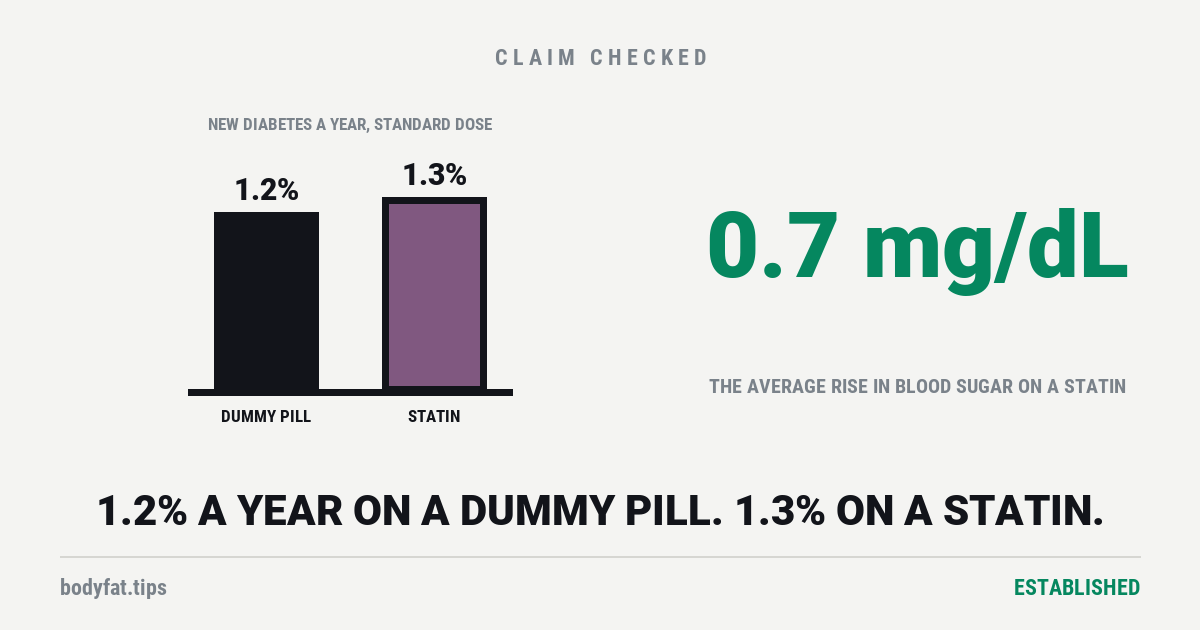
In people without diabetes, blood sugar on a statin averaged about 0.7 mg/dL (0.04 mmol/L) higher than on the dummy pill, in the nine standard-dose trials that took readings during treatment (the paper counts seven trials, of its 19, that tested everyone without diabetes as a matter of routine) [1]. For scale, the line for diabetes on a fasting test is 126 mg/dL (7.0 mmol/L) [1]. A rise of 0.7 is not something you would feel, or spot on a single test.
HbA1c — a blood test that reads your average blood sugar over the past three months, with 6.5% as the line for diabetes [1] — rose by 0.06 of a percentage point on a standard dose and 0.08 on a high one [1]. Those are the numbers the video quotes, and the paper prints them. What its appendix also shows is that each comes from a single trial. The standard-dose figure is one trial of 1,888 people, where the range the true answer probably sits in ran from zero to 0.12, so “no rise at all” was still on the table in that trial alone [1]. HbA1c was not a standard test for diabetes until 2011, after these trials had started, so almost none of them measured it [1].
Is it something else, like weight? Not much of it. Statin users without diabetes ended the trials 0.7 lb (0.30 kg) heavier than those on dummy pills, which the authors judge far too little to explain more than a small part of the diagnoses [1]. So: a real rise, pooled from the trials that took readings (nine on a standard dose and two on a high one for blood sugar, one of each for HbA1c), and small in every pooling [1].
Do statins cause diabetes?
In the blinded trials, more people on a statin were diagnosed. On a low or standard dose, 10% more than on the dummy pill; on a high dose, 36% more [1]. Standard here means doses like simvastatin 40 mg, pravastatin 40 mg or atorvastatin 10 mg; high means atorvastatin 40 to 80 mg or rosuvastatin 20 to 40 mg [1] [11].
“10% more” sounds like a lot until you ask: ten per cent of what? Of a small number. In the standard-dose trials, 1.2% of the people on dummy pills were diagnosed each year, and 1.3% of the people on a statin [1]. The difference is about 1.2 extra diagnoses for every 1,000 people taking a statin for a year [1]. The video’s “one per 1,000” is right.
On a high dose the paper’s own absolute figure is far bigger, 12.7 per 1,000 a year, and its authors warn against reading it that way. One of the two high-dose trials tested HbA1c in most of its volunteers, which finds diabetes that the other trials rarely looked for, in the dummy-pill group as much as the statin group [1]. The 36% is the number to trust there. A separate pooling of five trials that compared a high dose with a standard one found the higher dose added about 2.0 diagnoses per 1,000 people a year [6].
None of this is new. A 2010 analysis of 13 trials and 91,140 people found 9% more diabetes on statins, one extra case for every 255 people treated for four years, which is about one per 1,000 a year again [5]. A 2024 analysis of eight prevention trials, in people taking a statin to head off a first heart attack or stroke, found 10% more overall; when it split the trials by how common diabetes was in their comparison groups, the rise showed only where diabetes was common, about 20% more there and none detectable in the rest [7]. And on 28 February 2012 the US Food and Drug Administration added to every statin’s label that rises in blood sugar and HbA1c had been reported [10].
How does a rise that small tip someone over the line?
If blood sugar barely moves, how does anyone end up with a diagnosis? Because diabetes is not something you catch. It is a line drawn across a smooth scale, and some people are standing right next to it.
The 2024 paper drew the arithmetic. Take a population whose average HbA1c is 5.5%. Nudge everyone up by 0.05 of a point, and the share of people above the 6.5% line grows by about a fifth [1]. Nobody far from the line crosses it. The people who cross were a step away already.
And that is exactly where the trials found the extra diagnoses. About 62% of them were among people who started in the top quarter for blood sugar, whose HbA1c averaged 6.2% [1]. In the large rosuvastatin trial, virtually all of the extra diabetes was in people whose fasting blood sugar was already raised when they enrolled, and the statin brought their diagnosis forward by 5.4 weeks on average [2].
| Blood sugar at the start | Average HbA1c | Standard dose: extra per 1,000 a year | Same, over five years | High dose: extra per 1,000 a year |
|---|---|---|---|---|
| Lowest quarter of the trials | 4.7% | 0.6 | 3 | 2.3 |
| Second quarter | 5.5% | 0.7 | 3.5 | 2.7 |
| Third quarter | 5.8% | 1.6 | 8 | 5.9 |
| Top quarter, nearest the line | 6.2% | 4.8 | 24 | 17.8 |
Read down the standard-dose column. For half the people in the trials, the extra chance of a diagnosis in a given year was under one in a thousand. For people already at the line it was about five in a thousand, and over five years about one in forty.
What did the same trials find for heart attacks and strokes?
A statin is not taken for blood sugar. So the other side of the trade belongs on the same page, in the same unit. The trialists’ collaboration has estimated, from 22 trials, how many heart attacks, strokes, coronary deaths and artery-opening procedures a statin prevents over five years, depending on how high your risk was to begin with and how far the drug brings down your LDL — the cholesterol statins lower, and the kind eggs nudge up [4].
| Five-year heart risk before treatment | LDL lowered by 39 mg/dL (1 mmol/L) | LDL lowered by 77 mg/dL (2 mmol/L) |
|---|---|---|
| Under 5% | 6 | 10 |
| 5 to 10% | 15 | 27 |
| 10 to 20% | 31 | 57 |
| 20 to 30% | 45 | 84 |
| 30% or more | 61 | 119 |
Put the two tables side by side and the shape is plain. For someone with heart disease or a high heart risk, the heart column runs to dozens per 1,000 over five years, and on a standard dose the diabetes column reaches two dozen only for people already at the line. For someone at the lowest heart risk whose blood sugar is already near the line, the diabetes number can be the bigger of the two. Reading across two tables built from different groups of trials is our arithmetic, not a measurement in one group of people, so here is the measurement.
Two placebo trials count both sides in the same people over the same years, and so does a 2011 pooling of high against standard doses. That is the cleanest comparison there is.
| Trial, and who was in it | Extra diabetes diagnoses | Fewer heart events |
|---|---|---|
| Rosuvastatin 20 mg, about two years: 11,508 people with a diabetes risk factor [2] | 4.7 more (21.2 against 16.5) | 5.2 fewer heart attacks, strokes or deaths (11.5 against 16.7); 7.7 fewer on the trial’s widest count (16.4 against 24.1) |
| Same trial: 6,095 people with no diabetes risk factor [2] | None (1.8 against 1.8) | 7.8 fewer (15.5 against 23.3); 10.7 fewer on the widest count (19.2 against 29.9) |
| Pitavastatin 4 mg, about five years: 7,769 people with HIV [3] | 2.9 more (11.3 against 8.4) | 2.5 fewer major cardiovascular events (4.8 against 7.3) |
| High dose against standard dose, about five years: 32,752 people with heart disease and no diabetes, in five trials [6] | 2.0 more (18.9 against 16.9) | 6.5 fewer first heart attacks, strokes, heart deaths or artery-opening procedures (44.5 against 51.0) |
Among the rosuvastatin trial’s volunteers already heading toward diabetes, then, on the table’s first measure the two counts came out close: about five extra diagnoses against about five fewer heart attacks, strokes or deaths per 1,000 a year [2]. That is one of the narrower counts in the trial’s own table. On its widest the gap is 7.7 fewer against 4.7 more, and the authors’ own tally for this group is 93 fewer people with a first heart event, vein clot or death against 54 more new diagnoses, or 134 fewer events against 54 counting every event [2]. In the pitavastatin trial, whose volunteers were at low to moderate heart risk, it was about three against two and a half [3]. On a high dose against a standard one, in people who already had heart disease, it was 2.0 extra diagnoses against 6.5 fewer first heart events [6]. In the volunteers who were not heading toward diabetes, the diabetes column was empty and the heart column was not [2].
And the video’s “roughly five heart attacks or strokes prevented”, set against that one extra case per 1,000 a year? It is not in the 2024 paper the video credits, which counts diagnoses and blood sugar and prints no count of heart attacks prevented [1]. It is an older estimate, and an average. The 20-year follow-up of the Scottish pravastatin trial, cited further down this page, repeats it as five heart attacks prevented for every new case of diabetes [19], and a 2012 patient page in a cardiology journal credits it to the 2010 pooling of 13 trials: one extra diagnosis for every 255 people treated for four years, while 5.4 cardiovascular events were prevented [5] [24]. By our arithmetic that is about one against five per 1,000 people a year, averaged across 13 trials rather than measured in any one kind of patient. The tables above are what the trials themselves report, and they say the ratio depends on who you are.
What did the “new research” actually show?
The video’s “new research” is a February 2024 paper in Cell Metabolism [8]. Thirty people starting atorvastatin 20 mg were followed for 16 weeks beside 10 people who were not, and the authors filed it under the reporting standard for observational studies: nobody was randomised and there was no dummy pill [8]. In the statin group HbA1c went from 5.77% to 6.13%, and GLP-1 fell by about half [8]. GLP-1 is a gut hormone that tells the pancreas to release insulin after a meal; it is the hormone semaglutide and tirzepatide were built to copy, which has its own verdict.
The mechanism the paper proposes is genuinely interesting. A group of gut bacteria fell away on the statin, and with them a bile acid called UDCA that nudges GLP-1 release. In small groups of mice, a statin worsened the handling of blood sugar, and adding the missing bacteria or UDCA back eased it [8]. The video’s description says the high-fibre finding was in mice, which is fair.
What the human part can carry is less. The video calls the ten “similar patients”. They were not: none of them had diabetes, high blood pressure or a smoking habit, against a fifth, a half and a third of the thirty [8]. Fasting blood sugar in the statin group did not rise; it went from about 105 to 99 mg/dL (5.82 to 5.49 mmol/L), which the paper’s own table marks as not significant [8]. The HbA1c rise of 0.36 of a point, in a group that included people with diabetes, is several times the average rise the blinded trials found in people without it [1] [8]. And the human test of UDCA was five people measured before and after eight weeks of it, with no comparison group [8].
Is the gut explanation wrong, then? Not proven wrong, but a randomised test of it in people, published in March 2026, did not find it. A Danish team gave 15 healthy young men two weeks of atorvastatin, 40 mg and then 80 mg, and two weeks of dummy pills, in random order, without the men or the researchers knowing which was which. The team expected GLP-1 to fall. After a meal it rose a little instead; the men’s gut bacteria did not change, and neither did their blood sugar or insulin. One form of UDCA in the blood did fall, and glucagon, a hormone that raises blood sugar, went up, which the authors now suggest as a different link [20]. They call their own result hypothesis-generating: fifteen young, healthy men for two weeks are not older patients on a statin for years [20].
Two other placebo-controlled trials of rosuvastatin looked at the gut bacteria alone. In a trial of 66 women in Oslo over six months, no group of gut bacteria changed significantly in the 40 whose stool could be analysed, though some of the bacteria’s genes did [21]. A trial of 45 healthy young adults over eight weeks has posted results to its registry, and no paper, reporting a difference between the groups in how their bacteria changed without saying which bacteria or in which direction [22]. And the hospital team behind the 2024 study has registered two randomised trials of UDCA given with a statin. One, of a planned 1,000 people, started in March 2021; its registry entry was last updated in September 2022 and shows no results [23]. The other, double-blind, in 128 people, says in its protocol that the question “remains unexplored in prospective randomised trials”, and it was recruiting, with no results posted, when we checked [18]. On its own the gut-bacteria account would rate Preliminary here, with the randomised test of the whole chain pointing against it. It does not change the size of the effect, which the blinded trials had measured years before.
Which statin raises blood sugar the most?
Dose, more than brand. Among six different statins at standard doses in the blinded trials, the analysis could not tell them apart; at high doses, atorvastatin 80 mg and rosuvastatin 20 mg looked alike [1]. What moved the number was how hard the drug was pushed. Pravastatin, which some summaries call neutral, pooled to 8% more diabetes across its four blinded trials, with a range that ran from a little less to 20% more [1].
A head-to-head trial in South Korea did find a difference between two statins, and it may be the push again. There, 4,400 adults with heart disease were randomly given rosuvastatin or atorvastatin for three years, and everyone knew which they were taking. Among the 2,932 who did not have diabetes at the start, 7.2% on rosuvastatin and 5.3% on atorvastatin were started on diabetes medicine; by the trial’s wider definition of a new diagnosis, 10.4% against 8.4%, the gap was just the wrong side of the line researchers use for “probably not chance” [25]. Rosuvastatin also pushed LDL a little lower, to about 70 against 73 mg/dL (1.8 against 1.9 mmol/L), so the trial cannot separate a different drug from a harder push; it was funded by two drug companies [25].
Pitavastatin is the one usually sold as the exception. An online pharmacy’s page, one of the pages a search engine’s AI answer cites for this question, tells readers a branded pitavastatin “may have less of an effect on blood sugar levels”. There is evidence for that: a 2015 pooling of 15 short trials, about 1,600 person-years in total and funded by pitavastatin’s maker, found no rise [12], and a 2024 review that mixed observational studies with trials found a lower risk than with atorvastatin or rosuvastatin [13]. But in a blinded trial that followed 7,769 people with HIV for a median of five years, pitavastatin 4 mg brought 35% more diabetes diagnoses than placebo, 5.3% against 4.0%, even though average blood sugar did not differ [3]. So “pitavastatin is the one that doesn’t” would rate no better than Preliminary, and the long blinded test points the other way.
Will stopping a statin reverse diabetes?
We found no trial that took people diagnosed with diabetes while on a statin, stopped the drug, and followed whether the diagnosis went away. What exists is smaller.
Two case reports describe it happening. In 2005, a man diagnosed four months after starting atorvastatin 10 mg, with an HbA1c of 11.5%, was almost clear of diabetes three months after stopping it, after two months on insulin; on pravastatin his HbA1c crept up again and fell when that was stopped too [15]. In 2024, a man started on rosuvastatin 40 mg had symptoms within weeks and an HbA1c of 12.4% at three months, and was back at 5.5% at least three months after stopping, without diabetes medicine [16]. Cases like these show it can happen in one person. They cannot say how often, and the second report’s own authors call rises that dramatic rare [16].
Two small experiments from the same research group come closer. In one, twenty-one people with metabolic syndrome, twenty of them men, who had taken statins for years were tested on their statin and again 96 hours after a blinded switch to dummy pills: insulin resistance did not change [14]. In the other, eleven people with abnormal blood fats and metabolic syndrome were tested the same way, and how fast the sugar from a meal reached their blood did not change [27]. Four days cannot say anything about HbA1c, which reads three months, so neither answers the question.
UK guidance written for clinicians is direct: “Do not stop statins because of an increase in blood glucose level or HbA1c” [17]. That is advice to prescribers, and it is why the question belongs with your prescriber: stopping takes away the heart column above as well as whatever it does to the diabetes one.
What is the biggest side effect of statins?
By how often people complain, muscle aches. In the same 19 blinded trials, 27.1% of the people on a statin and 26.6% of the people on dummy pills reported muscle pain or weakness [11]. In the first year statins caused about 11 extra reports per 1,000 people, which means only about one first-year muscle complaint in 15 from people on a statin was caused by the statin; after the first year there was no clear excess [11]. Diabetes is rarer, at about 1.2 extra per 1,000 a year on a standard dose [1], but it is the one that ends in a diagnosis.
Does any of this apply to you?
Who was in the trials? In the 19 blinded trials the average age was 63, 28% were women, 81% were white where race was recorded (seven trials did not record it), and nearly half already had heart or artery disease; their main results were published between 1994 and 2016 [1]. The rosuvastatin trial enrolled healthy adults with normal LDL but a raised blood marker of inflammation [2]. The pitavastatin trial enrolled people with HIV, median age 50 [3].
The relative rise did not vary much by age, sex or body size, the authors report [1]. So where you land depends on two starting points, measured separately: your blood sugar, which sets your row in the diabetes table, and your heart risk, which sets your row in the heart table. Heart risk is built from more than cholesterol, blood pressure among it, and food moves it by other routes: cutting saturated fat has its own verdict. So do the things that move blood sugar after a meal, a walk after dinner for one.
This is journalism, not medical advice, and nothing on this page tells anyone to start or stop a medicine. The two numbers that decide the trade for a particular person are their latest HbA1c or fasting blood sugar and their estimated heart risk, and the person to weigh them with is a clinician who has both.
If the two counts can come out close, why do the trialists say the heart side wins?
This section is the desk’s own reasoning, and it is labelled as such. The trials agree that statins add diagnoses and prevent heart attacks. In lower-risk groups the two counts per 1,000 can sit close together [2] [3], depending on which heart events are counted (on the rosuvastatin trial’s own widest tally it was 93 against 54 [2]), and yet the trialists who weighed them, and the FDA, all conclude the heart side wins [1] [2] [4] [10]. Three reasons are offered. Here is what each one is worth.
Answer one: most of these diagnoses are early arrivals, not new disease. The extra cases came mostly from people already at the line [1], and in the rosuvastatin trial the diagnosis came 5.4 weeks sooner on average [2]. That half is measured. The other half is a surmise: that those people would have been diagnosed anyway, a little later. No trial on this page kept counting long enough after the statins stopped to show it.
Answer two: the rise is too small to do the damage diabetes is feared for. Trials of tighter against looser blood-sugar control, in people who already had diabetes, found that an HbA1c 0.9 of a point higher for five years brought 20% more serious kidney problems and 13% more eye problems, about 4 and 2 extra cases for every 1,000 people a year [1]. In the statin trials HbA1c rose 0.06 to 0.08 of a point in people without diabetes and 0.09 to 0.24 in people who had it, from about a fifteenth to about a quarter of that gap [1]. That is arithmetic from other trials, not a measurement in statin users, and the trialists say themselves that they could not assess eye and kidney damage in their data [1].
Answer three: the heart count already has the sugar in it. The trials counted heart attacks and strokes in everyone, including the people whose blood sugar rose, so any harm from that rise is already inside the benefit they report [1]. Among the 486 people in the rosuvastatin trial who developed diabetes, those on the statin still had fewer heart events, 8 against 10, a reduction in line with the trial as a whole [2]. That is measured, but on 18 events, with a range wide enough to include no benefit: a direction, not a proof.
Put the three together and here is what we think is true, stated plainly so you can disagree with it: a statin mostly moves the date of a diabetes diagnosis for people already walking toward one, and whether that trade is worth it turns on heart risk far more than on blood sugar.
What we could not find, and would like to: a follow-up that kept counting diabetes diagnoses for years after a statin trial ended, to see whether the dummy-pill group caught up. That would settle “early” against “extra”. The closest is the 20-year follow-up of the Scottish pravastatin trial, which found fewer hospital admissions for non-cardiovascular complications of diabetes among the men who had taken the statin, but that was the trial where diabetes had been less common on pravastatin to begin with [19] [9]. We would also like eye and kidney outcomes for people diagnosed while on a statin, and the UDCA trials’ results [18] [23]. If you know of the follow-up, the corrections line on this site is open.
Where “statins give you diabetes” came from
It began, oddly, with the opposite. In 2001 a look back at a Scottish pravastatin trial reported 30% less diabetes in the men on the statin, a finding its own authors called hypothesis-generating; that analysis was supported by an educational grant from the drug’s maker [9]. Re-analysed with every person’s records in 2024, the same trial came out at 18% less, with a range that included no difference [1].
Then the signal flipped. In 2008 JUPITER, a rosuvastatin trial funded by the drug’s maker, became the first large statin trial to report significantly more diabetes, 270 diagnoses against 216 [1] [2]. The 2010 pooling of 13 trials showed it across the drug class [5], the FDA put it on every label in February 2012 [10], and the trialists’ analysis sized it in March 2024. The collaboration’s own news item on that paper said people at high risk “may develop diabetes sooner” [26], which is the fairest one-line summary we have read. Seven weeks earlier, in February 2024, the Cell Metabolism study had supplied a mechanism story [8].
The September 2026 video stitched the two together. To its credit, its description carries the trade-off and tells viewers not to start, stop or change a medicine without their doctor. What it adds is a 40-person observational study billed as front-page news, and a 2010 average of about five events prevented per extra diagnosis, credited to a 2024 paper that does not contain it [1] [24].
Where it lands is where the money is. Ask a search engine and its AI answer says yes, a small rise, and among its citations is the online pharmacy page pitching a branded pitavastatin as easier on blood sugar, the claim the long blinded trial did not bear out [3]. A company that sells cholesterol-lowering foods ranks for the same question with a post that quotes a “nearly 50%” rise from a study that watched about 9,000 men rather than assigning anyone a statin, instead of the blinded trials’ 10%, then offers its foods as a way to keep the statin dose down. Fibre does lower LDL a little, as the psyllium verdict found; it is not a substitute for knowing your own numbers.
None of this is aimed at anyone who takes a statin, or who stopped one after a frightening video. The finding is real. The trouble starts only where it is sold as something bigger, or as a reason to buy something.
What this is rated, and what the rating covers
Established — for the claim that statins raise blood sugar slightly and bring a diagnosis of type 2 diabetes to more people than a dummy pill does, mostly people already close to the line.
It is rated Established because the rise shows up in an analysis of every person in 19 blinded trials [1]; because a 2023 blinded trial outside those 19, of the statin sold as the exception, found it too [3]; because a higher dose raised it further, in the 2024 analysis and in a 2011 pooling of dose comparisons [1] [6]; and because the regulator has put it on the label [10]. Earlier poolings found the rise as well, in 2010 [5] and in 2024 among prevention trials [7], but they are not independent checks: 10 of the 2010 pooling’s 13 trials and five of the 2024 pooling’s eight are among the 19, and four of the 2011 dose pooling’s five are among the 2024 analysis’s dose trials [1] [5] [6] [7]. The rating covers the direction and the size given above: about 0.7 mg/dL, and about one extra diagnosis per 1,000 people a year on a standard dose.
What is not rated here: the gut-bacteria and GLP-1 explanation, which on its own would be Preliminary: it rests on one 40-person observational study, mice, and five people measured before and after [8], and a two-week randomised trial in 15 young men did not reproduce its first steps [20]; the claim that fibre prevents it, Preliminary, mice only [8]; the claim that pitavastatin is the exception, where the evidence conflicts [12] [13] [3]; whether statin-linked diagnoses are extra or merely early, which is open; and whether a statin is right for any one person, which is a clinician’s call. The frame in the section above is this desk’s reasoning from the evidence rather than a result the evidence delivered, and it is marked as ours so that you can weigh it as ours. How we read a study, and what each tier means, is set out here.
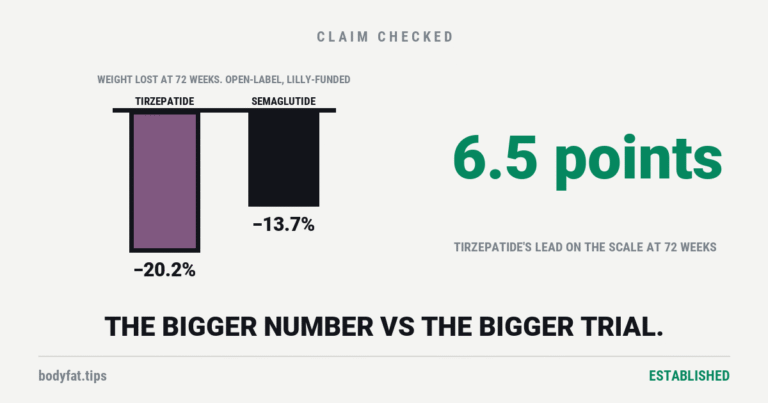
- Tirzepatide vs Semaglutide: Tirzepatide Lost 20.2% to Semaglutide’s 13.7% in the Only Head-to-Head Obesity Trial. Only Semaglutide Has Beaten Placebo on Heart Outcomes.
established - Does TRT Work? Clearly For Sex Drive. Barely For Energy.
supported - Does Lifting Weights Increase Testosterone? Yes — And It Made No Difference
unsupported