Sit-to-Stand Test: In Older Adults, the Slowest Risers Died at Nearly Twice the Rate. Whether Raising Your Score Buys Years Is Unproven.

On 4 October 2026 a health-video channel posted a video, 2 minutes 26 seconds long, called “6 SIGNS a 60 yr old will have a LONG Life?” Within three days it had 2,162,255 views. Its signs include how fast you walk, whether you can stand up without using your hands, and whether you can balance on one leg for ten seconds. Near the end, the description adds the line that sells it: every one of them “can be improved at any age.”
That is two claims in one breath. The first is that these little tests predict how long you will live. The second, tucked into the good news, is that if you train yourself to pass them, you will live longer. The first has a lot of evidence behind it. The second is a different question, and the answer is not the one the good news implies.
Which sit-to-stand test? There are two
Before any number, a warning about the name, because the studies use two different tests and the internet blends them. The chair sit-to-stand has you rise from an ordinary chair with your arms crossed, either five times against the clock (timed) or as many times as you can in 30 seconds (counted) [1] [10]. The floor sitting-rising test has you sit down on the floor and get back up, scored out of 10, losing a point for every hand, knee or forearm you lean on [2]. The chair test has been tied to deaths in several independent cohorts. The floor test has been tied to deaths at one clinic. That difference runs through everything below.
Does the sit-to-stand test predict how long you live?
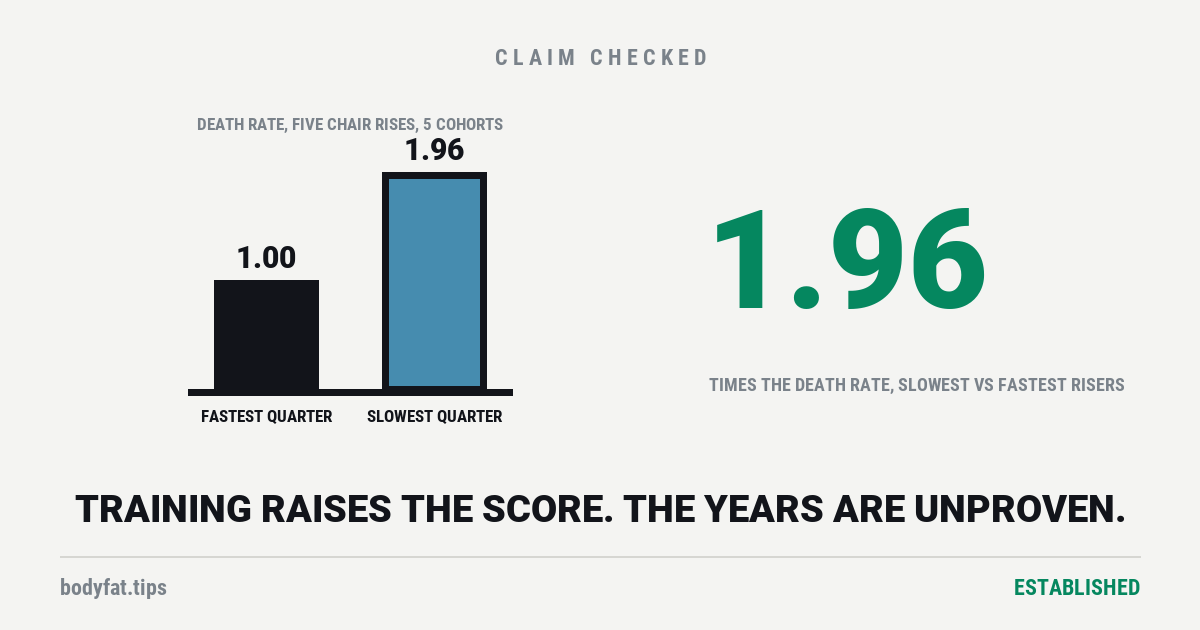
The chair version, yes, in older people, and in younger ones too. In 2010 a team of British researchers gathered every cohort study they could find that had timed people rising from a chair and then followed them, and asked the authors for results they had not published [1]. Five cohorts, 28,036 people, all of them averaging over 70. Each person stood up five times; the clock ran. Then the cohorts waited.
The slowest quarter of chair-risers died at 1.96 times the rate of the fastest quarter, after allowing for age, sex and body size [1]. That 1.96 is a hazard ratio: the death rate in one group divided by the death rate in another, at any point in the follow-up. A hazard ratio of 2 means twice the rate; 1 means no difference. The two quarters in between fell neatly in between [1]. People who could not get up from the chair at all fared worst of everyone [1].
Two fences belong on that number. The five cohorts disagreed about how big the gap was: 82% of the spread between their results was more than chance would produce, so 1.96 is an average of quite different answers [1]. And every one of them was a group of people averaging over 70, so the review could not say whether the same holds at 50 [1]. Later cohorts can.
Here is what the chair test has shown since. In a British birth cohort tested at 53, the slowest fifth at ten chair rises died over the next 13 years at about twice the rate of the fastest fifth: 2.13 times, allowing for sex [17]. Allow for social class, smoking, exercise habits and illnesses as well, and the gap shrank to 1.61, with a range wide enough to include no difference; those who could not do the test at all still died at more than four times the rate [17]. In 8,477 people aged 48 to 92 in Norfolk, England, slow chair rising predicted death about as strongly under 70 as over it, and still did after allowing for illnesses, smoking, drinking, television time and exercise [18]. In 7,838 Norwegians aged 40 to 84, the slowest risers, about one in twenty, died at 2.64 times the rate of those who were not slow, allowing for lifestyle and diseases [19]. In 43,605 people aged 50 and over in a Europe-wide survey, taking 18 seconds for five rises rather than 11 went with an 18% higher death rate (we read it as its abstract) [20]. How big the gap is varies a good deal from one group to the next. Which way it points has been the same in every one of them.
The floor version comes from a different kind of study. A private exercise-medicine clinic in Rio de Janeiro has given the test to its patients since the late 1990s, and in 2012 it reported on 2,002 of them aged 51 to 80 [2]. Over a median 6.3 years, 19.2% of those scoring 0 to 3 died, against 3.6% of those scoring 8 to 10 [2]. A 2025 follow-up of 4,282 patients aged 46 to 75, tracked for a median 12.3 years, found the same staircase: 42.1% of those scoring 0 to 4 died of natural causes, against 3.7% of those scoring a perfect 10 [3]. After allowing for age, sex, weight and their medical history, the lowest group’s death rate was 3.84 times the top group’s [3]. Scores of 8 and of 8.5 to 9.5 sat in between: 11.1% and 7.0% of those groups died, against 3.7% of the perfect scorers. After the same allowances their death rates came out 51% and 25% higher than the top group’s, with ranges wide enough to include no difference at all, and only 16 deaths among the perfect scorers to compare against [3].
Read who those patients were, in the authors’ own description: mostly white, from the upper income and education brackets of Brazil, about two-thirds men, and for the most part referred by their own doctors [3]. Nearly a third had a history of coronary artery disease [3]. The first study allowed only for age, sex and body mass, and the people with the lowest scores averaged 12 years older than those with the highest [2]. And every study linking the floor test to deaths that we found comes from that one clinic (PubMed in two wordings and an ordinary web search, 9 October 2026). That does not make it wrong. It makes it one clinic’s finding, waiting for someone else to check it.
One detail matters for later. In both floor studies, a patient who did not score a perfect 5 on a movement was given advice on how to do better and allowed another try, and the best score was the one that counted [2] [3]. Hold that thought.
Does walking speed predict life expectancy?
This is the strongest of the signs. In 2011 nine cohorts of people aged 65 and over, 34,485 in all, were pooled person by person: mostly Americans, average age 73.5, measured between 1986 and 2000 and followed for six to 21 years, during which 17,528 died [4]. Every one of the nine found the same direction, though, like the chair cohorts, they disagreed about how far: 82% of the spread between their results was more than chance would produce [4]. At any given age, each step up in walking speed of 0.22 mph (0.1 m/s) went with a death rate about 12% lower, and about 10% lower after allowing for diseases, smoking, weight and blood pressure [4].
The authors turned that into something a clinic could use. At about 1.8 mph (0.8 m/s) a person’s predicted life expectancy sat at the average for their age and sex; at 2.2 mph (1.0 m/s) or faster it was consistently longer [4]. In their model, a 75-year-old man’s chance of being alive ten years on ran from 19% to 87% across the range of walking speeds, and a woman’s from 35% to 91% [4]. Those are predictions from the model for groups, not odds for a person. Walking speed, age and sex predicted survival about as well as age, sex, chronic diseases, blood pressure, weight and recent hospital stays put together [4]. The 2010 review found the same: the slowest quarter of walkers died at 2.87 times the rate of the fastest [1].
Two more things in the same paper are worth knowing. A drug company gave a grant for the work, approved the initial proposal and had representatives review the first draft, and one author worked at its research laboratories [4]. And the authors ended by asking for “true experiments” to find out whether raising gait speed improves “function, health, and longevity” [4]. They were saying it had not been shown.
How long should a 72-year-old be able to stand on one leg?
The study behind the ten-second sign comes from the same Rio clinic, in 1,702 patients aged 51 to 75 [5]. They stood barefoot on one leg with the other foot resting on the back of the standing calf, arms by their sides, for ten seconds, with three tries. Failing got sharply more common with age: 4.7% of those aged 51 to 55 could not do it, 17.8% at 61 to 65, 36.8% at 66 to 70, and 53.6% of those aged 71 to 75 [5]. So, in that clinic’s patients, about half of people in their early seventies could not hold ten seconds. That is this study’s answer for a 72-year-old, and it is an answer about one clinic’s patients.
Over a median seven years, 17.5% of those who failed died, against 4.6% of those who passed; after allowing for age, sex, weight and diseases, the failers’ death rate was 1.84 times the passers’ [5]. Diabetes was three times as common among the failers [5]. Physical activity, smoking, diet and recent falls were not measured, as the authors list themselves [5].
Put that beside the wider literature. A 2024 pooling of 15 cohorts of older people found that failing a balance test went with a death rate 14% higher, with the cohorts’ results differing far more than chance would produce (we read it as its abstract) [6]. Balance does predict. The 1.84 is one clinic’s figure for one version of the test, and the pooled figure across many is a good deal smaller.
One-leg standing has been tied to deaths outside Rio too. In the British birth cohort at 53, the fifth who held a one-leg stand with their eyes closed for the shortest time died at 2.53 times the rate of the fifth who held it longest, after allowing for illnesses and habits, and those who could not do it at all at nearly ten times the rate [17]. In 13,423 Taiwanese adults aged 65 and over, the best fifth at standing on one leg died at half the rate of the worst fifth [21]. The ten-second line itself has been tested against deaths outside Rio twice, in what we found. In Finland, among 2,815 women averaging 59, the 200 who could not stand on one leg for ten seconds, hands on hips, died over about 18 years at 2.5 times the rate of women who showed none of the study’s three weaknesses, before allowing for age, weight or smoking [22]. The authors’ adjusted figure is misprinted in the version we read, so we leave it out. In 1,226 older adults studied by a Japanese university team, the tenth who failed both of two tests with a ten-second line, standing on one leg and rising from a chair five times, were the likeliest of four groups to have died five years later. The summary puts their odds of dying at 4.36 times, without saying which group it set them against, and does not say how those who failed only the one-leg test fared (we read it as its abstract) [26]. And in 3,278 Japanese adults aged 65 and over, holding the weaker leg up for under ten seconds went with about twice the rate of losing independence or dying, the two counted together (we read it as its abstract) [23].
Does thigh size predict how long you live?
The thigh study is real and it is Danish. In 1987 and 1988 a random sample of 2,816 adults aged 35 to 65 had a tape put round the right thigh just below the buttock crease, and were followed for 12.5 years [7]. Risk of death climbed as thighs got smaller below about 23.6 inches (60 cm), and did not keep falling above it, after allowing for waist size, weight and body fat [7]. The authors wrote that the threshold “needs further confirmation before the results can be generalised” [7].
The channel’s thigh video says “a follow-up analysis of 2.5 million people confirmed it.” That figure is real too, and it is the size of a 2020 review of 72 cohorts on eight body measurements, waist size above all [8]. Its estimate for thighs pooled three of those cohorts, 25,412 people, one of them the original Danish study: each 2 inches (5 cm) more thigh went with an 18% lower death rate [8]. The direction held. The 2.5 million belongs to the waists.
Can brisk walking reverse aging by 16 years?
The 16 years comes from a 2022 UK Biobank study of 405,981 people, average age 56 [9]. It did not measure deaths, and it did not measure anyone walking faster. It asked people whether they walked slowly, at a steady pace or briskly, and measured the length of their telomeres, the protective caps on the ends of chromosomes that shorten with age and have been proposed as a marker of biological age [9].
Brisk walkers had slightly longer telomeres. Using genetic variants as a stand-in for walking pace, the gap came out at the equivalent of 16 years of telomere ageing; the direct comparison of the walkers, after allowing for everything else measured, came out at the equivalent of 2 years [9]. The authors say plainly that the larger figure “is likely to be greater than the magnitude of change that can be anticipated from any future intervention” [9]. The channel’s version adds walking in nature and mentally engaging walks, which the study did not test. “Reverses aging by 16 years” is a statement about a telomere estimate its own authors fenced, told as a promise about your life.
What is a good score on the sit-to-stand test?
Here is how each test was done and where each study drew its line. Every line comes from a study, and every study was done on particular people, so read the last column first.
| Test | How it was done | The line the study drew | Who it was drawn on |
|---|---|---|---|
| Walking speed [4] | Usual pace from a standing start, timed over 8 to 20 feet (6 m) and converted to 13 feet (4 m), the course the authors suggest | About 5 seconds, 1.8 mph (0.8 m/s): predicted life expectancy about average for age and sex. 4 seconds or less, 2.2 mph (1.0 m/s): longer than average | 34,485 people aged 65 and over in nine cohorts, mostly American, measured 1986 to 2000 |
| Five chair rises [1] | Stand up from a chair five times while someone times you | No single line across the five pooled cohorts, whose risk rose step by step. One further US cohort drew one: 17 seconds or more went with a death rate 40% higher than under 17 | Five cohorts averaging over 70; the 17-second line from a separate US cohort of 3,024 older people |
| 30-second chair stand [10] | 17-inch chair, arms crossed on the chest, count full stands in 30 seconds | CDC’s falls screen calls these below average: 60–64, men under 14, women under 12; 70–74, under 12 and under 10; 80–84, under 10 and under 9 | Not stated on CDC’s sheet. A falls screen, not a line drawn against deaths |
| Floor sitting-rising test [2] [3] | Barefoot, sit on the floor and stand up; start at 10, lose a point per hand, knee or forearm used, half a point for a wobble | Scores of 8 and up were the lowest-risk groups; 0 to 4 the highest | Patients of one private clinic in Rio de Janeiro, aged 46 to 80, about two-thirds men, mostly well-off |
| One leg, 10 seconds [5] | Barefoot, top of the free foot resting on the back of the standing leg, arms by your sides, eyes on a point 6.6 feet (2 m) away, up to three tries | Pass or fail at 10 seconds | 1,702 patients aged 51 to 75 at the same Rio clinic |
| Thigh size [7] | Tape around the right thigh just below the buttock crease | Risk climbed below about 23.6 inches (60 cm) and did not keep falling above it | 2,816 Danish adults aged 35 to 65, measured in 1987–88 |
Three cautions before you try any of it. The 2010 review found the risk rose step by step across the whole range, with no threshold where it suddenly changed, and warned that cut-offs need to be set with care for each population [1]. A score describes a group: the walking-speed study itself found some very slow walkers who survived for long periods [4]. And the floor and one-leg tests in Rio were given by physicians, the one-leg test with a physician or nurse face to face with the patient [3] [5]; CDC’s chair sheet tells the tester to stand next to the person [10]. If your balance or your joints are doubtful, do them with someone beside you, or not at all.
How many sit-to-stands should you be able to do in 30 seconds?
The 30-second count is the first thing the search engine’s “People also ask” box raises for this test, and the honest answer is that CDC’s chart for it is a falls screen, not a lifespan chart. CDC’s version: a 17-inch chair without arms, arms crossed on your chest, full stands counted for 30 seconds; if you need your arms, the score is zero [10]. Its chart calls fewer than 14 below average for a man aged 60 to 64 and fewer than 12 for a woman, falling to fewer than 7 and fewer than 4 at 90 to 94, and says a below-average score “indicates a risk for falls” [10]. The sheet does not say where its numbers come from. Most of the cohorts tied to deaths timed five rises [1] [18] [19], but the 30-second count has been tied to deaths too: in the Taiwanese cohort, those in the best fifth at the 30-second chair stand died over about seven years at a little over half the rate of the worst fifth, allowing for age, weight, illnesses and exercise habits (smoking was not recorded) [21]. In men, the risk stopped falling at about 15 stands [21]. That plateau comes from one cohort, in Taiwan, and CDC’s chart is still a falls screen, not a lifespan chart.
Does training to pass the tests help you live longer?
This is the half of the video’s promise that matters, so here is what the trials show, plainly. Training raises the scores. Training buys real things. Neither of those is the same as buying years, and on years the trials are not settled.
A 2020 review gathered 93 randomised trials in which people over 65 were assigned to exercise, or not, for a year or more [11]. The exercise groups got better at the tests on this page that the trials measured: balance, walking speed and chair rising all improved [11]. The improvements were small, in the language researchers use for effect sizes, where 0.2 is small, 0.5 moderate and 0.8 large: 0.31 for balance, 0.27 for chair rising, 0.13 for walking speed [11]. Strength training on its own adds about 0.18 mph (0.08 m/s) to walking speed, across 24 trials in the 121-trial review behind our verdict on resistance training for seniors [12], and it makes getting out of a chair a good deal easier: an effect size of 0.94 across 11 small trials of 384 people, large on that scale, though the range runs from 0.38 to 1.49 [12].
And the trained groups fell less: 11% fewer falls across 44 trials, 22% fewer injuries from falls across 16 [11]. Two large trials in older people at risk of disability point the same way on mobility. In the American LIFE trial, 1,635 sedentary people aged 70 to 89 walked and did strength and balance work for an average 2.6 years; 30.1% lost the ability to walk a quarter of a mile (400 m), against 35.5% of a health-education group [13]. The European SPRINTT trial took 1,519 frail people over 70 and made its main comparison in the 1,205 with the lowest scores. Among them, exercise raised the combined walking, chair and balance score by about one point out of twelve at three years, and mobility disability came out at 46.8% against 52.7% [14]. In the 314 who started with higher scores it did not help: 29.7% against 23.9%, a gap that could be chance [14]. One caution there: more falls were recorded in the main group’s exercise arm, 13.2% against 8.2% [14].
Now deaths. Across the 56 trials in the 2020 review that counted them, 5.5% of the exercise groups died and 5.8% of the comparison groups [11]. As a ratio, 0.93: 7% fewer, with the range the true answer probably sits in running from 17% fewer to 4% more [11]. That range includes “no difference at all.” In the 39 trials of people described as apparently healthy it was closer to level, 0.96; in the 16 trials of patients with a disease it was 0.67, a third fewer deaths [11]. LIFE counted 48 deaths among those who trained and 42 in the health-education group [13]; SPRINTT 31 against 25 in its main group [14]. Neither trial made death its main outcome [13] [14].
There is a study in which people whose walking speed improved over a year went on to die less: 31.6% over eight years, against 49.3% of those who never improved, among 439 people aged 65 and over from an American health plan and veterans’ clinics [15]. But nobody assigned those improvements, so the study cannot say what caused them, and its authors wrote that whether improving gait speed changes survival still needed testing (we read it as its abstract) [15].
We found no trial set up to test whether raising one of these scores lowers deaths in older people at large (PubMed in two wordings, ClinicalTrials.gov, the newest review’s list of trials and an ordinary web search, 9 October 2026). The closest we found are two large trials that counted deaths without setting out to raise a score. A five-year Norwegian trial of endurance training, built to count deaths, found them almost level; it is set out, with the strength-training death counts, on our grip strength verdict, which asks this same question of a squeeze. And for nine years an American trial mailed an activity programme, with a website and phone messages, to half of 49,331 women averaging 80 [24]. Those offered it reported about 4% more exercise than the rest [25]. Its results, posted on the trial registry in May 2026, show heart attacks, strokes and heart deaths almost exactly level (a hazard ratio of 0.99), other deaths level (1.00), and the combined walking, chair and balance score of the 3,719 women who were tested level too, 7.38 against 7.37 out of 12 [24]. Falls came out very slightly lower, 0.55 a year against 0.57 [24]. And the women offered the programme rated their own physical function slightly higher, by about one point on a 100-point scale averaged over the nine years, 59.7 against 58.7, a difference unlikely to be chance [24]. We found no journal report of those results yet (PubMed, Europe PMC and an ordinary web search, 9 October 2026). The authors of the walking, floor and balance studies all list the trial as still to be done [4] [3] [5].
If the score predicts death, why hasn’t raising it been shown to change death?
This section is the desk’s own reasoning, and it is labelled as such. The cohorts say the tests predict. The trials say training moves the tests. Put those together and you would expect fewer deaths, and the trials have not clearly shown them. Here are three reasons that could be, with how much evidence sits behind each.
Answer one: the test is reading illness as well as fitness. Walking speed predicted survival about as well as a list of diagnosed diseases did [4]; the people who failed the one-leg test were three times as likely to have diabetes [5]; the 2010 review’s authors wrote that the tests could be “markers of disease and general health status” [1]. Training cannot reach the part of the score that is a disease nobody has found yet. This is measured in part: the tests do carry illness with them. How much of the prediction is illness, none of these studies could say.
Answer two: the trials moved walking speed a little, and a little would buy little. Take the walking-speed study at its word and suppose every bit of its link were cause and effect. Each 0.22 mph (0.1 m/s) went with a death rate about 10 to 12% lower [4]; strength training adds about 0.18 mph (0.08 m/s) [12]. Run one through the other and you would expect a death rate about 8 to 10% lower. The trials’ pooled answer was 7% lower, in a range from 17% lower to 4% higher [11]. That is consistent with the expectation and with no effect at all, which is what a range that wide does. This is arithmetic, not a measurement, and it borrows a number from one review to apply it to the trials of another. It is about walking speed alone. Chair rising moved more in the strength trials, a large effect [12], so on that test the training did more than a little; in the 2020 review’s year-long trials it moved by a small amount, 0.27 [11].
Answer three: a score can be coached. The Rio clinic advised patients who fell short of a perfect score on how to do better and let them try again, keeping the best attempt [2] [3]. The walking-speed researchers noted that their participants did not know what their speed meant, and that people who did might walk differently [4]. A fitness-streaming service’s page now teaches “3 Ways to Improve Your Sit-to-Stand Score.” Practise the floor test and you will get better at the floor test. Whether you get better at what the test was reading is another matter. This is a surmise, with the tests’ own protocols on its side.
Put the three together and here is what we think, stated plainly so you can disagree with it: take the test to learn where you stand, and train for what the trials show training buys, which is staying mobile and, across the pooled trials, falling less, not for the number. If the years come too, good. Nobody can promise them yet.
What we could not find, and would like to: a trial that takes people who fail one of these tests, trains them for years, and counts deaths in enough people to see a difference of the size the arithmetic above suggests. And a study of the floor test against deaths from anyone other than the clinic that devised it. If you know of either, the corrections line on this site is open.
Where “six signs of a long life” came from
The floor test’s mortality finding arrived with a press release. On 13 December 2012 the press office of the cardiology society whose journal published it announced the Rio study under the line that the test was a “strong predictor” of death, and quoted its senior author that strength and flexibility “have a favourable influence on life expectancy” [16]. The release also quoted the investigators that “a 1-point increment” in the score went with a 21% reduction in mortality [16]. That wording started in the paper itself: its abstract says each one-point increase “conferred” a 21% improvement in survival, and its discussion calls the increment “even more relevant” [2]. It was a comparison between different people. Worded as an increment, and as something a score confers, it reads like a change you could make.
Then it travelled. A medical school’s consumer-health publishing arm wrote up the clinic’s 2025 follow-up as “A brief fitness test may predict how long you’ll live” (1 October 2025), and that article is among the pages the search engine’s AI Overview cited for “sit to stand test” on 9 October 2026, beside the CDC’s chair sheet and a run of video clips. A year after that article, the health-video channel put four tests into one list with the promise that each can be improved, and the video passed two million views within three days. The same channel’s thigh video quoted the 2.5 million; its walking video, the 16 years.
And here is what sits on the same first page of results. A measurement-device maker’s “Sit to Stand Test Norms” (3 November 2025) ends on a featured digital dynamometer; a fitness-streaming service’s score-raising drills sit under banners for supplements and an annual subscription. A test that needs a kitchen chair arrives with a device and a programme attached.
None of this is aimed at anyone who tried the test in their living room. It is a reasonable thing to do, and the result tells you something true. It is the step from “predicts” to “train it and live longer” that nobody has earned yet. If a result worries you, that is a conversation with a clinician; we read the research, we are not your doctor.
What this is rated, and what the rating covers
Established — for the claim that how fast you walk and how easily you get up predict how long older adults live.
It is rated Established because the prediction holds across many independent cohorts, for walking speed [4] [1] and for rising from a chair [1] [17] [18] [19] [20] [21], always in the same direction. The cohorts disagree about how big the gap is, the walking-speed ones as much as the chair ones, but in both poolings every cohort found the slower group dying sooner [1] [4]. The chair cohorts no longer all average over 70: the same pattern shows from the 40s and 50s up [17] [18] [19]. And it survives allowing for illnesses and exercise habits in three of the four cohorts on this page that tried [18] [19] [21]; in the fourth, the British birth cohort at 53, the slowest fifth’s excess could be chance once everything was allowed for, though those who could not rise at all still died at more than four times the rate [17]. The rating says the tests predict. It does not say how big the gap is for any one group, or that a faster score causes a longer life. Rated alone, walking speed would be Established, and so would rising from a chair. The other signs, alone: balance tests Supported as predictors [1] [6] [17] [21], and the one-leg ten-second line Preliminary, drawn in one Rio clinic, a Finnish cohort of women and a Japanese study that paired it with a chair test, each standing and counting in its own way [5] [22] [26]; the floor test Preliminary, two analyses from that same clinic [2] [3]; thigh size Preliminary, three pooled cohorts and a line drawn by one [7] [8]; “brisk walking reverses aging by 16 years” Unsupported, because the study it rests on counted no deaths and its own direct estimate was 2 years of telomere length [9].
And the second half of the video’s promise, rated alone. That training to pass these tests makes you live longer: Preliminary. The trials that raised the scores leaned toward fewer deaths without settling it, and found fewer in patients with a disease [11]. That training keeps you mobile and on your feet: Supported [11] [13] [14]. Grip, the channel’s second sign, has its own verdict; moving all day, its sixth, is closest to our verdict on steps; and the other fitness number people are told predicts lifespan, aerobic capacity, has one on how it is measured and one on what raises it.
What is not rated here: loneliness, the channel’s fifth sign, which is a separate question; the falls screen as a falls screen; and the frame in the section above, which is this desk’s reasoning from the evidence rather than a result the evidence delivered. It is marked as ours so that you can weigh it as ours. This is journalism, not medical advice. How we read a study, and what each tier means, is set out here.
- Does Calisthenics Build Muscle? The Light-Load Leg Grew 6.8%, the Heavy-Load Leg 7.2%. Muscle Can’t Tell What It’s Lifting, Only How Close to Failure You Got.
supported - Does Dancing Help You Lose Weight? A Zumba Class Burned 369 Calories, Not 1,000. Eight Pooled Trials Couldn’t Find the Fat Loss.
preliminary - Exercise for Lower Back Pain: A 15-Point Gap at Three Months, 11 at Six
supported