Fish Oil vs Krill Oil: More in Your Blood, Maybe. No Better Result Shown.

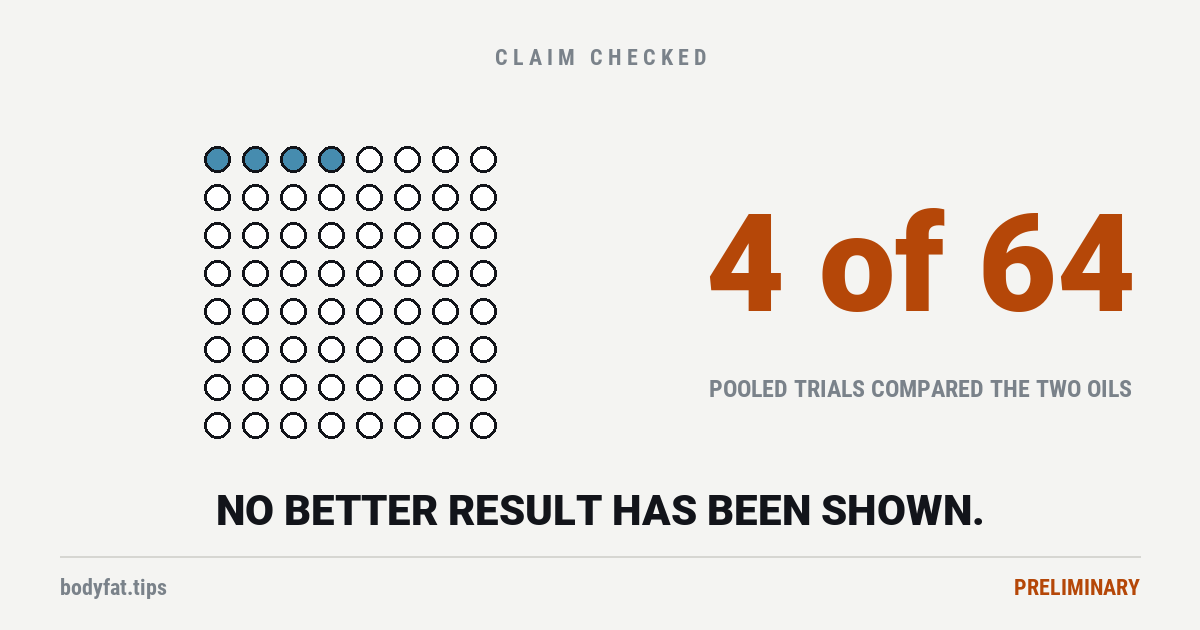
One review pooled 64 randomised trials of krill oil or fish oil. Only four of them put both oils in the same trial. [1]
Those four trials, about 330 people between them, leaned krill’s way on triglycerides, a blood fat: 11 mg/dL lower on krill oil, with a range of plausible answers running from 21 lower to just under 1 lower. [1] The reviewers reported that as significant and then declined to lean on it. Too few trials, they wrote, and possible bias from one of them, a 2004 trial that reported significant findings. [1] That trial’s krill oil was provided by the company that made it. [14]
In fact all four had a krill-oil company in the room: providing the oil, paying for the trial, or with its own staff among the authors. [5][10][11][14]
So the reviewers did what the rest of the 64 were there for. They compared the two oils through the things each had separately been tested against — olive oil, corn oil, dummy capsules — a method called a network meta-analysis. Counted that way, across 62 trials, the gap shrank to 4 mg/dL, with a range running from 15 lower on krill to 7 higher. [1] A range that straddles zero includes no difference at all.
On LDL, HDL and total cholesterol, neither way of counting separated the two oils. [1]
Not nothing, then, and not a finding either. Four trials, none of them large, each with a krill-oil company involved, add up to a difference on one blood fat. The wider comparison could not tell the oils apart.
The reviewers’ own summary: “The lipid-modifying effects of krill oil and fish oil do not differ. The reduction in triglycerides depends on the dose of n-3 fatty acids consumed.” [1] Triglycerides being a fat that circulates in your blood, and the one omega-3 moves most reliably.
It is not the krill. It is not the fish. It is how many grams of omega-3 you actually swallowed.
The review put numbers on that, and they come with a caution. Each gram of omega-3 a day lowered triglycerides by about 9 mg/dL from fish oil (8.97, plausible range 2.27 to 14.04) and about 10 from krill oil (9.84, range 0.72 to 19.40). [1] Krill’s range is the wide one, and the reviewers say why: there are few krill trials. Eight, by the review’s own table, lasting 4 to 12 weeks, with 276 people on krill oil by our count, at a gram of omega-3 a day or less wherever the dose was reported. Only one of the four head-to-head trials gave both oils at the same omega-3 dose. [1]
| Measure | Four head-to-head trials | Whole network |
| Triglycerides | −11.10 (−21.47 to −0.72) | −4.07 (−15.22 to 7.08) |
| LDL cholesterol | −14.67 (−51.66 to 22.32) | 3.01 (−5.49 to 11.51) |
| HDL cholesterol | 10.52 (−3.02 to 24.05) | 1.37 (−3.73 to 6.48) |
| Total cholesterol | −6.07 (−21.28 to 9.14) | 1.69 (−6.62 to 10.01) |
The 2011 dose-matched test had twelve people in it
Krill oil is sold on one idea: its omega-3 comes attached to phospholipids, the fats your cell membranes are made of, rather than packed as triglycerides, the ordinary storage form of fat that fish oil uses, and phospholipids are said to absorb better. The idea was in circulation before anyone had tested it at equal doses. Two earlier comparisons of blood levels were paid for in whole or in part by a krill-oil maker, and both gave the two oils at different doses. [10][11] Then, in 2011, came a study that gave them at the same dose, the first to do so by its authors’ account. [2] It is worth meeting.
Twelve healthy men. One dose. Three products compared head to head, matched at 1,680 mg of EPA plus DHA, the two omega-3s at issue. Matching took fourteen krill capsules against four of either fish oil. [2]
Krill did come out on top over 72 hours, on the measure the study used: the share of EPA and DHA in one fraction of blood fat, which the paper itself calls a proxy for absorption. And then the paper says this: “However, due to high standard deviation values, the observed differences were not significant.” [2]
Twelve people, and the headline result did not clear the bar.
Its one significant win was against the ethyl-ester kind of fish oil
One measurement in that study did reach significance — peak blood concentration. But when the authors compared the three arms against each other individually, only one pairing came out significant: krill oil versus fish oil in the ethyl ester form. [2]
The study used two kinds of fish oil, both concentrates. Ethyl esters are made from the natural triglycerides in fish oil; re-esterified triglycerides are made by converting ethyl esters back. [15] The ethyl-ester oil finished last of the three arms on EPA and DHA combined, which fits what is known about that form: it is absorbed somewhat less well than the others. [15] Against the re-esterified oil, krill did not significantly win on any measure. [2] Ordinary unconcentrated fish oil was not in the study at all.
So the claim that survives the study is narrower than the claim on the bottle: krill oil beat one form of its competitor, once, on one measure, in twelve men.
And the mechanism might not be the one being sold
Here is a detail in that paper that none of the nine first-page web results we read for “krill oil vs fish oil” on 7 October 2026 mentions, and it is in the authors’ own conclusion.
When they analysed the actual oils, the krill oil turned out to contain a large amount of free fatty acids — omega-3 not bound into anything at all. 22% of its EPA and 21% of its DHA. The two fish oils contained none. [2]
Free fatty acids are easy to absorb. So if krill oil went into the blood faster, the phospholipid story may not be why. The authors say so themselves: the free fatty acid content “might have a significant influence on the bioavailability” and “should be investigated in more depth”. [2]
A premium is being charged for a mechanism this study flagged as possibly not the mechanism.
We found ten more trials, and they do not agree
That twelve-man study is one of eleven trials we found that set krill oil against fish oil and measured the omega-3 in people’s blood. About 500 people in all, between 10 and 113 a trial, from a single dose to twelve weeks. [2][3][4][5][6][7][8][9][10][11][12]
Four gave the two oils at different doses, which cannot settle anything whichever way it comes out. [3][10][11][12] One of those tested each product at the dose on its label, put krill oil last of four, and was paid for by the company whose fish oil came first. The krill capsules carried about a fifth of the omega-3, and the authors themselves call the ranking what you would expect from the doses. [12]
Seven matched the dose or came close. In four of them blood levels rose more on krill oil, in one of the four for EPA only. [4][5][6][9] In three there was no significant difference. [2][7][8]
Look at who ran them. One of the four wins was designed by two employees of the company that supplied its krill oil, and a published commentary pointed out that its fish oil was 32% linoleic acid, an omega-6 fat, and not a typical fish oil; the authors replied that they had diluted it with corn oil to keep the doses level. [5] That is the trial the website of one krill-oil seller, Kori, footnoted for its promise of “superior absorption vs. fish oil” when we read it on 30 September 2026. Another win was sponsored by the company that made the krill oil, which the paper says had no role in collecting or analysing the data. [6] On the other side, the largest no-difference result was funded by a company that made both fish oils in the trial. [7]
That sponsored trial also tested krill meal, another krill product with its omega-3 bound in phospholipids. It did no better than fish oil, which its authors say “argues against the interpretation that phospholipids are better absorbed than triglycerides”. [6] So even a trial krill oil won is evidence against the reason given on the label.
The newest trial is the largest of the dose-matched ones. Published in May 2026 and paid for by Canada’s public health-research agency, it gave 72 healthy adults about 1.1 to 1.2 grams of EPA plus DHA a day for twelve weeks, as krill oil or as fish oil. [4] Blood EPA rose 1.4 times as much on krill oil, and DHA 1.5 times as much. [4] The krill capsules were provided by their maker; the funder had no role in the research, and the authors declare no conflicts. [4]
Then read what its own authors make of it. The higher levels, they write, are “probably not related to higher absorption” from krill oil, and may instead reflect how the body digests and then handles the two forms. [4] And a higher level in the blood, they add, “may translate into improved clinical outcomes or also reflect reduced uptake by peripheral tissues”. [4] In plain words: more in the blood could mean more reaching the places it is needed, or less. They measured plasma, which reflects short-term intake; the red-blood-cell measure that reflects the longer run was collected and had not been reported when we looked. The trial also finished with 72 people against a target of 160, and its registry entry, last updated in 2020, names a different primary outcome and a higher dose. [4]
Three of the dose-matched trials did report the red-cell measure, called the omega-3 index. One found it higher on krill oil at four weeks; two found no difference, at four weeks and at twelve. [5][7][8]
A 2024 analysis that pooled 26 absorption trials points both ways as well. On the curve of blood levels in the hours and days after a dose, krill oil came out above the ethyl-ester and re-esterified fish oils, across three trials. On the omega-3 index, across 22 trials, the fish oils ranked above krill, though nearly all of the spread between those trials’ results was more than chance would produce: an I-squared of 97%, the share of the spread that luck does not explain. That does not mean the trials pointed different ways. On the analysis’s own chart, 12 of the 13 combinations of oil, form and dose it set against a placebo came out above it on the index, and the one that did not, a krill oil, has a range that includes no change; where they differ is by how much. [13] Its authors still conclude krill oil is better absorbed at low doses. [13] The NIH’s fact sheet for health professionals says some studies find that and others do not. [15]
So does the same dose put more omega-3 into your blood if it comes from krill? Sometimes. In four trials of seven, none of them large, two of them designed or sponsored by the krill oil’s supplier. Whether the extra does anything for you is a different question, and it is the one you are paying to have answered.
There is also less omega-3 in there
One of the unequal-dose trials, in ten women, weighed what it was actually giving people. Five grams of oil either way. The krill oil carried 907 mg of long-chain omega-3. The fish oil carried 1,441 mg. [3]
That is two specific products, not a law of nature, and we are not going to pretend it settles the category. But it points at the arithmetic worth doing on whatever is in front of you: not the price of the bottle, but the price per gram of omega-3 inside it. That number is on the label, and it is the one the review’s dose finding points to.
We did that arithmetic once, on one seller’s own website, on 30 September 2026. Nature Made listed 100 softgels of a krill oil it sells under the name “Superior Absorption” at $37.89, with 120 mg of omega-3 in each, and 100 softgels of its 1,200 mg fish oil at $17.49, with 360 mg in each. That is about $3.16 per gram of omega-3 against 49 cents. One brand, two bottles, one day: it is not a survey of the shelf. But it is what the premium looks like, and the asterisks on that product name lead to a footnote that repeats the claim and cites no study.
Back in that ten-woman trial, EPA in the blood rose about the same from both oils, despite krill delivering 31% less of it. The authors suggest krill’s EPA may get into the blood more efficiently, and they give the plainer explanation first: fish oil’s rise was 12% higher, the difference was not significant, and “with a higher number of participants a significant difference might have been found”. They add that a study this short may not be enough to compare the two oils, since EPA has been reported to peak at 10 to 20 hours. DHA and DPA showed no difference between any of the groups. [3] Ten women, five hours, one dose.
One more thing, from the paper’s own small print
The competing-interests statement on the twelve-man absorption study: one author “founded Omegametrix, a company offering fatty acid analyses”, and two others “worked as consultants for companies which also produce and merchandise fatty acid supplements.” [2]
The statement opens with one more line about the author who founded that company: speaker’s fees from Solvay/Abbott, and grants from Sanofi-Aventis and Smartfish. And the methods add two things. The blood samples for the study’s main result were analysed at the company that author founded. The two fish oils were supplied free by Dr. Loges + Co., a German maker of herbal medicines and supplements; the krill oil was a commercial product. No grant paid for the study. [2]
They disclosed it, in the paper, where it belongs. That is the system working. It is simply information you should have, the same as who supplied the oil in every trial above.
The verdict
Preliminary, for the claim that krill oil works better than fish oil: the evidence is early, small and conflicting, and not something to act on alone.
Be precise about what that does and doesn’t mean, because two claims travel together here, and neither has been settled.
The first is about your blood: the same dose of omega-3 raises blood levels more if it comes from krill. That claim is not dead and not proven. Of seven trials at a matched or near-matched dose, four found it and three did not, and the largest and newest is among the four. [2][4][5][6][7][8][9] What would settle it: the red-blood-cell results from the 2026 trial, which had not been published when we looked, and a second trial of that size.
The second is about you: krill oil gives a better result. Krill oil does something. Against controls that were not olive oil or a vegetable oil, such as cellulose capsules or no supplement, it lowered triglycerides by about 23 mg/dL, with a plausible range of 8 to 39; against olive oil and against other vegetable oils its effect could not be told from zero. [1] Fish oil does something too, and the comparison between them is the four head-to-head trials and the one pooled analysis at the top of this page.
What has not been shown is the part you are paying for: that any of this produces a better result. The four trials that compared the two oils on blood fats were small, each had a krill-oil company involved, and pooled with the rest of the evidence no difference held up. [1] We found no trial, published or on the US trial registry, that followed people on krill oil for heart attacks, strokes or deaths. And every comparison of the two oils above comes from a short trial, mostly in healthy adults, at under two grams of EPA plus DHA a day.
That is why the rating is Preliminary. An earlier version of this page rated the claim Unsupported, on the strength of 64 trials that turned out to be four. Four small trials with a krill-oil company in each are not enough to call a claim failed, and nowhere near enough to call it right.
Which leaves the more awkward question hanging over both bottles. We already checked whether fish oil capsules protect your heart, across 86 trials and 162,796 people, and the answer was not the one the shelf implies. Choosing the premium version of that is a decision about which capsule, when the prior question was whether.
Related: fish oil benefits · magnesium benefits · collagen benefits · how much protein to build muscle · every claim we’ve checked
This page’s headline claim was wrong, and it was corrected on 30 September 2026 after an independent editorial review. We wrote that 64 randomised trials had compared krill oil with fish oil and found no difference. The review we cited pooled 64 trials of krill oil or fish oil; four of them compared the two. Those four, pooled, found triglycerides 11 mg/dL lower on krill oil, a result the reviewers themselves discount, and the full network found 4 mg/dL with a range that includes no difference. We had read only the abstract, which gives neither the count of head-to-head trials nor their result, and we called the paper paywalled; an archived copy and the publisher’s free supplementary table were there to be read. The title, the opening, the chart, the evidence panel and the verdict now say what the paper says.
We also described the absorption evidence as two single-dose studies in 22 people. We have since found eleven head-to-head trials, a 2024 pooled analysis and a twelve-week trial published in May 2026 in which blood EPA and DHA rose 1.4 and 1.5 times as much on krill oil; the page now reports them, with who paid for each. “The absorption study everyone cites” was not something we had checked: of the two sellers’ pages we have now read, one footnotes a 2013 trial and the other cites no study, and the claim was in circulation before the 2011 study tested it. The funding row now covers every source, including the fish oil the 2011 study was given free and the krill-oil company involved in each of the four head-to-head trials. We called ethyl-ester fish oil “cheaper” and “more processed” with no source; the second was backwards, and both are gone. We said one source was paywalled when the journal gives it away. A monthly search figure that we could not trace to a saved data pull has been removed, and one seller’s prices, read on the day, have been added. The rating changes with the facts, from Unsupported to Preliminary. Unsupported rested on 64 trials having compared the two oils and found nothing. Four did. They are small, each involved a krill-oil company, and they lean krill’s way on one blood fat while the wider analysis cannot tell the oils apart; the trials of blood levels disagree with one another. On this site that is what Preliminary means: early, small, conflicting, and not something to act on alone. It is still no reason to pay more.
Corrected on 23 October 2026. Of the 2024 analysis of absorption trials, we wrote that the 22 trials of the omega-3 index “disagreed with one another almost completely”, here and in the evidence panel. The figure behind that, an I-squared of 97%, is the share of the spread between the trials’ results that is more than chance would produce. It does not say the trials pointed different ways, and the analysis’s own chart suggests they mostly did not: 12 of the 13 combinations of oil, form and dose it set against a placebo came out above it on the index, by very different amounts. The page now says so. No figure we had printed changes, and the rating is unchanged: Preliminary.