Are Sugar Alcohols Bad For You? The Real Problem Is Digestive

Here is the problem with the question.
“Sugar alcohol” is a chemistry word. It describes a shape a molecule can have. It tells you surprisingly little about what the molecule does once you swallow it — and the ones sharing that label do wildly different things.
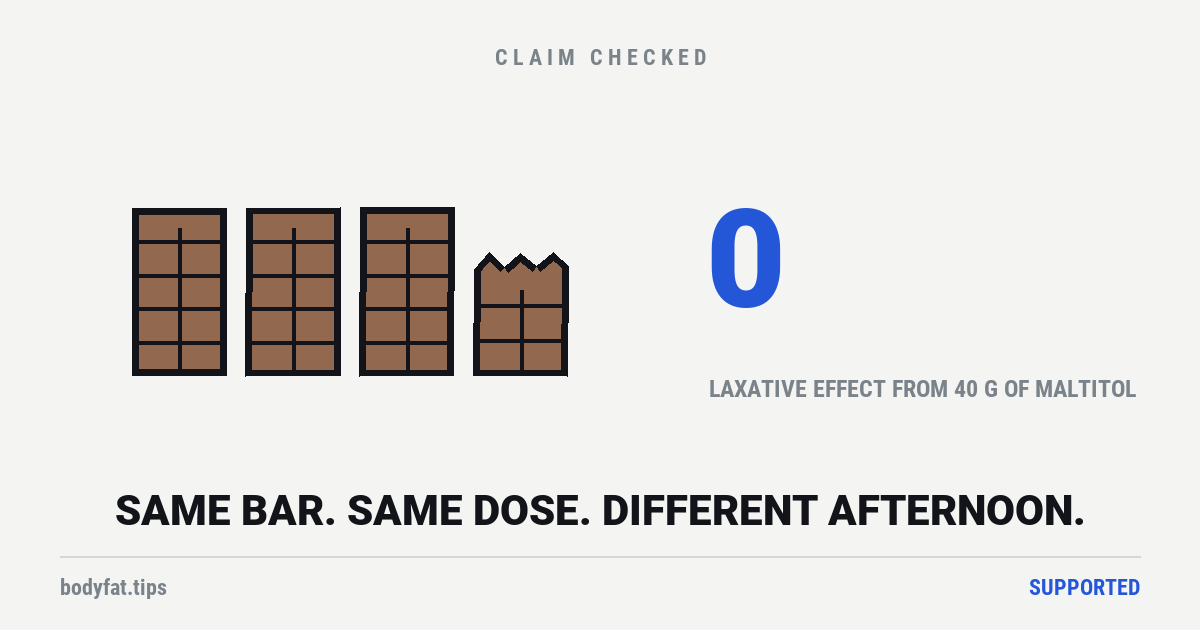
We can show you exactly how different, because in 1996 somebody ran the experiment properly: same fifty-nine healthy students aged 18 to 24, same milk chocolate, same dose, four different sweeteners, nobody told which was which [2].
| Lactitol, 30–40 g | Every symptom measured went up in both incidence and severity |
| Isomalt, 40 g | Every symptom went up, including mild laxation — but nothing rated severe |
| Isomalt, 30 g | Mild rumbling, mild wind, cramping and laxation — but no increase in trips to the toilet |
| Maltitol, 30–40 g | No laxative effect at either dose. Wind, rumbling and cramping at 40 g, all rated mild |
Read that bottom row again. Forty grams of maltitol — a serious quantity, the bulk sweetener in a whole chocolate bar — produced no laxative effect [2]. Thirty grams of lactitol pushed up every symptom on the list, both in how often it struck and in how bad the volunteers themselves said it was.
Both are sugar alcohols, and the ingredients list is required to tell you which one you are holding: US rules demand each ingredient’s specific name, and EU rules demand a sweetener’s name or its E-number, the code Europe gives each approved additive [8][9]. What the pack cannot tell you is how your gut is going to take it. And if a product blends several, any grams figure on the nutrition panel lumps them together, as “Sugar alcohol” in the US or “polyols” in the EU [8][9].
What we are actually rating here
So we should be precise about the claim, because this page carries a Supported badge and we do not want you reading more into it than we mean.
Supported: sugar alcohols can do something real and unpleasant to you, that something is digestive, it scales with the dose, and it happens at amounts printed on products people actually buy.
Not what we are saying: that they cause heart attacks. That question is live and we get to it below, and our separate erythritol verdict rates it Preliminary for good reasons.
The evidence for the gut part is unusually solid
This is the rare nutrition question where the answer does not rest on a single wobbly cohort study.
A systematic review screened 1,823 papers and included 79 of them [3]. Its conclusion: polyol malabsorption — sugar alcohol arriving in your large intestine instead of being absorbed on the way — happens dose-dependently in healthy people, and gets worse when polyols arrive alongside other carbohydrates. Which is worth knowing, because sugar-free products pair them: sorbitol and fructose, the review notes, often turn up together, and each is absorbed reasonably well on its own and poorly in combination [3].
And the symptoms are the ones you would guess: “flatulence, abdominal discomfort, and laxative effects”, in healthy volunteers and in people with irritable bowel syndrome alike [3].
One finding cuts the other way and belongs here: in human studies at moderate doses, isomalt and lactitol shifted the gut microbiome toward more bifidobacteria — generally regarded as one of the good ones — leading the reviewers to suggest polyols “may therefore be beneficial as prebiotics” [3]. The same property that gives you wind is the one feeding your gut bacteria. Those are not separate facts.
A regulator put a number on it. It is lower than you think.
Warnings about sugar alcohols are nothing new, and on both sides of the Atlantic they are law. US federal rules make any food that could reasonably add up to 50 g of sorbitol, or 20 g of mannitol, in a day carry the words “Excess consumption may have a laxative effect” [8]. In the EU, any food with more than 10% added polyols must say “excessive consumption may produce laxative effects” [9].
What was new in December 2023 was a number. Europe’s food safety authority, EFSA, re-evaluated erythritol and gave it a daily limit [1].
It read the clot study too, and concluded that the available evidence “does not demonstrate a causal relationship” between eating erythritol and heart disease [1]. The limit is a diarrhoea limit — by EFSA’s own account the first time a food additive’s limit has rested on an immediate effect like that [1].
They set an acceptable daily intake of 0.5 grams per kilogram of body weight — about 34 g for a 150 lb (68 kg) adult [1]. For scale, that is less than the 40 g of sweetener in the chocolate bars at the top of this page. And they set it at the lowest dose at which diarrhoea had not been observed, on the reasoning that diarrhoea is genuinely adverse because of what it does to your fluid and electrolyte balance.
Then they estimated what people are actually eating. The highest average they found was 742 mg per kg per day, in toddlers (12 to 35 months old). The highest 95th percentile — the level only the heaviest-eating one in twenty reach — was 1,532 mg per kg per day, in children aged 3 to 9 [1]. Both above the limit they had just set. Their conclusion, verbatim: exposure estimates “were above the ADI, indicating that individuals with high intake may be at risk of experiencing adverse effects after single and repeated exposure.”
In fairness — and EFSA says this itself — they consider their own exposure figures an overestimate [1]. We are reporting that because leaving it out would be the same trick we spend this site correcting.
And the detail that tells you what the regulator’s scientists thought of the industry position: the same opinion was assessing an application from Cargill, an erythritol producer, to exempt erythritol from the laxative warning label required under EU law [9]. EFSA’s panel concluded “the available data do not support the proposal for exemption”, and that the existing warning “remains appropriate” [1]. EFSA supplies the science; the legal decision belongs to the European Commission, which asked for the opinion [1].
So while the internet was arguing about blood clots, Europe’s food-safety scientists read the clot study, found it did not show that eating erythritol harms the heart, and advised keeping a warning about the toilet on the packaging.
The clot story, and where it really comes from
You have probably seen two separate headlines: erythritol linked to heart attacks in 2023, xylitol linked to heart attacks in 2024. Two sweeteners, two studies, two years apart. It reads like independent confirmation that something is wrong with this whole category.
It is not two independent findings.
Look at the cohorts. The 2024 xylitol paper used a discovery group of 1,157 patients undergoing elective cardiac evaluation, and a validation group of 2,149 [5]. Those are the same two numbers, the same patient description and the same research group as the 2023 erythritol paper [10]. That paper also checked a third group, 833 patients at a Berlin hospital, with co-authors there; the xylitol paper did not use it [10].
Which makes sense once you know how the work was done: they ran metabolomics — a single sweep that measures hundreds of molecules in one blood sample at once — and then asked which ones predicted heart attacks, strokes and deaths over the next three years. Several sugar alcohols came up, erythritol near the top [10], and two of them got papers of their own.
That is one dataset asked two questions, not one finding confirmed twice. Nothing improper happened; this is ordinary science. But if you counted the pair as replication, you counted wrong.
What the xylitol paper did add is a mechanism, same as its predecessor: xylitol increased platelet reactivity in human blood and clot formation in animals, and in ten volunteers a xylitol-sweetened drink measurably changed platelet behaviour [5]. In the top third of blood xylitol against the bottom third, events came at 1.57 times the rate [5]. Read what that blood test measured, though. The patients had fasted overnight, and the authors argue those levels mostly reflect xylitol the body makes itself, not anything recently eaten; a xylitol drink, by contrast, sent blood levels more than a thousand times higher for a few hours [5]. The authors’ own closing line asks for further study of cardiovascular safety — which is roughly where the honest reader should also land.
Replication did come later, for erythritol, and from other people. Since 2024, three teams that share no authors with the Cleveland group have looked for the same link in their own long-running studies, and each found one. Researchers at the US National Cancer Institute measured blood stored from 4,468 Finnish men, all smokers, taken when they joined a vitamin trial that began in 1985. Over roughly nineteen years, the quarter with the most erythritol died of cardiovascular disease at about 1.2 times the rate of the quarter with the least [11]. In a long-running study of US nurses, a Tulane and Harvard team found women in the top quarter for blood erythritol developed coronary heart disease — the narrowed-artery kind behind most heart attacks — at about 1.55 times the risk of women in the bottom quarter, after allowing for diet, lifestyle and weight [12]. And a Baylor-led team, following 4,006 older Americans, found higher erythritol went with more hospital stays for heart failure and more deaths [13].
Now look at what those three actually replicated. All of them measured erythritol in blood, which the body makes for itself, and none measured how much of it anyone ate [11][12][13]. Two of them, by their own authors’ account, drew that blood before erythritol was sold as a sweetener. The Finnish men gave theirs on joining a trial that began in 1985; the researchers date erythritol’s use as a sweetener to the 1990s [11]. The nurses gave theirs in 1989–90 and 2000–02, which that team says was before erythritol’s approval as a food additive, so their levels may mainly have been the body’s own [12]. In the nurses, the link shrank once the analysis allowed for diabetes, until the range of plausible answers included no effect at all [12]. And in the older Americans, whose blood was drawn in 2011–13 with erythritol by then in the US food supply, it predicted heart failure and death — including deaths that were not from heart disease or stroke — but not heart attacks or strokes themselves [13].
Our reading, and it is labelled as ours. In the Finnish men, erythritol forecast cancer deaths about as strongly as cardiovascular ones; in the older Americans, it forecast deaths from other causes about as strongly as cardiovascular deaths [11][13]. A molecule that does that behaves more like a gauge of metabolic health than like a clot-maker. The Baylor team calls erythritol and its breakdown product “markers of cardiometabolic health” [13], and the cancer-institute team calls a blood-sugar explanation for its own finding “certainly possible” [11]. None of that clears the sweetener. It does mean a link with erythritol in your blood is not yet a link with erythritol on your plate.
Xylitol has had no such test. As of 18 September 2026 we could find no study outside the Cleveland group that has checked the xylitol link with heart attacks, strokes and deaths.
We take the erythritol question apart properly, including the genetic studies that have tried to settle it, on the erythritol page.
The dental halo is thinner than the marketing
Xylitol has spent thirty years on gum packets as the sweetener that is good for your teeth. What does the evidence actually carry?
Cochrane went looking in 2015 and found ten trials covering 5,903 people. One was at low risk of bias. Seven were at high risk [4].
The clearest positive result: a fluoride toothpaste containing 10% xylitol may reduce cavities by about 13% over two and a half to three years compared with fluoride-only toothpaste — rated low-quality evidence [4]. And the reviewers attach a caveat that deserves to travel with the number: it comes from two studies “carried out by the same authors in the same population.” Cochrane also counts both as industry funded: several of their authors worked for Colgate-Palmolive [4].
One small infant trial also came out positive: over a year, a high daily dose of xylitol syrup cut cavities by 58% against a dose a third the size, in 94 infants, with a range of plausible answers running from 33% to 83% [4]. It is a single study, graded low quality, and Cochrane judged the syrup evidence too thin to conclude anything from [4].
Everything else — lozenges, sucking tablets, wipes, xylitol versus sorbitol, adults rather than children — came back with ranges of plausible answers that included fewer cavities and more cavities [4]. When the range spans both directions, the study has not told you which way it goes.
So: a small, low-confidence benefit in one specific product from one research group with toothpaste-company authors, one small trial in infants, and not much else.
As for side effects, Cochrane lists what the trials recorded — “sores in the mouth, cramps, bloating, constipation, flatulence, and loose stool or diarrhoea” [4] — but do not file that under this page’s theme. Four trials reported no side effects at all, the two that compared rates found them similar with and without xylitol, and the review found none from the toothpaste [4].
Where sugar alcohols do the job they were hired for
Let us be fair to the molecule. What is a sugar alcohol actually for? Sweetness without the blood-glucose spike. Does it deliver?
Yes, in the one trial on this page that measured it. In chocolate dairy desserts, every sugar-free recipe containing maltitol produced lower blood glucose and lower insulin responses than the same dessert made with dextrose, which is plain glucose [6]. Not slightly — the comparison came out clearly on the side of the maltitol versions.
Two things travel with that result. The blood tests came from a subgroup of 18 volunteers [6]. And the trial was paid for by Tereos Syral and Beghin Meiji, which supplied the maltitol and the fibre in the recipes; three of its seven authors worked for Tereos Syral, and the maltitol was Tereos Syral’s own product [6]. That does not make the result wrong. It makes it the kind you would want repeated by somebody with nothing to sell.
The digestive cost in that same trial was real but small: symptoms significantly more common than the control, though the researchers described them as staying “at the level of mild effects”, with slightly more and slightly softer bowel movements for the first 24 hours and not afterwards [6].
That is the actual trade on offer, and it is a reasonable one for a lot of people. It is just not the trade the packaging describes, which is usually no trade at all.
One genuine danger, and it is not to you
Outside one rare inherited condition, which we come to below, there is exactly one place in this whole topic where the answer to “is this dangerous” is an unqualified yes, and it gets far less attention than the clot headlines.
Xylitol is seriously toxic to dogs. The veterinary literature describes severe hypoglycaemia — a crash in blood sugar — followed in worse cases by acute liver failure and clotting problems [7].
The prognosis for a dog with uncomplicated low blood sugar is generally good if it gets treated [7]. The problem is exposure, and the veterinary review says so plainly: as xylitol products spread through the market and into the house, cases are expected to keep rising [7].
Sugar-free gum in a coat pocket. Peanut butter with xylitol in it. That is a real, specific, avoidable harm, and it is the one thing on this page we would ask you to act on today.
One human exception to that heading, and it is serious. People with hereditary fructose intolerance — a rare inherited condition, estimated at around 1 in 18,000 to 1 in 31,000 people — have to avoid sorbitol along with fructose and sucrose, because in them it can set off dangerous drops in blood sugar and other metabolic trouble [14]. If that is your diagnosis, your clinician’s list outranks anything on this page.
What to actually do
Stop treating the category as one thing. Read which sugar alcohol it is — the ingredients list is required to name it [8][9]. Erythritol is the gentlest, probably because most of it is absorbed before it reaches the large intestine [3]. In the one trial that put three others head to head, in chocolate, maltitol caused the least trouble and lactitol the most [2]. Sorbitol and mannitol carry US laxative warnings from 50 g and 20 g a day [8], and 20 g of sorbitol in a day can bring stomach pain and diarrhoea [3].
Watch the total, not the serving. The effects are dose-dependent and get worse when polyols arrive alongside other carbohydrates [3] — and a “keto” day can stack them from three different products without you noticing.
If you have IBS, treat this as a known trigger, not a curiosity. Polyols are the P in FODMAP for a reason, and the review found they can disturb gut motility in people with IBS specifically [3].
Keep xylitol away from the dog. Genuinely. Outside the rare inherited condition above, that is the one unambiguous hazard in this entire subject [7].
And if you came here worried about your heart rather than your stomach: that question is open, it is smaller than the headlines implied, and it is not the same question as aspartame or the broader sweetener guidance, neither of which covers sugar alcohols at all.
An independent editorial review on 18 September 2026 found this page wrong about the law, wrong about what Europe’s food-safety regulator did, and one-sided about who paid for the evidence. We said a pack does not tell you which sugar alcohol is in it; US and EU rules both require the ingredients list to name it. We called EFSA’s 2023 erythritol opinion “the only binding regulatory action anyone has taken on a sugar alcohol” and said it “got no coverage whatsoever”. In fact US rules require a laxative warning on foods that could deliver 50 g of sorbitol or 20 g of mannitol in a day, the EU requires one on any food over 10% added polyols, EFSA’s opinion is scientific advice to the European Commission rather than law, and Food Safety Magazine reported it the day it was published. We said EFSA’s review was “Not for clots. For diarrhoea”; the same opinion assessed the 2023 clot study and concluded the evidence does not demonstrate that eating erythritol causes heart disease. We also followed the opinion’s summary rather than its data table and merged two statistics: 742 mg per kg a day was the highest average intake, in toddlers, and 1,532 the highest 95th percentile, in children. And the funding row named only the heart researchers’ interests. It now also says that the maltitol trial behind “Does it deliver? Yes” was paid for by the company that made the maltitol, with three of its staff among the seven authors, and that Cochrane counts the two toothpaste trials behind its clearest result as industry funded, with Colgate-Palmolive employees among their authors.
We also said the heart signal had not been replicated. For erythritol that was out of date. Since 2024, three teams with no authors in common with the Cleveland group have reported links between blood erythritol and heart disease or death, in Finnish male smokers, US nurses and older US adults. All three measured blood levels rather than what anyone ate, two drew their blood, by their authors’ account, before erythritol was sold as a sweetener, the link faded after allowing for diabetes in one, and in another it predicted heart failure and death but not heart attacks or strokes. The page now reports all of that, and that the xylitol link is still untested outside that group. Smaller fixes in the same pass: two rows of the 1996 chocolate-trial table now include the cramping at 40 g of maltitol and the laxation at 30 g of isomalt; the volunteers, not the researchers, rated how bad symptoms were; the blood screen flagged several sugar alcohols, not two; Cochrane’s second positive result and its actual side-effect finding are reported, and the longest dental follow-up is four years, not three; the tolerance ranking in the advice is rebuilt from the sources; a line we could not source (“almost every write-up counted wrong”) is gone; and people with hereditary fructose intolerance, for whom sorbitol is a real danger, are now told so. Later the same day, when the erythritol verdict was corrected, one source line here was brought into line with it: it had called the senior author’s patents “related”, which that verdict’s sources do not support. The rating is unchanged: Supported.