Does Exercise Grow Your Brain? One Trial Found 2% — Not Four Times Faster

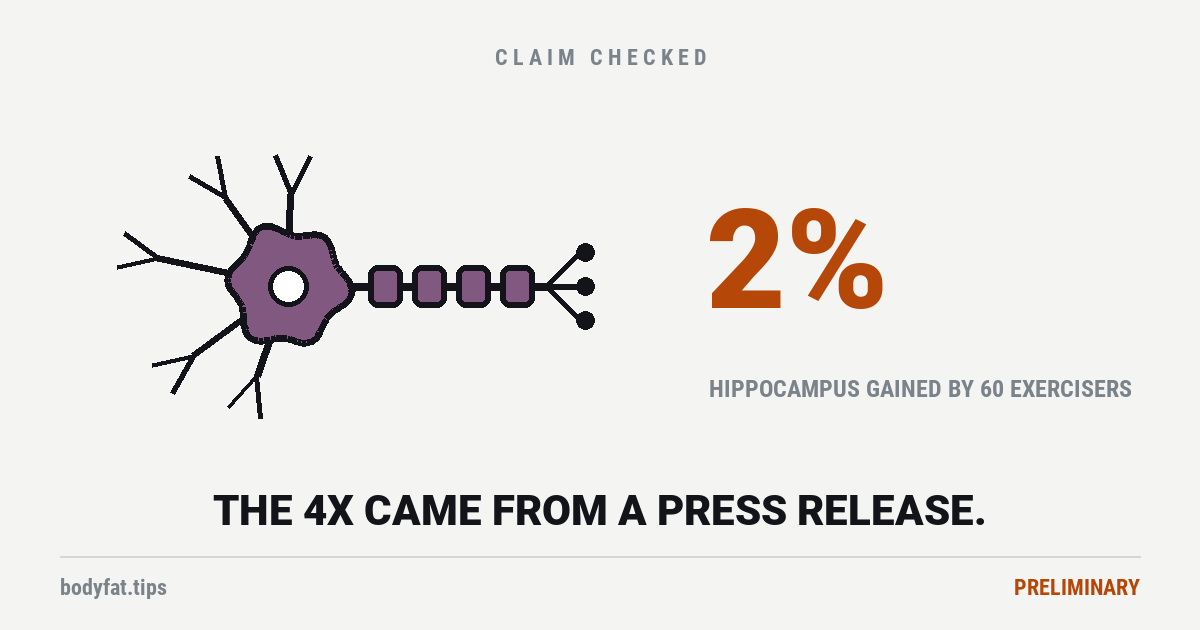
In one proper randomised trial in humans, which almost nobody quotes, part of the exercisers’ brains grew by about 2% in a year. Was that new brain cells? Has it held up? Neither answer is a simple yes.
What everybody quotes instead is four times faster. That number does not appear in the study it is attributed to. We know, because we searched the paper. All 100,585 characters of it.
This article used to repeat that number too. So this is partly a correction of our own work, and the chain below is one we were standing in.
Start with the humans, because there are some
In 2011 researchers randomly assigned 120 older adults either to aerobic exercise or to a control group, and scanned their brains before and after [1].
The exercise group’s anterior hippocampus grew by about 2% — the hippocampus being the seahorse-shaped structure most involved in forming memories, and one that shrinks as people age. That is size on a brain scan; nobody counted cells. The authors suggest new cells or more branching of existing ones might explain it, and say more blood vessels may also be contributing [1].
Their spatial memory improved too. So did the memory of the control group, who spent the year in stretching and toning classes with dumbbells, resistance bands and balance work, and the exercisers did not improve any more than they did [1]. The paper’s title says exercise “improves memory”; its results are narrower. Among the exercisers, the people whose hippocampus grew more tended to improve more on the memory test, but the link was modest: correlations (how closely two measurements move together) of 0.23 and 0.29 for the left and right sides, on a scale where 0 means no link and 1 a perfect one [1].
The researchers put that 2% in context in a way worth borrowing: it effectively reversed one to two years of age-related shrinkage [1].
Two details make this more convincing than the headline number. The control group’s hippocampus shrank over the same period, which is what should happen and confirms the measurement was working. And two other brain structures they measured — the caudate nucleus and the thalamus — did not change at all [1].
That last one matters more than it looks. If exercise had appeared to grow everything they measured, the honest reading would be that something was wrong with the scanner or the analysis. A specific effect in the structure you would predict, and nothing in the ones you would not, is what a real finding looks like.
So has anyone found it again? Other teams have run similar trials, and researchers have pooled them several times since. Three of those pooled analyses show why the answer is not tidy. A 2018 analysis of 14 studies (737 people) found no significant effect of aerobic exercise on the total size of the hippocampus — none clear enough to rule out chance — and a benefit on the left side that came from exercise preventing the shrinkage that happens over time, not from growth [4]. A 2021 analysis of 23 exercise programmes did find a significant effect on total size, but it came from the control groups shrinking while the exercisers’ average gain was not significant, and leaving the 2011 trial out took the effect just short of significance [5]. A 2024 analysis of eight randomised trials of aerobic exercise in healthy older adults (554 people), the 2011 trial among them, found no significant effect: the range of plausible answers still included no effect at all [6]. So the 2% belongs to one trial, not to the pooled evidence. Where that evidence finds anything, it looks like exercise slowing the hippocampus’s shrinkage rather than making it bigger.
Now the study everyone is actually talking about
In November 2024, engineers at MIT published something genuinely clever [2]. It went online that month and into the journal’s March 2025 print issue, which is the year the citation below carries.
They wanted to separate two things that are impossible to untangle in a living body. When a muscle contracts, it does two things to nearby nerves: it releases chemical signals called myokines, and it physically tugs on them. Which one drives the effect on nerves? In a live animal you can never tell, because they always happen together.
So the team took them apart. They grew muscle tissue in a dish, collected the fluid it secreted while contracting, and poured that fluid onto motor neurons growing separately. Then, in a different experiment, they grew neurons on a gel seeded with tiny magnets and used an external magnet to physically jiggle them — the mechanical half, with no chemistry at all [2].
Both worked. Neurons grew more in both conditions. But when the researchers sequenced the RNA to see which genes had switched on, the two groups had different signatures [2]. Same visible outcome, different machinery underneath. That is a real and interesting result.
Here is what it is not. Every cell in that study was a mouse cell, and every experiment happened in a dish. The muscle came from a mouse cell line; the motor neurons were grown from mouse stem cells [2]. Nobody exercised. There was no brain, no bloodstream, and no person.
The paper does not pretend otherwise — it says plainly that the difficulty of isolating this effect in a living body is precisely what motivated doing it in vitro [2].
So where did “four times faster” come from?
Not from the paper. We searched the full text for “four times”, “four-fold”, “fourfold” and “4x”.
There is exactly one hit, and it is in the methods section. It reads: “the experiments were repeated a minimum of four times” [2]. That is a note about how many times they ran a rheology measurement.
What the paper actually claims is that the neurons “significantly upregulate neurite outgrowth and migration” [2]. Real, measured, and carrying no multiplier.
The multiplier arrives one step later, in MIT’s own press release, which says the neurons “grew four times farther” [3]. To be fair to the press office, the release calls them “cellular-level experiments” in the same paragraph. It is less careful further down, where the neurons “began to grow, four times faster”, and its subheading already says the effects of exercise “could help heal nerves” [3].
Then the qualifier falls off the headline. One aggregator reprinted much of the release, “cellular-level” line and all, under this: “When Your Muscles Work Out, They Help Neurons Grow and Heal 4x Faster”. Watch what happened in that sentence. Faster and heal were already in the release; the headline moved them to the top, stretched the multiplier to cover healing, which nobody had measured, and added one word, your, which put the reader’s own body in a story about mouse cells in a dish.
And then it reached us, and an earlier version of this page told you that when you move, your neurons grow four times faster and farther. Which is how a careful in-vitro paper becomes a claim about your workout in four steps, none of which involved anybody lying.
What you can honestly take from this
Exercise did something measurable to the human brain in that trial. The number was 2%, it took a randomised trial in 120 people to find, and the memory improvement in its title did not beat a stretching and toning class [1]. Pooled with the trials since, the defensible version is smaller: exercise may slow the shrinkage of the hippocampus that comes with age [4][5], and in healthy older adults even that has not been shown clearly [6]. That is still a finding worth having. It is not a dramatic one, and it does not need to be.
The mouse work is a mechanism study. Its value is that it tells researchers where to look next — specifically, that the physical tugging and the chemical signalling are separate levers, which nobody could have shown in a living animal [2]. That is genuinely useful to the people designing the next experiment. It is not useful as a reason to train.
If you want a reason to train, look for it in the human trials, not in the dish.
And a rule that generalises well beyond this page: when a striking multiplier is attached to a study, check whether the multiplier is in the study. Often it entered at the press release, and the qualifier that came with it did not survive the trip.
Four descriptions of the evidence on this page were corrected on 15 September 2026 after an independent editorial review. The page said the exercisers in the 2011 trial improved their memory alongside the 2% growth; they did, but so did the control group, who did stretching and toning, and the paper’s own results report that the exercisers did not improve any more than they did. The evidence panel called the 2% a single flagship trial; later trials have been pooled several times, with mixed results, and the page now reports three of those analyses. The page and its provenance chain said an aggregator turned “farther” into “faster” and added “heal”; both words were already in MIT’s own release, and the chain now says what the aggregator did change. And the headline answered yes to whether exercise grows new brain cells, when the trial measured size on a brain scan and its authors name new cells as only one possible explanation; the headline and opening now say what was measured.
Also changed: the search description said 120 people exercised and the evidence figure credited the 2% to 120 people, when 60 exercised and 60 did stretching and toning; the MIT paper is dated November 2024, when it went online, rather than by its 2025 print issue alone; the press release is now linked; and the earlier rewrite note below carries its date, 28 July 2026. The rating has changed, from Supported to Preliminary. It rested on the 2011 trial; with the pooled analyses now on the page, the most the evidence carries is that exercise may slow the shrinkage of the hippocampus that comes with age, and in healthy older adults even that has not been shown clearly.
This article has been rewritten. An earlier version reported the MIT muscle-neuron research as though it described the reader’s own body, stating that “when you move, your muscles send signals that boost neuron growth, helping them grow four times faster and farther.” That study was conducted entirely in vitro using mouse cells, and the “four times” figure does not appear in the paper at all — it originates in the press release. The earlier version also combined several unrelated research programmes (magnetic nanodiscs, the ImPULS ultrasound implant, chromatin regulators) into a single “breakthrough finding”, and included an unsourced table asserting that myokines drive fat breakdown, glucose control and calorie burn. Those claims have been removed. The page now leads with the human randomised trial, which is the only evidence that can answer the question, and traces how the multiplier travelled — a chain this site was part of.