Dark Chocolate Benefits: Cocoa Shaved About 1.8 mmHg Off Blood Pressure in Short Trials. The 21,442-Person Heart Trial Used Capsules, and Missed Its Main Goal.

“Their circulating stem cells increased by up to 2X.” That line is from the description of “Scientifically Proven…THIS One Food Regrows Stem Cells & STARVES CANCER”, posted on 25 August 2026 by a physician-author’s food-and-health channel. The food is dark chocolate. The video had 4,067,031 views when we read it on 10 October 2026 [1]. The description says the study behind it gave people in their 60s with heart disease “two cups of hot chocolate made with dark chocolate every day for one month” [1].
Eight days earlier, a chiropractor’s health-video channel whose creator directs a supplement company posted “DRINK 1 CUP A DAY to Unclog Your Arteries”: a scoop of cacao powder and a scoop of beetroot powder in warm water, which “can help support healthy arteries by increasing nitric oxide”. It had 926,339 views [2].
In the United States, “dark chocolate benefits” is searched about 22,200 times a month, “cacao benefits” about 6,600 times a month and “cocoa flavanols” about 4,400 times a month (from a paid keyword database, pulled 10 October 2026) [3].
So we read the trials. Here is the short version; the rest of the page is the working.
Cocoa does something to blood vessels: a little, in the short term. In trials lasting 2 to 18 weeks, cocoa products took about 1.8 mmHg off blood pressure, and arteries widened better on an ultrasound test. Most of those products were drinks, capsules and bars made to keep the cocoa’s flavanols in, not a bar from the checkout [4] [5].
The big test on hearts came up short of its goal. 21,442 older Americans took cocoa-extract capsules or dummy capsules for a median of 3.6 years. Heart attacks, strokes and the other heart events it counted were not clearly fewer. Deaths from heart disease and stroke were fewer, in a result the trial’s own authors say to read with caution [6].
The “stem cells” were a blood count in 16 heart patients. The drink was made from a confectioner’s high-flavanol cocoa powder, the confectioner paid toward the trial, and the extra cells worked no better in the lab [7]. And the US regulator, asked by a chocolate company to allow a heart claim for dark chocolate, found “no credible studies” behind it [8]. The European regulator allows a narrower claim, about blood vessels, on dark chocolate, but only one that delivers 200 mg of flavanols a day [9].
Does dark chocolate do anything for your heart?
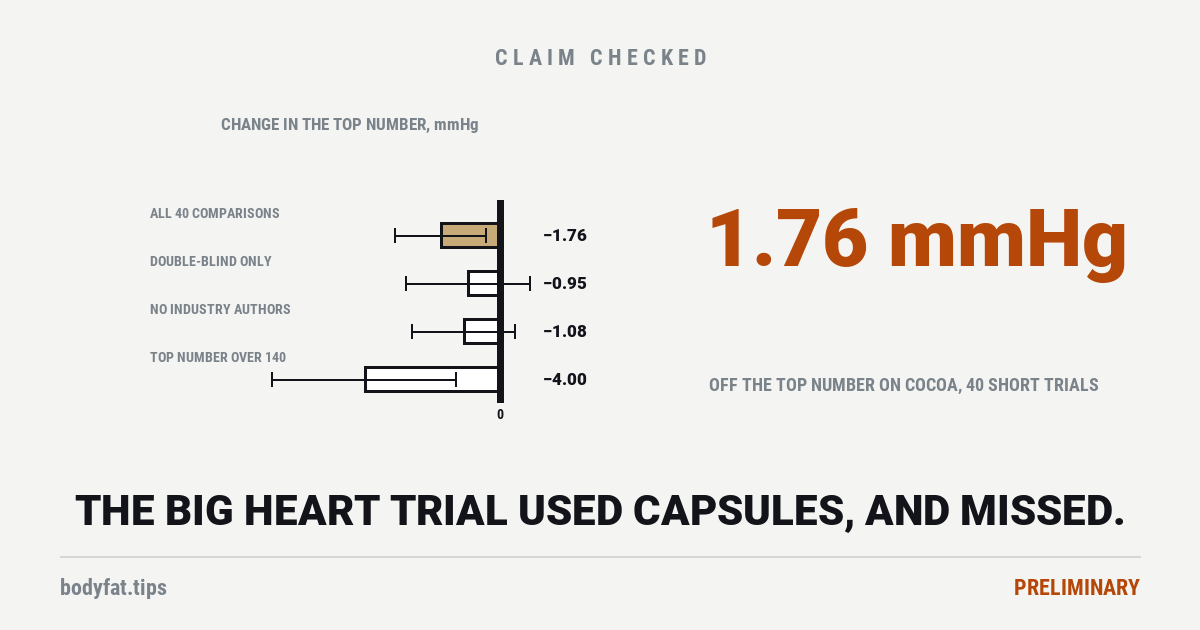
Start with the measurement that has been checked the most: blood pressure. A Cochrane review (Cochrane is the international network that pools medical trials for doctors and health services) put together 35 trials, with 40 comparisons and 1,804 mostly healthy adults, each lasting two to 18 weeks [4]. People who ate or drank cocoa products every day ended with a systolic pressure, the top number, 1.76 mmHg lower than people given a flavanol-free or low-flavanol version, and a bottom number 1.76 lower too [4]. mmHg, millimetres of mercury, is the unit on every blood-pressure cuff. The reviewers graded the evidence moderate and called the effect small [4].
Three things shrink that number, and the table shows all of them. In people whose top number started above 140, the fall was about 4 mmHg; in people with normal pressure it was 0.65, a gap that could be chance [4]. In the 23 comparisons that were double-blind, where neither the volunteers nor the researchers knew who had the real cocoa, the fall was 0.95, and the range the true answer probably sits in ran from 2.77 lower to 0.86 higher. When that range includes zero, “no effect at all” is still on the table [4]. And with the trials whose authors worked for a company in the business left out, the fall was 1.08, with “no effect” inside the range again [4].
| Trials pooled | Change in mmHg, against a flavanol-free or low-flavanol version | Could it be no effect? |
|---|---|---|
| All 40 comparisons, 1,804 adults [4] | −1.76 (range −3.09 to −0.43) | No |
| The 23 double-blind comparisons [4] | −0.95 (range −2.77 to +0.86) | Yes |
| Leaving out trials with authors employed by industry [4] | −1.08 (range −2.60 to +0.43) | Yes |
| People whose top number started above 140 [4] | −4.00 (range −6.71 to −1.30) | No |
| People with normal pressure [4] | −0.65 (range −2.13 to +0.84) | Yes |
| A 2026 review of 25 trials, funded by a food company that makes chocolate [5] | −2.73 (range −3.45 to −2.02) | No |
A newer review, searched to December 2025, found more: 2.73 mmHg off the top number across 25 trials, which differed from each other no more than chance would produce [5]. It was paid for by a Japanese food company that makes chocolate, and five of its seven authors work there [5]. That does not make its arithmetic wrong. It is why the funding is on this page.
The second measurement is flow-mediated dilation. A cuff squeezes the forearm shut for five minutes, and an ultrasound measures how much the main artery of the upper arm widens when the cuff lets go. It is a test of how well the artery’s inner lining is working [7]. In the 2026 review, cocoa added about 1.3 percentage points to that widening across six studies and 324 people, on evidence the authors graded low [5]. An independent pooling, by a university team in Tehran that declared no conflicts, put together 10 trials that gave dark chocolate for weeks: arteries widened by 0.69 of a percentage point more, with a range from 0.22 to 1.16 [10]. And 76% of the spread between its trials’ results was more than chance would produce: the size of the gain differed from trial to trial by more than luck allows [10]. The US Food and Drug Administration does not accept the test as a stand-in for heart disease: in 2023 it wrote that this test “does not reliably predict an effect” on the heart attacks and strokes it is meant to stand in for [8].
Which leaves the test that counts heart attacks instead of markers. The COSMOS trial gave 21,442 Americans, women aged 65 and over and men 60 and over, two capsules a day of a cocoa extract carrying 500 mg of cocoa flavanols, or dummy capsules, for a median of 3.6 years [6]. Flavanols are the plant compounds in cocoa that the vessel trials credit with the effect. The trial’s primary outcome, the main result it was designed to judge itself by, was a count of heart attacks, strokes, deaths from heart disease and stroke, heart and artery operations and a few related events: 410 people on cocoa had one, against 456 on dummies [6].
Researchers compare those as a hazard ratio: how fast events happened in one group relative to the other, where 1.0 means no difference. It came to 0.90, a 10% lower rate, with a range running from 0.78 to 1.02 [6]. “No difference” is inside that range. By the measure it set itself, the trial did not show that the cocoa cut those events.
Deaths from heart disease and stroke, counted together as one of its 14 secondary outcomes, were fewer: 76 against 104, a hazard ratio of 0.73 [6]. The authors did not adjust for testing that many outcomes at once, and wrote that at the usual threshold about one secondary outcome would come up significant by chance alone [6]. They call their secondary results hypothesis-generating: a lead, not a finding.
Two other readings of the same trial came out lower. Counting people only while they kept taking their pills, which the trial calls a per-protocol analysis, the main outcome came to a hazard ratio of 0.85, with a range from 0.72 to 0.99 [6]. And a narrower count of heart attacks, strokes and deaths from heart disease and stroke, which the authors say was not planned in advance, was 16% lower: a hazard ratio of 0.84, with a range from 0.71 to 0.99 [6].
Neither overturns the miss. A trial names its main measure before it starts so that nobody can choose, once the results are in, whichever reading looks best; a measure picked afterwards is one of many that could have been picked, and some of them will look good by luck. A per-protocol count also leaves out the time after people stopped their pills, which, as the section on the 39% below explains, can flatter a treatment. The authors themselves say the per-protocol result should be read with caution, because it rests on extra assumptions [6].
And those were capsules, not chocolate. The trial tested an extract, its authors wrote, to give people cocoa’s compounds without “adding excessive sugar, saturated fat, and calories” [6]. The site’s multivitamin verdict weighs the same trial’s other half, a daily multivitamin.
The “stem cell” study: what two cups of cocoa did in 16 people
The description does not name its study. The one that fits it, and the one we read, is a 2010 trial run at the University of California, San Francisco and published in the Journal of the American College of Cardiology [7]. That match is our inference.
Sixteen patients with coronary artery disease, average age 64 and already on standard heart drugs, drank a cocoa drink twice a day [7]. It was a crossover trial: each person had both drinks for 30 days, in an order decided by chance, a week apart. One drink carried 375 mg of cocoa flavanols, the other 9 mg, and neither the patients nor the researchers knew which was which [7]. Twice a day, that is 750 mg of flavanols a day, by our arithmetic. The drinks were made from a high-flavanol cocoa powder supplied by a confectionery company and mixed with skim milk or water [7]. Not dark chocolate: a powder made to keep the flavanols in.
The number the channel quotes is real. After the high-flavanol month, a count of circulating angiogenic cells in the blood was 2.2 times what it was after the low-flavanol month [7]. These are cells from the bone marrow, also called endothelial progenitor cells, that are thought to help repair the lining of blood vessels [7]. Arteries widened better too, from 4.6% to 8.4% on the ultrasound test, against 4.4% to 5.7% on the other drink, and the top blood-pressure number fell 4.2 mmHg more [7].
Now the parts the description leaves out. The count also rose on the low-flavanol drink, and the authors themselves raised regression to the mean, numbers drifting back toward their usual level on their own, as one possible reason [7]. The researchers took the cells out and tested whether they survived, multiplied and moved toward a signal; on every test they were “not different” between the two drinks [7]. More cells, then, but not better ones, and the trial did not measure whether they repaired anything.
Who was in the room: the trial was supported by an American Heart Association grant and an unrestricted grant from the confectioner to two of the authors; a third author had research funding from the same company, which supplied the cocoa powders, and a fourth of the 18 authors was its employee [7]. The University of California, Davis news release of 30 July 2010 called the cocoa “strikingly effective” at mobilizing the cells and compared the effect with statins [11]. It called them angiogenic cells. It did not call them stem cells [11].
Has it been repeated? We found two more studies that counted these cells after cocoa or chocolate [12]. In 2017 the same research network, with the same confectioner as a partner supplying the drinks and two of its employees among the authors, gave 12 healthy volunteers single cocoa drinks: two hours later the count was about five times its starting level, and about twelve times when the drink also carried theobromine and caffeine, the stimulants cocoa naturally contains [13]. That is one drink and two hours, not a month.
The other is the only one of the three that used a chocolate bar. In Italy, 26 adults with at least three heart risk factors ate 1.4 oz (40 g) a day of 70% dark chocolate for four weeks, once made with olive oil and once with dried apple, in an order decided by chance [14]. The count rose after the olive-oil chocolate and did not change after the apple chocolate [14]. Neither chocolate changed blood pressure [14].
Does dark chocolate “starve cancer”?
The title says it does; the description does not explain. In the channel’s frame, a food starves cancer by stopping a tumour from “hijacking your blood vessels”, as an earlier video of theirs puts it [1]: cutting off the new blood vessels a growing tumour needs, which researchers call anti-angiogenesis.
The cocoa evidence for that is in dishes and mice. In 2004, compounds taken from cocoa slowed the growth of human blood-vessel cells in a laboratory; the authors, two of whom gave the confectioner as their employer, wrote that their doses were likely higher than a body could reach, and that whether it happens in a living body was an open question [15]. In 1993 a Polish team injected mice with theobromine, the main stimulant in cocoa, on the day they implanted lung-cancer cells in the mice’s skin and on the two days after, and the new blood vessels the tumours drew were held back [16]. An injection into a mouse is not a square of chocolate, and we found no study in people that tested cocoa or chocolate on a tumour’s blood supply [12].
In people, cancer was counted: by the big trial. Invasive cancer was one of its secondary outcomes. 1,053 people were diagnosed, and the cocoa group’s rate was no lower: a hazard ratio of 1.10, with a range from 0.97 to 1.24 [6]. That is not a clear sign of harm either. It is no sign of starving, and the authors wrote that the short follow-up “limited our ability to evaluate cancer endpoints”, since a trial of a food or supplement usually needs far longer to show any effect on it [6].
Notice what the one title is selling. The cells counted in the stem-cell trial are called angiogenic, vessel-building [7]. The cancer claim is about stopping vessels from being built. The same video sells the same food for both. That is an observation about the title, not a finding about cocoa, and we mark it as one.
Can a cacao drink unclog your arteries?
Unclogging would mean less plaque, the fatty build-up that narrows an artery, or a wider channel for the blood. The video’s case runs through nitric oxide, a gas the lining of a blood vessel makes to relax it [2].
That step has measurement behind it. In 2006, a flavanol-rich cocoa drink raised nitric-oxide compounds in the blood of 10 healthy young men within hours; when researchers blocked the body’s nitric-oxide production in three of them, the artery-widening effect almost vanished, from 9.2% to 0.6% [17]. The confectioner part-funded that study and employed two of its authors [17]. In the 2010 heart-patient trial, nitrite, a marker of nitric oxide, rose on the high-flavanol drink [7].
Cocoa and beetroot together? A 2015 study gave 15 healthy people cocoa flavanols and nitrate, the compound beetroot is sold on, alone and one after the other. Each widened arteries for a few hours; the two added up at low doses, and after a high dose of nitrate the cocoa added nothing [18]. We read it as an abstract. The site’s beetroot verdict rates the nitrate route Supported, for about 3.5 mmHg off resting pressure in short trials.
None of that is plaque. The nearest tests we found measured the wall of an artery, and they point different ways. One is a 2013 British trial: 93 women past menopause, with type 2 diabetes and on statins, ate about 1 oz (27 g) a day of chocolate enriched with flavanols and isoflavones, plant compounds found in soy, or a matching dummy chocolate, for a year [19]. The thickness of the main neck artery’s wall, a marker of hardening arteries, did not change significantly, and neither did blood pressure [19]. The other, in 2023, came from a team at the German university where the 2017 single-drink studies were run: 36 men having a heart catheter passed in through the artery at the wrist took cocoa-flavanol capsules, 1,000 mg a day, or dummy capsules for two weeks around the procedure, and neither they nor the researchers knew which [20]. The catheter injures the wrist artery, and its wall can thicken afterwards; six months later it had thickened on the dummies and not on the flavanols, 0.44 mm against 0.37 mm [20]. The paper calls that six-month measurement its main one. Its registry record, filed in February 2018, after the trial had started, named a different main measure, artery widening two weeks after the procedure, listed wall thickness at one month as a secondary one, and described twice-daily flavanol drinks rather than capsules; we found no explanation of the change in the paper [20]. The confectioner donated the capsules, and the authors declared no conflicts [20]. That is healing after an injury, not plaque. In animals the plaque studies split: six months of cocoa powder left less of the main artery’s lining covered in plaque in rabbits bred to have high cholesterol, in a study five of whose nine authors worked for the Japanese confectioner that processed its cocoa powder [21], while 16 weeks of chocolate liquor, the ground cocoa mass that chocolate is made from, left larger plaques in mice bred to develop them [22]. Both measured plaque forming, not plaque clearing. We found no trial of a cacao drink, with or without beetroot, that measured plaque in people [12]. The same channel’s aged-garlic claim got further: on that page, six small trials slowed a number on a heart scan, and none showed an artery unclogging.
The 21,442-person trial, and where the 39% came from
On 14 September 2026 the physician-author’s channel posted a Short marked as a paid partnership with a cocoa-flavanol supplement brand, with a discount code. The brand, it says, provides 500 mg of cocoa flavanols, the daily amount in COSMOS, and “one of the study’s findings was a 39% lower risk of cardiovascular death” [1].
Here is where the 39% lives. When the researchers counted people only while they kept taking their pills, a per-protocol analysis, deaths from heart disease and stroke came to 44 against 69, a hazard ratio of 0.61 [6]. One minus 0.61 is 39%, by our arithmetic. It is the stronger-looking of two analyses of a secondary outcome, in a trial whose main outcome missed. Per-protocol counts can flatter a treatment, because the people who keep taking pills for years are not the same as the people who stop.
The brand belongs to the confectioner whose nutrition arm supplied the trial’s extract and paid toward the trial [23] [6]. Its page on the trial shows “+39%” for “important heart health outcomes”, labelled as counting only those who said they took the supplement, and “+27%” for everyone, and gives the study’s duration as five years [23]. The page as we read it does not show the result the trial was designed to judge itself by, and the median time people were followed was 3.6 years [23] [6]. The trial paper says the company had no role in its design, analysis or writing [6].
The framing reaches the journals too. A 2026 paper calls 500 mg a day “the amount proven to mediate cardiovascular benefits in the COSMOS trial” [24]. Two of its seven authors are employed by the confectioner and a third has an unrestricted grant from it; two more are the trial’s own lead investigators, who hold grants from the confectioner’s nutrition arm for the trial [24] [6]. The trial’s own report, with the same two as its first authors, says the extract “did not significantly reduce total cardiovascular events” [6]. A 2026 re-analysis by the trial’s team, scoring deaths ahead of other events, reported a significant result from the same data [25]. Its listed funders include a grant from the confectioner’s nutrition arm [25]. A new way of counting the same events is not a second trial.
What did the regulators say about dark chocolate?
In November 2018 a Swiss-based cocoa and chocolate company asked the FDA to let labels say that cocoa flavanols may reduce the risk of heart disease, naming high-flavanol cocoa powder and high-flavanol dark chocolate [8]. The agency went through the 241 publications the petition cited and could draw no conclusions from 207 of them; in the end it could draw conclusions from only two publications, both on high-flavanol cocoa powder [8]. In 2023 it allowed one wording, for high-flavanol cocoa powder only, and the label has to say the FDA “has concluded that there is very limited scientific evidence for this claim” [8].
For dark chocolate it found “no credible studies” supporting a link with lower heart-disease risk, and it pointed out that dark chocolate carries far more calories, fat and saturated fat than cocoa powder [8]. Its announcement says the claim does not apply to “other food products made from cacao beans, such as chocolate” [8].
The European regulator answered a narrower question, and said yes. In 2012 the European Food Safety Authority (EFSA), the EU’s scientific adviser on food, assessed an application from the Belgian company of the same Swiss-based chocolate group and concluded that cocoa flavanols help keep normal the artery widening that the cuff-and-ultrasound test measures [26]. It said that takes 200 mg of flavanols a day, which could come from 2.5 g of high-flavanol cocoa powder or about a third of an ounce (10 g), of high-flavanol dark chocolate [26]. Its conclusion leaned on one study, then unpublished, that the company claimed as its own data, a week-long test of doses from none to 800 mg in 20 people, and the European Commission records that the conclusion could not have been reached without it [26] [9].
Since 2013, EU labels may say that “cocoa flavanols help maintain the elasticity of blood vessels, which contributes to normal blood flow”, but only on cocoa drinks or dark chocolate that deliver at least 200 mg of flavanols a day, and the label has to say that 200 mg is the amount; for its first five years only the applicant could use it [9]. In 2015 the same claim was extended to capsules and tablets of a high-flavanol cocoa extract, and it was still on the EU’s list of permitted claims in the version of 20 August 2025 [9].
What each judgement settles is narrower than it sounds. The European one settles that, by its standard, 200 mg of cocoa flavanols a day keeps arteries widening normally; it is a claim about how blood vessels work, made under the EU’s rules for claims other than reducing the risk of disease, and it says nothing about heart attacks or strokes [9]. The American one settles that the agency found no credible evidence that dark chocolate lowers the risk of heart disease, and that it will not take the artery test as a stand-in for that risk [8]. Neither says that the dark chocolate in a shop delivers 200 mg, and neither is evidence about heart attacks in the people who eat it.
How much dark chocolate should you eat a day?
No trial we found answers that for heart attacks: we found none that gave people chocolate itself and counted heart attacks or strokes [12]; the trial authors call COSMOS the only long trial of a cocoa extract on heart events [6]. Google’s AI answer says 1 to 2 ounces a day [3]. Here is what an ounce buys.
A 2011 university study measured 12 commonly eaten dark chocolates: their flavanols ran from 93.5 to 651.1 mg per 3.5 oz (100 g), a sevenfold spread, and the cocoa percentage on the label did not always reflect the levels of flavonoids, the family flavanols belong to, that the laboratory measured [27]. We read it as an abstract. By our arithmetic, an ounce (28 g) of those bars carried about 27 to 185 mg. The big trial’s capsules gave 500 mg a day [6].
To reach 500 mg you would eat about 2.7 oz (77 g) of the richest of those bars, or about 19 oz (535 g) of the poorest. At the US Department of Agriculture’s figure for 70–85% dark chocolate, 598 calories per 3.5 oz (100 g), that is roughly 460 to 3,200 calories a day [28]. The arithmetic is ours, and the 2011 study measured flavanols by a different laboratory method from the trial’s, so read it as a rough guide, not a dose.
Some of the trials behind the blood-pressure figure did feed that much. In the Cochrane review, daily amounts ran from a few grams up to 3.7 oz (105 g) of cocoa product, and some trials gave 3.5 oz (100 g) of dark chocolate a day for 15 days [4]. One German trial gave 6.3 g, under a quarter of an ounce, for 18 weeks [4]: one square a day of a dark chocolate sold in shops, with about 30 mg of polyphenols, the wider family of plant compounds that flavanols belong to [29] [26]. In its 44 volunteers, aged 56 to 73 with mildly high blood pressure, the top number fell 2.9 mmHg from where it started, and on white chocolate it did not change [29]. It was small, and the volunteers knew which chocolate they were eating, though the staff measuring them did not [29].
Which is healthier, 70% or 85% dark chocolate?
The USDA’s figures do not split 70% from 85%; they put both in one group. They do show what happens as the percentage climbs from 60–69% to 70–85%: sugars fall from 36.7 g to 24.0 g per 3.5 oz (100 g), about 10.4 g against 6.8 g an ounce by our arithmetic, while calories stay close, 579 against 598 [28]. On flavanols, the percentage is a weak guide [27], because processing matters. Alkalizing cocoa, also called dutching, done to change its colour and flavour [6], can cut flavanols to under 10 mg per 3.5 oz (100 g) [4]. The channel recommends 80%, 85% or higher [1]; for flavanols, the wrapper’s number cannot promise what that implies.
Which dark chocolate is the healthiest, then? The trials do not say, and the one measurement that matters for the vessel effect is not the one printed on the front of the bar [27].
What happens if you eat dark chocolate every day?
An ounce of 70–85% dark chocolate carries about 170 calories, 6.8 g of sugars and 6.9 g of saturated fat, by our arithmetic from the USDA’s figures; it also carries about 3.4 mg of iron, 65 mg of magnesium and 23 mg of caffeine [28].
In three long-running US studies of nurses and health professionals, people who ate dark chocolate five or more times a week (a serving was an ounce or a bar) had a 21% lower rate of type 2 diabetes than those who rarely ate it, while milk chocolate showed no link and went with weight gain [30]. That is a cohort study: it follows people who chose what they ate, so it cannot separate the chocolate from the kind of people who eat it. When COSMOS tested the extract against dummies in 18,381 people without diabetes, the rate of new diabetes was not lower, a hazard ratio of 1.04 [31]. New high blood pressure was not either: 7.1 against 7.4 cases per 100 people a year [32].
Lead and cadmium in dark chocolate
In December 2022 a US consumer-testing magazine measured 28 dark chocolate bars and found lead and cadmium in all of them. For 23, eating an ounce a day would put an adult over a level that the magazine and public-health authorities say may be harmful, for at least one of the two metals [33].
A 2024 study of 72 dark chocolate and cocoa products bought from 2014 to 2022 used California’s warning levels, 0.5 micrograms (mcg) of lead and 4.1 mcg of cadmium a day, which its authors call conservative: at one serving a day, 43% of the products went over it for lead, and 13 of the 37 with a per-serving cadmium figure, 35%, went over it for cadmium. Against the FDA’s benchmark for lead, 70 of the 72 came in under [34]. Products labelled organic were more likely, not less, to be higher in both metals [34].
The FDA’s benchmark is a daily intake from food: 2.2 mcg of lead a day for children and 8.8 mcg for women who could become pregnant. The agency says no safe level of lead exposure has been identified [35]. Those two groups are where this matters most, and it is a question for a clinician rather than a wrapper.
Dark chocolate for women, men, iron, testosterone, skin and periods
These are the other searches people run, and this page did not weigh them. Two facts it can give: an ounce of 70–85% dark chocolate carries about 3.4 mg of iron, by our arithmetic from the USDA’s figure [28], and the site’s testosterone-booster verdict covers a cocoa-seed blend sold to men. In COSMOS the extract’s effect on heart events did not differ clearly between women and men; the one subgroup that stood out was people who had ever smoked, and the authors list subgroup results among those to read with caution [6].
Who paid for the cocoa research?
Here is the list. A confectionery company part-funded and supplied the 2010 stem-cell trial: its unrestricted grant went to two of the authors, a third had research funding from it, and a fourth was its employee [7]. It part-funded the 2006 nitric-oxide study, employing two authors [17]. It part-funded and supplied the 2017 single-drink studies as a partner; two of that paper’s 11 authors were its employees, among those who designed the studies and wrote the paper, one of them helping analyse the data, and four more, the corresponding author among them, held unrestricted grants from it [13]. Two of the six authors of the 2004 cell study gave it as their employer [15], and it donated the capsules for the 2023 wrist-artery trial [20]. It supplied the extract for COSMOS and gave it infrastructure grants, alongside US National Institutes of Health money [6], and a grant from its nutrition arm is among the listed funders of the 2026 re-analysis [25]. Of the 2026 paper that calls the dose proven, it employs two authors and gave a third an unrestricted grant, and two more, the trial’s own lead investigators, hold its grants for COSMOS [24]. Its supplement brand sells the extract [23]. A Swiss-based chocolate manufacturer filed the FDA petition [8], its Belgian company applied for the EU claim [26], and it sold the ingredients for the one-year British trial’s chocolate, whose senior author had separate funding from it for a review [19]. A Japanese food company paid for and wrote the newest blood-pressure review [5].
Industry money does not make a result wrong. The Cochrane review measured how much it mattered here: with trials whose authors worked for industry left out, the fall in the top number shrank from 1.76 to 1.08 mmHg and stopped being clearly different from no effect [4]. Six of its trials, seven of its comparisons, had authors employed by the industry [4].
If cocoa does something to arteries, why won’t the regulators say it of an ordinary bar?
This section is the desk’s own reasoning, and it is labelled as such. The trials say cocoa flavanols move blood pressure and artery widening a little [4] [5] [10]. The US regulator says its cocoa claim does not reach chocolate [8]. The European one authorises an artery claim for dark chocolate, but only for a chocolate that delivers 200 mg of flavanols a day [9]. Neither says it of an ordinary bar, and what an ordinary bar delivers is the question the evidence leaves open. Three answers, each rated.
Answer one: the dose. The heart-patient trial gave 750 mg of flavanols a day and COSMOS gave 500 [7] [6]; an ounce of the bars one laboratory measured carried about 27 to 185 mg [27], and the European claim needs 200 a day [9]. By our arithmetic, 200 mg would take about 1.1 oz (31 g) of the richest of those bars and about 7.5 oz (214 g) of the poorest. This is arithmetic, not a measurement of anybody’s arteries, and it rests on one 2011 study of 12 bars read as an abstract. One small trial cuts against it: a single square a day of a dark chocolate sold in shops lowered the top blood-pressure number over 18 weeks [29].
Answer two: the package. Chocolate brings calories, fat and saturated fat with its flavanols, and sugar too; the first three are the reason the FDA itself gave for wanting chocolate tested on its own [8] [28]. That the package cancels the benefit is a surmise. The longest test of a chocolate we found, a year of an enriched chocolate, saw no significant change in the artery wall or blood pressure, and its chocolate was not an ordinary bar [19]; the 18-week trial of a small daily square did see blood pressure fall [29]. So the surmise has a trial on each side of it.
Answer three: the test products were built to keep the flavanols in. The 2010 trial used a high-flavanol powder, COSMOS used a capsule, and the FDA’s allowed claim requires a powder that is at least 4% cocoa flavanols by weight, 400 mg in 10 g, kept through processing [7] [6] [8], and the European claim needs the drink or the chocolate to deliver 200 mg a day [9]. Heavy alkalizing can strip almost all of them out [4]. This is measured in products, not in people.
Put the three together and here is what we think is true, stated plainly so you can disagree with it: the heart evidence is for cocoa flavanols, and a dark chocolate bar is one of the least efficient ways to buy them.
What we could not find, and would like to: a trial that gave people an ounce of ordinary dark chocolate a day, or none, for years, and counted heart attacks and strokes [12]. We would also like the results of a 2016 British trial that registered blood-vessel repair cells as a measure, of a trial a company registered in July 2026, not yet recruiting, that lists the cells among its measures, and longer follow-up of COSMOS, which its authors say they want to extend [12] [6]. If you know of any of them, the corrections line on this site is open.
Who these studies were done on
The blood-pressure trials were mostly in healthy adults, for weeks; in trials whose volunteers averaged 50 or older the fall in the top number was 0.98 mmHg, with “no effect” inside its range, though the review found no clear difference between the age groups [4]. COSMOS was US women aged 65 and over and men aged 60 and over with no heart attack or stroke behind them, average age 72; it left out people with kidney failure or extreme sensitivity to caffeine [6]. The stem-cell trial was 16 heart patients averaging 64, 13 of them men, on standard drugs; their top number still fell 4.2 mmHg on the high-flavanol drink [7]. The one-year chocolate trial was women past menopause with type 2 diabetes [19]. The German chocolate trial was 24 women and 20 men aged 56 to 73, the nitric-oxide study young men, and the wrist-artery trial men [29] [17] [20]. In COSMOS, 58% had high blood pressure and 13% diabetes at the start [6]. The heavy-metal benchmarks are strictest for children and for women who could become pregnant [35].
Where “dark chocolate is good for your heart” came from
The research came first, and the cocoa came from one company. In 2006 and 2010, small trials gave volunteers drinks made from a confectioner’s high-flavanol powder, with the confectioner part-funding them and employing some of the authors [17] [7]. In 2010 the heart-patient trial counted the repair cells, and the university’s release called the cocoa “strikingly effective” [11].
Then the framing, which went through a regulator and a sales page. A chocolate manufacturer asked the FDA in 2018 for a heart claim covering dark chocolate, and in 2023 got one, for cocoa powder only, with “very limited” in the wording [8]. The confectioner’s supplement brand turned a secondary result of COSMOS into “+39%” [23].
Then the spread. The physician-author’s channel turned 2.2 times more repair cells into “Regrows Stem Cells” and dark chocolate, in videos with millions of views, and carried the brand’s 39% in a paid Short [1]. The chiropractor’s channel put cacao and beetroot in one cup [2]. A chocolate maker’s blog in May 2025 cited a 2018 study and a 2007 study for cocoa raising these cells, by journal and year with no links; we could not find either in PubMed [36] [12]. And Google’s AI answer tells searchers to pick bars of “at least 70% to 85% cacao” and eat 1 to 2 ounces a day [3].
None of this is aimed at anyone with a square of dark chocolate after dinner. It is food, and a fine one. It is the medicine label that the evidence does not carry.
What this is rated, and what the rating covers
Preliminary — for the claim that dark chocolate is good for your heart.
It is rated Preliminary because the evidence in its favour is real but indirect. Cocoa products lowered blood pressure by about 1.8 mmHg and improved artery widening in trials of weeks, most of them with products made to keep the flavanols in [4] [5]. The one large trial that counted heart attacks and strokes tested capsules, and missed its main outcome, with fewer deaths from heart disease and stroke as a secondary result, and lower counts in two analyses that were not its main test, all to read with caution [6]. We found no trial of chocolate itself on heart events [12], and the FDA found no credible study for dark chocolate [8]. Chocolate as people buy it has been tested in trials for weeks: 11 of the Cochrane review’s 35 blood-pressure trials, which lasted 2 to 18 weeks, used chocolate sold in shops [4]. On diabetes, the evidence on this page for chocolate as people eat it comes from studies that watch eaters rather than assign them [30].
Rated alone, in words. That cocoa flavanols lower blood pressure slightly in the short term: Supported; consistent across two poolings, small, and smaller in double-blind trials [4] [5]. That they improve artery widening in the short term: Supported; in a company-funded review of cocoa products and in an independent pooling of dark-chocolate trials, by an amount that varied from trial to trial [5] [10], and accepted by the European regulator at 200 mg of flavanols a day [26]. That cocoa raises nitric oxide: Preliminary; measured in small studies, most from one research network that the cocoa supplier helped fund [17] [7], and in one independent German trial where a nitric-oxide marker in the blood rose over 18 weeks on a dark chocolate sold in shops [29]. That dark chocolate doubles your stem cells: Preliminary for the count, one 16-person month-long trial of a special drink, one two-hour study of 12 people from the same network, and one mixed result with chocolate [7] [13] [14]; that it regrows stem cells as a benefit to you, Unsupported, of the untested kind, since no trial we found measured whether the extra cells repaired anything [12]. An untested claim is not a disproven one. That dark chocolate starves cancer: Unsupported, of the tested kind, with a fence. The one test in people, the 21,442-person trial whose capsules carried cocoa flavanols and about 50 mg a day of theobromine, counted new cancers and found no clear difference: a hazard ratio of 1.10, with a range from 0.97 to 1.24, which leaves room for no more than a small benefit; its authors say the short follow-up “limited our ability to evaluate cancer endpoints” [6]. What favours the claim is laboratory work: in dishes cocoa’s compounds slowed blood-vessel cells, and in mice theobromine held back the vessels tumours grow [15] [16]. The mechanism as sold, cutting off a tumour’s blood supply, nobody we found has tested in people [12]. That a cacao drink unclogs arteries: Unsupported, of the untested kind; nobody we found has tested cocoa on plaque in people [12], the two trials that measured an artery’s wall point different ways and neither measured plaque [19] [20], and the animal studies we found measured plaque forming, not clearing, and split on that [21] [22].
What is not rated here: dark chocolate for diabetes, iron, skin, periods, mood or testosterone, which this page reports on without weighing; heavy metals, which are a safety question with numbers above, not a tier; and the frame above, which is this desk’s reasoning from the evidence rather than a result the evidence delivered. It is marked as ours so that you can weigh it as ours. This is journalism, not medical advice: if you have heart disease or high blood pressure, the question of what to add to your treatment belongs to the clinician treating it. The site’s blood-pressure verdict weighs what moves the number further, a diet first; it does not cover cocoa. How we read a study, and what each tier means, is set out here.
- Lycopene Benefits: Cook Tomatoes With Oil and More Gets Into Your Blood. In Seven Trials, Tomatoes Didn’t Clearly Move the Scale.
supported - The Study Behind Clove Coffee’s Blood-Sugar Claim: 13 People, No Comparison Group, Maker-Paid
preliminary - Hibiscus Tea Benefits: A Few Points Off Blood Pressure in Small, Short Trials. Against Prescription Pills, the Trials Split.
preliminary