How to Get Rid of Cellulite: Twelve Weeks of Daily Glute Exercises Left It Where It Was. Nothing Tested So Far Melts It.

“Melt Cellulite by Doing This 3X a Week (No Squats Needed).” That is the title of a video a chiropractor’s health-video channel posted on 15 June 2026; it had 635,036 views when we read it on 10 October 2026 [1]. The description says cellulite “is often linked to connective tissue, inflammation, and high insulin, not just body fat,” and prescribes two things: high-intensity interval training, which is short bursts of hard effort with easy recovery in between, and a low-carb diet. “Just 20 minutes of sprints or cycling, three times per week, combined with lowering insulin through diet” [1].
The same channel’s older video on the subject, “Get Rid of Cellulite for Good,” posted on 3 January 2022, had 5,942,242 views. Its list of fixes starts with lunges and squats [1]. Both descriptions advertise the creator’s own supplement line [1].
It is a busy question. In the United States, “how to get rid of cellulite” is searched about 18,100 times a month, “cellulite treatment” about 14,800, “what causes cellulite” about 6,600 and “does cellulite go away” about 1,900 (from a paid keyword database, pulled 10 October 2026) [2]. So we read the trials. Here is the short version; the rest of the page is the working.
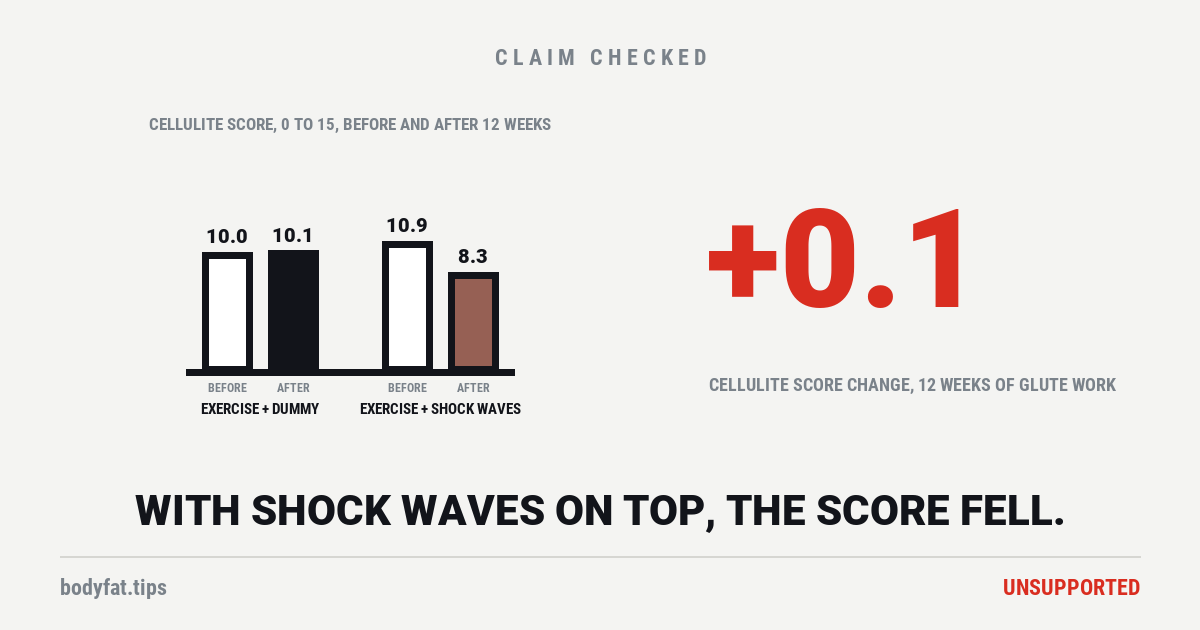
Exercise has been tested, and on its own it has not been shown to do better than doing nothing. In a randomised trial, women did two glute exercises twice a day for twelve weeks. Their cellulite score went from 10.0 to 10.1 [3].
A low-carb diet, as the video means it, has never been tested on its own. The one randomised trial of a lower-carbohydrate diet we found cut carbohydrate to 40% of calories, against 60% on its normal diet: a modest cut. Over five months the authors saw no important effect on weight or cellulite, and only five women finished that diet, so it settles little [4]. The one study that reported success bundled a ketogenic diet with exercise and a cream, had no comparison group, and was paid for by the company selling the diet [5].
Nothing tested so far melts it. The best-tested treatment, an injection approved in 2020, made about four in ten women a step better on two photo ratings, against one or two in ten given a dummy, in trials its maker paid for [6]. Cellulite is mostly anatomy, and the treatment with the strongest trials works on the anatomy directly.
What is cellulite, and why do women get it?
Under the skin of the thighs and buttocks sits a layer of fat divided into little lobules by fibrous bands, called septa, that run from the skin down to deeper tissue. Where the bands hold the skin down and the fat between them pushes up, you get the dimple-and-bulge pattern people call cellulite.
The pattern differs by sex. In a 1998 study that took small tissue samples from the thighs of seven adults, the connective tissue just under the skin was smooth and continuous in the men and irregular, with gaps, in the women; the fat itself, how it released energy and how much blood reached it, did not differ between dimpled and smooth skin [7]. A 2019 study of 20 body donors counted more fat lobules under the skin in the men, 10.05 against 7.51, which the authors read as more anchoring connections, and found the men’s bands took more force to break, 38.46 against 23.26 newtons [8]. That is about 40% less force for the women’s, by our arithmetic. Scans in living women with cellulite show more of the bands running straight down from the skin [9], and in 30 women scanned on both sides of the buttocks, bands showed up under 96.7% of the dimpled areas examined [10].
Men can get it, rarely. A 2017 review describes cellulite in men as “a product of androgen deficiency”: castration, low testosterone from other causes, Klinefelter’s syndrome, or estrogen treatment for prostate cancer [11]. The paper that named the anatomy in 1978 was titled “So-called cellulite: an invented disease”, and argued for its “essential normality and inevitability” in women [12].
How it is measured matters for everything below. The trials mostly use photo scales. The Cellulite Severity Scale scores five features from 0 to 3 each, among them how many dimples there are and how deep, for a total from 0 to 15; 1 to 5 is mild, 6 to 10 moderate, 11 to 15 severe [13] [4]. An older grading asks whether dimples appear only when the skin is pinched, when standing, or even lying down [5].
How common is it? The 2017 review gives 80 to 90% of women after puberty, while admitting that “little epidemiologic data” exist [11]. The counts we found: 77.7% of 184 girls aged 12 to 18 examined in São Paulo [14], and 92.5% of 614 Brazilian women answering a questionnaire, rising from 72% of those aged 12 to 19 to 100% of those over 70 [15]. The second team writes that prevalence estimates are not based on high-quality population studies; theirs was a questionnaire passed round by dermatologists, a convenience sample rather than a random one [15].
What causes cellulite on the stomach?
The same structure, wherever there is fat under the skin. The 2017 review lists the hips, the abdomen around the navel, the breasts and the backs of the arms alongside the usual thighs and buttocks [11]. In one study of 20 women recruited at normal weight, 4 had it on the abdomen [5].
The 2022 video says the opposite: “Cellulite only occurs in the butt, thighs, and hips” [1]. That line has a source. One of the six links under the video is a chapter of a cosmetic-chemistry textbook, by two authors, one of whom lists a skincare company as affiliation, which says “True cellulite occurs only on the buttocks and thighs” [16]. The clinical literature we read does not agree [11] [5].
Does exercise get rid of cellulite?
This is the question the video turns on, and it has been tested more often than you might think, though rarely as the main question. The cleanest test was not designed as one.
In 2013 a German team randomised 53 women with cellulite to a shock-wave treatment or a dummy version of it [3]. To keep everyone coming back, both groups were also given two glute exercises to do at home: fifteen repetitions a leg, morning and evening, every day for twelve weeks [3]. So the dummy group was, in effect, an exercise-only group. Their cellulite score, on the 0-to-15 scale, was 10.0 at the start and 10.1 at the end. The group that got the real shock waves went from 10.9 to 8.3 [3]. The authors’ own summary: the dummy treatment and the glute training “were not able to change” the score [3].
That is worth setting beside what Google’s AI answer tells people who ask: squats and lunges build muscle “which flattens and smooths the appearance of the skin above” [2]. A trial that gave women daily glute work for three months, then graded their cellulite on a scale, found no change [3].
Here is every test of exercise and cellulite we found.
| Study | What the exercise group did | Cellulite in the exercise group |
|---|---|---|
| 53 women, randomised, 12 weeks [3] | Two glute exercises at home, 15 reps a leg, twice a day, plus a dummy shock-wave treatment | 10.0 before, 10.1 after, on a 0–15 severity scale: no change [3] |
| 45 women, randomised, 3 weeks [17] | Six 30-minute sessions of stepping up and down on an 8-inch (20 cm) step at moderate effort | Median score 7 before, 6 after, a fall the paper counts as significant within the group; the untreated group stayed at 7, and the paper reports a significant difference only for the group that added shock waves [17] |
| 86 women with obesity, randomised [18] | A diet plus 30 minutes of cycling at an easy-to-moderate pace three times a week | No cellulite difference reported; only the group that added a pressure device improved [18] |
| 28 women students, not randomised, 6 weeks [47] | Glute-strengthening exercise added to shock-wave treatment, against shock waves alone | 11.15 to 8.69 on the 0–15 scale with the exercise, against 11.08 to 9.85 without: about twice the fall [47] |
| 20 women, 3 months [19] [20] | Treadmill at 85–90% of maximum heart rate, 45 minutes, twice a week | Not graded on any scale; no thigh or saddlebag measurement changed significantly [20] |
| 123 overweight women, 3 months [21] | Fifteen minutes of sprint intervals three times a week, plus a massage and a diet | Reported as responding by the third month; no cellulite figures; nobody left untreated [21] |
| 9 women, 5 weeks, for a TV series [22] | An exercise routine (three women) | Photo score 12.7% better; nobody left untreated [22] |
A few details from those rows. In a Portuguese trial of 45 young women, an aerobic programme was one of three groups. The exercise-only group’s median score, the middle woman’s, fell from 7 to 6 in three weeks, a change the paper’s test within that group counts as significant, while the untreated group stayed at 7; between groups, the paper reports a significant difference only for the women who added shock waves, against each of the other two [17]. Its authors call the exercise-only result smaller but “also meaningful” [17]. In an Austrian trial of 86 women with obesity, every diet group lost weight and fat. The only cellulite difference the abstract reports is for the group that added a lower-body pressure device, rated better than the untreated and diet-only groups; the group that dieted and cycled three times a week, at half its aerobic capacity, is not reported as improving [18].
One small study points the other way. In 2019 an Indonesian physiotherapy team gave 28 overweight or obese women students shock-wave treatment for six weeks, and half of them glute-strengthening exercise as well; it was a quasi-experimental study, which means the groups were not assigned by chance [47]. With the exercise added, the score fell 2.46 points on the 0-to-15 scale, from 11.15 to 8.69; without it, 1.23 points, from 11.08 to 9.85, a gap the paper reports as very unlikely to be chance (p < 0.001) [47]. It is the mirror image of the German trial, where both groups exercised and only one got real shock waves. Its limits are real: not randomised, no blinding described, 13 women analysed in each group where the abstract says 14, six weeks, and a journal PubMed does not index [47]. And what it tested is exercise added to a treatment that works on the bands, not exercise on its own.
One study is left out of the table on purpose. In a 2019 Brazilian trial of 42 women, 21 had ten sessions on a vibrating platform, lying, sitting and squatting in nine postures held still for 45 seconds each, and blinded reviewers rated more of them improved than among the 21 left untreated [48]. The postures included squats and a bridge, but they were held still while the platform vibrated, so it tests the platform more than any workout. Its abstract does not say how the groups were formed; its registry entry says by chance [48].
The nearest thing to high-intensity training in a cellulite trial is one of the 2022 video’s own references. Twenty women trained on a treadmill at 85 to 90% of their maximum heart rate, 45 minutes twice a week for three months; half also had infrared lamps shone on their legs while they did it [19]. The paper credits the lamps. Its first author’s doctoral thesis, which reports the same study, shows why: in the treadmill-only group, none of the eight thigh and saddlebag measurements changed significantly, and body fat went from 35.7% to 36.9% [20]. The cellulite itself was judged from photographs and the women’s comments, not graded on a scale [20].
And sprint intervals, the thing the 2026 video prescribes? The one study we found that put women with cellulite on them did it three times a week for three months, the video’s frequency [21] [23]. It also gave them an anti-cellulite massage after every session and a food-combining diet, left nobody untreated, reported that the cellulite “response” became significant around the third month, and printed no cellulite figures at all [21]. The two other programmes in the same study, which had no intervals, lost about the same weight [21]. Whatever happened, the intervals cannot be picked out of it.
The newest systematic review of randomised cellulite trials, 24 of them with 2,084 patients, sorted the treatments into seven kinds: mechanical stimulation such as massage, creams, shock waves, lasers and light, radiofrequency, injections and ultrasound [24]. Exercise is not one of them. And the first of the six links under the 2022 video, a review of cellulite in menopause, concludes that physical activity “cannot be an effective method in itself of getting rid of the cellulite” [25].
None of this says exercise is pointless. It does plenty, including for body fat. It says that exercise on its own has not been shown to move the dimples, specifically, any more than doing nothing does.
Does losing weight get rid of cellulite?
Sometimes it helps, and sometimes it makes it worse. A 2006 study followed women through medically supervised weight loss and measured their skin with laser scanning, X-ray body scans and ultrasound [26]. Most improved; some got worse. The ones who improved started heavier, lost more and lost thigh fat; the ones who got worse started lighter, lost less, and their tissue became looser [26]. We read that study as an abstract. A trade magazine’s report of it at the time gives the figures: 29 women, improvement in 58%, worse in 31%, after losses ranging from 2.3 to 102 lb [27]. The same report quotes a co-author: the dimples “appear to be permanent features which lessen in depth as the pounds come off” [27].
Two more pieces suggest weight loss alone is a weak lever. In the Austrian trial, losing weight on a diet, with or without cycling, is not reported to have changed how cellulite was rated [18]. And a 2026 study from a Greek clinic, looking back at 92 patients, 88 of them women, given the weight-loss drug tirzepatide, a skin gel, or both, found that how much their cellulite improved was not related to how much weight they lost [28]. That study was not randomised, and its lead author invented the gel [28].
Does a low-carb diet help cellulite, and what about insulin?
The insulin story goes like this: carbohydrates raise insulin, insulin tells fat cells to store fat, and stored fat pushes up between the bands. Each step sounds reasonable. What happens when someone tests the end of it?
A Brazilian dermatology team came closest, in a randomised trial published in 2014 [4]. Forty-three women of normal weight, aged 18 to 40, with moderate or severe cellulite, were put on one of three diets with the same calories [4]. The one the paper calls low in carbohydrate took 40% of its calories from carbohydrate and 45% from fat; the high-protein diet took 45% from carbohydrate; the normal diet, the comparison, took 60% [4]. So the trial’s low-carb diet was a modest cut from the normal diet, not the low-carb diet the video prescribes for “lowering insulin”. The women recorded what they ate over five months [4]. Only 19 finished: five on the low-carb diet, six on the high-protein diet, eight on the normal one [4]. Buttock cellulite improved on none of them. The high-protein group lost weight and its thigh cellulite improved. The low-carb group’s thighs graded lower than the normal-diet group’s at month 2, and on one thigh at month 5, but they had started lower, and the paper reports no improvement over time on that diet [4]. The authors’ own reading: no important effect of the low-carbohydrate diet on either weight or cellulite grade [4]. With five finishers, that is a weak no, and a no for a modest cut. It is the only randomised test of a lower-carbohydrate diet for cellulite we found [23]. It was paid for by the dermatology research centre where it was run, where the lead author is principal investigator; the authors declare no conflicts [4].
The study that did report success is the one a diet company paid for. Twenty women, recruited at normal weight, went through the company’s cellulite programme: a ketogenic diet of 800 to 1,200 calories a day, so low in carbohydrate that the body switches to burning fat for fuel, then a low-calorie diet, the company’s protein products, toning exercises, and its caffeine gel rubbed into the affected areas [5]. Eighteen of the 20 improved by at least one grade, and their body fat fell from 42.9 lb to 35.6 lb (19.47 to 16.13 kg) [5]. The authors list the lack of a comparison group as a limitation, and there was no way to tell the diet’s share from the exercise’s, the gel’s or simply the weight lost [5].
As for insulin itself: we found no published study that measured insulin in women with cellulite and compared it with women without [23]. A 1985 Argentine report says it tested 130 women with cellulite for carbohydrate intolerance, with no comparison group, and its abstract gives no results [29]. A company registered a trial of its supplement that planned to measure cellulite grade and blood insulin in the same women; its record lists no results [30].
What does exist is an association. In the São Paulo study of 184 girls, cellulite went with a higher body-mass index, an earlier first period, eating more carbohydrate, drinking less water and exercising less [14]. A survey taken at one moment can show that two things travel together; it cannot show which one causes the other, or whether a third, such as weight, drives both.
So where did “high insulin” come from? The 2022 video’s first link is a 2014 review of cellulite in menopause, which says that eating more carbohydrate and fat “supports hyperinsulinemia”, too much insulin in the blood, and calls it “one of deciding aetiological factors” [25]. That sentence cites no study. Four years later the diet company’s paper repeated it in close paraphrase, citing the 2014 review [5].
Inflammation, connective tissue and the estrogen story
The 2026 video’s other two culprits hold up differently. “Connective tissue” is right: the bands are connective tissue, and the scans, the tissue samples and the treatment trials below all point at them [7] [10] [6].
“Inflammation” is a hypothesis with a little behind it. In 15 lean women with cellulite and 15 without, a protective, anti-inflammatory hormone made by fat, adiponectin, was produced less in the dimpled fat, while its level in the blood was the same [31]. A 2023 review lists low-grade inflammation in affected fat among the features of cellulite and proposes a new theory around it [32]. No trial on this page tested whether treating inflammation changes cellulite.
The 2022 video tells a different story again: that cellulite is “a collagen disorder caused by excess estrogen”, that its collagen bands are “partially or entirely dissolved”, and that the fix includes “an aromatase inhibitor cream”, a cream meant to block the body’s production of estrogen in the skin [1]. The textbook chapter it links makes the same case [16], and its last link is a 1999 patent for a cream that blocks the making or action of estrogen in the fat under the skin [33]. The patent’s own test, randomised and double-blind by its own description, put the cream on one side of the body and a plain cream on the other in 24 women, and reports the active side better [33]. That is the only test of such a cream we found, and a patent is not a peer-reviewed trial [23].
Notice the direction, too. The “dissolved bands” picture runs against the scans, which found bands present, not missing, under nearly every dimple [10]. And the drug that got further than any other treatment did so by dissolving the bands on purpose [6].
What actually reduces cellulite? The medical treatments
Before the table, the verdict of the reviewers. A 2015 systematic review of 67 studies found that only 19 had a dummy comparison and random allocation, and concluded that “no clear evidence of good efficacy could be identified in any of the evaluated cellulite treatments”, with some evidence for shock waves and one laser [34]. The review had no funding; one of its three authors disclosed travel support from a shock-wave device maker and stock options in an aesthetic-device company [34]. The 2025 review, which counted only randomised trials, called the overall quality moderate and named shock waves, radiofrequency and injections as promising [24].
| Treatment | Best trial we found | What it showed | Who paid |
|---|---|---|---|
| Collagenase injection (an enzyme that dissolves the bands) | Two trials, 843 women, against a dummy injection [6] | At 10 weeks, 7.6% vs 1.9% and 5.6% vs 0.5% of women rated two steps better by both doctor and patient; about 4 in 10 vs 1 or 2 in 10 one step better [6] | The drug’s maker [6] |
| Subcision (cutting the bands with a needle-like blade) | 55 women, one treatment, no comparison group [35] | 93% improved by at least one point at a year; 45 followed to three years and 37 to five, when the registry reports 86% rated a grade or more better than before [35] [36] | Device companies, as sponsor and collaborator, by the registry record; a device-company author on the follow-up [35] [36] |
| Laser fired under the skin (1440 nm) | 57 women, one treatment, no comparison group [37] | Blinded reviewers picked the before photo 91% of the time at a year, in the 30 of 57 women who came back [37] | The laser’s maker; every author a paid consultant to it [37] |
| Shock waves (acoustic wave therapy) | 53 women, against a dummy treatment [3] | 10.9 to 8.3 on the 0–15 scale, against no change on the dummy [3] | The device maker paid the journal’s fees [3] |
| Radiofrequency (heat from radio waves) | A 2025 review of randomised trials [24] | Thighs about 0.82 inch (2.09 cm) smaller; size, not dimpling [24] | The review: no funding, no conflicts [24] |
The injection deserves its own paragraph, because it is the one tested properly and because of what happened next. It is an enzyme, collagenase, that breaks down the collagen in the bands. In two trials, 843 women with moderate or severe buttock cellulite were given up to three sessions of it or of a dummy injection, and were rated ten weeks later against reference photographs, by a doctor and by themselves [6]. Being rated two steps better on both was rare: 7.6% against 1.9% in one trial and 5.6% against 0.5% in the other [6]. One step better on both was more common: 39.4% against 14.6% when the two trials are added together [38]. It was approved in the United States in July 2020 [6].
Bruising was the problem. After the first session, 74.8% and 86.9% of the women in the two trials bruised [6]. On 6 December 2022 the maker announced it would stop making and selling the drug, citing “market concerns about the extent and variability of bruising following initial treatment as well as the potential for prolonged skin discoloration” [39]. The drug was not banned; the announcement says it remained approved [39]. Subcision bruises too: a 2024 pooling put bruising at 89% after the injection and 99% after subcision [40].
The devices are harder to judge. The subcision and laser trials treated women once and followed them, with no comparison group; the improvements were graded from photographs by reviewers who did not know which photo was which [35] [37]. The shock-wave trial had a dummy group, but it was small [3], and a 2015 review of eleven shock-wave studies, by that trial’s lead author, counted only five randomised trials, with 123 women between them; its abstract reports no pooled result [41]. Low-level red and green light has its own verdict on this site, which covers the cellulite laser trial its maker sponsored.
What naturally reduces cellulite? Creams, massage and dry brushing
Creams. A 2014 review found 21 studies of anti-cellulite creams, two thirds of them comparing one thigh with the other on the same woman [42]. Pooling the seven controlled trials big enough to count, the creamed thigh ended up 0.18 inch (0.46 cm) slimmer than the comparison, on average. The range the true average probably sits in runs from 0.03 to 0.33 inch (0.08 to 0.85 cm); it describes the average, not how much any one woman’s thigh changed. And the trials’ results varied more than chance alone would produce [42]. Thigh size is not dimpling. Retinol, a vitamin A cream, made the skin 10.7% more elastic over six months in 15 women, while “the lumpy-bumpy appearance of the skin showed either little response or was not responsive” [43]. A caffeine solution trimmed thigh measurements in a one-month study with no untreated comparison described in its abstract [44].
Massage. In a 1999 British trial, 52 women had a massage-and-suction machine, an aminophylline cream (a caffeine relative) or both, with one leg compared against the other; after twelve weeks there was “no statistical difference” between legs in any group, and the women judged their cellulite better in 10 of 35 machine-treated legs and 3 of 35 creamed ones [45]. In a Turkish trial, 60 women had one of three kinds of massage and nobody went untreated: thighs came out 0.2 inch (0.5 cm) smaller and skin folds thinner in all three groups [46]. The site’s lymphatic drainage verdict reads that trial the same way, and its page on two kinds of missing evidence calls the contouring question unsettled.
Dry brushing. The only test we found was three women, for five weeks, in a comparison run with a television series [22] [23]. Their photo scores improved 25.8%, against 12.7% for three women who exercised and 14.7% for three who used a cream, and nobody was left untreated [22].
Can cellulite go away by itself?
Not usually, and for the reason this page keeps coming back to: it is the way the skin is anchored, and it becomes more common with age, reaching 100% of the over-70s in the Brazilian questionnaire, though its authors trust their figures only for white women aged 20 to 59 [15]. In the body donors, older age went with thinner skin [8].
Ratings do drift, though. In the injection trials, 14.6% of the women given a dummy injection were rated a step better ten weeks later, by their doctor and by themselves [38]. In the shock-wave trial, the dummy group did not move [3]. Whether a change is real, on a given day, in a given light, is exactly what the photo scales were built to answer [13]. As for overnight, fast or two weeks, the searches people run: every change measured on this page took weeks or months.
What did a celebrity use for cellulite?
We did not check what any celebrity used. Whatever it was, it is probably one of the treatments above, and the trials for it are listed there. A before-and-after photograph, however famous the thighs, is not a trial.
Who these studies were done on
Women, almost entirely. The trials on this page that describe their volunteers enrolled women; cellulite in men is rare enough that the review we read describes it only with hormone problems [11].
Age: the injection trials averaged about 47 [6], the glute-exercise trial took women from 18 to 65 [3], the diet trial 18 to 40 [4] and the aerobic trial 18 to 32 [17]. Weight: the diet trial took only women of normal weight [4], the interval study overweight women [21] and the Austrian trial women with obesity [18]. That matters, because in the weight-loss study the heavier women improved and the lighter ones were likelier to get worse [26]. Skin tone: the injection trials reported it, about four in ten women with the darker skin types on the standard six-type scale [6].
Pregnant and breastfeeding women were excluded from the injection trials [6]. This is journalism, not medical advice: a new lump, a change in one leg, or skin that is red, hot and painful is not cellulite and is a reason to see a clinician.
If cellulite is anatomy, why is it sold as a fitness problem?
This section is the desk’s own reasoning, and it is labelled as such. The trials above leave a reader with a puzzle. The tests of exercise on its own, and of a modest cut in carbohydrate, were not shown to do better than no treatment or a dummy; one small study found exercise helped when it was added to shock waves; and the treatments that moved the score worked on the bands. Yet the advice people meet first, from the video, from the AI answer, from the gym, is a workout. Three answers, each rated.
Answer one: the bands are out of a workout’s reach. The score moved when something acted on the bands or the skin over them, and did not move, or was not shown to move more than with no treatment, in women who only exercised [3] [17] [6]. Glute work builds the muscle underneath; the bands anchor the skin above the fat, which sits between the two [7]. That the trials found this is measured. That the reason is distance, that exercise simply cannot reach the layer that matters, is our inference from the anatomy. One small study cuts against it: when glute exercise was added to shock waves, the score fell twice as far as with shock waves alone [47]. If that holds up, exercise may change how the dimples look once something else is working on the bands, and the layer is not wholly out of reach. It is one study, not randomised, so we hold this answer loosely.
Answer two: fat sets how much the bands show. Lose fat and the bulges between the anchors shrink, which is why heavier women improved with weight loss; lose it and have the skin slacken, and the dimples can deepen, which may be why some lighter women got worse [26]. The two directions are measured, in one study we read as an abstract and a trade report. The mechanism is a surmise.
Answer three: cellulite ratings drift, and drift looks like results. One woman in seven given a dummy injection was rated better ten weeks later [38]. Anyone who starts a plan and looks again in a few weeks, in different light, has decent odds of seeing a change. The drift is measured. That it explains the testimonials is a surmise.
Put the three together and here is what we think is true, stated plainly so you can disagree with it: cellulite is a question of how your skin is anchored, not of how fit you are. Train for your heart, your strength and your waist. Do not expect the dimples to read the programme.
What we could not find, and would like to: a randomised trial that gives women interval training, or any training, against a group that does none, for at least three months, and grades cellulite on a validated scale with the graders kept blind; and a randomised trial of a diet genuinely low in carbohydrate, well below the 40% of calories the one diet trial tested, large enough that more than five women finish it [4] [23]. If you know of either, the corrections line on this site is open.
Where “HIIT and low-carb melt cellulite” came from
The research step is a sentence, not a study. In 2014 a review of cellulite in menopause said that eating more carbohydrate and fat drives up insulin and called that “one of deciding aetiological factors”, citing nothing for it [25]. The same review concluded that exercise could not get rid of cellulite on its own [25].
The framing came from a company that sells a diet. Its 2018 study repeated the insulin sentence, cited the 2014 review for it, and ran its own ketogenic programme, bundled with exercise and a gel, on 20 women with no comparison group [5].
The spread was video. The channel’s 2022 video linked the 2014 review and put “too much insulin” on its list of causes; its 2026 video turned the list into a plan, intervals three times a week and a low-carb diet, and a promise, “melt” [1]. In Google’s results for “how to get rid of cellulite”, pulled on 10 October 2026, the first ordinary result, below Google’s AI answer, was a university health system’s video whose entry listed two of the channel’s videos, the 2022 one among them, and the row of videos further down opened with another of the channel’s, posted in April 2026 [2].
The product is in the descriptions: both advertise the creator’s supplement line, and the 2022 video adds an estrogen-blocking cream to the list [1]. None of this is aimed at anyone doing intervals three times a week. That is a good habit, for reasons that have nothing to do with dimples. It is the “melt” that the evidence does not carry.
What this is rated, and what the rating covers
Unsupported — for the claim that high-intensity interval training three times a week and a low-carb diet melt cellulite.
Parts of the claim were tested, and the claim as made never was. Tested, and not shown to do better than doing nothing: exercise on its own, in a twelve-week randomised trial where the exercise-only group’s score did not move and a three-week one where it was not shown to move more than an untreated group’s [3] [17]; and a modest cut in carbohydrate, to 40% of calories, in one small five-month randomised trial with five finishers on that diet [4]. A diet with easy cycling, in a third trial, is not reported to have improved it [18]. Never tested in a controlled design: interval training on its own, a diet low in carbohydrate in the sense the video means, and the two together. The one programme that bundled a ketogenic diet with exercise had no comparison group and was paid for by its seller [5] [23]. So it is Unsupported of both kinds: the parts that were tested did not hold up, and nothing tested supports the rest. Nothing on this page melted cellulite; the treatments that changed it did so by a step or two, mostly in trials their makers paid for [6] [37].
Rated alone, in words. That exercise on its own reduces cellulite: Unsupported, of the tested kind; two randomised trials had an exercise-only group, and neither found it doing better than a dummy or no treatment [3] [17]. That exercise added to a treatment aimed at the bands helps: Preliminary, on one small study that was not randomised [47]; it says nothing about exercise without the treatment, and nothing about intervals. That interval training does, on its own: Unsupported, of the untested kind; nothing tested supports it, since the one study that used intervals bundled them with massage and a diet and printed no cellulite figures, and in another study the women who trained hard on a treadmill without lamps saw no thigh or saddlebag measurement change significantly [21] [20]. An untested claim is not a disproven one. That a modest cut in carbohydrate does: Unsupported, of the tested kind, on very thin evidence [4]. That a diet genuinely low in carbohydrate does: Unsupported, of the untested kind; the one programme that used a ketogenic diet bundled it with exercise, protein products and a gel, its women lost fat as well, and it had no comparison group, so nothing tested isolates the diet [5]. The two together, rated for improving cellulite rather than melting it: Unsupported, of the untested kind too; the two nearest programmes each had one half of the plan, bundled with something else, and neither left anyone untreated [21] [5]. That losing weight improves it: Preliminary; in one study it helped most of the women, the heavier ones especially, and made it worse for some lighter ones [26]. That cellulite is linked to connective tissue: Supported, by imaging, tissue samples and a drug that works on the bands [10] [7] [6]. That it is linked to inflammation: Preliminary [31]. That it is linked to high insulin: Unsupported, of the untested kind [23]. That an estrogen-blocking cream reduces it: Preliminary, and only just; its one test, randomised and double-blind with each woman’s other side as the comparison, is the patent holder’s own, reported in the patent rather than in a journal and never repeated [33] [23]. Nothing tested shows one fixing it.
The treatments, rated alone. The collagenase injection improving buttock cellulite modestly: Supported, by two large trials against a dummy, both paid for by the maker, and no longer on sale [6] [39]. Subcision, the 1440-nm laser, shock waves and radiofrequency: Preliminary, small or uncontrolled trials, most with maker money [35] [37] [3] [24]. Anti-cellulite creams, including retinol and caffeine: Preliminary [42] [43]. Machine massage: Unsupported, of the tested kind [45]. Dry brushing: Preliminary, and only just: three women who did nothing else improved on photo scores, with no untreated group to compare them with [22]. It sits at the floor of Preliminary for the same reason as the estrogen-blocking cream: each has one small test in its favour and no better evidence either way. The cream’s test was the better designed and the less independent.
What is not rated here: liposuction, fat-freezing and other body-contouring procedures, which treat fat rather than the bands; supplements sold for cellulite; and the frame above, which is this desk’s reasoning from the evidence rather than a result the evidence delivered. It is marked as ours so that you can weigh it as ours. How we read a study, and what each tier means, is set out here.