Compression Boots: A Little Less Soreness. The Flush Is the Seller’s Word.

One maker’s leg boots list at $899, sold with the line “Pulsing massage flushes fatigue, boosts circulation, and accelerates recovery.” [9]
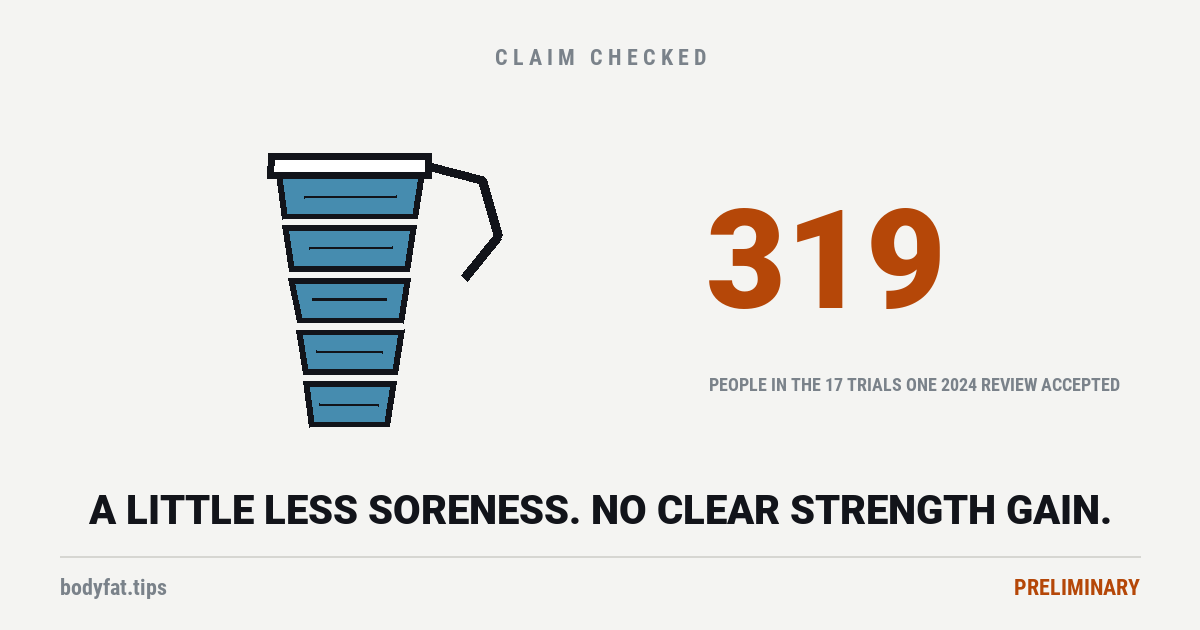
What does that money buy, according to the reviews that pooled the trials? A little less soreness, in trials that mostly had no dummy treatment to compare against, and, in the 2024 review, nothing significant for strength, power or the blood markers a “flush” would be expected to clear [1].
What the boots have
A 2024 review gathered the trials of lower-limb intermittent pneumatic compression — the technical name for the inflatable boots — that set the boots against rest or a dummy treatment in adults, published in English up to November 2022. It found 17 trials covering 319 people and pooled 14 of them. [1]
Three hundred and nineteen people, and that is one review’s count, not the whole literature. An earlier review, searched to March 2021, took in 12 trials, four of which the 2024 review left out [4]. Trials have kept coming: a PubMed search we ran on 1 October 2026 returns at least eleven more published between November 2022 and August 2026, and journals PubMed does not index hold more. Two recent ones with a dummy treatment show the range. In 21 trained cyclists, soreness, fatigue and knee strength recovered better with the boots, and the next day’s time trial was no faster [7]. In 23 elite under-19 soccer players after matches, nothing measured improved [8]. Three later reviews have pooled the boots again, and we read all three as their published summaries. The largest, of 27 studies and 554 healthy adults searched to August 2024, found a drop in soreness and pain its authors call small (an effect size of 0.45, where 0.2 is small and 0.5 moderate) and a small effect on creatine kinase, a blood marker of muscle damage, though its summary does not say which way that ran and prints a range that does not contain its own estimate; nothing else it measured came out significant, performance among them; it says the evidence does not allow a firm recommendation [11]. A 2026 review of 10 trials found much the same for soreness, 0.34 [12]. A 2025 review that searched only to July 2023 and pooled soreness a day after found no reduction, at what it rates moderate certainty [13].
Who was studied matters too. Ten of the 2024 review’s 17 trials enrolled only men and none enrolled only women; every one studied athletes or active adults, most of them in their twenties [1].
Here is how the reviewers describe what they found, in their own words: a “trivial to small” benefit for muscular function. A “trivial to moderate” effect on pain and soreness. And a “highly variable” effect on markers of muscle damage.
Their conclusion hedges about as far as a conclusion can: the boots “might be a method with potential effects”, mainly for perceived soreness. [1]
What a pair of tights has
Now the comparison that makes this page worth writing.
Ordinary compression garments — the passive kind you pull on, no pump, no power supply — were pooled across 12 studies. [2] Effect sizes came out at 0.40 for soreness, 0.46 for strength recovery, 0.49 for power recovery, and 0.44 for creatine kinase, a blood marker of muscle damage.
On the usual scale, 0.2 is small, 0.5 is moderate and 0.8 is large. So all four sit just under moderate. All four were statistically significant at p below 0.001, which means a fluke explanation is very unlikely.
| Compression boots | Compression garments | |
| Soreness | 0.49 straight after, 0.37 at four days; 0.17 to 0.64, not significant, in between | 0.40 |
| Strength recovery | 0.09 to 0.24 for muscle function, none significant | 0.46 |
| Power recovery | in the same muscle-function pool, none significant | 0.49 |
| Muscle damage marker | −0.20 to 0.87, none significant | 0.44 |
On soreness, the two come out about the same size. The boots’ two significant figures, 0.49 straight after exercise and 0.37 four days on, sit either side of the garments’ 0.40, and the 2022 review of the boots put their soreness effect at 0.33 across 24 to 96 hours [1] [4]. On strength and power the garment review found more: 0.46 and 0.49, against 0.09 to 0.24 for the boots’ muscle function, none of those significant [1] [2].
We are not going to overstate this either way. These are different reviews of different trials, and a 2018 review saw no significant drop in the muscle-damage marker that the garment review reported [3]. Trials that put the boots and a garment side by side are few and small. The boot review cites one, which found more recovery with the device [1]; it had eight students, and it treated their arms, not their legs [6]. In a 2022 trial of 30 men treated in the lower legs, neither the device nor a garment changed jump height compared with no treatment, and both held some squat-jump force and power measures better than no treatment did [10].
And the 99-study review, which never tested the boots
In 2018 a team pooled 99 studies of nine post-exercise recovery methods: active recovery, massage, compression garments, water immersion, contrast therapy, cryotherapy, electrostimulation, stretching and hyperbaric therapy. The boots were not among them, and the search ended in November 2017. [3]
Six of those reduced soreness. The rest did nothing measurable for it.
And one came out on top. In the reviewers’ words: “Massage was found to be the most powerful technique for recovering from DOMS and fatigue” — DOMS being delayed onset muscle soreness, the ache that shows up a day later. They also found massage and cold exposure to be the most powerful techniques for reducing inflammatory markers. [3]
Their overall conclusion: “Massage seems to be the most effective method for reducing DOMS and perceived fatigue.”
That ranking covers those nine methods and tells you nothing about the boots, which were never in the running. In the two side-by-side trials of boots and massage that the boot review includes, both in ultramarathon runners, it reports “similar effects” [1]. In the larger, with 72 finishers of a 100-mile (161 km) race, massage lowered pain and soreness ratings straight after the session, both lowered fatigue ratings, and from the next day to a week later no group differed from runners who had simply lain down [5].
So what should you actually do?
If your legs feel better in the boots, they feel better in the boots. Perceived soreness is the one outcome the boots review did find something for, and feeling recovered is not nothing — it changes whether you train tomorrow.
But if you are choosing where to put money, know what the money buys. On soreness, the boots’ pooled effect is about the size reported for ordinary compression garments, and in the trials that tried both, massage did about as well as the boots. On strength and power, the pooled boot trials found nothing significant [1].
Also worth saying: the big numbers in these reviews, such as massage’s −2.26 on soreness, come from small groups given treatments that are hard to disguise, and the 99-study review says it could not rule out a placebo effect [3]. The boot review’s authors see all of these methods as a complement to sleep and ordinary food, not a substitute [1].
The verdict
Preliminary. There is a signal — the boots probably reduce how sore you feel, a little — and two reviews of overlapping trials both pooled it, at 0.33 to 0.49 on the scale above [1] [4]. But when we read the ten trials in the 2024 review’s soreness analysis one at a time, seven reported no significant soreness benefit on their own; only six of its 17 trials gave the comparison group a dummy treatment; and the two reviews read the largest of those trials differently at 24 hours. The reviewers call the effect on muscle function trivial to small and the muscle-damage results highly variable, and their own conclusion is that the method might have potential.
That is genuinely unresolved rather than debunked. What the trials can tell you is its size: a small drop in how sore you feel, and, in the 2022 and 2024 reviews, nothing significant for strength, power or the muscle-damage marker; a 2025 review reported a small effect on that marker, in a summary that does not say which way it ran.
The “flush” is another matter. The 2024 review says the boots seem not to change how fast lactate clears from the blood, and that an effect on creatine kinase, the muscle-damage marker, is “unlikely” [1]. Rated on its own, that half of the claim would read Unsupported; the rating above rests on the soreness signal.
What we cannot give you is a ranking of the recovery aisle. The reviews behind this page measured different methods in different trials, and the trials that put the boots directly against massage or a garment are few and small.
Related: ice baths, which work for soreness and, used routinely after lifting, can blunt muscle growth, tart cherry juice, and saunas. If the goal is actually building the muscle rather than recovering it, start with creatine.
If you want to know what earns each rating, we wrote down how we read a study, and everything we have checked is in one place.
This page was corrected on 9 October 2026 after an independent editorial review. Its headline called 319 people “the whole literature” on compression boots. That is the count in the 17 trials one 2024 review accepted (boots against rest or a dummy treatment, in English, to November 2022); an earlier review took in four trials it left out, and PubMed lists at least eleven more since. The page said massage “won” across 99 studies of “every” recovery method; that 2018 review never included the boots, and the 2024 review reports similar effects for boots and massage in the two trials of both that it includes. And its table set the boot review’s words against the garment review’s numbers: on the same scale the two are about the same size for soreness, with the garments ahead on strength and power.
Also corrected: “none of these are large effects” (the 99-study review reports several); the claim that the boots are the most expensive thing in the aisle with the thinnest file in it (the page compared no prices, and its own source shows thinner files); the funding row, which said funding was not stated (the 2024 review states public funding and no conflicts); and the follow-up row (that review’s analysis ran to 96 hours). The page now dates each review’s search, says who was studied and how few trials used a dummy treatment, adds what has been published since, and rates the “flush” half of the claim on its own. The provenance chain’s search figure now says where it came from and when we pulled it. It now also reports three reviews published since, two of which found the same small drop in soreness and one of which found none a day after. The rating is unchanged, and the claim beside it is now the recovery half alone.