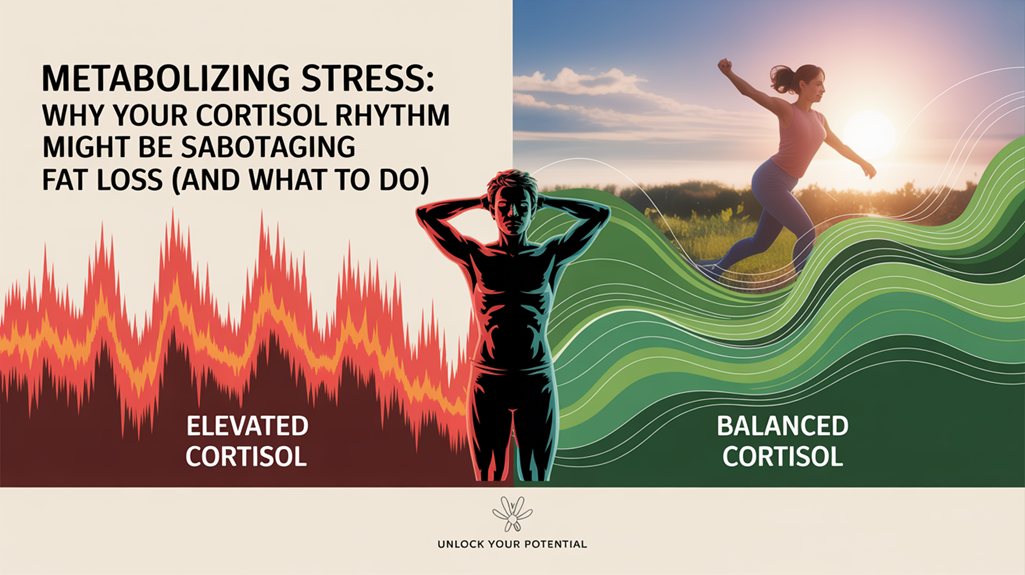
Metabolizing Stress: Why Your Cortisol Rhythm Might Be Sabotaging Fat Loss (and What to Do)

If you’ve been training hard, eating well, and still watching belly fat cling to you, there’s a good chance your stress system has shifted the internal timing that governs energy, hunger, and recovery. Research in the journal Stress shows that chronic psychological strain can flatten or delay the normal cortisol curve, creating a kind of fat-loss resistance where your physiology pushes against your goals even when your habits look “right.”

This isn’t about willpower. It’s about rhythm. Cortisol is supposed to follow a predictable rise-and-fall pattern across the day. When stress distorts that curve, your energy, appetite, cravings, and sleep become inconsistent — and those inconsistencies quietly undermine fat loss.

The Cortisol–Fat Loss Connection, Explained Simply

Cortisol is often misunderstood as a simple “stress hormone.” According to NIH endocrine research, it is actually a circadian hormone that manages energy availability. When stress hits, the hypothalamic–pituitary–adrenal (HPA) axis releases cortisol to mobilize quick fuel and sharpen alertness. Short bursts are normal. The trouble comes when cortisol spikes at the wrong times, especially late in the day.

PubMed-indexed metabolic studies link mis-timed cortisol to:

  • increased visceral fat (the deeper, stress-responsive fat found around the waist),
  • reduced insulin sensitivity,
  • stronger cravings for quick comfort foods,
  • disrupted recovery and sleep,
  • and loss of muscle tissue, which lowers metabolic rate.

None of this creates fat out of nothing. But it does weaken glucose control, increase cravings, and reduce recovery — three pillars that make sustainable fat loss much harder.

What a Healthy Cortisol Rhythm Actually Looks Like

According to research published in PNAS, cortisol should follow a clean daily curve:

  • Morning: a strong rise shortly after waking (the cortisol awakening response),
  • Daytime: a steady decline supporting stable energy,
  • Evening: low levels to allow melatonin to rise,
  • Night: the lowest point of the day to enable deep recovery.

A predictable curve supports metabolic flexibility — your body’s ability to switch between burning carbs and burning fat. Circadian-misalignment studies show that inconsistent sleep, late meals, and nighttime light exposure all flatten or delay that curve. When timing is off, hunger and energy swings increase, cravings become louder, and fat loss becomes harder to sustain.

How a Flattened or Flipped Cortisol Curve Stalls Fat Loss

A review in Obesity Reviews describes three stress-driven cortisol patterns strongly associated with fat-loss plateaus:

  • Blunted mornings: sluggishness and difficulty getting moving,
  • High evenings: wired at bedtime, restless sleep, late-night hunger,
  • Flattened curves: a constant “background hum” of stress hormones.

These patterns make fat loss harder in several ways:

  • Poor glucose handling: A PNAS trial found that late-day cortisol spikes worsen insulin resistance, making evening calories more likely to be stored as fat.
  • Visceral fat sensitivity: PubMed-indexed glucocorticoid research shows that visceral fat expresses more cortisol-responsive receptors, which is why stress-related fat storage shows up in the midsection first.
  • Reduced metabolic rate: Prolonged cortisol exposure breaks down muscle tissue according to NIH metabolic-aging research.
  • Cravings and appetite swings: Sleep studies from the National Institute on Aging show that fragmented sleep increases ghrelin (hunger) and decreases leptin (satiety), fueling overeating.

These patterns don’t mean you’re failing — they mean your stress physiology is overriding your fat-loss efforts.

Real-World Signs Your Rhythm Is Off

PubMed-indexed reviews describe several clear signs of a cortisol curve working against you:

  • feeling “tired but wired” at night,
  • waking up at 2–4 a.m. with a racing mind,
  • sluggish mornings despite enough hours in bed,
  • belly fat that sticks while limbs look leaner,
  • intense workouts that wreck you for days,
  • dependence on caffeine or sugar to function.

These signs point to rhythm disruption, not personal failure — and once the rhythm becomes predictable again, fat loss typically becomes more responsive.

Clearing Up the Biggest Cortisol Myths

  • Stress belly ≠ Cushing’s: According to the NIH, Cushing’s syndrome includes rapid central obesity, thin limbs, purple stretch marks, and severe metabolic issues. Everyday stress fat does not resemble this.
  • You can’t “detox” cortisol: The Endocrine Society emphasizes that cortisol is essential for survival; the goal is to restore rhythm, not eliminate it.
  • 30-day hormone resets are misleading: Circadian-realignment studies show meaningful improvements occur over weeks to months, not days.

How to Reset Your Cortisol Rhythm for Better Fat Loss

NIH chronobiology research shows that small, repeatable daily anchors — not extreme routines — are the most reliable way to restore rhythm.

Morning Anchors

  • Wake at roughly the same time: Strong circadian cue according to Sleep Medicine Reviews.
  • Get morning sunlight: PubMed-indexed studies show that light within 30–60 minutes of waking strengthens the cortisol awakening response.
  • Eat a protein-forward breakfast: Helps stabilize glucose and reduce mid-morning cravings.
  • Delay stress inputs: Even 10–15 quiet minutes before checking your phone reduces sympathetic activation.

Daytime Anchors

  • Walk more often: Even 10–15 minute walks improve insulin sensitivity in PubMed-indexed trials. For a deeper look at muscle-driven metabolic benefits, see
    Move Your Muscles, Grow Your Neurons.
  • Add a caffeine cut-off: NIH sleep data suggests avoiding caffeine 6–8 hours before bedtime.
  • Choose balanced meals: Predictable glucose = predictable energy = more predictable appetite.
  • Take micro-pauses: Short breaks reduce allostatic load and blunt late-day spikes.

Evening Anchors

NIH sleep research shows that predictable bedtimes improve appetite regulation, recovery, and cortisol timing.

  • Dim screens and lights: Harvard Medical School confirms blue light delays melatonin. For a practical guide:
    Why Blue Light Exposure Kills Deep Sleep.
  • Wind-down routines: Repeated cues help your nervous system shift into recovery mode.
  • Avoid heavy late-night meals: Cell Metabolism research shows late eating impairs glucose tolerance independent of calories.
  • Choose calming hobbies: Some ideas:
    Hobbies That Don’t Involve Screens.

Training and Nutrition for a Stressed Metabolism

Training

  • Prioritize strength work: NIH metabolic research shows it improves insulin sensitivity and resting metabolic rate.
  • Use gentle cardio: Supports fat loss without overwhelming recovery.
  • Limit HIIT during stressful periods: A Sports Medicine review found excessive HIIT elevates cortisol and worsens recovery when sleep is poor. For a mindful alternative:
    Mindful Intense Workouts.
  • Support recovery: Heat exposure improves parasympathetic activity according to research in the Journal of Strength & Conditioning Research. More here:
    Hot Tubs vs Ice Baths.

Nutrition

  • Regular meals: Prevent reactive late-day cortisol spikes.
  • Protein + plants: Improve satiety and stabilize glucose.
  • Limit ultra-processed foods: NIH research links them to reward-driven overeating.
  • Watch alcohol: The Sleep Foundation notes that alcohol fragments sleep and increases next-day cortisol.

Foods That Support a Healthy Cortisol Curve

  • Leafy greens & legumes: Supported by NIH magnesium research.
  • Omega-3 rich foods: PubMed-indexed studies show they reduce stress-related inflammation.
  • Slow-digesting carbs: Steadier glucose → steadier cortisol.
  • Fermented foods: NIH-backed microbiome research links gut diversity with better stress recovery.

How Long It Takes to See Change

Circadian-reset studies suggest:

  • 1–2 weeks: steadier sleep and daytime energy,
  • 3–6 weeks: fewer cravings and better workout recovery,
  • 6–12+ weeks: belly fat becomes more responsive as the cortisol curve stabilizes.

When to Talk to a Doctor

According to NIH guidance, contact a clinician if you notice:

  • rapid central fat gain,
  • thin limbs with central obesity,
  • new purple stretch marks,
  • severe fatigue or weakness,
  • consistently elevated blood pressure or glucose,
  • or major mood changes.

Morning serum cortisol and 24-hour urinary free cortisol tests have clinical relevance. The Endocrine Society notes that saliva “adrenal fatigue” panels are not reliable diagnostics for weight-loss issues.

Working With Your Biology Instead of Against It

Your body isn’t trying to sabotage you — it’s trying to protect you. When daily timing becomes predictable again, cravings soften, sleep deepens, and fat loss becomes more physiologically supportive.

You don’t need a massive overhaul. Choose one or two anchors — morning light, consistent bedtimes, fewer all-out sessions — and repeat them. Over time, those steady cues restore the rhythm that makes fat loss possible again.

If you want to explore how light, stress, sleep, or movement shape body composition, the most-read guides on BodyFat.tips are a helpful next step.

Frequently Asked Questions About Cortisol, Stress, and Fat Loss

Why does my belly fat stick around even when the rest of my body leans out?

Belly fat is more sensitive to stress hormones than other areas. When your cortisol rhythm slips — especially if evenings get “wired” — that central fat tends to hold on. It’s not a character flaw. It’s physiology reacting to timing problems, not effort mistakes.

How do I know if my cortisol rhythm is actually off?

Most people feel it before they measure it. Signs include waking up groggy, getting a second wind at night, craving sugar when you’re not truly hungry, or waking up in the 2–4 a.m. window with your mind buzzing. These patterns usually matter more than a lab number.

Do I need hormone testing to fix my cortisol curve?

Not for the everyday stress patterns most people struggle with. Simple habits — consistent wake times, morning light, predictable evening routines — usually make a noticeable difference. Testing becomes relevant only if you see extreme symptoms like rapid central weight gain or severe fatigue.

What’s the fastest way to calm evening cortisol?

Two things work surprisingly well: stepping away from bright screens at night and creating a 20–30 minute wind-down ritual. Even one or two repeated cues (a warm shower, dimming lights, reading something quiet) help your body shift gears.

Usually not. If your cortisol timing is off, pushing harder can backfire — cravings get worse, sleep gets lighter, and workouts feel heavier. Restoring rhythm first makes calorie adjustments actually work instead of feeling like punishment.

How long does it take to see results once I fix my rhythm?

Most people notice early improvements in 1–2 weeks (better mornings, fewer late-night cravings). The real fat-loss changes show up over 6–12 weeks as your cortisol curve becomes more predictable and your body stops fighting you.

Can exercise make cortisol worse?

Only when you’re already running on fumes. High-intensity training during stressful seasons can keep your system in “go mode.” Strength work plus gentle cardio tends to support recovery better until your rhythm stabilizes.

Is there a “best” time to eat for cortisol balance?

Generally, earlier meals help. Your body handles glucose better earlier in the day, and lighter evenings help sleep — which helps your cortisol curve. But perfect timing isn’t required. Consistency is what moves the needle.

Are late-night cravings caused by cortisol?

Often, yes. When your evening cortisol is elevated, your body goes looking for fast comfort energy — usually sugar or carbs. It’s less about willpower and more about your internal clock being out of sync.

When should I actually worry about my cortisol levels?

If you’re seeing signs like sudden central weight gain, new purple stretch marks, extreme fatigue, or big mood swings, it’s worth checking in with a clinician. The NIH suggests morning cortisol and 24-hour urinary cortisol as the meaningful tests for more serious conditions.