Metabolizing Stress: Why Your Cortisol Rhythm Might Be Sabotaging Fat Loss (and What to Do)

If you’ve been training hard, eating well, and still watching belly fat cling to you, has someone told you the culprit is your cortisol rhythm? Here is what the research behind that idea can and cannot say. A 2017 meta-analysis pooling 179 associations from 80 studies found that flatter daily cortisol slopes went with poorer health overall, and in 10 of the 12 kinds of health outcome it examined, measures of body fat among them [1]. Worth knowing how strong that link is before you build a plan on it: the average effect size was r = 0.147, which is small, and the researchers are careful to say a flat slope may be either a marker of trouble or a mechanism causing it [1]. So this is a real pattern, not a proven engine.
The pitch goes like this: it isn’t about willpower, it’s about rhythm. Cortisol does follow a rise-and-fall pattern across the day [1]. The part stacked on top — that stress bends the curve, and a bent curve quietly undermines your fat loss — is the claim this page rates, and it rests on far less than the pitch suggests.
The Cortisol–Fat Loss Connection, Explained Simply
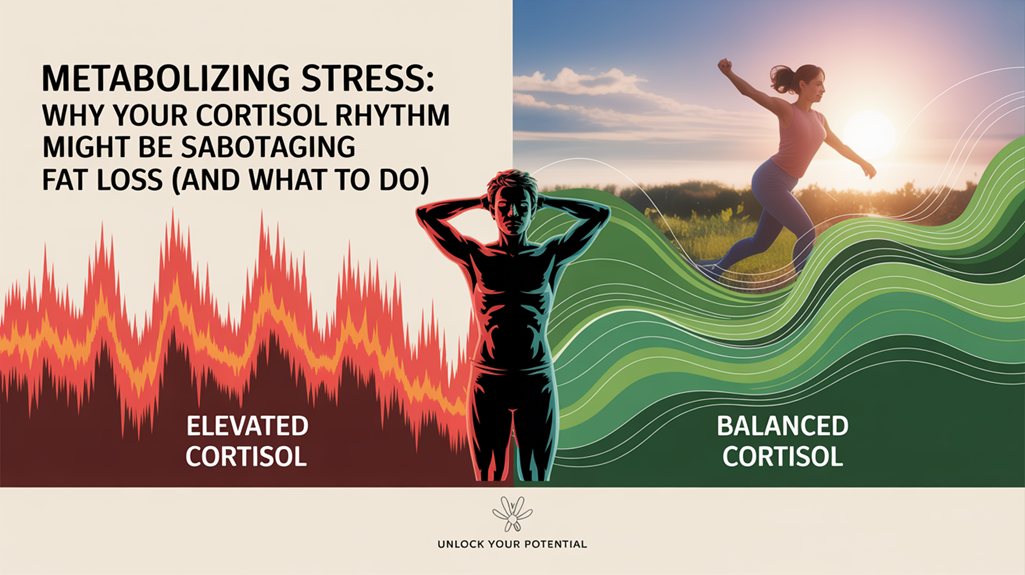
Cortisol is often misunderstood as a simple “stress hormone.” It is better described as a circadian hormone that manages energy availability — it runs on a daily clock rather than firing only when you are stressed. When stress hits, the hypothalamic–pituitary–adrenal (HPA) axis releases cortisol to mobilize quick fuel and sharpen alertness. Short bursts are normal. The worry in the research behind this page is not a single spike but the shape of the whole day: a curve flatter than usual [1], or one running out of step with the body clock [2].
A mistimed cortisol rhythm travels with a familiar cluster [1][3]. Note the word travels — these are associations, and the direction of the arrow is genuinely unsettled:
- increased visceral fat (the deeper, stress-responsive fat found around the waist),
- reduced insulin sensitivity,
- and disrupted recovery and sleep.
None of this creates fat out of nothing. And because these are associations, none of it shows that the rhythm is doing the damage rather than keeping company with it.
What a Healthy Cortisol Rhythm Actually Looks Like
The shape is well described. The meta-analysis above sums up the typical day like this [1]:
- Morning: high on waking, then a surge averaging 50–60% over the next 30 to 40 minutes (the cortisol awakening response),
- Daytime: a quick drop over the next few hours, then a slower decline,
- Evening: the lowest point of the day, reached around bedtime,
- Night: a climb back towards a peak close to your usual wake time [2].
So what happens when your day and your body clock disagree? The cleanest test is a laboratory study that forced the problem. Ten healthy adults lived in dim light on seven 28-hour “days”, a schedule built to pull sleep and meals apart from the body clock, which kept its own time: cortisol still peaked close to their usual wake time [2]. When they were eating and sleeping about twelve hours out of step, the cortisol pattern across their waking day completely reversed — low as they got up, high as they went to bed. Leptin fell 17%, glucose rose 6% despite insulin rising 22%, and three of eight showed post-meal glucose in the prediabetic range [2].
What can ten people on that schedule tell you? That living out of step with your body clock upsets blood sugar and hormones within a ten-day protocol. The authors compare it to jet lag and shift work, so shift workers and frequent long-haul travellers are the people it describes most closely [2]. It cannot tell you how fast a rhythm resets, because the design never let one. It also measured the mix of carbohydrate and fat people burned — the fuel switching that metabolic flexibility refers to — and being out of step made no measurable difference to it. Hunger and fat loss were not measured, since meals were fixed, though the authors note that lower leptin, a hormone that keeps appetite in check, could contribute to weight gain if it lasted [2].
How a Flattened or Flipped Cortisol Curve Might Stall Fat Loss
Three cortisol patterns get described in this context. We have not found a single paper that establishes them as distinct types, so treat them as vocabulary rather than diagnosis:
- Blunted mornings: sluggishness and difficulty getting moving,
- High evenings: wired at bedtime, restless sleep, late-night hunger,
- Flattened curves: a constant “background hum” of stress hormones.
Four routes from these patterns to harder fat loss get proposed. Here is how far each one has been checked:
- Poor glucose handling: the laboratory study above found glucose rose 6% despite insulin rising 22% when sleeping and eating times were pushed out of phase [2]. That is circadian misalignment, not “late-day cortisol spikes” — an earlier version of this article described it as the latter, which the study does not support.
- Visceral fat sensitivity: cortisol excess — whether body-wide or generated locally inside fat tissue — preferentially expands central and especially visceral fat, while fat under the skin at the periphery can actually shrink [3]. The usual explanation is that visceral fat carries more cortisol-responsive receptors, though the authors of that review say plainly that the depot-specific mechanisms “remain poorly understood” [3].
- Reduced metabolic rate: prolonged cortisol exposure is thought to break down muscle tissue. We have not verified that step.
- Cravings and appetite swings: the sleep evidence we have checked is about how long you sleep, not how broken it is — in the randomised trial behind our sleep verdict, people helped to sleep longer ate less without being asked to. Whether fragmented sleep, or a mistimed cortisol curve, drives hunger is something we have not checked.
These patterns don’t mean you’re failing. Whether they mean your stress physiology is overriding your fat-loss efforts is the question the evidence above cannot yet settle.
Real-World Signs Your Rhythm Is Off
The signs people describe when the rhythm is off are consistent enough to be worth listing, though they are descriptions rather than a diagnostic test:
- feeling “tired but wired” at night,
- waking up at 2–4 a.m. with a racing mind,
- sluggish mornings despite enough hours in bed,
- intense workouts that wreck you for days,
- dependence on caffeine or sugar to function.
None of them is personal failure, and none of them can tell you what your cortisol is doing: the clinical reference behind our verdict on high cortisol symptoms says even a doctor’s history and examination are often not enough. One pattern is left off this list on purpose. Fat gathering around the middle while the arms and legs get thinner is not a rhythm sign to fix with habits; it is on the doctor list below.
Clearing Up the Biggest Cortisol Myths
- Stress belly is not Cushing’s: Cushing’s syndrome is a real disease, and a rare one — see our verdict on cortisol face and cortisol belly, which puts a sourced number on how rare. Everyday stress does not produce it.
- You cannot “detox” cortisol: cortisol is not a toxin to be cleared. About seventy-four thousand searches a month are for a cortisol detox; it is not a procedure that exists.
- 30-day hormone resets are misleading: nothing we have read measures how long an ordinary rhythm takes to realign, so a thirty-day promise has nothing under it that we can find. The laboratory study cited above cannot answer that either; it was built so the body clock could not adjust [2].
Daily Habits Worth Trying (Not a Cortisol Reset)
The practical approach below is small, repeatable daily anchors rather than extreme routines. That is a reasonable reading of the timing evidence above, not a separate finding we have sourced. If lowering cortisol itself is the goal, the practices we have checked with randomised-trial evidence are meditation and yoga — see our verdict on how to lower cortisol, which also explains why cortisol may not be the reason they help.
Morning Anchors
- Wake at roughly the same time: the laboratory work above showed what living twelve hours out of step with the body clock does; whether a steadier wake time helps on an ordinary schedule is something it did not test.
- Get morning sunlight: light early in the day is the strongest signal your body clock takes. We have not checked the specific claims about the cortisol awakening response, so treat this as a cheap thing to try rather than a proven lever.
- Eat a protein-forward breakfast: a reasonable start to the day. The glucose-and-cravings claim attached to it is one we have not checked.
- Delay stress inputs: a quiet start before you check your phone costs nothing. The claim that it calms your fight-or-flight response is one we have not checked.
Daytime Anchors
- Walk more often: short walks are the lowest-friction thing on this list, and we have a sourced verdict on what walking actually does. For the muscle-and-brain angle, see
Does Exercise Grow New Brain Cells? - Add a caffeine cut-off: plausible and cheap to try. We have not sourced a specific cut-off time and the ones in circulation are not ours to repeat.
- Choose balanced meals: a sensible default. The chain from steadier glucose to steadier energy to steadier appetite is one we have not checked.
- Take micro-pauses: short breaks are cheap and pleasant. The claim that they lower cortisol through the day is one we have not checked.
Evening Anchors
Enough sleep is the evening habit here with randomised-trial evidence behind it — see our verdict on sleep and body composition. That evidence is about how long people sleep; whether a regular bedtime matters on top of that is something we have not checked.
- Dim screens and lights: we checked the blue-light claim separately and rated it Preliminary. Blue light suppressing melatonin, a hormone the body releases at night, is well established; the effects on sleep itself are mixed. See
Blue light and deep sleep: the mechanism is real, the muscle-recovery link is not. Whether dimming lights changes cortisol is something we have not checked. - Wind-down routines: pleasant and free. The claim that repeated cues shift your nervous system into recovery mode is one we have not checked.
- Avoid heavy late-night meals: eating late sits badly with the timing story above. The specific claim that it impairs glucose tolerance independent of calories is one we have not checked.
- Choose calming hobbies: we have no sourced list of hobbies to offer. What we have checked is the habit many of them would replace:
Doomscrolling and sleep: the studies agree they go together, and none can say which way.
Training and Nutrition for a Stressed Metabolism
Training
- Prioritize strength work: we have a sourced verdict on what lifting does to body composition. The insulin-sensitivity and metabolic-rate claims specifically are not ones we have checked.
- Use gentle cardio: a low-strain way to move more. The claim that it supports fat loss without taxing recovery is one we have not checked.
- Limit HIIT during stressful periods: we have not sourced this one, and it is advice we have seen repeated more often than evidenced. For a mindful alternative:
Forest bathing. - Support recovery: heat exposure — a sauna or a hot bath — is a pleasant way to end a day. The parasympathetic claim attached to it is not one we have checked.
Nutrition
- Regular meals: worth doing for their own sake. The claim that regular meals steady cortisol is one we have not checked.
- Protein + plants: a sensible base for most meals. The satiety and glucose claims attached to them are ones we have not checked.
- Limit ultra-processed foods: a reasonable default. The reward-driven overeating claim specifically is not one we have checked.
- Watch alcohol: the sleep-fragmentation claim is widely repeated and we have not verified it here.
Foods Said to Support a Healthy Cortisol Curve
- Leafy greens & legumes: a sensible base for most diets. We have not checked the magnesium-and-cortisol claims attached to them.
- Omega-3 rich foods: oily fish is worth eating on its own merits — we checked what is actually in a tin of it. The stress-inflammation link specifically is not one we have verified.
- Slow-digesting carbs: the claim that steadier glucose means steadier cortisol is one we have not checked.
- Fermented foods: we have not checked the microbiome and stress-recovery claim attached to these.
How Long It Takes to See Change
Realistic timelines are hard to give honestly, because we could not source the week-by-week figures this article previously listed. What the laboratory work supports is that living out of step with the body clock upsets blood sugar and hormones within a ten-day protocol [2]. It was built so the body clock could not adjust, so it says nothing about how fast a rhythm resets, let alone how fast a normal life reorganises. Treat any precise schedule with suspicion.
- We are not going to print a week-by-week schedule. An earlier version of this article did — immediately below the paragraph above explaining that we could not source one.
When to Talk to a Doctor
This is the part to take to a doctor rather than to a website. Contact a clinician if you notice:
- rapid central fat gain,
- thin limbs with central obesity,
- new purple stretch marks,
- severe fatigue or weakness,
- consistently elevated blood pressure or glucose,
- or major mood changes.
There are real clinical tests for cortisol excess, and a doctor will know which to order. The direct-to-consumer saliva “adrenal fatigue” panels sold online are not among the tools we have seen used to diagnose anything, and we have not found evidence supporting them.
Working With Your Biology Instead of Against It
Your body isn’t trying to sabotage you. What the research behind this page supports is smaller than the sales pitch: a flatter daily cortisol curve goes with poorer health, weakly [1], and living out of step with the body clock upsets blood sugar in the lab [2]. That a steadier routine softens cravings, deepens sleep or unlocks fat loss is not something the evidence here shows.
You don’t need a massive overhaul. Choose one or two anchors — morning light, enough sleep, fewer all-out sessions — and repeat them. They are cheap and sensible. Whether they change your cortisol, or your fat loss, we have not seen shown.
If you want to explore how light, stress, sleep, or movement shape body composition, the most-read guides on BodyFat.tips are a helpful next step.
Frequently Asked Questions About Cortisol, Stress, and Fat Loss
Why does my belly fat stick around even when the rest of my body leans out?
Not because of a slipped cortisol rhythm, on any evidence we have read. What is documented is cortisol excess — the disease kind, or cortisol made inside fat tissue — which expands fat around the middle while fat under the skin elsewhere can shrink [3]. That is why a middle that grows while the arms and legs get thinner sits in the doctor list above, not in a list of habits: if that is happening to you, especially with new purple stretch marks or bruising from almost nothing, take it to a clinician rather than to a new routine. If your belly is simply the last place to lean out, we have not checked the research on why, and we will not hand you a hormone story instead.
How do I know if my cortisol rhythm is actually off?
From how you feel, you cannot. Waking in the small hours, a second wind at night and craving sugar are descriptions, not a test. The clinical reference behind our verdict on high cortisol symptoms says that even in a clinic, history and examination are often not enough to diagnose cortisol excess, and lab tests are typically needed; the signs that do send a doctor looking are physical — wide purple stretch marks, bruising from almost nothing, weakness getting out of a chair. Cortisol is also a rhythm rather than a single level, which makes it harder to measure than a home kit implies. If anything in the doctor list above describes you, a clinician can test properly.
Do I need hormone testing to fix my cortisol curve?
Testing is for the signs in the doctor list above, and a doctor will choose the test. It is not a way to tune an everyday stress curve: the habits on this page are cheap and sensible, but we have not seen evidence that they change your cortisol or your fat loss, so there is no number to chase.
What’s the fastest way to calm evening cortisol?
We do not know of one, and nothing we have read timed it. Dimming screens and lights and a regular wind-down cost nothing to try; our blue-light verdict found the light-and-melatonin mechanism well established and the effects on sleep mixed, and whether either calms cortisol is something we have not checked. The practices we have checked with randomised-trial evidence for lowering cortisol at all are meditation and yoga, and the reviews of those trials give no dose or schedule.
Will cutting calories harder fix stress-related fat gain?
We have not seen that tested, so we will not promise either way, and “restore your rhythm first” is not a finding we have read. What does have trial evidence is sleep’s effect on how much you eat and on what a diet takes off you — see the sleep verdict linked above — so if you are dieting hard, protect your sleep.
How long does it take to see results once I fix my rhythm?
We do not know, and neither does anyone quoting you a number. The laboratory study behind this page was built so the body clock could not adjust, so it says nothing about how fast a rhythm resets, and nothing else we have read measures how quickly an ordinary life reorganises. Distrust any precise schedule — including the one this article used to print here.
Can exercise make cortisol worse?
We have not sourced an answer. Cutting back high-intensity training during stressful periods is advice repeated more often than it is evidenced, as the training section above says. If hard sessions are wrecking you for days, easing off is a reasonable judgement call, not a proven cortisol fix.
Is there a “best” time to eat for cortisol balance?
Not one we can source. The laboratory study behind this page showed something narrower: eating and sleeping about twelve hours out of step with the body clock pushed blood sugar up despite more insulin [2] — a shift-work pattern, not a late dinner. Whether an earlier dinner changes your blood sugar or your cortisol on an ordinary schedule is something we have not checked.
Are late-night cravings caused by cortisol?
Not on any evidence we have read. Neither paper cited for the cluster above reports cravings, and in the research linking cortisol curves to health, which way the arrow points is still open [1]. What we have checked is sleep: in the trial behind our sleep verdict, people helped to sleep longer ate less without being asked to.
When should I actually worry about my cortisol levels?
If you’re seeing signs like sudden central weight gain, new purple stretch marks, extreme fatigue, or big mood swings, that is a conversation with a clinician rather than a website. Real tests exist and a doctor will choose them.
The correction below, dated 28 July, said this article had appealed to evidence 20 times without naming a study, and that the false authority had been removed. A full re-scan against the raw HTML found fourteen more it had not reached, all of them in the second half of the page: three claims naming a journal but no paper (Obesity Reviews, PNAS, Sports Medicine), nine appeals to the NIH, Harvard Medical School, the Sleep Foundation or the Endocrine Society with nothing cited, and two week-by-week timelines.
One of those was worse than the rest. Under “How Long It Takes to See Change”, the article said we could not source a week-by-week schedule and told you to treat any precise schedule with suspicion — and then printed one in the next block. The FAQ printed it again. Both are gone.
One claim was not merely unsourced but wrong: a “PNAS trial” was said to show late-day cortisol spikes worsening insulin resistance. The only PNAS paper here is the circadian misalignment study already cited, which tested sleeping and eating twelve hours out of phase — not late-day spikes. That line now describes what the study actually did.
As before, nothing has been given an invented citation. The three real papers were re-verified against PubMed: authors, journal, volume and pages all match, and every figure quoted from the circadian study is correct. The rest had the false authority removed and now say plainly that we have not checked them. The lesson from doing this twice is procedural: enumerate against the whole document with a script, because reading until you stop noticing things undercounts every time.
This page was corrected on 15 September 2026 after an independent editorial review, and the first fix is a safety one. Our list of everyday signs that your rhythm is off included belly fat that sticks while the limbs look leaner, and an FAQ answer blamed the same pattern on timing, while our own doctor section lists thin limbs with central obesity as a reason to see a clinician. That pattern now appears only in the doctor section. Another FAQ answer said symptoms “usually matter more than a lab number”. The clinical reference behind our verdict on high cortisol symptoms says history and examination are often not enough to diagnose cortisol excess even in a clinic, and the answer now says that. We also misread the laboratory study. It was built so the body clock could not adjust, and cortisol kept the clock’s timetable while sleep and meals moved around it, so it cannot show the curve is “movable by timing alone” or say how long realignment takes; the “weeks to months” line is gone. It also found no measurable change in the mix of carbohydrate and fat people burned, which the page had presented it as demonstrating.
Also corrected: the funding row said funding was not stated, but all three papers state public funding and none names an industry sponsor; the meta-analysis found poorer health in 10 of its 12 outcome types rather than “across the board”, with wide variation between studies, and its authors leave open whether a flat slope is a marker, a cause or both, which our 28 July correction above also overstated; bullets on cravings and muscle loss that neither cited paper reports were removed; the sleep, blue-light and hobby links now describe what their pages contain; the detox figure counts searches, not people; and the evidence panel now adds the meta-analysis’s smaller figure for body fat alone. The 8 August correction said the claims it had stripped of false authority now say plainly that we have not checked them, but the rest of the page had not caught up: eight FAQ answers still asserted what the body calls unsettled or unchecked, three lines still asserted “late-day spikes”, and a script re-scan found seven more habit-list claims with no label. All now carry the label the evidence earns, and the opening, three headings and the closing no longer sell the claim this page rates Preliminary. The rating is unchanged.